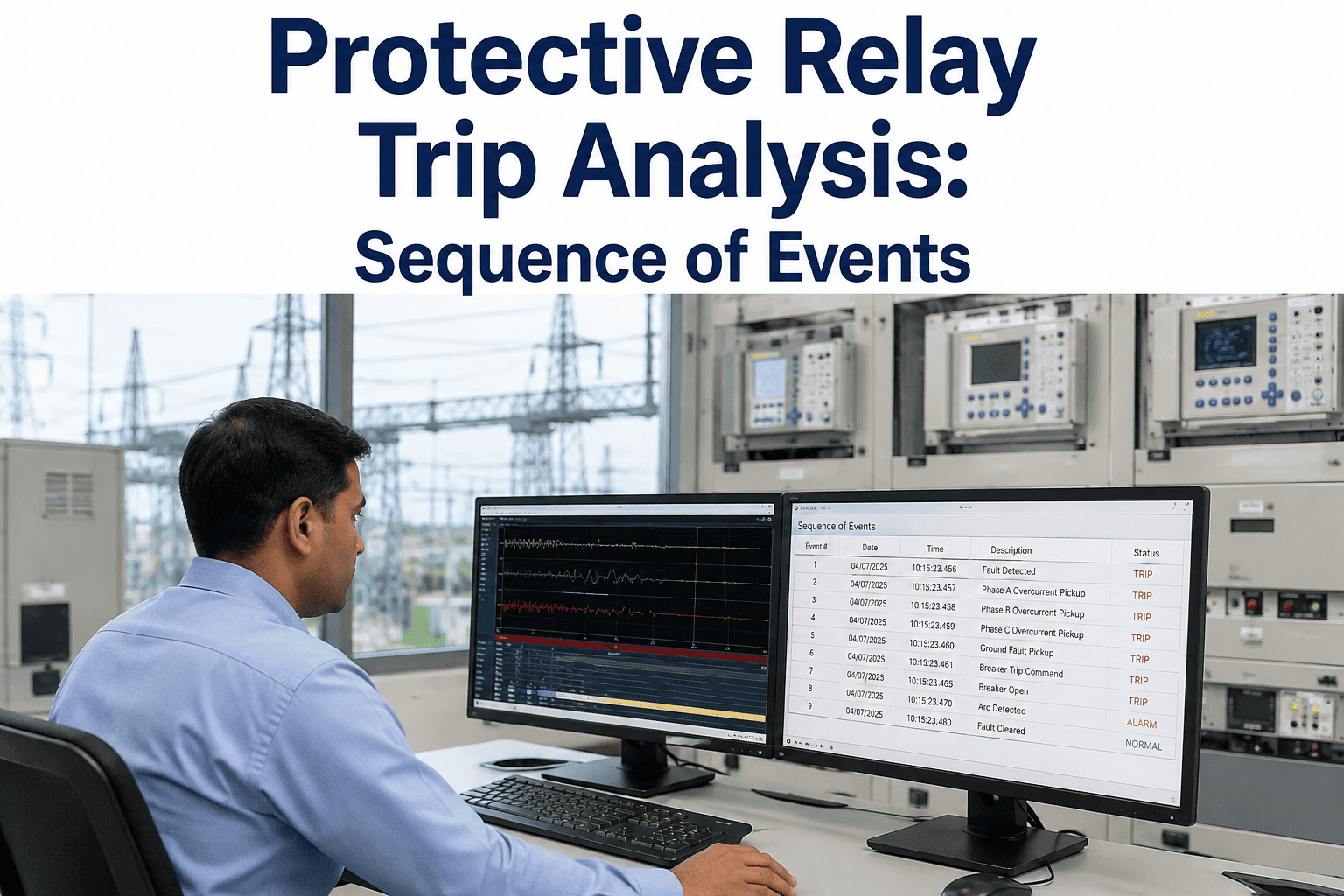
When a breaker trips at 2 a.m. and the control room needs an answer before the morning shift change, the difference between a five-minute diagnosis and a five-day investigation almost always comes down to one thing: whether the sequence of events recorder captured a clean, time-stamped trail of what happened in the milliseconds before and after the trip. Protective relays exist to protect equipment, but when they operate, someone still has to figure out why — and that answer isn't always obvious just because a relay picked up.
POWER GENERATION · PROTECTION & RELIABILITY
Turn Every Relay Trip Into a Fast, Confident Root Cause
iFactory pulls SOE records, relay settings, and trip history into one timeline so your team knows within minutes whether a trip was a real fault, a coordination miss, or a spurious operation.
Why It Matters
Why Relay Trips Are Hard to Diagnose Without Sequence of Events Data
A protective relay operating is not, by itself, an explanation. It's a symptom. The relay saw a condition it was set to respond to — an overcurrent, an undervoltage, a differential imbalance — and it did exactly what it was configured to do. The question an investigator actually needs answered is upstream of that: what caused the condition the relay reacted to, and did every device that should have responded actually respond in the right order?
Sequence of events recording exists precisely because relay trip investigation is fundamentally a timing problem. A breaker opening 40 milliseconds after a fault is a normal protective operation. The same breaker opening 40 milliseconds after a neighboring breaker already cleared the fault is a coordination failure, a stuck contact, or a relay that picked up on a transient it should have ridden through. Without millisecond-resolution timestamps across every relay, breaker, and digital input involved, these two very different events look identical on a post-incident summary.
This is compounded by the fact that most plants have multiple protection layers stacked on top of each other by design — primary protection, backup protection, and sometimes a third tier for critical buses — specifically so that a single relay failure doesn't leave equipment unprotected. That redundancy is good for reliability, but it multiplies the number of devices an investigator has to cross-reference during any single trip event.
The Investigation Process
Reconstructing a Trip: The Sequence of Events Timeline
A disciplined trip investigation follows the same basic structure regardless of the fault type — reconstruct the timeline first, then interpret it. Jumping to interpretation before the timeline is fully assembled is the single most common source of misdiagnosed trips.
T-0
Initiating Event Captured
The fault or abnormal condition begins — a phase-to-ground fault, a loss of excitation, a sudden load rejection — and is captured by digital fault recorders and relay event logs with sub-cycle time resolution.
T+1
First Relay Pickup
The relay closest electrically to the fault should be the first to pick up. If a backup relay picks up before or simultaneously with the primary, that's an early signal of a coordination or setting problem.
T+2
Trip Signal Issued
The relay issues a trip contact closure to the breaker's trip coil. The elapsed time from pickup to trip should match the relay's configured time-current curve or definite time setting.
T+3
Breaker Interruption
The breaker mechanism operates and interrupts current. Breaker operating time is a known, testable quantity — a trip that takes meaningfully longer than the breaker's rated interrupting time points toward a mechanical or control circuit issue rather than a relay problem.
T+4
Downstream Confirmation
Voltage and current at adjacent buses should return to normal once the faulted section is isolated. If abnormal readings persist, the fault may not have been fully cleared or a second condition may be developing.
Classifying the Trip
Four Categories Every Trip Investigation Should Sort Into
Once the timeline is reconstructed, the next step is classification. Every relay trip falls into one of a small number of categories, and identifying which one early keeps the investigation focused instead of chasing possibilities that the timeline has already ruled out.
Correct Operation
A genuine fault occurred, the correct relay picked up first, and the trip time matched the expected curve. No protection system action is required, though the underlying cause of the fault itself still needs investigation.
Miscoordination
The wrong relay operated first, or a backup relay operated before the primary had a chance to clear the fault, indicating a time-current curve or setting error somewhere in the protection scheme.
Spurious Trip
The relay operated with no corresponding fault current or abnormal condition visible in the recorded data, pointing toward a wiring issue, a relay malfunction, or interference on control circuits.
Failure to Trip
A fault occurred but the expected relay did not operate, or operated with unacceptable delay, requiring immediate testing of the relay, its wiring, and its trip circuit before the equipment is returned to service.
Spurious trips deserve particular attention because they're the category most likely to be dismissed without proper investigation — a breaker that trips with no obvious cause is easy to reset and move past, but repeated spurious operations are frequently early warnings of degrading relay hardware, loose control wiring, or ground faults elsewhere in the control circuit that will eventually cause a more serious failure. Book a demo to see how trip classification data rolls up across your fleet automatically.
Coordination Verification
Verifying Relay Coordination After Every Significant Trip
Relay coordination — the deliberate time and current staggering between primary and backup protection — is designed once during system studies but degrades quietly over time as loads change, equipment ages, and settings get modified in isolation without revisiting the full coordination study. A trip investigation is one of the few moments an operations team gets real-world confirmation of whether that original coordination study still holds.
| Coordination Check | What Good Looks Like | Warning Sign |
|---|
| Pickup order | Relay closest to fault picks up first | Backup relay picks up simultaneously or first |
| Time margin | Backup operates with full coordination time margin intact | Time margin between primary and backup has narrowed |
| Curve shape match | Actual trip time matches configured time-current curve | Trip occurs significantly faster or slower than curve predicts |
| Instantaneous zone | Instantaneous element only operates within its intended reach | Instantaneous element operates for faults outside its designed zone |
When a trip reveals a coordination problem, the fix isn't always a relay setting change — sometimes it's a sign that a load addition, a topology change, or an equipment replacement elsewhere in the system has shifted fault current levels enough that the original study assumptions no longer hold. Treating every coordination gap as a simple setting adjustment without asking why the gap appeared risks missing a more significant underlying change to the system.
Data and Tooling
What a Modern Trip Investigation Actually Requires
Fast trip analysis depends less on any single tool and more on whether all the relevant data sources are synchronized to a common time reference and accessible from one place. An investigation that requires pulling event logs from three separate relay vendor software packages, a digital fault recorder, and a SCADA historian — each with a slightly different clock — turns a straightforward diagnosis into a multi-day reconciliation exercise.
Time-Synchronized Data Sources
Relays, digital fault recorders, and SCADA all referenced to a common GPS or network time source, since even a few cycles of clock drift can make the true operating sequence unreadable.
Accessible Historical Settings
A record of what each relay's settings actually were at the time of the trip, not just the current settings, since settings changes made after an event can obscure what was actually in effect when the trip occurred.
Cross-Device Event Correlation
The ability to view events from every relevant device on a single merged timeline rather than reviewing each device's log independently and mentally reconstructing the order.
Trip History Trending
Visibility into whether a given relay or breaker has a pattern of prior trips, which turns an isolated event into a maintenance signal rather than a one-off investigation.
FROM TRIP TO ROOT CAUSE, FASTER
See a Live Trip Timeline Reconstruction
Walk through how iFactory merges relay events, breaker operations, and fault recorder data into a single synchronized timeline your team can trust.
Building Long-Term Reliability
Turning Trip Investigations Into Fleet-Wide Reliability Improvements
Individual trip investigations are valuable on their own, but their real long-term worth comes from being aggregated across a fleet over time. A single spurious trip on one feeder relay is a minor event; the same relay model showing a pattern of spurious trips across a dozen installations is a fleet-wide reliability issue that justifies a firmware review or a hardware replacement program.
Plants that treat each trip as an isolated ticket to close tend to miss these patterns entirely, because the data from each investigation lives in a separate report rather than a shared, queryable history. Building that history deliberately — tagging every trip with its classification, root cause, and affected equipment — turns years of trip investigations into one of the most valuable predictive datasets a protection engineering team has, often surfacing degrading equipment well before it causes a more serious failure to protect against.
The organizational habit that separates strong protection teams from reactive ones is simple to describe and hard to sustain without the right tooling: close every trip investigation with a documented classification and root cause, not just a breaker reset and a return to service. That discipline, applied consistently, is what turns a protection system from a set of devices that occasionally trip into a source of genuine predictive insight about the health of the electrical system it protects.
Root Causes
Common Underlying Causes Behind Relay Trips
Once a trip has been classified as correct operation, miscoordination, spurious, or a failure to trip, the investigation isn't finished — each classification still needs an underlying cause identified, and the same classification can trace back to very different causes depending on the plant, the equipment age, and the environment the relay operates in.
Settings Drift
Relay settings changed for a specific outage or test and never restored to their original coordinated values, quietly leaving a coordination gap until the next fault exposes it.
CT/PT Wiring Issues
Current or voltage transformer wiring that's loose, reversed, or degraded can feed a relay inaccurate signals, producing trips that look spurious until the instrument transformer circuit itself is tested.
Control Circuit Contamination
Moisture, dust, or insulation breakdown in trip and control wiring can create unintended current paths that trigger a trip contact without any actual fault condition present on the power system.
System Topology Changes
Load growth, new generation sources, or reconfigured feeders shift available fault current levels across the system, which can silently invalidate coordination margins set years earlier under different conditions.
Documentation Practice
Why Trip Documentation Quality Determines Long-Term Value
A trip investigation that ends with a verbal explanation and a breaker reset has essentially no lasting value beyond the immediate shift. The organizational value of trip analysis comes almost entirely from consistent, structured documentation that can be searched, trended, and compared across events months or years apart.
Standardized Classification Fields
Every trip record should capture classification, root cause category, affected equipment, and resolution status in consistent fields, not free-text notes that vary by author and are difficult to search or aggregate later.
Linked Settings History
Documentation should reference the exact relay settings in effect at the time of the trip, cross-referenced against the settings change history, so investigators aren't left guessing whether a later settings change was the fix or a coincidence.
Photographic and Waveform Evidence
Attaching the actual event waveform capture and any physical evidence, such as a photo of degraded wiring, turns a written summary into something a future investigator can independently verify rather than take on faith.
FAQs
Protective Relay Trip Analysis — Frequently Asked Questions
What resolution does sequence of events data need to be useful for trip analysis?
Most protection engineers consider millisecond-level resolution the practical minimum for meaningful trip analysis, since coordination margins between primary and backup protection are often designed with only a few cycles of separation. Data recorded at one-second resolution or coarser cannot distinguish a coordination failure from a correct sequential operation, which means the investigation ends up relying on assumptions rather than evidence. GPS time synchronization across all recording devices is what makes millisecond correlation reliable across an entire substation or plant.
How common are spurious relay trips compared to genuine fault-driven trips?
The proportion varies significantly by plant age, relay technology, and maintenance practices, but spurious trips are common enough that most protection engineering teams track them as a distinct category rather than treating every trip as fault-related by default. Older electromechanical relays and aging control wiring tend to show higher spurious trip rates than modern microprocessor-based relays with digital communication, which is one reason relay replacement programs are often justified on reliability grounds beyond just improved protection functions.
Book a demo to see spurious trip trending across your own equipment.
Should relay settings be changed immediately after a coordination problem is discovered?
Not without first understanding why the coordination gap appeared, since an isolated setting change can sometimes mask a more fundamental issue such as a load growth pattern that has shifted fault current levels across a section of the system. A responsible approach treats the discovered gap as a trigger to review the broader coordination study rather than a one-off correction, particularly if the same equipment has shown coordination issues more than once.
Who should be involved in reviewing a significant protective relay trip?
Effective trip reviews typically involve protection engineering, operations, and maintenance together, since each brings a different piece of context — protection engineering understands the coordination logic, operations knows what was happening on the system at the time, and maintenance can speak to the equipment's recent service history. Reviews conducted by only one of these groups in isolation more frequently miss contributing factors that a cross-functional review would have caught.
How long should trip investigation records be retained?
Many plants retain detailed trip records for the operational life of the associated equipment, since long-term trending of trip frequency and classification is one of the most reliable indicators of gradual equipment degradation. Retention periods shorter than a few years tend to erase exactly the patterns — infrequent but recurring spurious trips, slowly narrowing coordination margins — that matter most for catching problems before they escalate into forced outages.
POWER GENERATION · PROTECTION RELIABILITY
Give Your Protection Team a Timeline They Can Trust
iFactory brings relay events, breaker operations, and fault recorder data together automatically, so every trip investigation starts with a clear timeline instead of a manual reconciliation exercise.