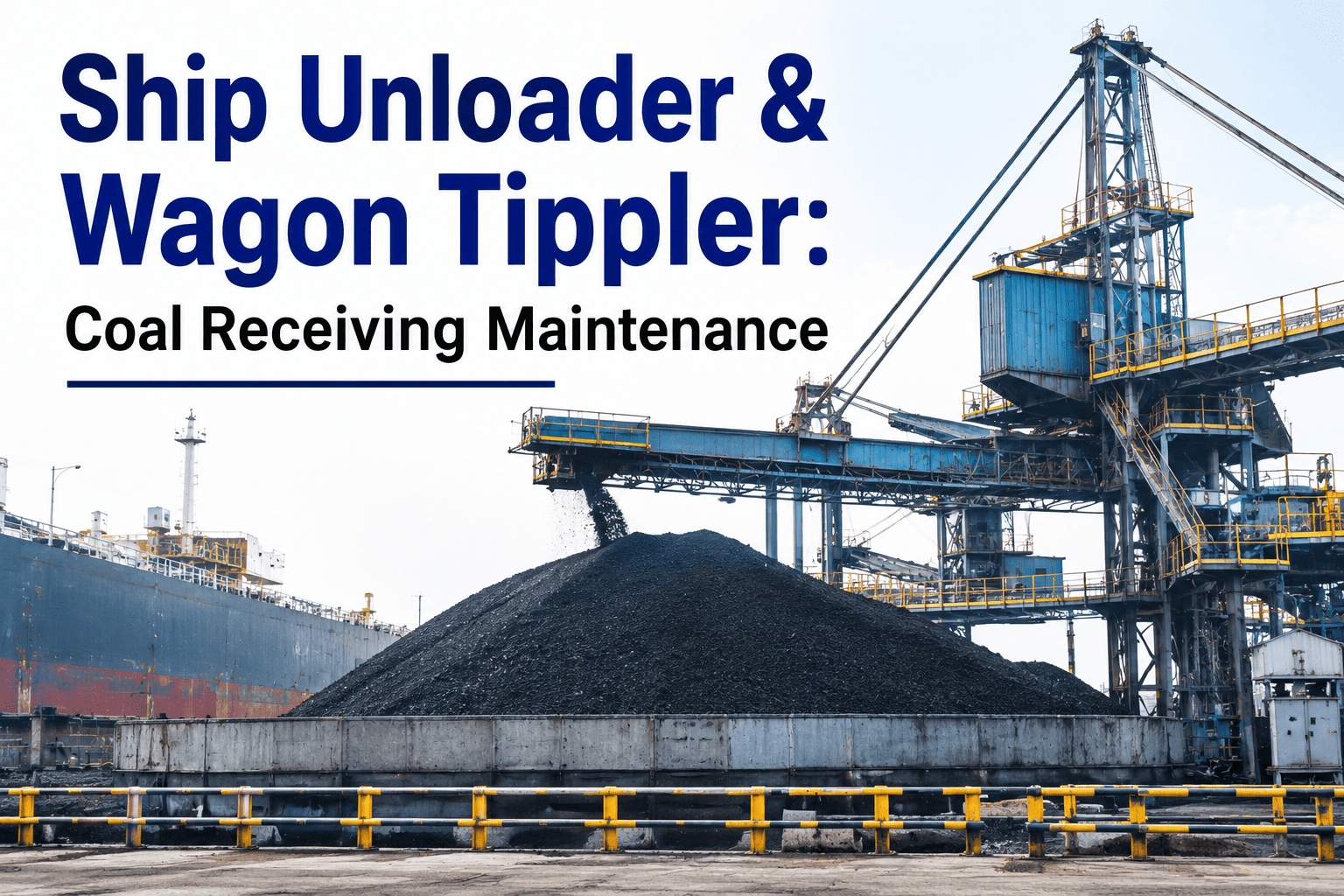
Every tonne of coal that reaches a power plant bunker passes through a receiving chokepoint first, a ship unloader pulling cargo out of a vessel's hold, a wagon tippler rotating railcars to empty them by gravity, or both feeding into hoppers that meter material onto the plant's conveyor system. When any link in that chain goes down, the failure does not stay contained to one machine. Demurrage on a bulk carrier alone can run into the tens of thousands of dollars per day, and rail demurrage has become what logistics providers now describe as a seven-figure annual expense for shippers who cannot turn cars fast enough. This article covers how ship unloaders, wagon tipplers, and hoppers actually fail, and how condition monitoring keeps the receiving chain from becoming the reason a vessel sits idle.
The Coal Supply Chain Starts at the Receiving End. So Does the Risk.
Ship unloaders, wagon tipplers, and receiving hoppers are the first mechanical link between fuel supply and the plant. A failure here backs up vessels, stacks up wagons, and starves every downstream conveyor at once.
The Receiving Chain: Three Machines, One Point of Failure
Coal arrives at a plant or port terminal by ship, by rail, or both, and each mode has its own dedicated receiving equipment standing between the transport and the stockpile. What they share is a structural vulnerability: none of them have a parallel backup. A terminal typically runs one or two ship unloaders and one or two tipplers, not a redundant fleet, which means a failure at receiving does not degrade throughput gracefully, it stops it.
Why a Receiving Failure Is Worse Than a Mid-Line Conveyor Failure
A conveyor failure somewhere in the middle of a coal handling plant is serious, but it is contained: material already received can often still move through an alternate path, and stockpiled coal keeps bunkers fed while the fix happens. A receiving equipment failure has no such buffer on the inbound side. If the tippler is down, wagons keep arriving on schedule with nowhere to unload, and rail demurrage clocks start running the moment cars sit idle beyond free time. If a ship unloader fails mid-discharge, the vessel remains at berth accruing demurrage that scales directly with every additional day, while the terminal's own operations queue behind it.
Because a tippler does not operate as an isolated machine, the consequences cascade in both directions. Wagons get delayed, rail turnaround times increase, stockyard planning gets disrupted, and vessel loading schedules downstream come under pressure, all from a single piece of equipment losing availability. That cascading exposure is exactly why receiving equipment reliability deserves the same monitoring discipline usually reserved for the conveyor network it feeds.
A single seized bearing on a wagon tippler does not just stop one machine. It backs up every wagon behind it, stalls the conveyor feed, and puts the entire coal supply chain on hold. See what continuous condition monitoring catches before that happens.
Where Receiving Equipment Actually Fails
Each machine in the receiving chain has its own dominant failure modes, shaped by how it physically interacts with the material and the harsh marine or trackside environment it operates in.
| Equipment | Common Failure Points | Typical Warning Signs |
|---|---|---|
| Ship Unloader | Grab wire rope wear, boom slew bearing wear, corrosion in marine environment | Increased cycle time, vibration in slew mechanism, rope fraying |
| Wagon Tippler | Clamping mechanism wear, rotary drive bearing failure, hydraulic seal degradation | Clamp misalignment, drive motor temperature rise, hydraulic pressure drop |
| Positioning Equipment | Indexer chain wear, wagon coupler alignment drift | Positioning delay, coupler impact noise, indexing overshoot |
| Receiving Hopper & Feeder | Liner wear from abrasive coal, feeder gearbox wear, chute blockage from moisture | Feed rate inconsistency, gearbox vibration, material bridging |
The Cold-Weather Complication Most Maintenance Plans Miss
One failure mode specific to rail-delivered coal deserves separate attention: at low temperatures, residual moisture inside a wagon can cause bulk material to harden and stick to the wagon walls, creating unloading situations where the tippler cycles correctly but the material does not fully discharge. This is not a mechanical fault in the tippler itself, but it produces the same operational symptom, wagons that should be empty and are not, backing up the same way a genuine equipment failure would. Monitoring discharge completeness alongside mechanical condition is what separates a tippler problem from a frozen-cargo problem, and the two require completely different responses.
What Continuous Monitoring Actually Watches
Why Receiving Reliability Is a Conveyor Problem Too
Coal handling plants often organize maintenance around the conveyor network as the primary asset class, with receiving equipment treated as a separate, upstream concern owned by a different team or even a different contractor at port terminals. That organizational split creates a monitoring gap exactly where the consequences of failure are most severe, since a receiving stoppage does not just idle the tippler or unloader, it starves every conveyor, crusher, and bunker feed downstream at the same time a mid-line conveyor failure would only affect. Treating receiving equipment condition data as part of the same monitoring program as the conveyor network, rather than a separate silo, closes that gap and gives the maintenance team a single view of the entire fuel supply chain from vessel or wagon to bunker.
Frequently Asked Questions
Don't Let the Fuel Supply Chain Stall at the First Machine
See continuous condition monitoring running across ship unloaders, wagon tipplers, and receiving hoppers alongside the rest of your coal handling network.