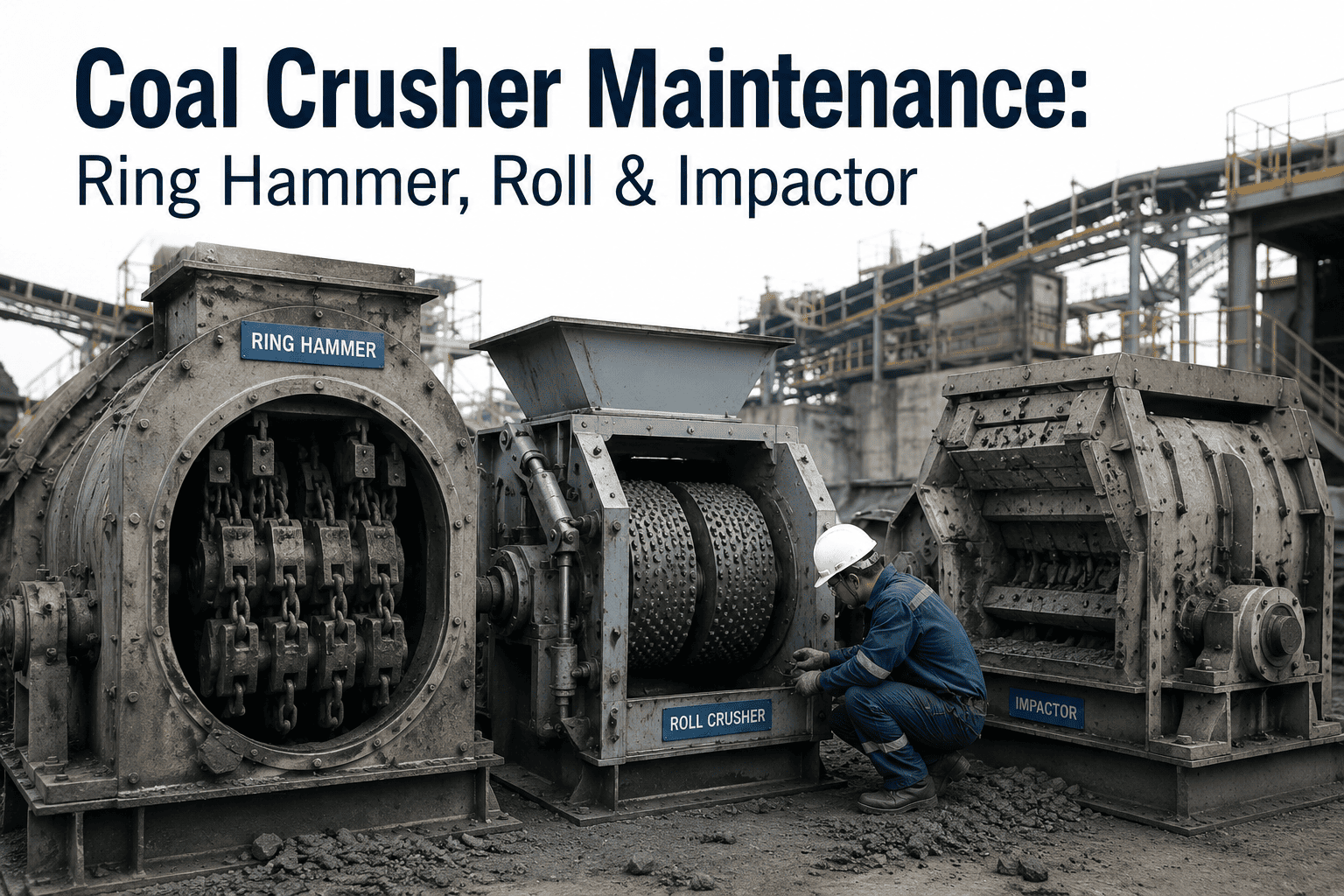
Three coal crushers running the same tonnage can wear out on completely different timelines depending on which crushing principle they use. A ring hammer crusher lives or dies by hammer condition, a roll crusher lives or dies by gap consistency, and an impactor lives or dies by liner wear pattern. Applying one generic wear-parts schedule across all three is how plants end up either replacing parts too early and wasting budget, or too late and taking an unplanned outage on the one crusher standing between the coal yard and the boiler. Book a demo to see wear tracking built around each crusher type specifically.
Coal Preparation · Crusher Reliability
Coal Crusher Maintenance: Ring Hammer, Roll, and Impactor Crushers Compared
Each crushing principle wears differently and fails differently. A maintenance plan that does not account for that difference is guessing at intervals rather than tracking actual condition.
Ring Hammer
Roll Crusher
Impactor
Crusher Types
How Each Crushing Principle Actually Wears
Understanding the mechanism each crusher uses to reduce coal size explains why the wear parts, failure modes, and inspection priorities differ so much from one type to the next.
Ring Hammer Crusher
Rotating hammers mounted on rings impact coal against a grate or breaker plate, sizing it through repeated impact rather than compression. Hammer tip wear is the dominant maintenance driver, along with grate bar wear and rotor balance as hammers wear unevenly around the circle, particularly on machines processing coal with variable hardness or high ash content.
Roll Crusher
Two counter-rotating rolls, often toothed, pull coal through a fixed gap and reduce it by compression and shear. Gap consistency across the roll width and tooth wear on the roll surface are the primary factors determining product size and crusher condition, making these machines well suited to applications needing tight control over final sizing.
Impactor Crusher
A high-speed rotor with fixed or swing hammers throws coal against impact plates or aprons, breaking it on impact and again as fragments strike each other. Liner and apron plate wear, along with rotor bar condition, drive maintenance intervals more than any single component, and these crushers often produce a more cubical product shape than compression-based designs.
Ring Hammer Crushers
Managing Hammer and Grate Wear
Ring hammer crushers are common in coal handling because they tolerate variable feed size well, but that same impact-based sizing action means hammer tips wear continuously and unevenly if not managed with a defined rotation and replacement plan.
1
Measure Hammer Tip Wear on a Fixed Interval
Track hammer weight or tip profile against a baseline rather than relying on visual judgment alone, since gradual wear is difficult to assess by eye until it has already affected product size distribution.
2
Rotate Hammers to Maintain Rotor Balance
Uneven hammer wear around the rotor circle creates an imbalance that increases bearing load and vibration. A planned rotation sequence keeps wear distributed and extends both hammer and bearing life.
3
Inspect Grate Bars for Wear and Gaps
Grate bars control final product size and wear from constant material contact. Widening gaps from wear allow oversized material through, which shows up downstream as handling or combustion issues rather than at the crusher itself.
4
Check Pin and Bushing Wear on Hammer Mounts
The pins that allow hammers to swing freely wear over time, and excessive play here increases impact stress on the hammer and rotor rather than allowing hammers to swing cleanly on each strike.
iFactory Tracks Wear Trends Specific to Your Crusher Type, Not a Generic Schedule.
Hammer wear curves, roll gap drift, and liner condition are tracked against each crusher's own baseline, so replacement timing reflects actual condition instead of a calendar guess.
Roll Crushers
Why Gap Consistency Matters More Than Tooth Count
A roll crusher's product size is determined almost entirely by the gap between the two rolls, which means even a small amount of uneven wear across the roll width changes product size distribution before any individual tooth looks obviously worn.
Checking gap measurement at multiple points across the roll width, rather than a single center-point reading, catches this uneven wear pattern early. A gap that measures correctly in the center but has opened up at either end typically indicates uneven loading across the roll face, often traceable to a feed chute that is not distributing material evenly along the full roll length.
Tooth wear itself follows a more predictable pattern and can generally be tracked through periodic profile measurement or weight loss tracking on sample teeth. Where roll crushers differ most from other crusher types is in how directly gap consistency ties to downstream product quality, making gap measurement the single most valuable routine check on this crusher type.
Wear Progression
A Typical Wear Curve Across a Component's Service Life
Early Life
Stable, predictable wear rate
Mid Life
Wear rate remains steady, easiest phase to predict remaining life
Late Life
Wear accelerates, product size begins drifting out of spec
End of Life
Replacement needed before structural or balance issues develop
The late-life acceleration phase is where most unplanned crusher issues originate, since wear that was predictable for months suddenly speeds up as components lose their original geometry. Tracking wear rate rather than a single point-in-time measurement is what allows a maintenance team to catch that inflection point before it becomes a problem.
Impactor Crushers
Liner and Apron Plate Management
Impact Plate Wear
The plates that coal strikes after leaving the rotor wear fastest at the point of highest impact concentration. Rotating or reversing plates where the design allows extends usable life significantly compared to running them until failure in one position.
Apron Gap Adjustment
The gap between the rotor and the apron controls final product size, similar in principle to roll crusher gap but adjusted through apron position rather than roll spacing. This gap widens as both the rotor bars and apron wear, requiring periodic readjustment.
Rotor Bar Condition
Rotor bars take direct impact with material and wear both in profile and in overall mass. Uneven rotor bar wear creates the same balance concerns as hammer wear on a ring hammer crusher, affecting bearing load and vibration.
Housing and Liner Bolting
Liner bolts loosen under continuous impact loading, and a loose liner can shift position during operation, creating an uneven wear pattern or, in severe cases, structural contact between the liner and rotor.
Before vs. After
Generic Wear Schedule vs. Crusher-Specific Tracking
Category
Generic Interval Schedule
Crusher-Specific Tracking
Hammer Replacement
Swapped on a fixed calendar date regardless of actual tip condition or tonnage processed
Replaced based on measured wear curve, matching actual duty rather than a guess
Roll Gap Checks
Single center-point measurement, missing uneven wear at the roll ends
Multi-point measurement across the roll width catches uneven feed distribution
Impactor Liners
Visual check only, missing gradual thickness loss until a plate fails
Point measurement at highest-wear zones tracks remaining life accurately
Product Size Consistency
Drifts gradually as wear parts age, often unnoticed until a downstream complaint
Held within spec because wear is corrected before it affects sizing
Parts Budget
Either over-spent replacing parts too early or exposed to failure risk running them too long
Spend aligned with actual remaining wear life across all three crusher types
Operational Impact
What Happens Downstream When Crusher Wear Goes Unmanaged
Crusher wear rarely stays contained to the crusher itself. As hammers, rolls, or liners lose their original geometry, the product size distribution leaving the crusher gradually shifts, and that shift ripples through every downstream system built around a specific size specification.
Oversized material passing through a worn grate or an opened roll gap can jam downstream conveyors, screens, or feeders that were sized for a narrower distribution, creating secondary maintenance issues that appear unrelated to the crusher until someone traces the pattern back. In boiler applications, coal sized coarser than specification burns less efficiently and can increase unburned carbon in ash, directly affecting combustion performance and emissions in ways that are far more expensive to correct than a timely crusher wear-parts replacement would have been.
Fine material generated by an over-worn crusher creates its own set of problems, increasing dust generation at transfer points and adding load to dust collection systems that were not sized for the additional fines. Both directions of size drift, too coarse or too fine, tend to develop gradually enough that they are easy to attribute to something else entirely unless wear data from the crusher itself is available to check against.
Routine Checks
A Practical Weekly Round for Any Coal Crusher
Regardless of crusher type, a short list of checks performed consistently catches the majority of developing wear issues before they affect product size or crusher reliability.
A
Sample product size distribution at the crusher discharge and compare against the specification range, since a gradual shift here is often the first measurable sign of developing wear on any crusher type.
B
Listen for unusual vibration or noise during operation, which can indicate rotor imbalance from uneven hammer or rotor bar wear before it becomes severe enough to damage bearings.
C
Check mounting bolts on liners, hammers, and grate bars for looseness, since vibration from continuous impact loading gradually works fasteners loose on all three crusher types.
D
Review motor amperage trends against a healthy baseline, since a crusher working harder than normal to achieve the same throughput often signals wear parts approaching end of life.
Choosing Between Types
Why Coal Plants Often Run More Than One Crusher Type
It is common to find ring hammer, roll, and impactor crushers all operating within the same coal handling plant, each serving a different stage of size reduction. Primary crushing on run-of-mine coal often uses a ring hammer or impactor design capable of handling large, variable feed size, while secondary sizing ahead of the boiler frequently uses roll crushers for tighter control over final product size.
This staged approach means a single plant maintenance team is often managing all three wear mechanisms simultaneously, which is precisely why a one-size-fits-all wear-parts schedule causes so much friction in practice. A technician trained to think in terms of gap measurement for roll crushers needs an entirely different mental model when moving to the ring hammer machine in the same shift, and treating both with the same generic checklist leads to gaps in coverage on whichever machine does not match the checklist's assumptions.
Standardizing the underlying data collection approach, even while the specific wear indicators differ by crusher type, helps teams manage this complexity without needing a completely separate maintenance philosophy for each machine on the yard.
Avoid These
Common Mistakes in Crusher Wear Management
Judging Hammer Wear by Eye Alone
Visual inspection catches severe wear but misses the gradual profile change that affects product size well before a hammer looks obviously worn. Weight or profile measurement against a baseline gives a far more accurate picture than a visual check alone.
Measuring Roll Gap at One Point Only
A single center-point gap reading can look perfectly healthy while the roll ends have already opened up significantly, since uneven feed distribution rarely affects the center of the roll first.
Replacing Liners on a Fixed Calendar Date
Wear rate varies with coal hardness, moisture, and tonnage, so a fixed replacement date either wastes remaining liner life or risks running a liner well past the point where wear has started affecting performance.
Ignoring Motor Amperage as a Wear Signal
A crusher drawing higher amperage to process the same tonnage is often compensating for worn hammers, rolls, or liners well before that wear shows up in a physical measurement, making amperage trend an early and easily accessible indicator.
From the Field
A Roll Crusher Gap Problem That Wasn't the Rolls
Our roll crusher started producing an inconsistent product size, coarser on one end than the other, and the initial assumption was worn teeth on that side of the roll. We measured tooth wear and it was actually even across the full width. The gap measurement told a different story, wider at one end than the other, and tracing it back led us to a feed chute liner that had worn through and was directing more material to one side of the roll face. Replacing the chute liner fixed the gap problem completely without touching the rolls themselves.
— Plant Engineer, Coal Preparation Facility, Central Appalachian Basin
0Roll teeth actually needed replacement
1Worn feed chute liner was the real cause
100%Product size consistency restored after the fix
Conclusion
The Right Wear Check Depends on the Crusher in Front of You
A hammer weight check means little on a roll crusher, and a gap measurement means little on a ring hammer machine. Building a maintenance program around the specific wear mechanism of each crusher type, rather than a single generic wear-parts checklist, is what keeps product size consistent and prevents the kind of gradual drift that eventually forces an unplanned stop, whether that plant runs one crusher type or all three side by side.
iFactory's platform tracks wear trends specific to each crusher type against its own historical baseline, flagging the point where wear rate begins accelerating well before a component reaches failure. Book a demo to see how this applies to your coal preparation equipment.
Frequently Asked Questions
Coal Crusher Maintenance — Common Questions
How often should ring hammer crusher hammers be inspected?
Hammer tip wear should be measured on a defined interval, commonly every one to two weeks depending on tonnage and coal characteristics, since impact wear accelerates once tips lose their original profile. Rotor balance should also be checked whenever hammers are rotated or replaced, since uneven wear around the rotor circle increases bearing load and vibration well before hammer wear alone would prompt a replacement. Machines running abrasive, high-ash coal typically warrant a tighter interval than this general guideline.
Contact support for guidance on setting an interval for your specific tonnage.
What causes uneven gap wear on a roll crusher?
Uneven gap wear across the roll width is most often caused by uneven material distribution from the feed chute rather than a problem with the rolls themselves. A worn or damaged chute liner can direct more material to one side of the roll face, concentrating wear there faster than the rest of the roll. Measuring gap at multiple points across the width, rather than relying on a single center reading, is the most reliable way to catch this pattern early.
How is impactor liner wear typically tracked?
Impact plate and apron liner wear is generally tracked through periodic thickness measurement at defined check points, along with visual inspection for uneven wear patterns that suggest a liner has shifted or is taking disproportionate impact. Because wear concentrates at the point of highest impact rather than evenly across the plate, point measurements at the highest-wear zone give a more accurate picture of remaining life than an average across the whole plate.
Book a demo to see how continuous wear tracking applies to impactor liners.
Why does crusher wear accelerate near the end of a component's life?
As a wear component loses its original geometry, whether a hammer tip, roll tooth, or impact liner, the remaining material often has a less favorable shape for absorbing impact or shear force efficiently. This changes the load pattern on the component and accelerates wear compared to the earlier, more predictable phase of its service life. Tracking wear rate over time, rather than checking against a single threshold measurement, is what allows this acceleration point to be caught before it leads to a more serious failure.
Can one maintenance schedule work across ring hammer, roll, and impactor crushers?
A single generic schedule tends to either over-maintain crushers that could safely run longer between interventions or under-maintain ones approaching a critical wear point, since each crusher type wears through a different mechanism entirely. A gap check that matters greatly on a roll crusher has little relevance on a ring hammer machine, and hammer rotation has no equivalent on an impactor. Building a schedule around each crusher's specific wear indicators produces more accurate replacement timing than applying one interval across all three types.
Track Wear the Way Each Crusher Type Actually Fails
Hammer wear curves, roll gap consistency, and impactor liner condition tracked against each machine's own baseline, so replacement decisions are based on measured trend, not a calendar guess.