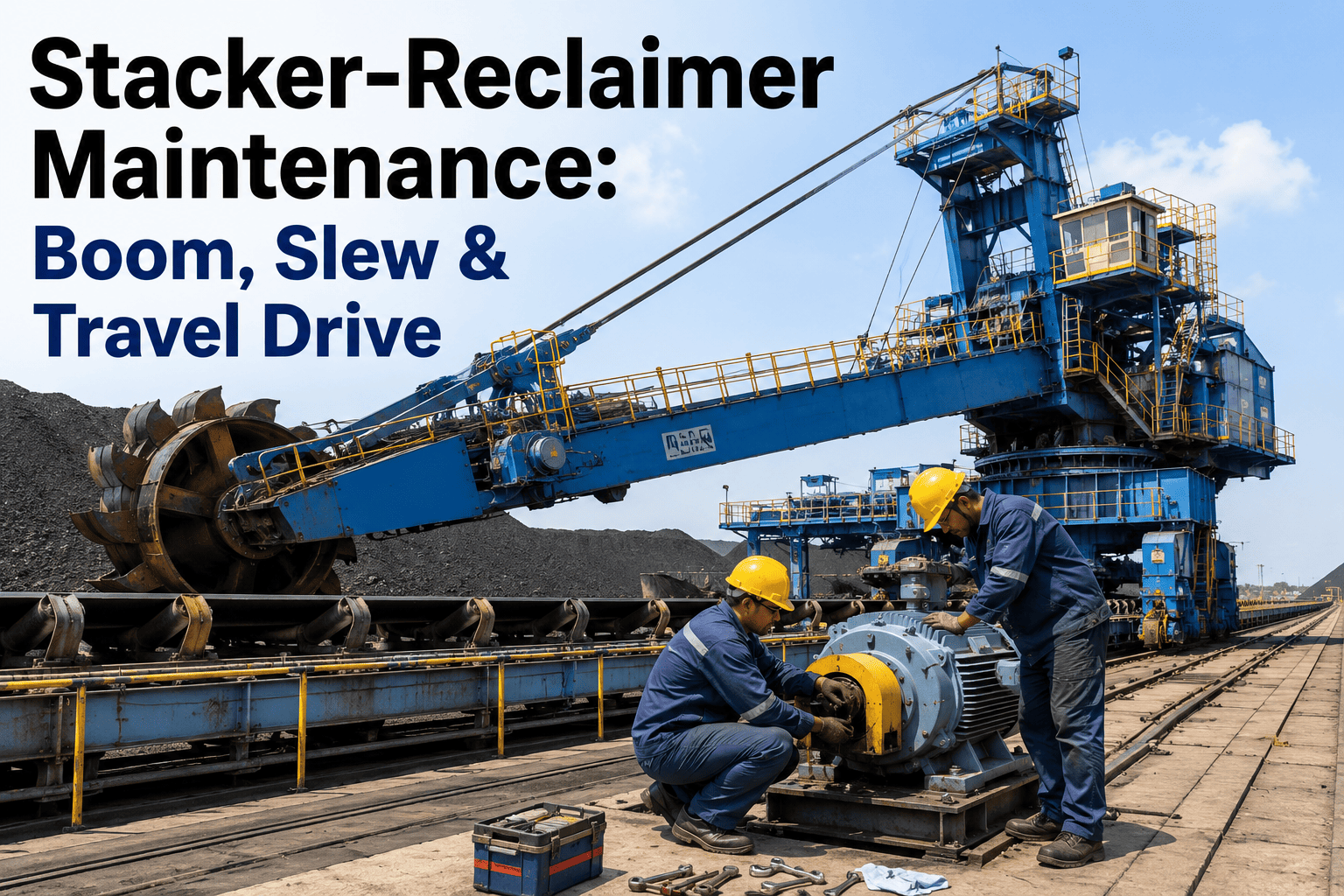
A stacker-reclaimer looks like one machine, but it runs on four largely independent systems that each fail in their own way and on their own schedule. The boom bends and flexes under load, the slew bearing carries enormous radial force every time the machine rotates, the travel drive hauls hundreds of tons along rail with no room for a stuck wheel, and the bucket wheel takes the direct abrasive punishment of the coal itself. Treating all four as one maintenance item is how a plant ends up surprised by a failure that a component-specific inspection would have caught weeks earlier. Book a demo to see how condition data from each of these systems comes together in one view.
Coal Yard Reliability · Stacker-Reclaimer
Stacker-Reclaimer Maintenance: A System-by-System Guide to Boom, Slew, and Travel Drive Reliability
The machine that keeps your coal yard organized is really four separate reliability problems wearing one paint job. Each one needs its own inspection routine.
Machine Anatomy
Four Systems, Four Failure Patterns
Before setting up an inspection routine, it helps to see the machine as its major reliability zones rather than one asset. Each zone below carries a distinct load path and a distinct set of wear mechanisms.
Zone 1
Boom Structure
The long cantilevered arm carrying the belt conveyor and, on reclaimers, the bucket wheel. Subject to cyclic bending stress, weld fatigue at gusset connections, and corrosion at drainage points where coal dust and moisture collect.
Zone 2
Slew Bearing and Drive
The large-diameter bearing and gear ring that allow the boom to rotate around the base. Carries the full overturning moment of the boom and is exposed to grit ingress if seals degrade, making it one of the most expensive single components to replace.
Zone 3
Travel Drive and Rail Wheels
The gearboxes, motors, and wheel assemblies that move the entire machine along its rail track. Failures here are often traced to rail alignment issues, wheel flange wear, or gearbox lubrication breakdown under continuous duty cycles.
Zone 4
Bucket Wheel and Digging Chain
The direct interface with the coal pile, carrying the highest abrasive wear of any component on the machine. Bucket lips, digging teeth, and chain pins wear continuously and require the tightest inspection interval on the machine, since even a few weeks of neglect here can noticeably reduce digging efficiency.
Boom Structure
Where Structural Fatigue Actually Starts
Boom failures rarely start as a dramatic crack across a main chord. They start small, at a weld toe or a bolted connection carrying repeated stress cycles every time the machine slews or the belt loads and unloads.
1
Inspect Gusset Welds and Connection Points
These carry concentrated stress where structural members meet and are the most common origin point for fatigue cracks. A visual check under good lighting, supplemented by dye penetrant testing on any suspect weld, catches cracks while they are still surface-level.
2
Check for Corrosion at Drainage and Low Points
Coal dust and rainwater collect in boom low points and drain holes, and corrosion there thins structural steel from the inside out where it is hardest to see during a routine walk-down.
3
Verify Bolted Connections Remain Torqued
Vibration from the belt drive and bucket wheel gradually loosens bolted joints over time. A torque check on a defined schedule catches loosening before it allows movement that accelerates fatigue at the connection.
4
Monitor Boom Deflection Under Load
A gradual increase in boom sag under the same load condition over time can indicate developing structural fatigue or a loosening connection well before a visible crack appears, making deflection tracking a useful early warning tool.
iFactory Tracks Slew Bearing Vibration and Boom Structural Data in One Dashboard.
Instead of four separate inspection logs for four separate systems, condition trends for the boom, slew bearing, travel drive, and bucket wheel come together where the whole reliability team can see them.
Slew Bearing and Drive
Protecting the Most Expensive Component on the Machine
A slew bearing replacement is one of the largest single maintenance costs a coal yard team can face, both in parts cost and in the crane time and downtime required to swap it. Most premature failures trace back to a small number of preventable causes.
Seal Condition
Worn or torn bearing seals allow grit and moisture to enter the raceway, accelerating wear far faster than the rated bearing life. Seal inspection should happen on every routine round, not just during scheduled overhauls, since a torn seal can go unnoticed for weeks if it is only checked quarterly.
Lubrication Schedule Adherence
Slew bearings require regular greasing at defined intervals and rotation positions to distribute lubricant evenly around the raceway. Skipping intervals or greasing only at one boom position leaves sections of the bearing under-lubricated.
Gear Ring Tooth Wear
The gear teeth that drive slew rotation wear gradually under normal operation but accelerate sharply if lubrication breaks down or misalignment develops between the pinion and the ring gear, which is why grease sampling is as valuable as a visual tooth check.
Bolt Preload Retention
The bearing mounting bolts carry the full structural connection between the boom and the base. Loss of preload on even a few bolts concentrates stress on the remainder and can lead to progressive bolt failure.
Maintenance Schedule
A Practical Inspection Interval by System
System
Daily / Shift
Monthly
Annual
Boom Structure
Visual walk for new cracks or leaks
Bolt torque spot check
Full dye penetrant weld survey
Slew Bearing
Seal and grease fitting check
Vibration reading and grease sample
Bolt preload verification
Travel Drive
Rail alignment visual, wheel listen
Gearbox oil sample and level
Full gearbox and motor inspection
Bucket Wheel / Chain
Bucket lip and tooth visual check
Chain pin wear measurement
Full digging chain replacement review
Travel Drive and Rail
Why Travel Drive Problems Often Start With the Rail, Not the Gearbox
When a travel drive fails prematurely, the investigation often points back to the machine's own gearbox or motor. In practice, a significant share of travel drive issues actually originate with rail condition, since a machine fighting misaligned or worn rail places abnormal load on every wheel and gearbox along its length.
Rail alignment should be checked on a defined interval using a straightedge or laser alignment tool across the full travel length, not just at the ends where problems are most visible. Rail joints, in particular, deserve attention since a small step at a joint repeats thousands of times per year as the machine passes over it, and that repeated impact accelerates wear on both the wheel flange and the rail itself.
Wheel flange wear is one of the clearest indicators of a rail alignment problem versus a wheel-specific issue. If flange wear is concentrated on one side across multiple wheels along the machine, the rail itself is very likely the root cause rather than any individual wheel or gearbox. Correcting rail alignment at that point protects every wheel on the machine going forward, rather than treating each wheel failure as an isolated event.
From the Field
A Slew Bearing Failure That Traced Back to a Torn Seal
We lost a slew bearing on our main reclaimer about eighteen months before its rated life, and the failure investigation found a torn seal that had likely been letting grit in for months. Nobody had flagged it because seal inspection wasn't on anyone's daily checklist, it was buried in a quarterly overhaul task. We rebuilt the inspection schedule so seal condition gets checked every shift, and we haven't had a repeat issue since, even on our older machines running the same duty cycle.
— Coal Yard Maintenance Supervisor, Utility-Scale Generating Station
18 monthsBearing failed early of its rated service life
1 sealRoot cause traced to a single torn seal
Every shiftNew inspection frequency for seal condition
Bucket Wheel and Chain
Managing the Component That Wears the Fastest
The bucket wheel and digging chain take more direct abrasive contact with coal than any other part of the machine, which means their wear pattern is the most predictable but also the most time-sensitive to manage.
A
Track bucket lip thickness against a defined minimum rather than waiting for visible failure, since lip wear that goes unmanaged reduces digging efficiency long before it becomes a safety issue.
B
Measure chain pin and bushing wear at defined intervals, since chain elongation from pin wear changes how buckets engage the pile and accelerates wear on adjacent components if left uncorrected.
C
Rotate or replace digging teeth on a planned schedule based on material hardness and duty cycle rather than reacting only after a tooth breaks off during operation.
D
Watch for uneven wear across the bucket wheel, which often signals a digging pattern or approach angle that is concentrating wear on one section rather than distributing it evenly.
Before vs. After
Reactive Repairs vs. a Component-Specific Program
Category
Reactive Approach
Component-Specific Program
Slew Bearing
Replaced only after failure, often taking the machine offline for an extended, unplanned repair
Seal and vibration trends flag wear early enough to schedule replacement during planned downtime
Boom Structure
Cracks found only during a major overhaul, sometimes after they have already propagated significantly
Weld and connection inspections on a fixed interval catch fatigue at the surface-crack stage
Travel Drive
Gearbox replaced repeatedly without ever addressing the rail condition driving the wear
Rail alignment checked alongside gearbox condition, addressing the actual root cause
Bucket Wheel
Teeth and lips replaced only after a visible break disrupts digging performance
Wear tracked against a defined minimum, with replacement scheduled before failure
Downtime Planning
Unplanned stops that disrupt coal delivery schedules and stockpile management
Repairs scheduled around production needs rather than forced by sudden failure
Avoid These
Common Mistakes in Stacker-Reclaimer Maintenance Programs
Even plants with a formal maintenance program can fall into patterns that quietly undermine it. These are the mistakes that show up most often when reviewing machines with a history of unexpected component failures.
Treating the Machine as One Asset
A single work order covering the entire machine tends to bias attention toward whichever system is easiest to inspect, usually the boom, while the slew bearing and travel drive receive less scrutiny simply because they take more effort to access.
Skipping Seal Inspections as Minor
Bearing seals are small components relative to the rest of the machine, which leads some programs to deprioritize them. In practice, seal condition is one of the strongest predictors of slew bearing life and deserves attention every shift.
Replacing Gearboxes Without Checking Rail
A travel drive gearbox failure investigated in isolation, without checking rail alignment along the full travel length, often results in the replacement gearbox wearing out on the same accelerated timeline as the one it replaced.
Waiting for Visible Bucket Damage
Bucket lip and tooth wear is gradual and measurable well before it becomes visible damage. Programs that rely on visual inspection alone tend to catch the problem only after digging efficiency has already dropped noticeably.
Why It Matters
What a Coordinated Program Protects Beyond the Machine Itself
The direct cost of a stacker-reclaimer failure is only part of the picture. When the machine that manages coal stockpiles goes down unexpectedly, the disruption ripples through blending operations, delivery scheduling, and fuel quality management across the entire plant.
A coal yard typically relies on its stacker-reclaimer fleet to maintain proper blending across stockpiles, ensuring consistent fuel quality reaches the boiler. An unplanned outage on even one machine can force operations to draw from a single stockpile source, changing fuel characteristics in ways that affect combustion efficiency and emissions performance downstream. That operational ripple effect is often larger in cost than the repair itself, which is part of why a component-specific, predictive approach pays for itself well beyond the maintenance budget line.
Coordinating maintenance schedules across the four systems also reduces the total number of times a crane or specialized access equipment needs to be mobilized to the machine, since structural, bearing, and drive work can often be planned into the same outage window rather than requiring separate mobilizations months apart.
Digital Monitoring
What Continuous Data Adds Beyond Scheduled Inspections
Scheduled inspections catch a great deal, but they are still snapshots. A slew bearing checked once a month can develop a serious vibration signature the week after the check and run unnoticed for the following three weeks until the next scheduled round arrives.
Continuous vibration and temperature monitoring on the slew bearing and travel drive gearboxes closes that gap by flagging deviation from a healthy baseline as soon as it appears, rather than waiting for the next calendar-driven inspection. The same principle applies to structural monitoring on the boom, where strain gauges or periodic laser survey data can reveal a gradual increase in deflection over months, long before it would be visible during a routine walk-down.
The value of this data compounds when it sits in one place rather than scattered across separate logs for each system. A maintenance planner reviewing slew bearing vibration alongside travel drive alignment and boom deflection trends can spot correlations that would be invisible looking at any one system in isolation, such as a travel drive issue that is quietly increasing structural stress on the boom during operation.
Conclusion
One Machine, Four Reliability Programs
A stacker-reclaimer maintenance program that treats the boom, slew bearing, travel drive, and bucket wheel as one undifferentiated asset will always miss something, because each system fails for different reasons on a different timeline. The plants that avoid expensive surprises are the ones running distinct inspection routines for each zone, with the tightest attention going to the components carrying the highest cyclic stress or abrasive wear, and the discipline to treat a seal check or a rail measurement as seriously as a major structural survey.
iFactory's monitoring platform brings vibration, lubrication, and structural inspection data together across all four systems in one place, so a developing issue on any zone surfaces before it becomes an unplanned outage. Book a demo to see how this applies to your coal yard equipment.
Frequently Asked Questions
Stacker-Reclaimer Maintenance — Common Questions
How often should a slew bearing be inspected on a stacker-reclaimer?
Seal condition and grease fitting checks should happen every shift or at minimum daily, since seal failure is the leading cause of premature bearing wear and is easy to catch early with a quick visual check. Vibration monitoring and grease sampling on a monthly basis catch developing wear before it becomes audible or visible, while a full bolt preload verification once a year confirms the structural connection between the boom and base remains sound. Machines running heavier duty cycles or older bearings may warrant a tighter interval than this general baseline.
Contact support for a schedule template suited to your machine's duty cycle.
What are the early warning signs of boom structural fatigue?
Early signs include hairline cracking at weld toes and gusset connections, visible corrosion at drainage points and structural low points where moisture collects, loosening bolted connections found during torque checks, and a gradual increase in boom deflection under the same load condition compared to previous readings. None of these signs alone confirms a serious problem, but a pattern across several of them on the same section of the boom warrants a closer structural inspection.
Why do travel drive gearboxes fail earlier than their rated life?
Premature travel drive failure is frequently traced back to rail condition rather than the gearbox itself. Misaligned or worn rail forces the wheel and gearbox to work against abnormal side loads with every pass, which accelerates wear well beyond what the gearbox was designed to handle under normal straight-line travel. Checking rail alignment across the full travel length, including joints, is often the more effective fix compared to simply replacing the gearbox and expecting the new one to last longer under the same rail conditions.
How is bucket wheel wear typically measured?
Bucket lip thickness is measured against a defined minimum specification using calipers or a wear gauge at set intervals, rather than waiting for visible thinning or breakage during operation. Digging chain wear is tracked separately by measuring pin and bushing wear, since chain elongation changes how buckets engage the material pile and can accelerate wear elsewhere on the machine if it goes unaddressed.
Book a demo to see how continuous wear tracking works for bucket wheel components.
Can vibration monitoring really predict a slew bearing failure before it happens?
Yes, vibration signatures on a slew bearing typically change well before a failure becomes audible or causes a noticeable performance issue, since developing raceway damage or lubrication breakdown produces characteristic frequency patterns that continuous monitoring can detect early. The key is establishing a healthy baseline signature for each bearing and tracking deviation from that baseline over time, rather than relying on a single snapshot reading that offers no comparison point.
Give Every System on Your Stacker-Reclaimer Its Own Reliability Program
Boom structural trends, slew bearing vibration, travel drive alignment, and bucket wheel wear tracked separately and surfaced together, so nothing falls through the gap between four different inspection schedules.