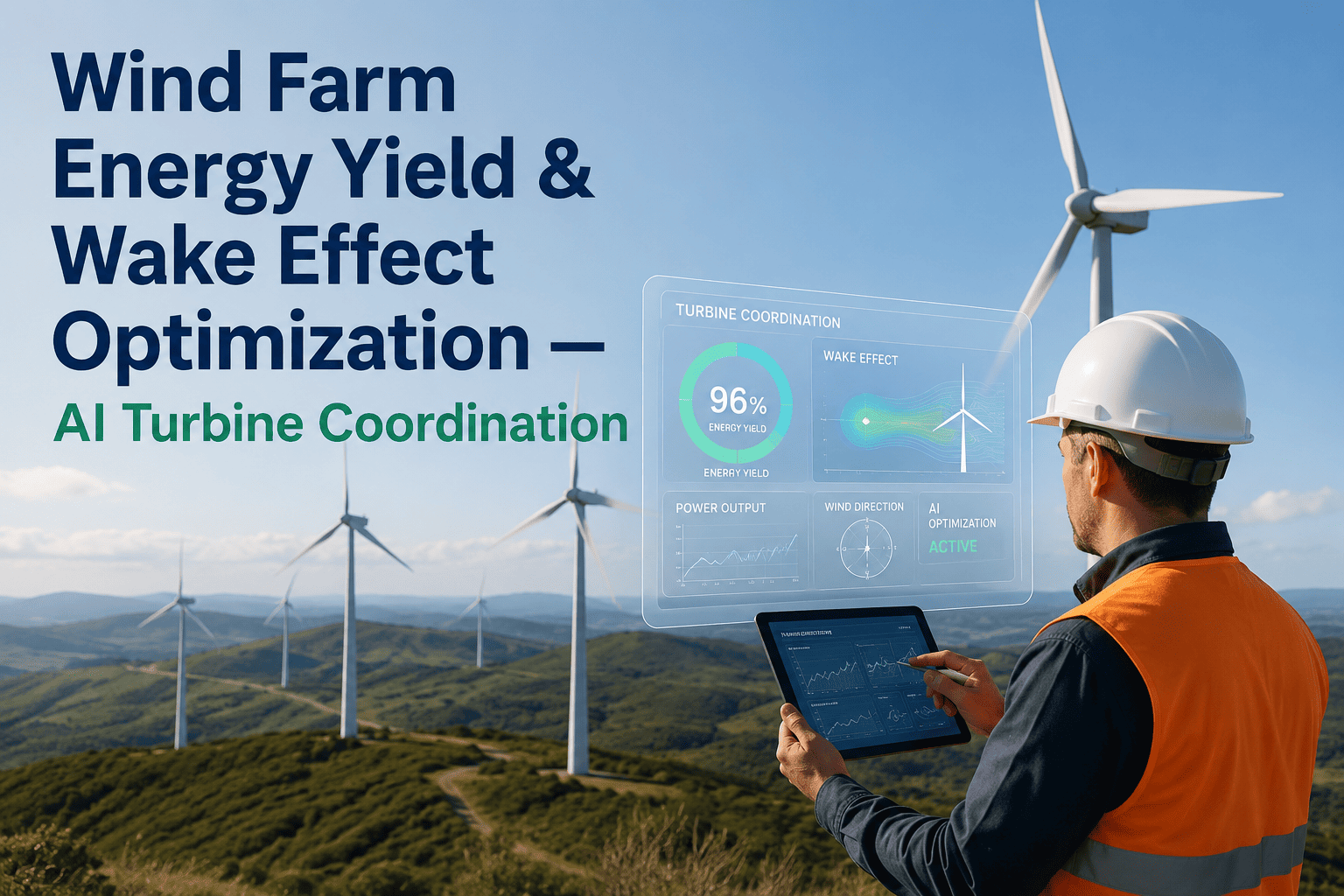
Every wind farm loses energy nobody notices on a turbine-by-turbine basis. When wind passes through the front row of turbines, it slows down and turns turbulent before it ever reaches the rows behind it, a phenomenon operators call the wake effect. Individual turbine controllers have no visibility into this interaction because each one is tuned to maximize its own output, not the farm's. Operations Directors are increasingly turning to AI turbine coordination to close that gap, adjusting yaw angles and blade pitch across the whole fleet in real time. The result is a farm that behaves like a single coordinated system instead of a collection of independent machines, and teams exploring this shift often start with a quick wind farm optimization walkthrough before committing to a rollout.
Wind Power / Fleet Coordination
Wind Farm Energy Yield & Wake Effect Optimization
AI-driven turbine coordination that recovers energy lost to wake interaction and lifts total farm output, not just individual turbine performance. Built for Operations Directors who need every megawatt already promised in the site's wind resource assessment to actually reach the meter.
4-8%
Typical wake-related yield loss on tightly spaced farms
10-14
Downstream rows commonly affected by upstream wake shadow
2-5%
Farm-wide output gain reported from coordinated yaw steering
The Hidden Cost of Wake Effect
Why Rows Behind the Front Line Underperform
A turbine facing directly into the wind extracts energy from that wind and leaves behind a slower, more turbulent wake that can stretch for a kilometer or more depending on wind speed and turbine size. Turbines sitting downstream inherit that disturbed air, which reduces the energy available to them and increases fatigue loading from turbulence, gradually wearing down bearings and blade components faster than a machine facing clean, undisturbed wind. Standard turbine control does not account for this because each machine is programmed to align itself precisely into the wind for maximum self-output, which is exactly the setup that maximizes wake shadow on the row behind it, meaning the default behavior of every individual turbine actively works against the farm's total output.
Front row — full wind exposure
Row 2 — partial wake shadow
Row 3+ — compounded turbulence loss
Where It Matters Most
Farm Layouts That See the Largest Gains
Wake losses are not distributed evenly across every wind farm. Some layouts and site conditions concentrate the problem, and coordinated control tends to deliver the biggest yield recovery on exactly those sites rather than on farms that are already spaced generously apart.
Tightly Spaced Farms
Farms built with turbines closer together to maximize land use see the deepest wake interaction between rows, which also means they have the most yield sitting unclaimed for coordinated control to recover.
Complex Terrain Sites
Hills, ridgelines, and uneven elevation change how wake travels in ways that manual spacing rules were never designed for, which is why terrain-aware sites often see the largest surprise gains once a live wake model is introduced.
Mixed OEM Fleets
Farms that combine turbines from different manufacturers or generations often lack a unified control strategy across the fleet, and coordination software can bridge that gap without replacing any existing hardware.
Curious how much wake loss is sitting inside your own SCADA data? A short review usually surfaces it within minutes.
Coordinated Control
How AI Turbine Coordination Recovers Lost Yield
01
Farm-Wide Flow Modeling
The system builds a live wake model across the entire layout using SCADA feeds, met mast data, and turbine-level sensors, mapping how each machine's wake shifts with wind direction and speed.
02
Wake Steering Calculation
Instead of pointing every turbine straight into the wind, the model calculates small yaw offsets for upstream turbines that redirect wake away from downstream rows, trading a small individual loss for a larger group gain.
03
Blade Pitch Coordination
Pitch angles are adjusted alongside yaw to manage loading on turbines that receive turbulent inflow, protecting components while the farm captures the wake-steering benefit.
04
Continuous Re-Optimization
As wind direction and speed shift throughout the day, the coordination model recalculates offsets in near real time, keeping the whole farm tuned to current conditions rather than a static layout assumption.
Optimization Levers
What Gets Adjusted Across the Fleet
| Control Lever | Upstream Turbine Effect | Downstream Farm Effect |
|---|---|---|
| Yaw offset / wake steering | Small reduction in individual output | Wake deflected away from next row, higher group yield |
| Blade pitch coordination | Reduced fatigue loading from turbulence | Longer component life on downstream turbines |
| Dynamic re-scheduling | Offsets adjust with live wind direction | Consistent gains across changing weather patterns |
| Curtailment sequencing | Selective output limits during extreme wind events | Farm-wide load protection without full shutdown |
Why Operations Directors Care
Farm-Level Thinking Changes the Revenue Picture
Optimizing each turbine in isolation looks reasonable on paper, but it consistently leaves energy on the table once wake interaction is accounted for. Coordinated control reframes the goal from maximizing one machine's output to maximizing the megawatt-hours that reach the meter at the point of interconnection. Over a full year of variable wind direction, that shift compounds into a measurable revenue difference without adding a single new turbine to the site, and it does so using data the farm is already collecting rather than requiring a new capital project or a lengthy procurement cycle.
MWh
Additional annual energy captured through coordinated wake steering
PPA
Stronger delivery consistency against power purchase agreement targets
O&M
Lower fatigue-driven maintenance from balanced turbulence exposure
Common Questions
Wake Optimization, Explained Simply
Does wake steering reduce the output of upstream turbines permanently?
Upstream turbines do generate slightly less energy while yawed away from direct wind alignment, but the loss is small compared to the gain recovered by downstream rows. The coordination model only applies an offset when the net farm-wide effect is positive, and it constantly recalculates as conditions change, so the trade-off is never applied blindly. Teams typically see the clearest picture of this balance after reviewing a short turbine coordination walkthrough against their own layout.
How much of my existing SCADA and sensor infrastructure can be reused?
Most farms already have the SCADA feeds, met mast data, and turbine controllers needed to support coordinated control, since the wake model is built from data that is already being collected for standard operations. Integration typically focuses on connecting the AI coordination layer into the existing control pathway rather than replacing hardware. Our support team can walk through your current setup to confirm compatibility before any changes are made.
Will coordinated yaw control increase mechanical wear on the turbines?
Yaw offsets used for wake steering are modest and are paired with blade pitch adjustments that manage loading rather than ignore it, so the intent is to reduce net turbulence exposure across the fleet rather than add stress to any single machine. In practice, downstream turbines often experience less fatigue loading once turbulent wake is redirected away from them. Component-level load data is monitored continuously so any unexpected wear pattern is caught early.
Does this work on farms with irregular turbine spacing or complex terrain?
Yes, the wake model is built from the actual layout and terrain data of the site rather than a generic spacing assumption, which matters because irregular spacing and complex terrain often produce wake patterns that are harder to predict manually. These are frequently the sites that see the largest optimization gains, since manual tuning tends to underperform most in exactly these conditions. A site-specific review is the fastest way to see the expected gain for a particular layout.
How long does it take to see measurable energy yield improvement?
Most operators begin seeing measurable shifts in farm-wide output within the first few weeks of live coordination, since the model starts adjusting offsets as soon as it has enough wind direction and speed data for the site. Seasonal wind pattern changes continue to refine the model's accuracy over the following months. Ongoing support is available throughout that period to review performance against expectations.
See how much wake-related yield your farm could be recovering. Book a walkthrough with our team and bring your layout.