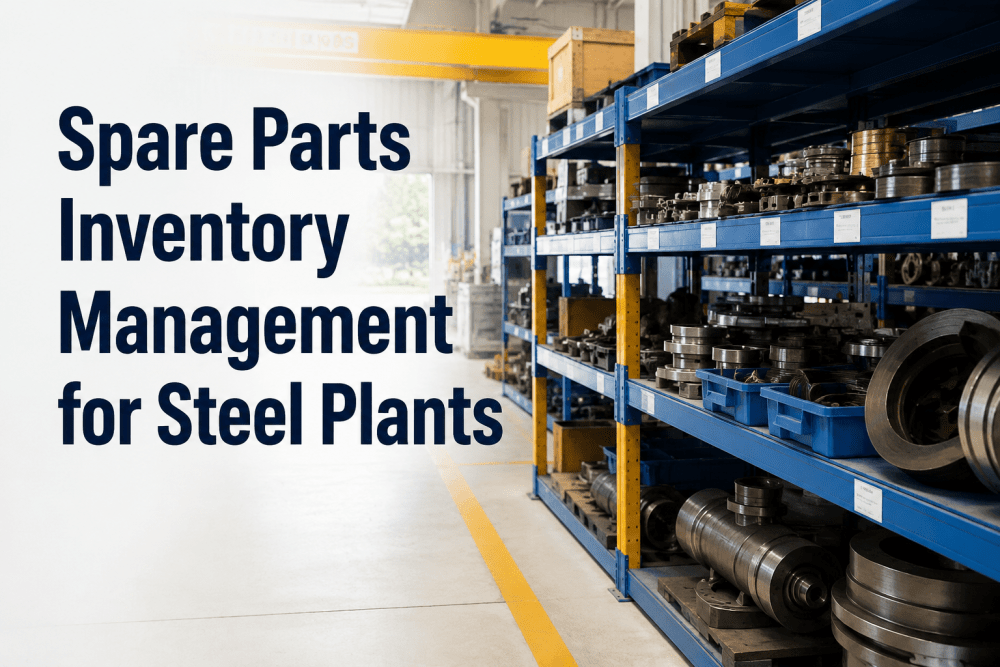
A support block for a steel mill conveyor system doesn't sound like a candidate for advanced manufacturing technology — until the machine that uses it hasn't been produced in fifteen years and the OEM stopped stocking the part a decade ago. A peer-reviewed life cycle study on exactly this scenario found that producing a stainless steel mill support block through a hybrid wire arc additive process cut steel consumption by roughly 70% compared to machining it from solid billet, and reduced environmental impact by nearly half. iFactory's spare parts intelligence helps plant teams identify which parts in their own inventory are genuine candidates for that kind of shift.
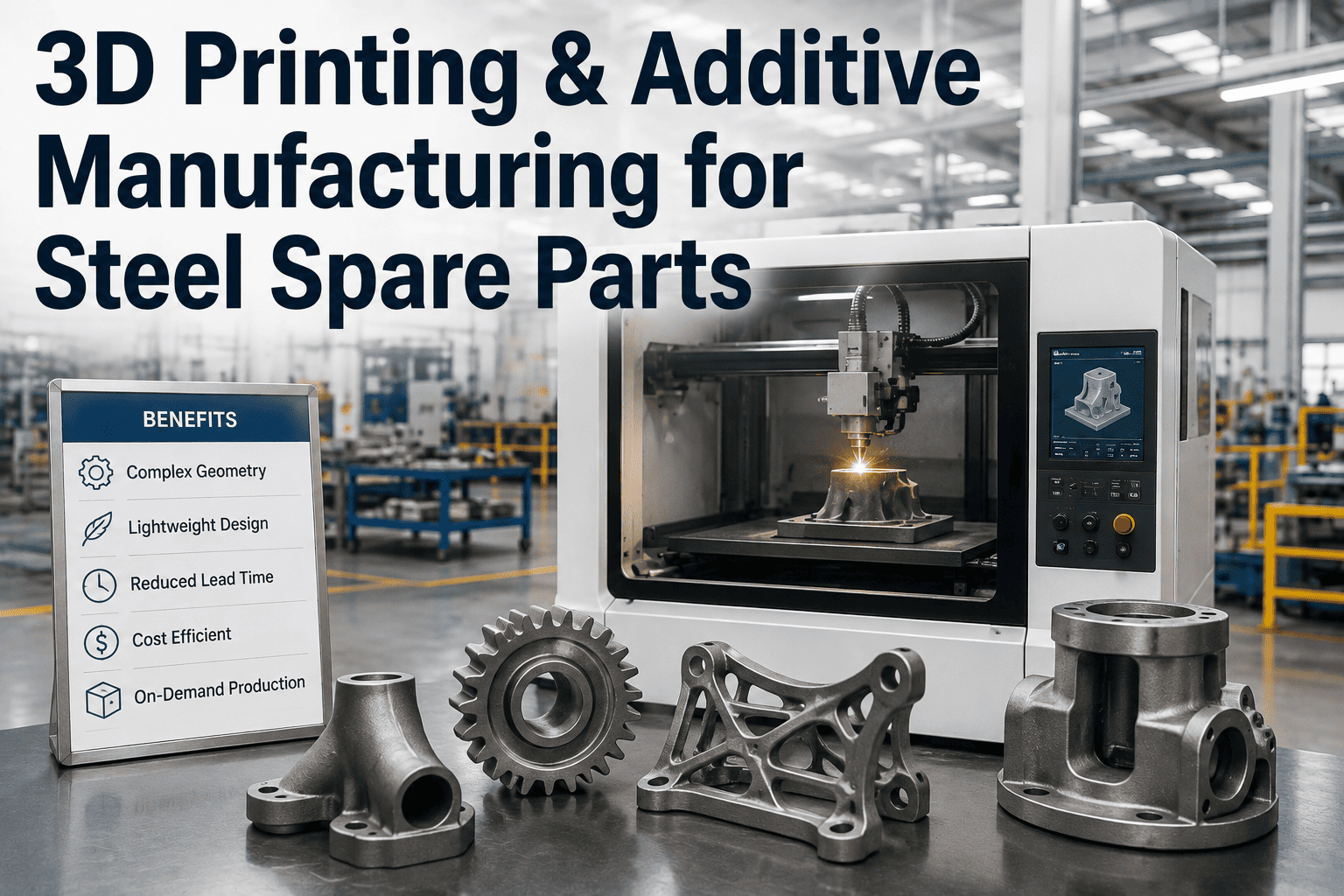
3D Printing & Additive Manufacturing for Steel Plant Spare Parts
Additive manufacturing is not a replacement for casting or forging across the board. It is a specific answer to a specific problem: low-volume, high-value, hard-to-source parts where waiting weeks for a traditional supply chain costs more than the part itself. This guide covers where that answer applies and where it doesn't.
The Problem AM Actually Solves: Obsolescence, Not Volume
Steel plant equipment routinely outlives the manufacturer's willingness to keep stocking parts for it. A conveyor drive, a pump housing, or a structural bracket installed fifteen years ago may sit on a machine the OEM stopped producing a decade ago, with spare parts availability that depends entirely on whether the manufacturer kept tooling around long enough to service a shrinking installed base. When that tooling is scrapped or the OEM exits the product line entirely, the plant is left with a genuinely obsolete part, no drawings, and a machine that otherwise still runs.
This is the scenario additive manufacturing was built to answer, and it is a narrower use case than the marketing around 3D printing sometimes suggests. AM is not generally competitive with casting or forging for high-volume production of simple, well-tooled parts — the economics of amortized tooling still favor traditional methods once volume climbs. Where AM wins decisively is the opposite case: a single part, or a handful of parts, needed urgently, where the alternative is either an extended search for a surplus unit, a full reverse-engineering and re-tooling project, or accepting extended downtime while a traditional supply chain works through a multi-week lead time.
The obsolescence problem compounds in a specific way that makes it worse over time rather than better. Every year a machine keeps running past its original service life is another year the population of plants still operating that equipment shrinks, which means the addressable market for a replacement part shrinks with it. A supplier that once found it worthwhile to keep a casting die or forging tool in service for a slow-moving part eventually reaches a point where the remaining demand no longer justifies the storage and maintenance cost of that tooling. At that point the part doesn't become harder to source — it becomes unsourceable through the original channel entirely, and the plant's options narrow to finding a surplus unit, commissioning a full re-tooling project at a cost disproportionate to the part's value, or reverse engineering it for additive production.
Find Out Which of Your Spare Parts Are Genuine AM Candidates
iFactory flags parts with long lead times, obsolete sourcing, or low order volume — the exact profile where additive manufacturing has the strongest business case.
The Two Metal AM Processes Relevant to Steel Plants
"3D printing" covers a wide range of processes, but two are specifically relevant to the scale and materials common in steel plant applications. Choosing between them depends heavily on part size and required precision.
LPBF uses a high-power laser to selectively melt fine metal powder layer by layer inside an enclosed build chamber, producing parts with tight dimensional tolerances and fine surface detail. This is the process best suited to smaller, geometrically complex components — housings, brackets, internal-channel components — where precision matters more than raw size. Build chamber dimensions limit LPBF to parts that fit within it, typically on the order of tens of centimeters per side depending on the specific machine, which rules it out for large structural components.
WAAM uses a robotic arm and an electric arc to melt metal wire, depositing it layer by layer to build a part with no enclosed chamber constraint — the technology behind the world's first fully functional 3D-printed steel pedestrian bridge. Deposition rates in the range of 2 to 8 kilograms per hour make WAAM the practical choice for large structural steel components: brackets, support blocks, reinforcement sections, and repair overlays on existing equipment. Surface finish and dimensional accuracy are coarser than LPBF, which is why WAAM parts are frequently finished with a CNC machining pass on critical surfaces — a hybrid approach that captures AM's near-net-shape material savings while still meeting tight tolerances where they actually matter.
What the Steel Mill Life Cycle Study Actually Found
A published life cycle assessment and cost analysis compared two production routes for a stainless steel support block used in steel mill equipment: conventional CNC machining from solid billet versus a hybrid process combining plasma arc wire arc additive manufacturing with CNC finishing. The comparison used standardized life cycle assessment methodology and a cradle-to-gate cost model — not a vendor case study, but an independent academic evaluation of the same part produced two different ways.
The hybrid WAAM-CNC route reduced average environmental impact by 49% across eighteen separate impact categories and cut steel consumption by approximately 70%, driven by the near-net-shape nature of additive deposition versus the substantial material removed as scrap chips when the same part is machined from a solid billet. The finding matters beyond this specific part: it demonstrates, with independent methodology, that the material efficiency case for additive manufacturing on steel mill components is not just theoretical — it holds up under rigorous life cycle accounting on a genuinely representative industrial part.
Repair and Lifecycle Extension: Beyond Making New Parts
A parallel and increasingly significant use of wire arc additive manufacturing in heavy industry is not replacement but repair. Structural steel components under sustained stress — support beams, load-bearing brackets, welded joints — develop fatigue cracks and localized wear over years of service, and fully replacing a permanently installed structural member is often expensive or impractical. Research programs applying WAAM to structural steel repair use the robotic arc process to deposit reinforcement directly onto the damaged area, creating a weld seam and material buildup that restores structural integrity without removing and replacing the entire component. This shifts additive manufacturing's role from purely a spare-parts production method to an in-place maintenance technique — extending the service life of equipment that would otherwise require a full component swap.
Build a Digital Inventory of Your Obsolete-Risk Parts
iFactory tracks which parts have single-source suppliers, discontinued tooling, or extended lead times — the digital inventory that makes an AM decision fast when a part actually fails.
AM vs. Traditional Manufacturing: When Each Wins
The decision between additive and traditional manufacturing is not a technology preference — it is a function of volume, part complexity, and how urgently the part is needed. The comparison below reflects the general pattern, not an absolute rule for every part.
| Factor | Favors Additive Manufacturing | Favors Casting / Forging | Why |
|---|---|---|---|
| Order volume | 1-50 units | Hundreds to thousands | Tooling amortizes only at volume |
| Part availability | Obsolete, no active supplier | Actively stocked or sourced | No reason to reinvent a stocked part |
| Lead time need | Urgent, days to weeks | Flexible, weeks to months acceptable | AM skips tooling lead time entirely |
| Part complexity | Complex geometry, internal features | Simple geometry | AM geometric freedom vs. die/mold limits |
| Material requirement | Standard steels, some exotics | Structural steels needing isotropic strength | Forging's grain flow still leads on some loads |
| Original documentation | Missing — needs reverse engineering anyway | Available drawings and specs | AM pairs naturally with a reverse-engineering step |
What Reverse Engineering an Obsolete Part Actually Requires
Producing an obsolete part via additive manufacturing almost always starts without a usable CAD file — the original design documentation is often incomplete, lost, or was never digital in the first place. Reverse engineering a legacy part into a printable digital file typically combines high-resolution 3D scanning or CT scanning to capture precise dimensions and tolerances from the physical part itself, engineering judgment to identify the functional requirements the part actually needs to meet (not just its shape), and material analysis to confirm the printed material's properties will hold up under the same loads, temperatures, or corrosive conditions the original part faced.
The engineering judgment step deserves more weight than it typically gets. A worn or damaged sample part being scanned for reverse engineering does not represent the part's original, as-manufactured dimensions — it represents the part after years of wear, and a naive scan-and-print approach risks faithfully reproducing that wear rather than the functional geometry the part actually needs. Distinguishing original design intent from accumulated wear requires either a second, less-worn reference sample, original drawings if any fragment survives, or engineering analysis of the part's function well enough to reconstruct what the unworn geometry should have been. Skipping this step is one of the more common ways an otherwise well-executed AM reverse-engineering project produces a part that fits but doesn't perform.
Steel plant equipment frequently operates under high temperature, high load, or corrosive conditions that demand more from a replacement part than simply matching the original's shape. Confirming that a printed part's mechanical properties genuinely match or exceed the original — not just visually, but under the actual service conditions — is where most of the engineering effort in an AM spare-parts program goes. This is also why AM adoption for genuinely critical, high-stress structural components tends to move more cautiously than adoption for brackets, housings, and other secondary components, where the consequence of an imperfect match is lower.
Common Mistakes When Evaluating AM for Spare Parts
Evaluating AM against high-volume production economics. Additive manufacturing will almost always lose a cost comparison against a well-tooled casting or forging process running at scale. That comparison is irrelevant for the obsolete, low-volume parts AM actually targets — the honest comparison is against the true cost of extended downtime or a reverse-engineered tooling investment, not against mass production economics.
Skipping material qualification for load-bearing parts. Matching the visual geometry of an obsolete part is necessary but not sufficient. A printed part going into a high-stress or high-temperature application needs its mechanical properties verified against the original specification, not assumed equivalent because the shape matches.
Treating every legacy part as an AM candidate. A part still actively produced and stocked by a supplier, at a reasonable lead time and cost, rarely benefits from an AM production shift — the value proposition depends specifically on scarcity, obsolescence, or urgency, not on the technology being available.
Ignoring post-processing costs in the initial estimate. A WAAM or LPBF part frequently needs stress relief, heat treatment, and finish machining on critical surfaces before it's usable. Quoting only the print time and material cost, without the full post-processing chain, understates the real cost and lead time of a finished, usable part.
Waiting for a failure before building the digital file. Reverse engineering and qualifying a part takes real time and is far easier to do calmly, before a failure, than under the pressure of an unplanned outage. Plants that identify obsolescence-risk parts in advance and pre-build the digital file can move to a printed replacement in days once a failure actually occurs.
Additive Manufacturing Spare Parts KPIs to Track
Digitized Legacy Part Count
Number of obsolete or high-risk parts with a completed, qualified digital file ready for on-demand printing, tracked against the total population of at-risk parts in inventory.
Obsolete Part Downtime
Downtime hours attributable specifically to waiting for an obsolete or hard-to-source part, before and after an AM digital inventory program is in place.
Material Qualification Completion Rate
Percentage of printed load-bearing or high-temperature parts with documented mechanical property verification against the original specification before installation.
Emergency Print-to-Install Lead Time
Time from identifying a failed obsolete part with an existing digital file to installing the printed replacement — the metric that captures AM's actual operational value.
The plants that get real value out of additive manufacturing are not the ones chasing every part that could theoretically be printed. They're the ones who did the unglamorous work of identifying, in advance, exactly which parts on their floor are single-source, out of production, and genuinely at risk — and then built and qualified the digital files for those specific parts before anything broke. When you wait until a failure to start reverse engineering, you've given up most of the speed advantage AM actually offers. The technology is fast. The reverse engineering and qualification work is not, and that work has to happen on a calm timeline, not an emergency one.
Building the Business Case Beyond the Single-Part Comparison
A single obsolete part rarely justifies building an internal reverse-engineering and qualification capability on its own — the real business case emerges once a plant looks at the pattern across its full spare parts inventory rather than one part at a time. Most steel plants running equipment older than fifteen or twenty years carry a meaningful population of parts sharing the same risk profile: single-source, discontinued, or increasingly expensive to source through diminishing traditional channels. Digitizing and qualifying that population as a standing program, rather than reacting to each failure individually, changes the economics considerably, because the reverse-engineering cost gets spread across many parts and the resulting digital inventory sits ready whenever the next failure happens to occur.
This is also where the distinction between reactive and proactive AM adoption matters most for actual operational outcomes. A plant that only considers additive manufacturing after a critical part has already failed is choosing between weeks of downtime while reverse engineering happens under pressure, or weeks of downtime while a traditional supply chain works through an uncertain lead time — neither option captures AM's real advantage. A plant that has already identified its at-risk parts and pre-built qualified digital files turns the same failure into a multi-day event instead of a multi-week one, because the only step remaining is printing and finishing a part whose design was already verified on a calm timeline.
Frequently Asked Questions
It depends entirely on volume and context. For high-volume, well-tooled production, casting and forging remain more cost-effective because tooling costs amortize across thousands of units. For the low-volume, urgent, or genuinely obsolete parts that steel plants most often need additive manufacturing for, the comparison changes completely — a published life cycle and cost study on a steel mill support block found a hybrid additive-CNC route reduced steel consumption by roughly 70% and environmental impact by nearly half compared to machining from solid billet, precisely because there was no tooling investment to amortize and near-net-shape deposition avoided most material waste. Book a demo to see how iFactory identifies which specific parts in your inventory fit the low-volume, high-value profile where AM economics actually work.
Laser Powder Bed Fusion builds parts inside an enclosed chamber using a laser to melt fine metal powder, producing tight tolerances and fine surface detail, but the build chamber size limits it to smaller components. Wire Arc Additive Manufacturing uses a robotic arm and electric arc to deposit metal wire with no chamber constraint, at deposition rates of roughly 2 to 8 kilograms per hour, making it the practical choice for large structural steel components, though typically requiring a CNC finishing pass on critical surfaces to hit tight tolerances. Choosing between them depends primarily on part size — small, geometrically intricate components favor LPBF, while large structural brackets and support components favor WAAM. Book a demo to see which process fits your specific part geometry and size.
Yes — wire arc additive manufacturing is increasingly used as a repair technique for structural steel components that have developed fatigue cracks or localized wear after years of service. A robotic arc process deposits reinforcement material directly onto the damaged area, restoring structural integrity without removing and replacing the entire permanently installed component, which is often far more expensive or logistically impractical than an in-place repair. This shifts additive manufacturing from a purely spare-parts-production role into an active maintenance and lifecycle-extension technique for existing equipment. Book a demo to see how iFactory tracks structural repair history alongside conventional spare parts data.
Reverse engineering typically starts with high-resolution 3D scanning or CT scanning of the physical part itself to capture precise dimensions and tolerances, combined with engineering analysis to understand the part's actual functional requirements — the loads, temperatures, or stresses it needs to withstand — rather than simply replicating its visible shape. Material analysis of the original part, where a sample is available, helps confirm what mechanical properties the printed replacement needs to match or exceed. This process requires genuine engineering expertise, not just a 3D scan, particularly for parts operating under demanding conditions where an imperfect match could cause a failure. Book a demo to see how iFactory documents the reverse-engineering and qualification trail for legacy parts.
The strongest candidates share a specific profile: single-source or discontinued supplier, extended lead times when they can be sourced at all, relatively low order volume, and moderate rather than extreme complexity in load or temperature requirements — since qualification is more straightforward for secondary components than for the most demanding structural or high-temperature applications. Parts that are still actively stocked and reasonably priced through normal channels rarely justify the reverse-engineering investment, regardless of how printable they might technically be. Book a demo to see how iFactory ranks your own spare parts inventory against this exact profile.
Turn Obsolete Parts Into a Digital File, Before You Need It
iFactory identifies the single-source, discontinued, and long-lead-time parts in your inventory that are the strongest candidates for additive manufacturing — so the reverse-engineering work happens on your schedule, not during an outage.