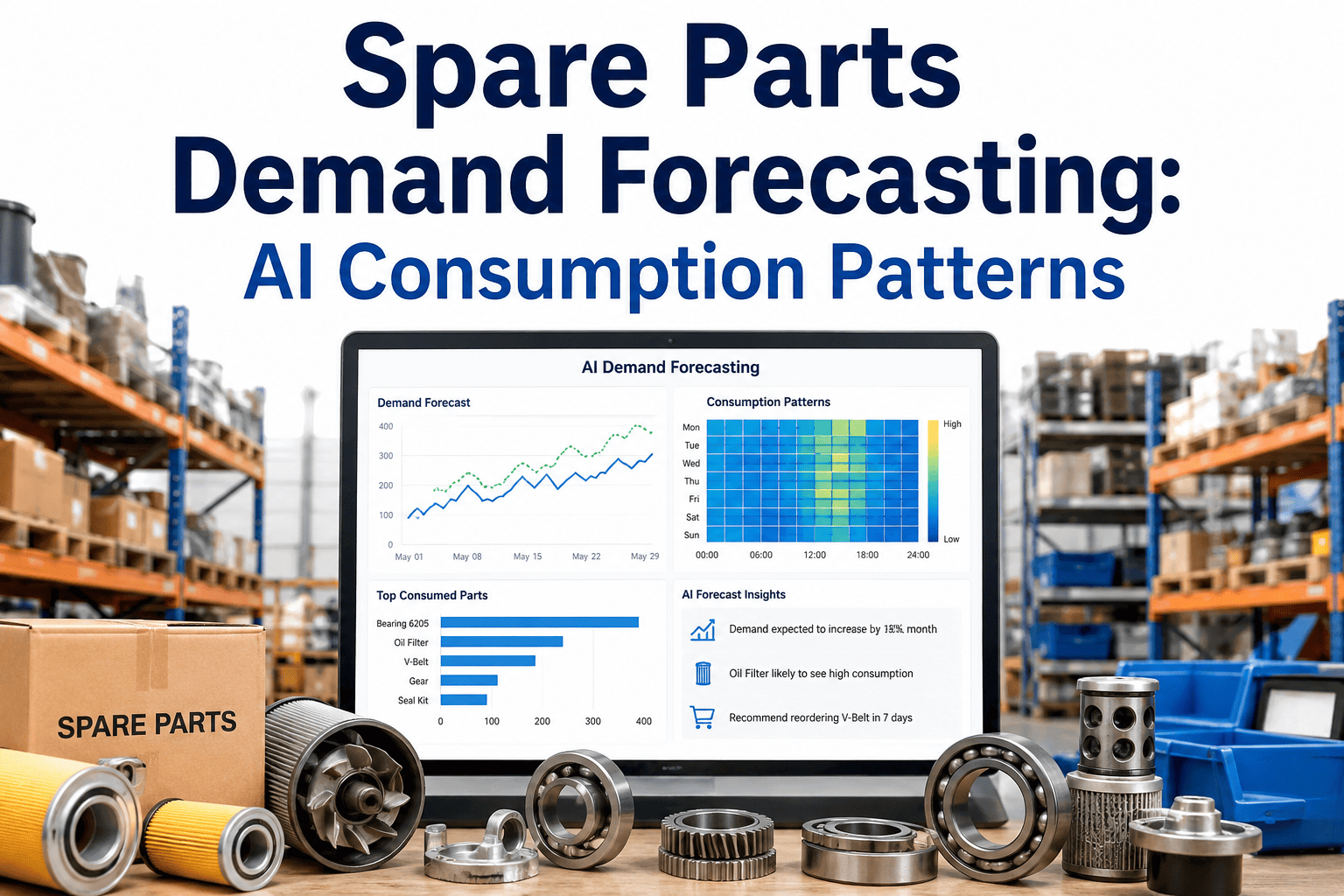
Spare parts demand does not follow the smooth, predictable curve of finished goods sales, it follows the far messier pattern of equipment wear, maintenance schedules, and the occasional unplanned failure, which is exactly why the demand forecasting methods borrowed from retail inventory planning consistently underperform in a steel plant storeroom. Book a demo to see AI-driven consumption pattern analysis built for intermittent, equipment-driven spare parts demand.
Spare Parts Demand Does Not Follow a Sales Curve, It Follows Your Equipment
Generic forecasting models assume steady, predictable demand. Spare parts consumption is intermittent, lumpy, and directly tied to equipment age, run hours, and maintenance intervals. AI-based demand forecasting learns the actual consumption pattern behind each part instead of applying a one-size-fits-all statistical model.
The Problem With Applying Retail Demand Models to Spare Parts
Retail and finished goods forecasting models are built around the assumption of relatively continuous demand with seasonal or trend variation layered on top. Spare parts demand looks nothing like that. A bearing might consume zero units for eight months and then three units in a single week when a run of failures happens to cluster together, and a standard moving average or exponential smoothing model interprets that pattern as noise rather than as the genuine signal it actually is.
This mismatch is why so many plants end up either carrying excess stock as a hedge against forecasting models they do not fully trust, or experiencing stockouts on parts that a naive average suggested would not be needed again soon. The fix is not a better version of the same model, it is a different modeling approach built specifically for intermittent, equipment-driven demand.
Four Signals AI Demand Forecasting Correlates Against Consumption
Stop Forecasting Spares With a Model Built for Retail Shelves
iFactory learns the actual consumption pattern behind every part, correlating equipment age, maintenance schedules, and condition data into a forecast built for intermittent demand.
Moving Average vs AI-Driven Consumption Forecasting
| Factor | Moving Average / Simple Statistical Model | AI Consumption Pattern Model |
|---|---|---|
| Handles intermittent, lumpy demand | Poorly, treats spikes as noise | Directly models clustering and spikes |
| Accounts for equipment age | No, treats all periods equally | Yes, learns wear-driven acceleration |
| Incorporates maintenance schedule | No | Yes, anticipates planned demand |
| Adapts as new failure data arrives | Slowly, requires manual re-tuning | Continuously, retrains on new data |
| Typical forecast accuracy on low-volume parts | Low, frequent large misses | Meaningfully improved, still imperfect |
No forecasting method eliminates uncertainty on genuinely rare, low-volume parts, since a part that has failed twice in five years simply does not generate enough data for any model to predict the third failure precisely. What AI-driven forecasting improves is the consistency and defensibility of the estimate, and its ability to incorporate signals a simple average cannot use at all.
Turning a Demand Forecast Into an Actual Stocking Decision
A forecast on its own does not set inventory policy, it feeds into it. Once a part's expected demand and demand variability are estimated, that output combines with the part's criticality classification and lead time to calculate an appropriate safety stock level and reorder point, closing the loop between forecasting and the physical stocking decision on the shelf.
This connection matters because a highly accurate forecast on a low-criticality part delivers far less value than a modest accuracy improvement on a vital, long-lead-time part, so the forecasting effort itself should be prioritized in line with the criticality classification already applied across the parts catalog.
Five Steps to Deploying AI Demand Forecasting for Spares
Common Questions About AI Spare Parts Demand Forecasting
How much historical consumption data is needed before AI forecasting produces useful results?
Parts with several years of consistent transaction history and at least a handful of consumption events generally produce the most reliable models, since the algorithm needs enough examples of actual demand events to learn a meaningful pattern rather than fitting noise. Very low-volume parts with only one or two historical events in the available data will still have wide uncertainty ranges regardless of modeling approach, since that is a genuine data limitation rather than a modeling shortfall. Book a demo to assess data readiness for your parts catalog.
Can the forecasting model account for a part that is being consumed differently after a recent equipment upgrade?
A model trained purely on historical data can be slow to recognize a genuine shift caused by an equipment change, which is why continuous retraining and a mechanism for flagging known equipment changes are both important parts of a working system, allowing recent data to be weighted more heavily following a documented upgrade rather than treating the shift as a statistical anomaly to smooth over. Contact support to review how equipment changes are incorporated into forecast updates.
Does demand forecasting reduce inventory levels, or does it sometimes recommend carrying more stock?
Improved forecasting typically produces a redistribution of inventory rather than a uniform reduction, decreasing stock on parts the model finds are over-stocked relative to actual demand variability while sometimes recommending an increase on vital parts where the previous informal estimate underestimated real risk. The net effect for most plants is lower total inventory value with better protection against stockouts on the parts that matter most, but individual parts can move in either direction. Book a demo to see typical inventory impact from an initial forecast review.
How does the forecasting system incorporate condition monitoring data if the plant has predictive maintenance sensors installed?
Where condition monitoring data such as vibration trends or oil analysis results is available, it can serve as a leading indicator that shifts a specific part's near-term demand estimate ahead of a scheduled maintenance date, effectively giving the forecast an earlier and more specific signal than historical consumption patterns alone would provide. This integration depends on the condition monitoring systems already in place and is configured during setup. Contact support to connect condition monitoring data to your demand forecast.
Can demand forecasting help plan for parts affected by long-term supplier lead time increases?
Demand forecasting estimates how much of a part will be needed and when, which combines with current lead time data to determine when a reorder needs to be triggered, so a documented increase in a supplier's lead time directly raises the reorder point and safety stock recommendation for that part even if the underlying demand forecast itself has not changed. Keeping lead time data current in the system is what allows this adjustment to happen automatically rather than being missed until a stockout occurs. Book a demo to see how lead time changes flow into stocking recommendations.
Forecast Spare Parts Demand the Way Equipment Actually Fails
iFactory builds demand forecasts around your equipment's real consumption pattern, connecting historical data, asset age, and maintenance schedules into a model built for intermittent spare parts demand.