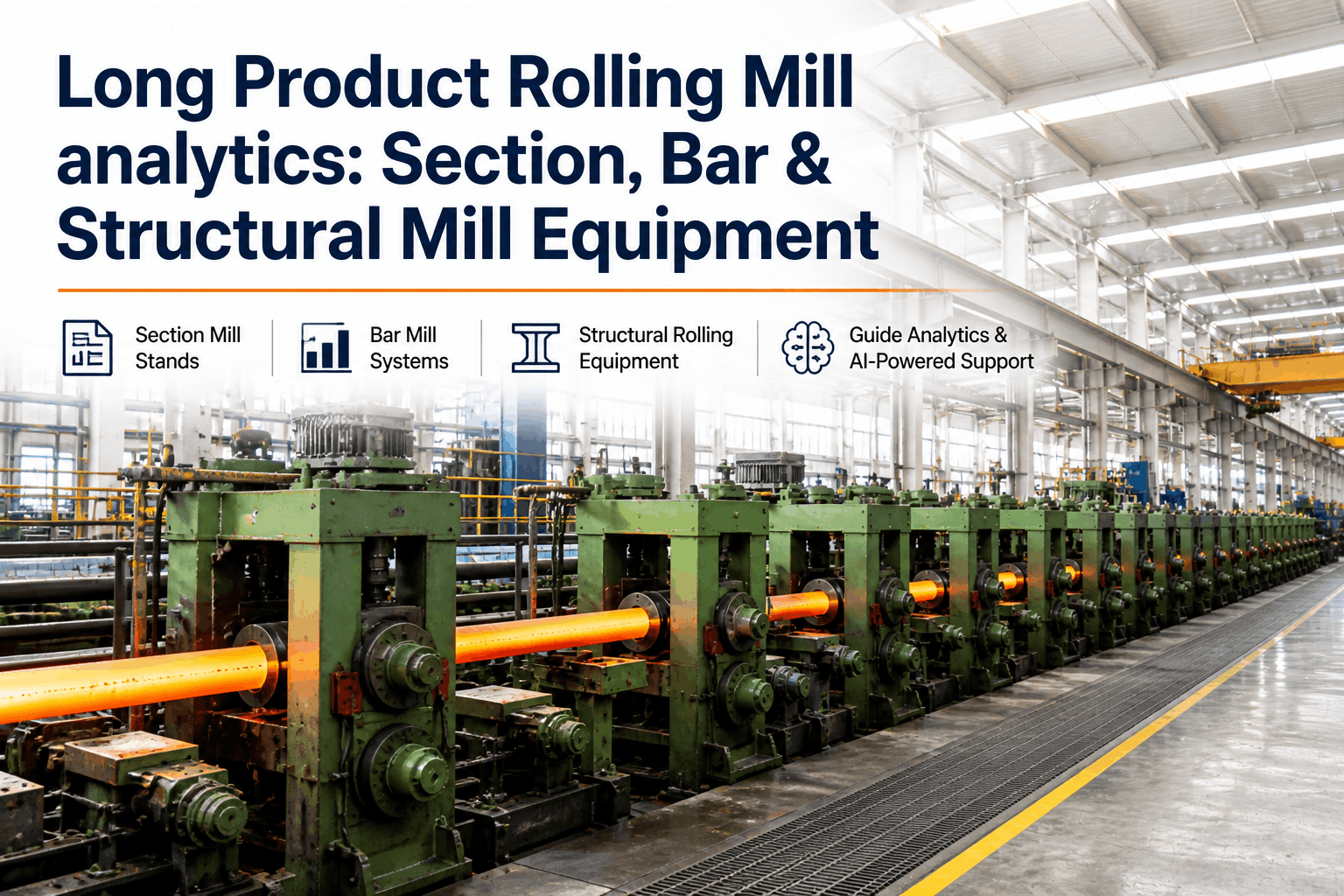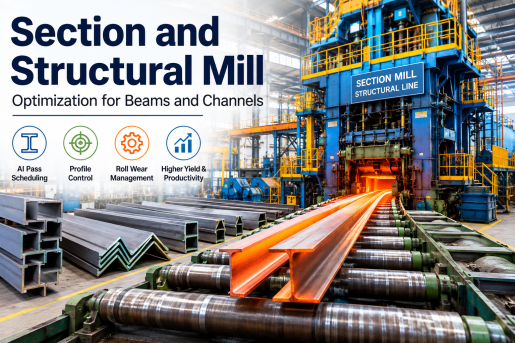
Section mills producing structural steel profiles — wide-flange beams, H-beams, I-beams, channels, angles and specialty structural shapes — operate under a fundamentally different set of dimensional constraints than flat product or long product rolling. The universal mill configuration of vertical and horizontal rolls must coordinate flange and web reduction simultaneously across multiple passes through the universal roughing, universal intermediate and universal finishing stands. A deviation of 0.3 mm in flange thickness or 1.5 mm in web height at the roughing stand is amplified through subsequent passes, producing finished sections that fail EN 10034, ASTM A6, or AS/NZS 3679 dimensional compliance at the inspection station — after full processing cost has been incurred. The mills that consistently deliver tight dimensional tolerances across beam, channel, and angle production runs are not necessarily those with the newest universal stands. They are the mills with the most complete, most continuous pass-by-pass visibility into how each section dimension is developing across the rolling sequence and the AI-driven analytical capability to detect and correct dimensional drift before the section is dimensionally committed at the finishing stand. iFactory's Section Profile AI platform delivers that analytical layer for structural mills, combining universal stand process monitoring with predictive models that anticipate profile deviation, roll wear-driven dimension shift, and straightness degradation before they produce off-specification sections. Schedule a structural mill optimization assessment to evaluate how AI-driven profile control and roll wear management can improve your section mill's dimensional yield and throughput.
Why Section Mill Profile Control Requires AI-Driven Process Analytics
The dimensional control challenge in a universal section mill is structurally unique in steel rolling because flange and web reduction must be coordinated across multiple stand types — the breakdown mill (BD), the universal roughing stand (UR), the universal intermediate stand (UI), and the universal finishing stand (UF) — each applying reduction to different combinations of flange thickness, flange width, web thickness, and web height. The interaction between these dimensions across the pass sequence creates a multi-variable control problem that static pass schedule models cannot resolve: adjusting the UR roll gap to correct flange thickness changes the web height entering the UI stand, which in turn affects the flange width distribution at the UF stand.
What separates high-yield structural mills from average performers is not the quality of their pass schedule design — it is the ability to detect when the actual dimensional development is diverging from the modeled trajectory at each stand and to apply corrective adjustments before the finished section exits the final stand outside dimensional tolerance. iFactory's Section Profile AI monitors every dimension at every stand for every bloom, comparing measured values against the model prediction to detect the early-stage divergence patterns that precede dimensional non-conformance. Book a section mill profile audit to benchmark your mill's dimensional control capability against AI-optimized performance.
The breakdown mill transforms the rectangular bloom into the initial section shape through a series of calibre passes. iFactory monitors roll force distribution across the calibre, temperature drop per pass, and the dimensional development of the rough section flange and web pockets. AI models detect when bloom temperature variation is producing asymmetric filling of the calibre — a condition that propagates into flange thickness variation at the subsequent universal stands — and recommends adjustments to the breakdown reduction sequence before the bloom advances.
The universal roughing stand applies simultaneous vertical roll (flange) and horizontal roll (web) reduction. iFactory correlates the UR exit flange thickness and web height measurements against the model prediction, identifying early-stage divergence patterns. A flange thickness 0.15 mm above the model target at UR exit, combined with a web height 0.8 mm below target, signals that the vertical roll gap is not tracking the rolling load increase from the web reduction — a condition the AI flags for roll gap correction before the section advances to the intermediate stand.
The universal intermediate stand applies the primary dimensional reduction toward target section geometry. iFactory's cross-stand dimensional propagation model predicts the UI exit dimensions based on UR exit measurements and the UI stand reduction settings, identifying sections where the incoming UR exit profile is outside the UI stand's correction capability. Sections at risk of exiting the UI stand with residual dimensional deviation are flagged for direct routing to dimensional inspection rather than continuing through the finishing stand unsampled.
The universal finishing stand applies the final calibration pass. iFactory monitors UF exit flange width, flange thickness, web height, web thickness, and section straightness against the ASTM, EN, or AS/NZS specification limits for the product grade. Sections predicted to exit outside dimensional tolerance — based on the UI exit measurement and UF reduction settings — are flagged for immediate inspection at the hot saw, enabling corrective action before the entire production batch is cut to ordered lengths.
AI Roll Wear Management and Pass Life Extension for Structural Mills
Roll wear in universal section mills is the most significant variable driving dimensional drift across a roll campaign — and it is the variable that static pass schedule models handle least effectively. The vertical rolls that control flange dimensions wear at a different rate than the horizontal rolls that control the web, and the wear pattern within a single roll barrel is non-uniform, with greater material loss at the flange root radius where contact stress is highest and less wear at the flange tip where contact pressure is lower. This asymmetric wear produces a progressive change in the section geometry across the campaign: flange thickness gradually increases (because the vertical roll gap effectively widens as material is removed from the roll face), web height drifts, and the flange-to-web angle changes as the roll profile degrades asymmetrically. Schedule a roll wear analytics review to benchmark your current roll campaign utilization against AI-optimized pass life targets.
Section Straightness, Cooling, and Straightener Integration Analytics
Section straightness after cooling is determined by three interacting factors: the residual stress distribution induced by the rolling process, the cooling rate differential between flanges and web on the cooling bed, and the correction applied at the straightener. Of these three factors, the rolling process contribution is the least visible and most difficult to diagnose. Uneven reduction distribution between the top and bottom flanges at the universal finishing stand, asymmetric roll cooling that produces a temperature differential across the section at the finishing stand exit, and uneven spread at the flange tips all produce residual stress patterns that manifest as camber, sweep, or twist after the section is cut to length and cooled. iFactory's straightness analytics module correlates finishing stand exit measurements with cooling bed position data and straightener correction records to build a complete causal chain from rolling conditions to finished section straightness, enabling process engineers to identify and eliminate the rolling-stage root causes of straightness deviation.
Section Mill Profile Optimization: Key Process Capability Benchmarks
iFactory's Section Profile AI platform delivers measurable improvements across the full structural mill process chain — from breakdown mill and universal stands through to cooling bed and straightener. The following table summarizes the process capability benchmarks from live structural mill deployments, comparing conventional operations against AI-driven profile control performance.
| Process Parameter | Conventional Operation | iFactory AI-Optimized | Improvement |
|---|---|---|---|
| Flange Width Tolerance (ASTM A6) | ±3.2 mm average deviation from nominal | ±1.8 mm average deviation from nominal | 44% tighter width distribution |
| Web Height Consistency | ±2.8 mm standard deviation across campaign | ±1.4 mm standard deviation across campaign | 50% reduction in web height variability |
| Flange Thickness Uniformity | ±0.35 mm deviation flange-to-flange | ±0.14 mm deviation flange-to-flange | 60% improvement in flange thickness symmetry |
| Section Straightness (Camber) | Average 4.2 mm/m after cooling bed | Average 2.1 mm/m after cooling bed | 50% reduction in camber deviation |
| Roll Campaign Yield | 82% dimensional conformance across campaign | 94% dimensional conformance across campaign | 12 percentage point yield improvement |
| Straightener First-Pass Rate | 71% of sections corrected in single pass | 89% of sections corrected in single pass | 18 percentage point first-pass rate increase |
| Crop Loss per Bloom | 3.8% of bloom weight cropped as front and tail end | 2.4% of bloom weight cropped as front and tail end | 37% reduction in crop end loss |
5-Week Deployment and ROI Plan: From Data Audit to Live Profile Control
Every iFactory Section Profile AI engagement follows a structured program with defined deliverables per phase — and measurable ROI indicators beginning from the pilot phase. The deployment sequence ensures that the dimensional models are validated against your mill's specific universal stand configuration, product mix, and roll campaign strategy before plant-wide rollout.
What Structural Mill Managers Say About iFactory Section Profile AI
The following testimonial is from a section mill manager at a facility currently running iFactory's Section Profile AI platform in North America.
Frequently Asked Questions: Section and Structural Mill AI Optimization
Conclusion: The Profile Control Layer Your Structural Mill Has Been Missing
The gap between what a universal section mill is capable of producing and what it actually delivers on any given shift is a dimensional visibility problem before it is a mill equipment problem. Universal stands that are producing flange thickness drift from bloom 15 of a new campaign are operating corrected only after bloom 40 — producing 25 blooms of off-target sections that are either downgraded or reprocessed. Roll sets that could deliver 12,000 tonnes of compliant sections are being changed at 9,000 tonnes because the dimensional drift trajectory was never quantified and the conservative change point was set based on experience rather than data. Cooling beds and straighteners that are rejecting sections for straightness deviation caused by finishing stand asymmetry are treating a downstream symptom of an upstream rolling problem that was never diagnosed.
iFactory's Section Profile AI platform brings stand-level dimensional correlation, roll wear tracking, and straightness prediction to structural mill operations that have been managing these variables in isolation. The result is a section mill that produces tighter dimensional distribution, maintains conformance further into each roll campaign, and dispatches more saleable tonnes per operating hour — with no new equipment and no capital approval required to begin. The dimensional data is already there. The profile analytics just needs to be applied to it.