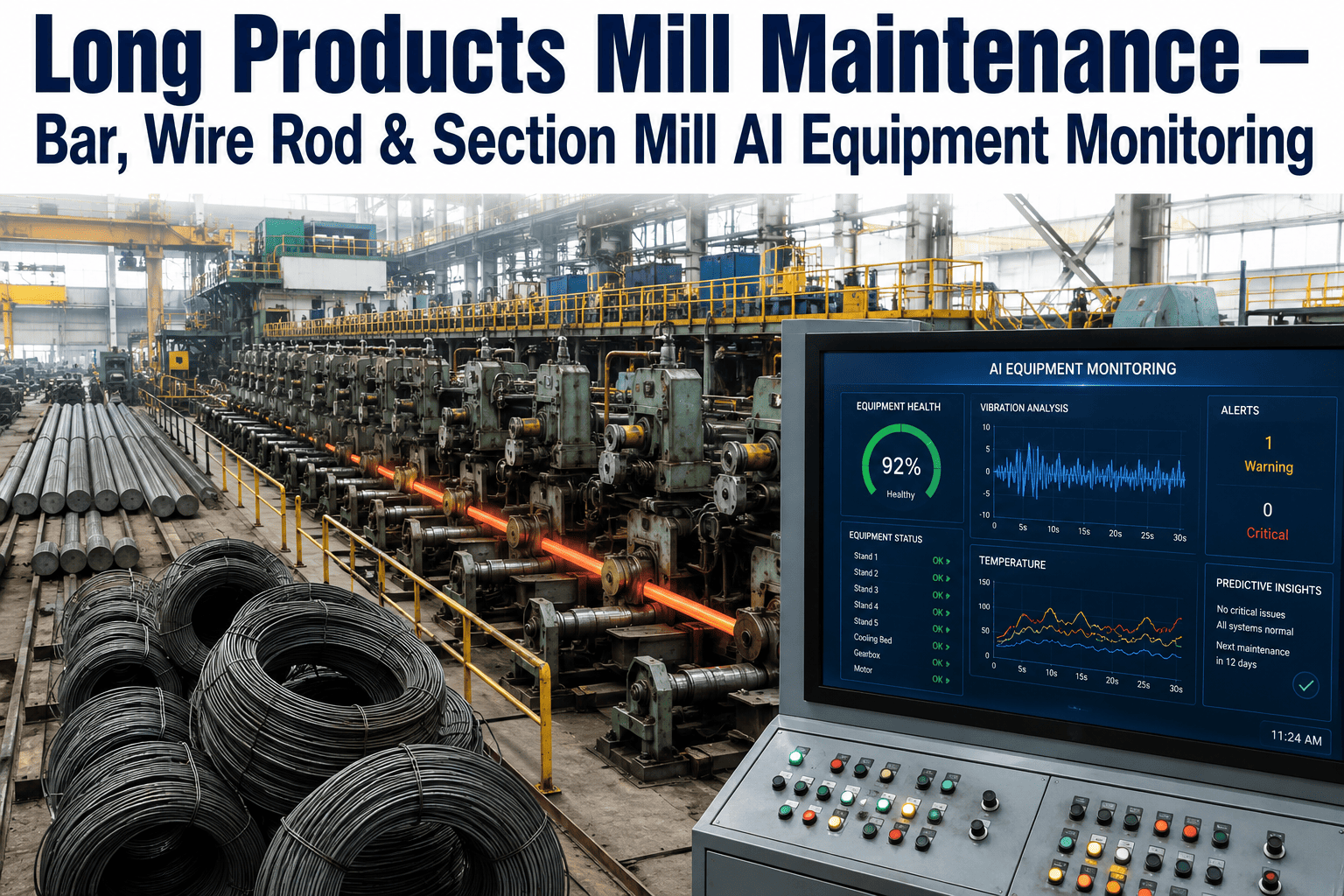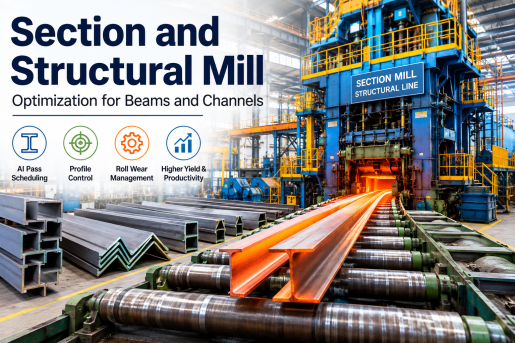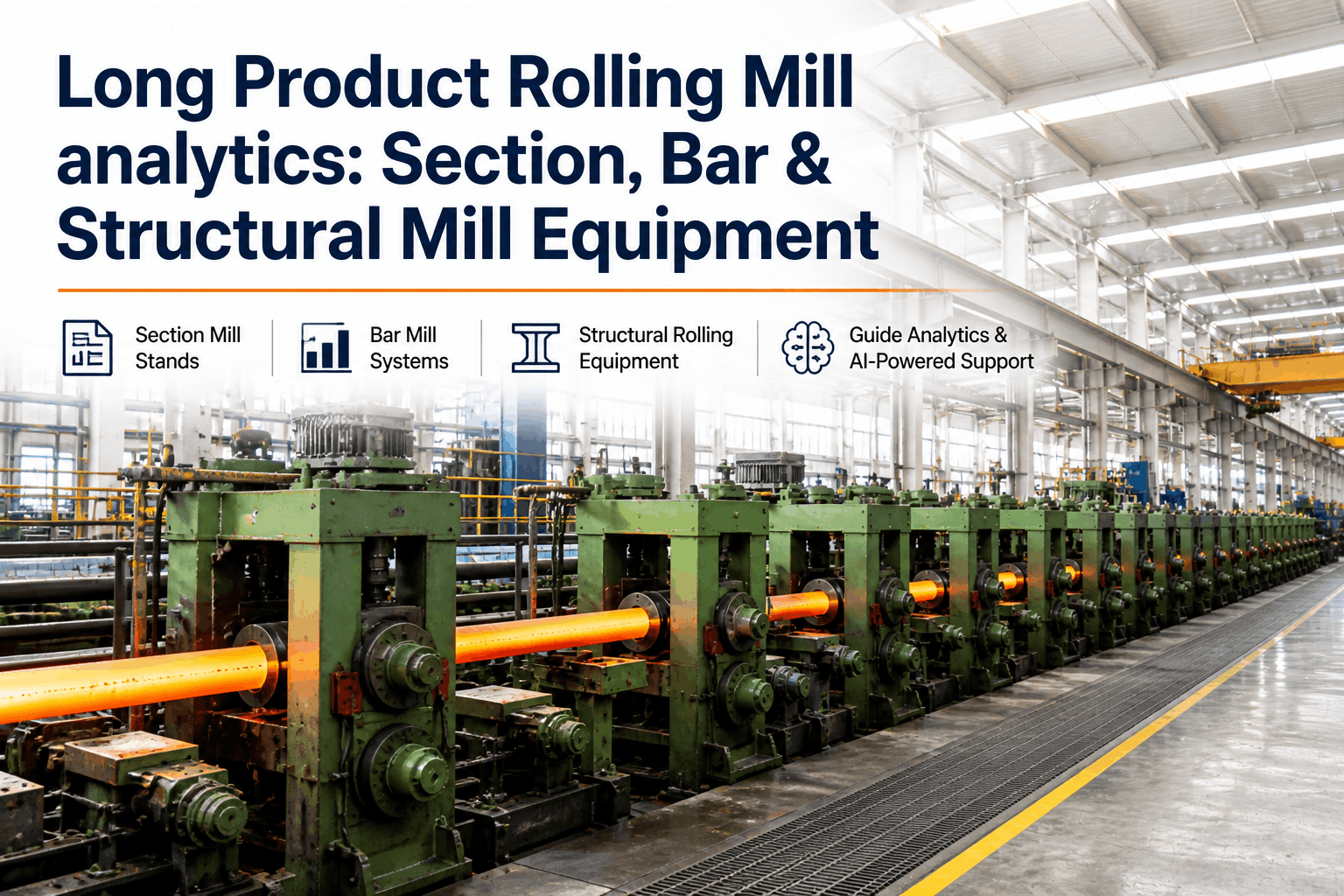
Long product rolling mill analytics and AI-driven integration is transforming how world-class manufacturers monitor, document, and control section precision across their entire production ecosystem. Traditional rolling strategies for bars, sections, and structural shapes often depend on manual gauge checks, paper-based roll logs, and reactive guide adjustments — systems that introduce human error, documentation gaps, and high-cost mill cobbles at every stage. When AI-driven analytics connect directly to mill stands and guides, operations teams gain real-time visibility into roll pass integrity, automated section alerts, and predictive warnings before a gauge deviation becomes a major yield loss event. Facilities that have integrated AI-driven platforms with their long product mills report up to 60% reduction in cobble events and dramatically faster section changeover cycles. Book a demo to see how iFactory links your rolling plan to live equipment analytics from day one.
Why Long Product Rolling Strategies Fail Without Real-Time Precision Analytics
The Rolling framework is only as reliable as the equipment monitoring it depends on. When mill stands, guides, and cooling beds operate outside optimized parameters or degrade silently between manual checks, section deviations (out-of-round, off-gauge) can be generated without triggering the corrective actions a roll-pass design requires. This is precisely where traditional mill implementation creates systemic yield risk.
AI-driven equipment analytics close this gap by establishing continuous performance baselines for every rolling stand and detecting anomalies — roll wear, force spikes, and guide drift — that a manual gauge check will never catch. The result is a mill system that monitors itself, not one that depends on technician availability to confirm that section tolerances are being met accurately.
Fixed-interval section checks miss deviations occurring between observation windows. Customers increasingly reject manual logs as insufficient evidence of continuous gauge control.
Identifying guide misalignment only after a cobble event means hours of production downtime. iFactory identifies guide drift in minutes, enabling intervention before failure occurs.
Roll dressing logs and section quality records stored in separate systems cannot produce an integrated roll life history — the chain of evidence IATF audits require.
Without AI-driven pattern recognition, teams cannot distinguish a stand showing early wear from one operating normally under unusual temperature conditions — making every alert reactive.
How AI-Driven Integration Connects Long Product Mills to Precision Analytics
Linking AI-driven analytics to long product rolling requires mapping each mill stand to the specific roll pass and guide responsible for that section — then feeding that real-time performance data into an analytics platform capable of recognizing precision signatures. Book a demo with iFactory to see how this works.
Mill Stand Asset Mapping
Each mill stand in the rolling string is linked to its corresponding roll pass design — roughing stands for reduction, intermediate for shaping, finishing for precision. This creates a direct, auditable connection between goals and assets.
Real-Time Roll Force Baselining
IoT-connected sensors on mill stand housings continuously stream roll force and vibration data to the AI platform. Baseline models are established for each pass — enabling the system to detect statistical drift and wear.
AI-Driven Section Deviation Scoring
Machine learning models analyze sensor streams against established baselines. When a section shows early precision signatures, the platform generates a deviation score — distinguishing a stand requiring adjustment from one that is stable.
Automated Roll Dressing Work Orders and Compliance Records
When AI flags a roll wear event, the platform auto-generates a dressing work order linked to the roll ID. Every corrective step is documented in real time — producing the unbroken chain of records that quality audits require.
Continuous Roll Life Documentation
Rather than assembling roll logs manually, the platform maintains a continuously updated digital record for every roll — tonnage rolled, dressing history, and section precision — accessible as a single audit trail.
Long Product Mill Assets and the Failures That Put Section Quality at Risk
Every long product rolling mill has a defined set of assets where equipment failure directly translates to section non-conformance. The table below maps common assets to their AI-detectable precision gaps and the market consequence of undetected failure.
| Mill Asset Category | Monitoring Logic | AI-Detectable Precision Gap | Production Metric at Risk | Market Consequence |
|---|---|---|---|---|
| Roughing Mill Stands | Roll force, bite angle | Over-reduction, slippage | Total Yield Per Billet | Increased Material Scrap Rate |
| Intermediate Stands | Inter-stand tension, loops | Tension variation, loop instability | Section Consistency (Oval/Square) | Internal Defect Risk (Laps) |
| Finishing Stands | Roll vibration, temperature | Roll wear, thermal expansion | Final Gauge Tolerance (mm) | Customer Quality Claim (Off-gauge) |
| Rolling Mill Guides | Guide alignment, friction | Guide drift, sticking event | Surface Quality (Scratches) | Surface Defect Non-Conformance |
| Cooling Beds | Transfer timing, air flow | Camber formation, cooling lag | Straightness (mm/m) | Construction Standard Breach |
| Flying Shears | Cut timing, blade force | Cut length deviation, blade wear | Bundle Weight Consistency | Logistics Claim / Material Loss |
Roll Life Compliance Tracking: What AI-Driven Documentation Delivers That Manual Logs Cannot
Construction and automotive standards (ASTM, DIN, IATF) all require documented evidence that section precision is being maintained. Manual logs fail this standard in predictable ways — records are incomplete and roll history cannot be traced. Book a demo to see how iFactory's compliance module meets these standards.
Every gauge measurement is timestamped and asset-attributed, replacing manual logs with a continuous, tamper-evident digital record that satisfies quality audit requirements.
Roll dressing certificates attach directly to the roll ID and are linked to every section record produced — creating the unbroken compliance chain auditors require.
When an AI alert triggers a guide adjustment, the platform documents who responded and when the section returned to a controlled state — automatically.
Periodic straightness verification tasks are scheduled and documented in the system, meeting construction standards with no manual document assembly.
The platform generates complete rolling audit packages on demand — gauge history, roll logs, and guide events — reducing pre-audit preparation time.
Rather than scheduling dressing based on tonnage alone, AI-driven scheduling adjusts based on actual roll wear — ensuring rolls are dressed when data indicates it is needed.
Implementing Long Product AI-Driven Integration: A Phased Roadmap for Rolling Mills
Integrating AI-driven analytics with a long product rolling mill is a structured deployment that starts with high-consequence stands. The roadmap below reflects the approach used by industry leaders. Schedule a consult.
Roll Pass Digital Import and Asset Mapping
Import your existing roll pass designs and map each pass to equipment assets. Establish the precision parameters and corrective action protocols in the system — replacing paper with live digital records.
Sensor and Force Integration Establishment
Connect mill stands to the AI platform via IoT sensors or SCADA streams. Collect 4–6 weeks of baseline data. Baseline quality determines AI detection accuracy — prioritizing finishing stands.
AI Model Configuration and Alert Calibration
Configure AI models tuned to long-product specific failure signatures. Set severity-tiered alert thresholds that distinguish immediate gauge alerts from long-term roll recommendations.
Workflow and Documentation Automation
Activate automated work orders for gauge alerts and guide responses. Configure document templates for IATF and construction. Connect workflows to production lots for automatic tracking.
Audit Readiness Verification and Improvement
Conduct an internal audit simulation using the platform's automated documentation export to validate that all records satisfy certification. Review AI accuracy quarterly.
Long Product AI-Driven KPIs: Measuring the Impact of Precision Analytics
Operations directors need measurable evidence that AI-driven rolling integration is delivering quality outcomes. The KPIs below identify gaps before they become market findings.
Long Product AI-Driven Integration Across Key Rolling Mill Segments
The operational requirements of AI-driven rolling analytics vary by segment. Effective integration must be configured for the specific profile types of each environment. Book a demo to explore how iFactory configures for your mill.
Oval and round pass precision — AI analytics detect roll wear and guide drift 2–4 weeks before they produce a section out-of-tolerance event.
Angle and channel precision — tracking flange thickness and web height against world-class targets for zero-waste production.
H-beam and I-beam precision — AI-driven monitoring of universal stands ensures continuous flange parallelism across high-speed production runs.
Reduction and bite angle analytics — AI detects slippage and housing strain before they produce billet deformities or motor trip events.
Final gauge and surface analytics — AI-driven monitoring of finishing blocks ensuring the most accurate section profiles with automated documentation.
Shearing and bundling precision — tracking cut length and bundle weight against customer requirements with automated corrective action documentation.
Frequently Asked Questions: Long Product Rolling and AI-Driven Analytics
AI adds continuous real-time force and vibration monitoring — none of which manual checks provide. It detects roll pass degradation before it results in a section non-conformance.
Finishing stands and universal stands for H-beams deliver the fastest ROI. These are where precision tolerances are final and quality scrutiny is most intensive.
IATF requires evidence of continuous gauge control. AI platforms generate this automatically — timestamped gauge data and equipment-attributed guide work orders.
Yes. Most platforms support integration via IoT sensor retrofit kits and SCADA streams. You can begin analytics using the data your mill already collects.
Initial deployment typically requires 4–8 weeks. Most facilities report measurable reductions in cobble rates within 3–6 months of full operation.
Yes, iFactory tracks every roll ID, documenting total tonnage rolled and dressing history to ensure maximum roll life and precision across the entire inventory.
By monitoring vibration and friction signatures, iFactory identifies guide misalignment 24–48 hours before it produces visible surface defects on the bar or section.
During changeovers, the system automatically switches to the new section's baseline, providing immediate verification that the new setup is within precision specs from the first bar.
Yes, our digital section logs and straightness reports are designed to meet the transparency requirements of ASTM A6 for structural steel shape reporting.
Structural mills achieve an 12:1 ROI by eliminating just 2–3 cobbles per month. The primary gain is the recovery of lost production hours and the reduction of expensive roll damage.