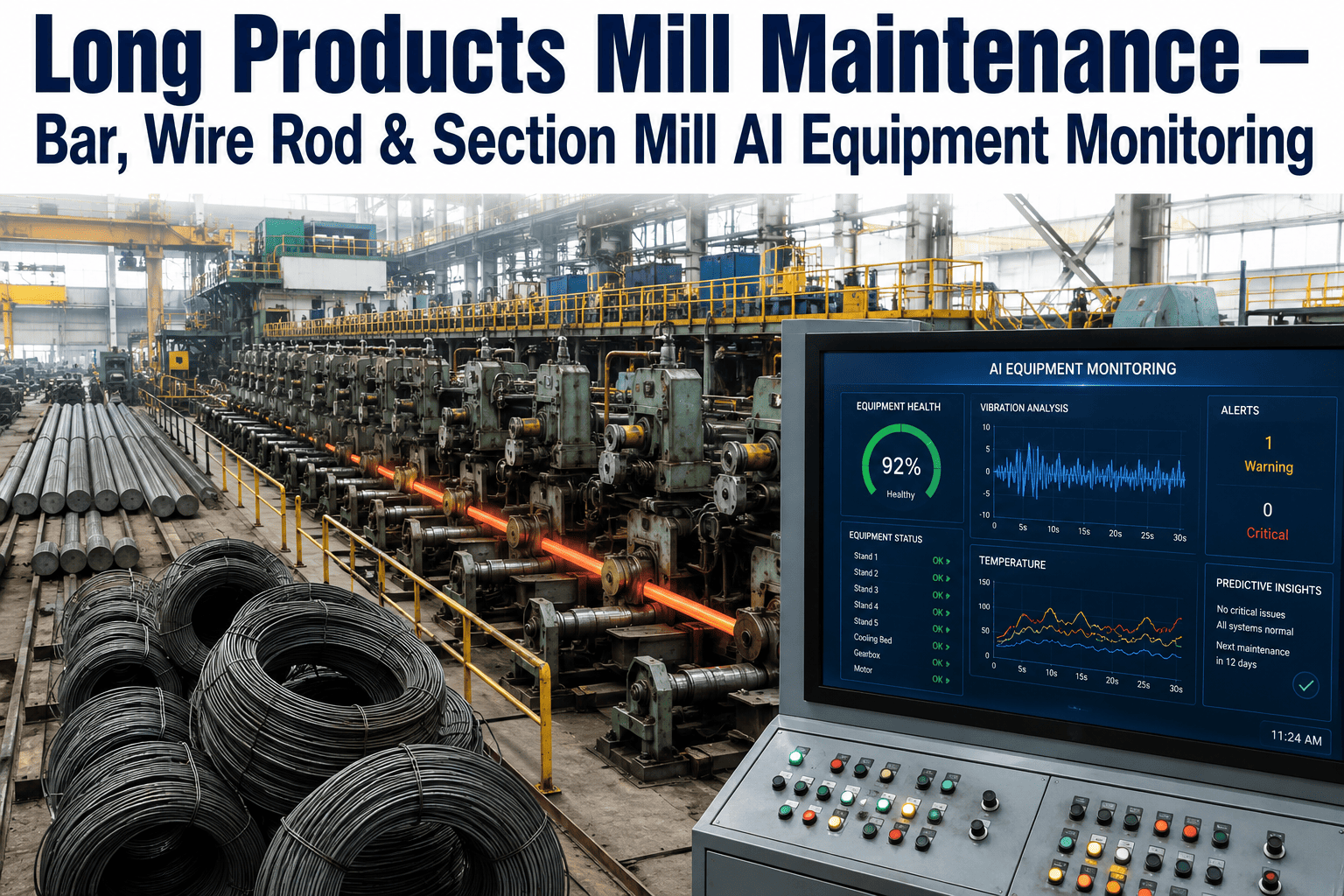
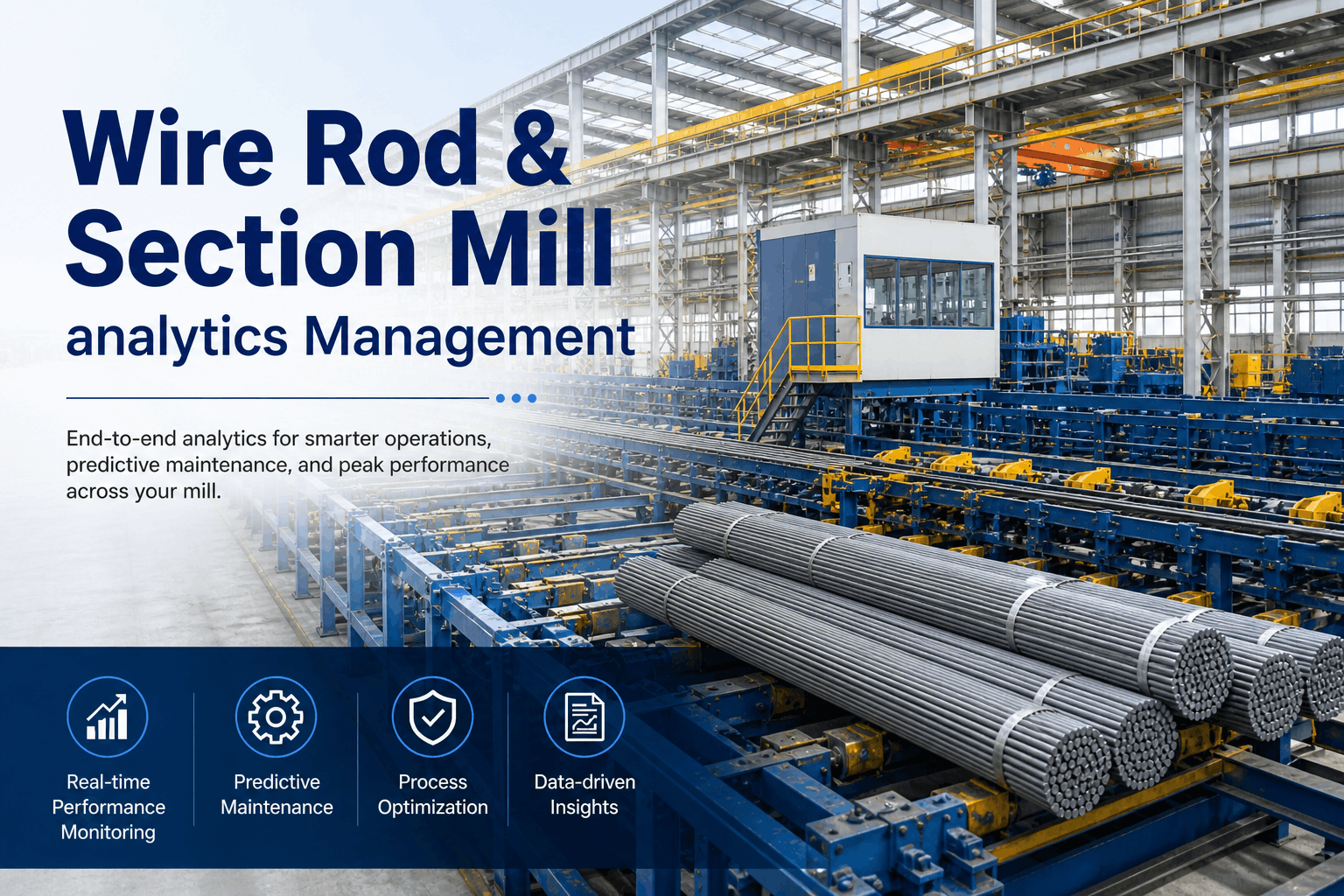
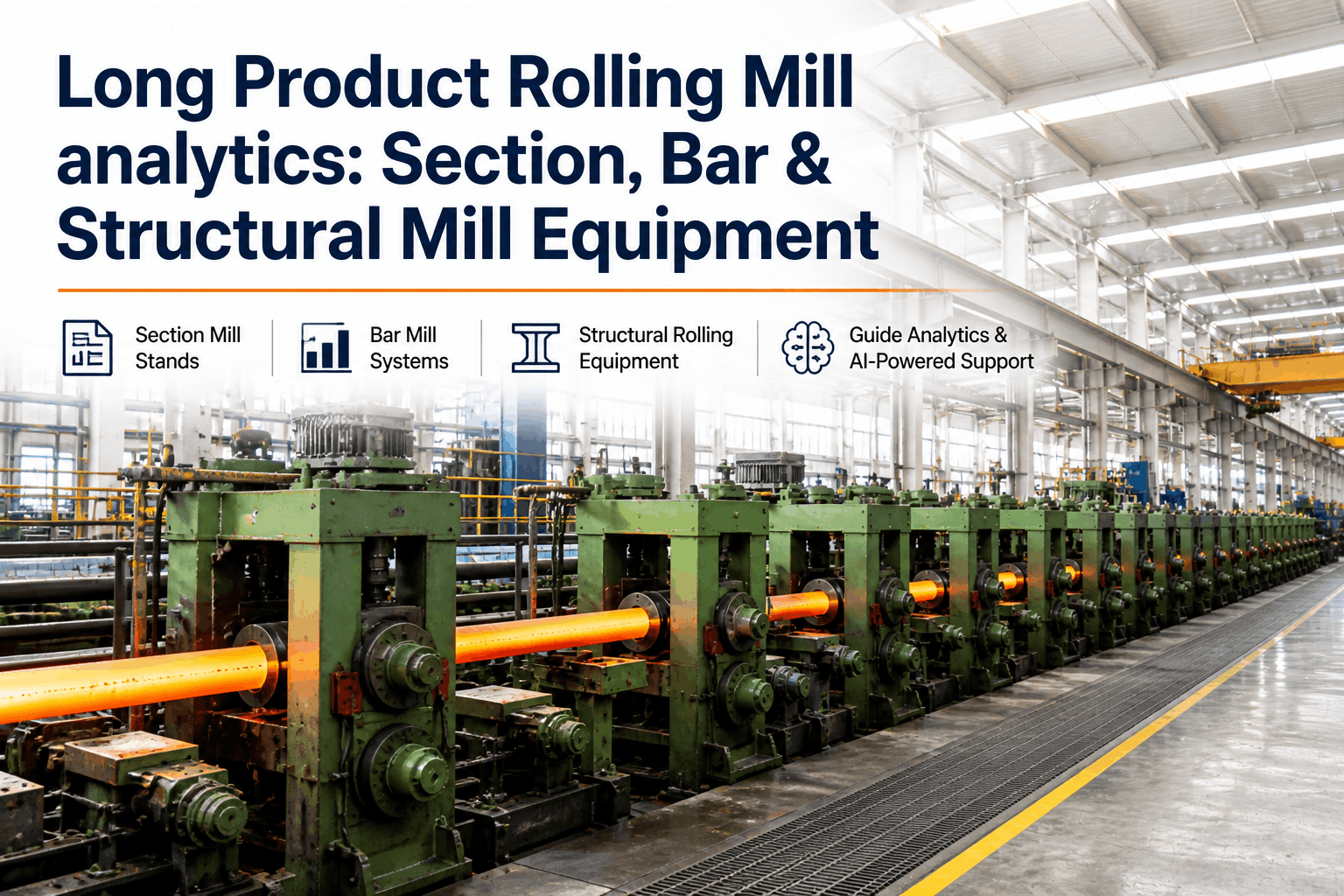
A long products mill rarely stops because of one big failure — it stops because of dozens of small ones that compound across a stand train running at high speed. A worn guide lets a bar wander half a millimeter off center, that misalignment chews into the next set of rolls faster than the maintenance plan expects, and three shifts later a stand seizes mid-campaign with a coil of wire rod still threading through it. Bar mills, wire rod blocks, and section mills each carry their own version of this chain reaction, and because the failure signatures are subtle before they are catastrophic, they are exactly the kind of pattern AI-based condition monitoring is built to catch early. iFactory's long products monitoring is tuned to the stand, guide, and cooling bed failures that are specific to this mill type.
iFactory Long Products Mill AI
Stop Guide Wear and Stand Failures Before They Stop the Mill
Monitor bar mills, wire rod blocks, and section mills with AI that reads stand vibration, guide condition, and cooling bed behavior, catching the small deviations that precede an unplanned stop.
3 Mill Types
Bar, wire rod, section
Stand-Level
Per-stand condition tracking
High Speed
Built for wire rod block speeds
Early
Guide wear caught before damage
How One Worn Guide Becomes a Mill Stop
Long products mills are unforgiving of small deviations because every stand feeds the next one at speed. A guide that has worn past tolerance lets the bar enter the next stand slightly off-center, which increases roll load asymmetrically, accelerates wear on that stand, and raises the odds of a cobble — the tangled mass of misfed bar that can take hours to clear. The chain below shows how a single early fault compounds if it isn't caught at the source.
The Failure Chain a Guide Wear Sensor Interrupts
1
Guide Wears
Tolerance opens up gradually over thousands of passes
→
2
Bar Misaligns
Entry angle into the next stand shifts off-center
→
3
Roll Load Skews
Asymmetric load accelerates wear on that stand
→
4
Cobble Risk
Misfeed risk climbs sharply, mill stop likely
AI flags guide wear at step 1 — before the chain ever reaches step 4.
What AI Watches on Each Mill Type
Bar mills, wire rod blocks, and section mills share a family resemblance but fail differently enough that a single monitoring template does not serve all three well. The models are tuned to the speed, geometry, and product mix specific to each.
Bar Mill
Stand vibration and bearing condition across the finishing train
Guide box wear tracked against pass schedule and product size
Roll wear progression by groove, tied to tonnage rolled
Wire Rod Block
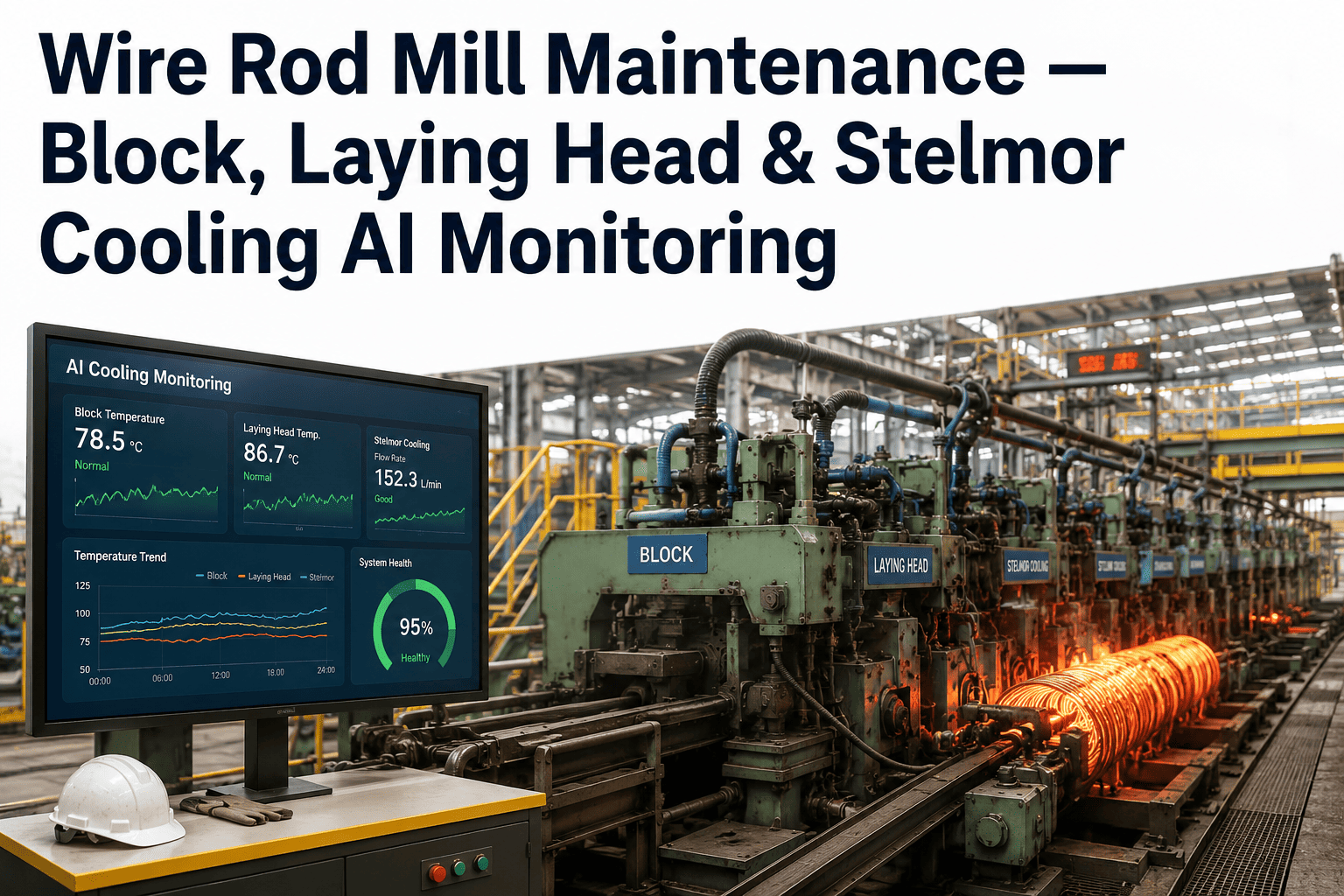
High-speed block bearing signatures at speeds up to 100+ m/s
Water box cooling consistency along the rod path
Laying head and coil former condition tracking
Section Mill
Universal and edging stand roll gap consistency
Torque signature analysis for complex profile shapes
Straightener and cooling bed alignment monitoring
Want to see this running against your own stand vibration data? Book a 30-minute walkthrough and bring a recent trend export.
Cooling Bed: The Overlooked Failure Point
The cooling bed gets far less monitoring attention than the rolling stands, yet misalignment there causes bent bars, tangles, and secondary damage that shows up as quality rejects rather than an obvious mechanical failure. Rack alignment, walking beam timing, and bar-to-bar spacing drift are all trackable signals that most mills currently rely on operator eyes to catch — long after the drift has already cost yield.
Rack Alignment Drift
Detects gradual rack misalignment before it causes bar tangling or bent-bar rejects.
Walking Beam Timing
Tracks beam cycle timing against bar arrival rate to catch developing synchronization faults.
Bar Spacing Consistency
Monitors spacing uniformity across the bed width, an early signal of feed or guide issues upstream.
Typical Fault Signatures by Equipment
The table below shows a sample of the fault signatures AI models are trained to recognize across a long products line, and the lead time they typically provide before the fault would otherwise surface as a stoppage or quality reject.
| Equipment | Fault Signature | Typical Lead Time |
|---|
| Finishing stand bearing | Vibration harmonics shift | 2-3 weeks |
| Guide box | Entry angle deviation trend | 1-2 weeks |
| Wire rod block bearing | High-frequency signature drift | days to 1 week |
| Cooling bed rack | Timing and spacing drift | 1-2 weeks |
What Mills Report After Adopting AI Monitoring
The outcomes below reflect what plants running bar, wire rod, and section mills typically see once stand and guide condition become visible in real time instead of discovered at the next planned inspection.
Fewer
Cobbles
guide and alignment issues caught before misfeed
Longer
Roll campaigns
wear tracked by groove instead of a fixed change interval
Higher
Cooling bed yield
fewer bent-bar and tangle rejects from rack drift
Weeks
Of advance warning
on bearing and guide faults across the stand train
Curious what your mill's fault signatures would show? Talk to our long products team about connecting your stand data.
Frequently Asked Questions
Can this monitor a wire rod block at the speeds it actually runs?
Yes — wire rod blocks are one of the specific mill types the models are tuned for, including the high sampling rates needed to catch bearing signatures at speeds that can exceed 100 meters per second. The system is built to process that high-frequency vibration data continuously rather than relying on periodic manual checks, which is the only way to catch a developing fault on equipment running that fast before it becomes a failure.
We run multiple product sizes through the same stands — does that confuse the models?
The models are trained to account for pass schedule and product size as context rather than treating every signal as if the mill only ever ran one product. That means a guide wear trend is evaluated against what is normal for the size and schedule currently running, so switching between products does not generate false alarms the way a simple fixed-threshold system would.
How is cooling bed monitoring different from what our operators already watch for visually?
Operators can catch a rack that is visibly out of alignment, but the drift that causes most bent-bar and tangle rejects tends to develop gradually and is hard to see reliably from the pulpit, especially across a wide bed. AI tracks rack alignment, walking beam timing, and bar spacing continuously and quantitatively, catching the gradual drift days or weeks before it becomes visible enough for an operator to flag it.
What sensors or data do we need to have in place already?
Most mills already have some combination of vibration sensors, drive torque signals, and process historian data from the mill control system, and that existing instrumentation is typically the starting point rather than requiring a full new sensor buildout. Additional sensors are recommended selectively where a specific gap is identified, such as cooling bed timing, rather than as a blanket requirement across the whole line.
How long before we see useful fault predictions after connecting our data?
Because long products mills generate high-frequency, high-volume data, models often reach useful accuracy faster than in lower-throughput processes, with initial fault signatures typically visible within the first weeks of historical data review. Full predictive lead-time accuracy improves over the following weeks as the system observes a broader range of operating conditions and confirms its early flags against actual maintenance findings.
Catch the Guide Wear Before the Cobble.
See Stand-Level Fault Detection on Your Own Mill Data
Bring vibration or process data from a bar mill, wire rod block, or section mill. We'll show how AI reads guide wear, roll condition, and cooling bed drift weeks before they become a mill stop.