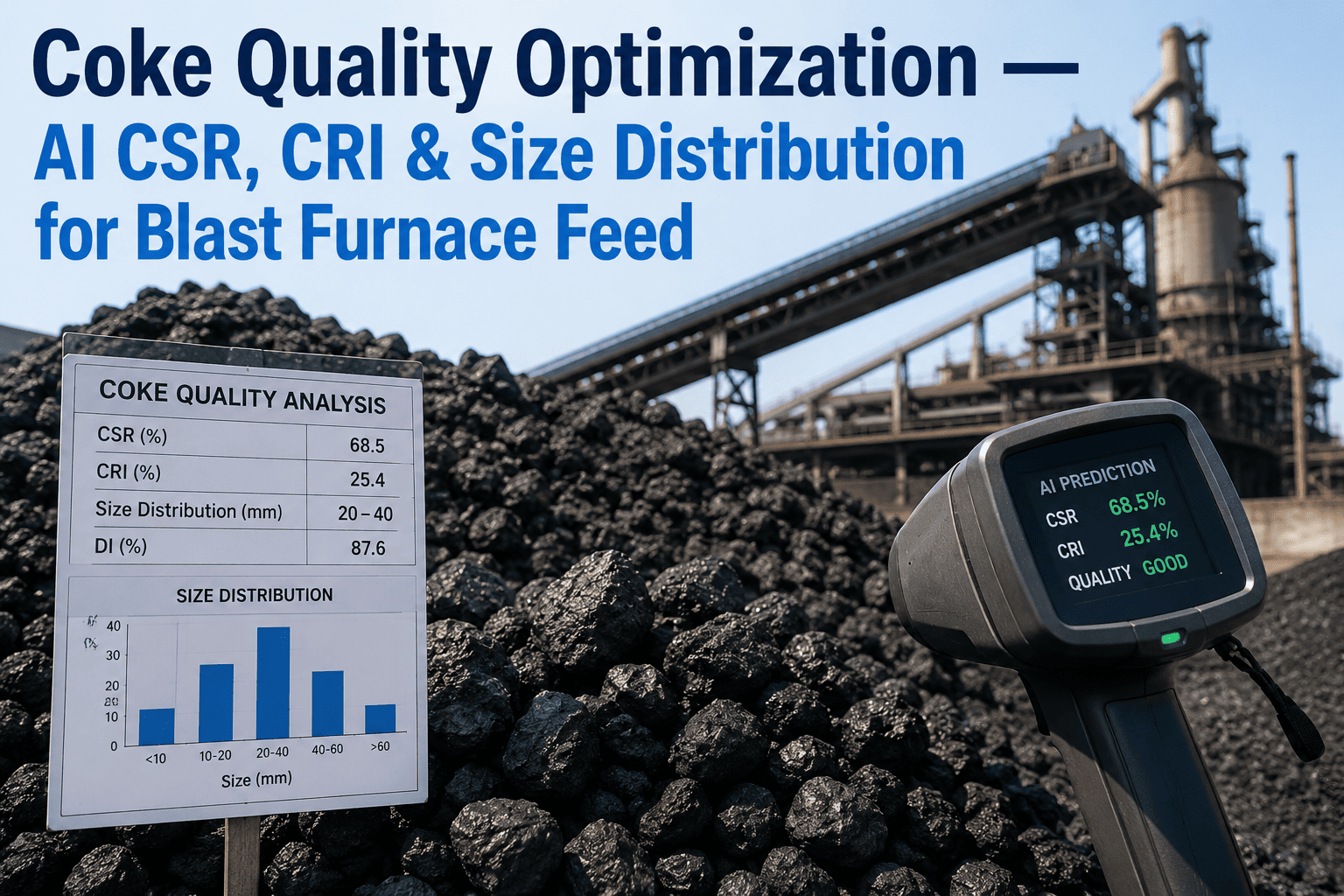
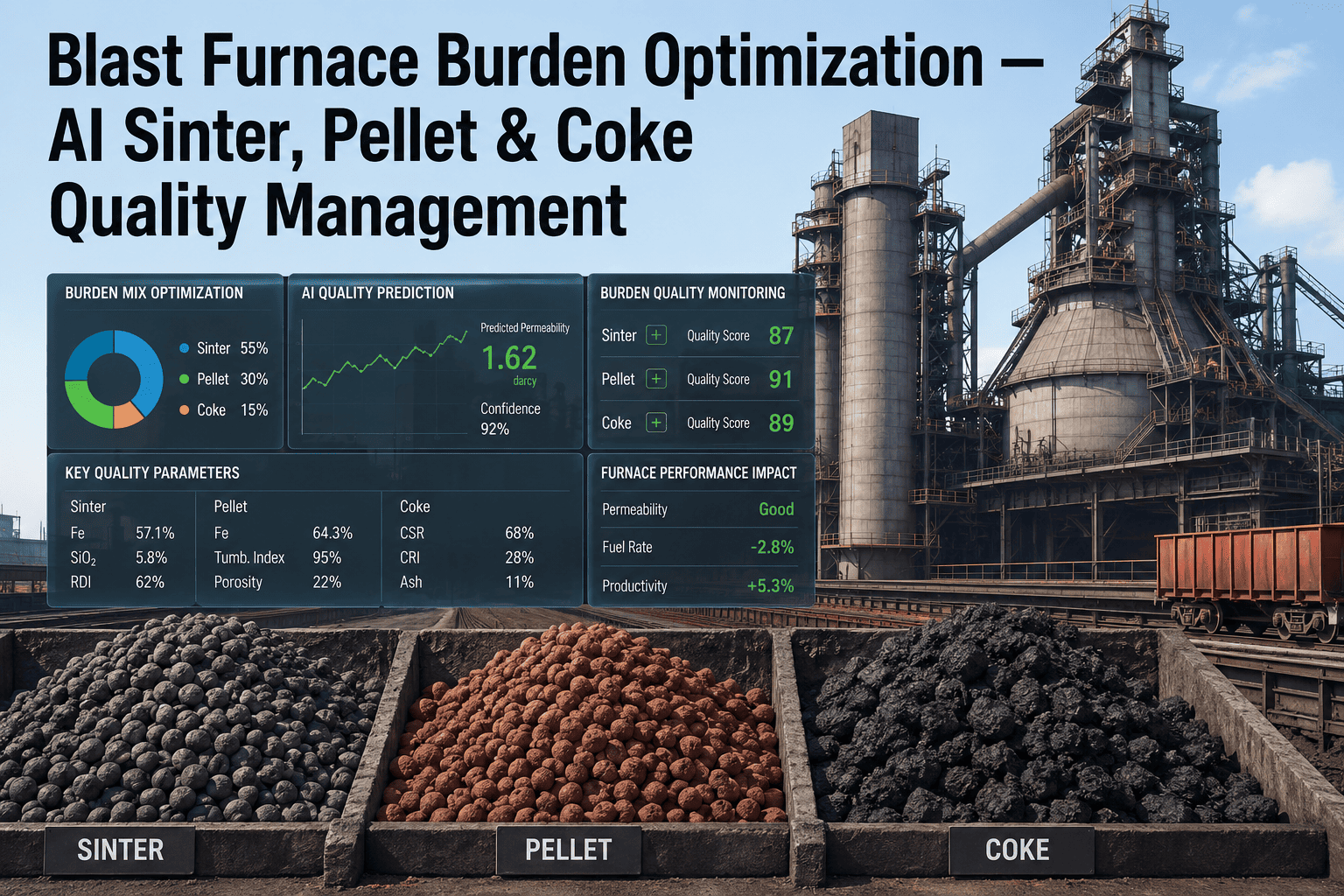
The stockhouse is the gateway to the blast furnace — every ton of iron ore, pellet, sinter, coke, and flux that enters the furnace passes through stockhouse bins and weigh hoppers before being charged into the furnace top. Raw material quality directly determines furnace permeability, fuel rate, hot metal temperature, and silicon variability: a 1% decrease in iron ore Fe grade increases coke consumption by approximately 2 to 3 kg per ton of hot metal, a 5 mm shift in coke size distribution alters burden permeability by 8% to 12%, and a 0.10 change in sinter basicity (CaO/SiO2) shifts slag volume by 15 to 25 kg per ton. Traditional stockhouse management relies on supplier certificates, manual grab sampling, and periodic lab analysis that delivers results 4 to 8 hours after the material has already been charged into the furnace. iFactory's Raw Material Traceability AI connects weigh hoppers, conveyor belt scales, bin level sensors, NIR moisture analyzers, and vision cameras to an on-premise AI platform that tracks every batch from receipt to furnace top, predicts quality parameters in real time, and alerts operators to material deviations before they affect furnace performance. Book a Demo to see the platform configured for your stockhouse instrumentation and material flow configuration.
Can You Trace Every Batch of Ore, Coke, and Flux From Stockyard to Furnace Top?
iFactory's Raw Material Traceability AI connects stockhouse weigh hoppers, conveyor scales, NIR moisture sensors, and vision cameras to an on-premise NVIDIA edge server that tracks material quality in real time — with zero cloud dependency, read-only PLC connectivity, and no modifications to your existing stockhouse control system.
Why Raw Material Quality Tracking Directly Determines Blast Furnace Profitability
Every furnace operator knows that raw material quality variation is the largest source of unplanned operating cost in the ironmaking process. Material quality deviations force coke rate increases, burden distribution adjustments, and hot metal silicon variability that downstream steelmaking must absorb through additional desulfurization, flux additions, or temperature corrections. The financial impact of poor material tracking extends from the stockhouse through the cast house: a U.S. integrated mill producing 10,000 tons of hot metal per day loses $400,000 to $1,200,000 annually from coke rate increases caused by undetected raw material quality drift alone — before accounting for the cost of silicon variability, slag volume changes, and burden distribution corrections that cascade from material quality errors. The four material groups that drive furnace performance each present distinct quality parameters that must be tracked from the stockyard through the bin to the furnace top.
Four Material Quality Groups That Drive Blast Furnace Performance
Each material group entering the blast furnace presents a distinct set of quality parameters that must be tracked continuously from stockyard receipt through bin charging to furnace top discharge. The table below maps the critical quality parameters, conventional monitoring methods, and AI-enabled tracking capabilities for each material group.
Iron Ore Quality
Fe grade, alumina-to-silica ratio, loss on ignition, and moisture content determine the slag volume, coke rate, and furnace permeability. A 0.5% decrease in Fe grade increases slag volume by 20 to 30 kg/THM and raises coke consumption by 1 to 2 kg/THM. AI vision coupled with NIR spectroscopy enables continuous Fe grade prediction on the conveyor belt with lab-equivalent accuracy at 30-second update intervals.
Pellet Quality
Cold compression strength, reducibility index, swelling index, and size distribution determine how pellets degrade during handling and reduction in the furnace shaft. Pellets below 150 kg CCS generate excessive fines that reduce burden permeability. AI vision systems on the conveyor line detect cracked, deformed, and undersized pellets in real time, triggering reject gates before low-quality pellets reach the furnace bin.
Coke Quality
CSR (coke strength after reaction), CRI (coke reactivity index), ash content, and size distribution are the most critical coke parameters for blast furnace permeability and carbon consumption. Every one-point decline in CSR below 62% increases coke consumption by 3 to 5 kg/THM. AI models predict CSR and CRI from coal blend data and coking parameters before the coke reaches the stockhouse, enabling proactive blend adjustments.
Flux & Sinter Quality
Sinter basicity (CaO/SiO2), flux CaO and MgO content, and sinter size distribution directly control slag chemistry and desulfurization capacity. A 0.05 shift in sinter basicity changes slag volume by 10 to 15 kg/THM and alters the limestone and dolomite charge rate required to maintain target slag chemistry. AI-based XRF prediction models on the sinter strand provide real-time basicity forecasting before sinter reaches the stockhouse bin.
Key Gaps in Conventional Stockhouse Material Management — and How AI Closes Them
The gap between what conventional stockhouse material management can provide and what the blast furnace needs for stable operation is measured in hours of delay, tons of uncaptured material genealogy data, and hundreds of thousands of dollars in avoidable coke consumption. The comparison table below maps six critical material management functions against conventional and AI-enabled approaches, showing the performance gap that an integrated traceability platform closes. Book a Demo to discuss which material tracking capabilities deliver the highest ROI for your stockhouse configuration and furnace operating strategy.
| Material Management Function | Conventional Approach | AI-Enabled Approach | Performance Improvement |
|---|---|---|---|
| Moisture Measurement | Manual grab sampling every 4–8 hours; oven drying takes 2–4 hours per sample | Continuous NIR spectroscopy on conveyor belt with 30-second update intervals | Eliminates sampling delay; detects moisture excursions within 1 minute |
| Size Distribution Analysis | Periodic sieve analysis every shift; sample represents 0.001% of material flow | AI vision cameras on conveyors measure particle size distribution in real time across 100% of flow | Continuous vs discrete measurement; detects size shifts within 2 minutes |
| Chemistry Tracking | Lab analysis of grab samples; results available 4–8 hours after sampling | AI prediction models trained on XRF, NIR, and LIBS sensor fusion data predict chemistry in real time | Reduces chemistry data lag from hours to seconds; enables proactive charge corrections |
| Layer Charging Traceability | Manual logs of bin discharge sequence; relies on operator notes and shift reports | Automated RFID, weigh hopper, and conveyor tracking creates digital material genealogy per furnace charge | Complete traceability from stockyard bin to furnace top with sub-charge resolution |
| Inventory Management | Spreadsheet-based stock tracking with manual bin level measurements | Digital twin of stockhouse bins with radar level sensors, conveyor flow integration, and consumption prediction | Real-time inventory accuracy within 1% vs 5–8% with manual methods |
| Contamination Detection | Visual inspection by stockhouse operators; relies on human vigilance during high-workload periods | AI anomaly detection on conveyor vision feeds identifies foreign material, degraded product, and segregation in real time | Detects contamination events in seconds vs hours with manual inspection cycles |
Six AI Capabilities That Transform Stockhouse Material Quality Management
iFactory's Raw Material Traceability AI platform delivers six integrated capabilities that cover the full material management cycle — from inbound quality verification at the stockyard through real-time quality prediction on the conveyor belt to traceability reporting at the furnace top. Each capability operates on sensor data from existing stockhouse instrumentation, augmented with purpose-deployed AI vision cameras and NIR analyzers, all processed on an on-premise NVIDIA edge server.
Machine vision cameras mounted above stockhouse conveyor belts capture continuous images of material flow. AI models trained on over 500,000 labeled images of iron ore, pellet, sinter, and coke identify particle size distribution, shape classification, color variation indicating chemistry shifts, and foreign material contamination — all at belt speed with 30-millisecond inference time per image. The vision system detects a 2 mm shift in mean particle diameter within 30 seconds of occurrence and alerts the stockhouse operator to potential segregation or quality deviation before the material reaches the furnace bin.
NIR moisture sensors installed at the conveyor discharge point measure surface moisture for every ton of material flowing to the furnace bins. AI models correlate the NIR moisture measurement with weather station data, stockyard drainage status, and material source to predict moisture content at the bin discharge point — accounting for drainage that occurs during stockpile residence. The predictive moisture model reduces the effective moisture measurement uncertainty from +/- 1.5% (conventional grab sampling) to +/- 0.3%, enabling the stockhouse to charge dry-weight-corrected burden calculations continuously.
Every batch of material is tagged at the stockyard receipt point with source, grade, date, and quality certificate data. As the material moves through reclaim, conveyor transfer, bin charging, and furnace top discharge, RFID readers, weigh hopper transactions, and conveyor flow meters record each movement event in a digital ledger that creates a complete material genealogy record per furnace charge. When a furnace operating issue is traced to a material quality parameter, the genealogy system identifies the specific batch, supplier, and stockyard location that supplied the material — enabling targeted corrective action rather than blanket material sourcing changes.
Unified operator dashboards display material quality parameters for every bin and every furnace charge in real time, with trend charts showing quality trajectory over the last 24 hours, 7 days, and 30 days. The dashboard integrates data from AI vision, NIR moisture sensors, lab analysis results (when available), and supplier certificates into a single view per bin — eliminating the operator workflow of switching between lab information systems, stockhouse SCADA screens, and spreadsheet-based quality logs to assess current material status.
AI models trained on furnace performance data — permeability index, fuel rate, hot metal silicon, slag chemistry — learn how each material quality parameter affects furnace operation. The blend optimization module recommends adjustments to the ore-to-coke ratio, sinter-to-pellet ratio, and flux addition rates based on the real-time quality profile of material in each bin. When the AI detects that the current bin material quality has shifted from the planned blend target, it calculates the optimal compensating adjustment and presents the recommendation to the stockhouse operator before the furnace experiences the resulting quality impact.
The AI vision system continuously monitors conveyor material flow for anomalies — including foreign material (wood, plastic, rubber from stockyard handling), material segregation (fines concentration at belt edges, coarse material in center), and quality deviation indicators (color changes in pellets, dust loading on coke). The anomaly detection model is trained on normal material flow patterns and triggers an alert when the visual pattern deviates beyond statistically expected variation, enabling the stockhouse operator to divert contaminated material to a reject bin before it reaches the furnace.
What a Raw Materials Manager Learned Deploying AI Material Tracking on a 10,000-THM Blast Furnace
Based on iFactory's deployments across blast furnace stockhouse operations at U.S. integrated steel mills producing 6,000 to 12,000 THM/day, the following operational outcomes consistently emerge when AI raw material traceability is implemented with proper sensor infrastructure and phased deployment discipline.
"I have spent eighteen years managing raw materials and stockhouse operations across three integrated steel mills in the United States, ranging from 6,000 to 12,000 tons of hot metal per day. For the first fifteen of those years, we managed material quality with the same tools that had been in place since the 1980s: supplier certificates that arrived with the rail car or barge, grab samples collected by the stockhouse operator once per shift, and lab results that came back four to eight hours after the material had already been charged to the furnace. The furnace operator was always flying blind — receiving material quality reports that described what the furnace had already consumed, not what was currently being charged. The AI traceability system changed that completely. The first time we saw the dashboard show a 0.4% moisture spike on the conveyor belt in real time and watched the operator adjust the dry-weight coke charge before the wet material reached the furnace top, I understood that this was not an incremental improvement — it was a fundamental change in how material management connects to furnace operations. We reduced material-related furnace disruptions by approximately 60% in the first six months and cut the coke rate variability by 40% through continuous charge corrections that were impossible under the 8-hour lab cycle."
Raw Material Traceability AI Is Deployable Today — With Documented Furnace Stability and Coke Rate Improvements
The case for AI-driven raw material traceability in the stockhouse is built on documented operating results from U.S. integrated steel producers who have deployed machine learning models and AI vision systems on their stockhouse conveyor lines, weigh hoppers, and bin systems. Material quality visibility improved from 4-to-8-hour lab cycles to continuous real-time tracking, material-related furnace disruptions reduced by 60%, and coke rate variability decreased by 40% through continuous charge corrections that were impossible under conventional material management workflows.
The technology infrastructure required for deployment is the stockhouse's existing instrumentation — conveyor belt scales, weigh hoppers, bin level sensors — augmented with purpose-deployed AI vision cameras, NIR moisture analyzers, and RFID tag readers that form the sensor layer for the AI platform. iFactory's Raw Material Traceability AI connects to these systems through read-only data links, trains site-specific models on the mill's own material flow patterns, and delivers real-time quality predictions and advisory recommendations on a dedicated operator console that does not write back to any control system component. No cloud data transmission required. No modifications to the stockhouse PLC or furnace charging control logic. Book a Demo to see the iFactory Raw Material Traceability AI platform configured for your stockhouse instrumentation and material flow configuration, or contact support to schedule a stockhouse-specific deployment assessment.
Track Every Ton of Ore, Coke, and Flux From Stockyard to Furnace Top with AI
iFactory's Raw Material Traceability AI delivers a unified platform — AI vision for material characterization, predictive moisture analytics, end-to-end material genealogy, real-time quality dashboards, automated blend optimization, and anomaly detection — deployed on a pre-configured NVIDIA edge server with read-only PLC connectivity, no control system modifications required, and an 8 to 14 week deployment timeline.
Stockhouse and Raw Material AI Tracking — Frequently Asked Questions
What sensors and infrastructure are required to deploy AI raw material tracking in the stockhouse?
The platform connects to existing stockhouse instrumentation through read-only data links to conveyor belt scales, weigh hoppers, bin level sensors, and the furnace charging PLC. Standard connectivity protocols include OPC-UA, Modbus TCP, and API-based data ingestion. Augmenting sensor infrastructure typically includes 4 to 8 AI vision cameras mounted above conveyor discharge points, 1 to 3 NIR moisture analyzers at problematic moisture measurement locations, and RFID tag readers at stockyard receipt and bin charge points. The NVIDIA edge server is deployed on the plant network with all data processing contained on-premise and no cloud data transmission required.
How does AI material tracking handle multiple material sources and variable supply quality?
The AI platform maintains a supplier quality database that records historical quality data from each source — iron ore mine, pellet plant, coke battery, or sinter plant — and builds supplier-specific baseline models for expected quality parameters including Fe grade, moisture, size distribution, and chemistry. When a new batch arrives at the stockyard, the system compares incoming sensor data against the supplier's historical baseline and the quality certificate data, flagging any statistically significant deviation. The platform adapts to new suppliers within 10 to 15 batches by learning the supplier's quality distribution profile and incorporating it into the prediction models.
Does the AI platform require modifications to the stockhouse PLC or furnace charging control system?
No modifications to the stockhouse PLC, furnace charging control system, or weigh hopper control logic are required. The AI platform connects through read-only data links to existing instrumentation and control systems. Material quality predictions, charge adjustment recommendations, and anomaly alerts are displayed on a dedicated operator console that does not write data or commands back to any control system component. The platform operates as an advisory decision-support tool that the stockhouse operator uses to adjust charge parameters through the existing furnace charging control interface.
What is the typical ROI timeline for AI raw material traceability deployment in a U.S. integrated steel mill?
Documented ROI from comparable AI material traceability deployments shows full platform payback within 6 to 12 months at a typical 10,000 THM/day blast furnace with a diverse raw material supply chain. Primary ROI drivers include coke rate reduction of 3 to 6 kg/THM from continuous moisture-corrected charging ($300,000 to $800,000 annual savings), elimination of quality-compromised heats from contaminated or degraded material detection, and reduced silicon variability that saves $200,000 to $500,000 annually in downstream desulfurization and alloy addition costs. The total platform investment is $150,000 to $280,000 based on stockhouse size and sensor infrastructure requirements.
How does AI vision perform under dusty stockhouse conditions with varying lighting and weather exposure?
The AI vision cameras are deployed in enclosed housings with compressed air purge systems that prevent dust accumulation on the lens surface, and integrated LED illumination arrays provide consistent lighting independent of ambient conditions, conveyor bay lighting status, and day-night cycles. The vision models are trained on a dataset that includes images captured under varying dust levels, lighting conditions, and material moisture states — ensuring the model maintains greater than 95% detection accuracy across all operating conditions. The system self-monitors image quality metrics and alerts maintenance when lens cleaning is required, with typical cleaning intervals of 7 to 14 days under normal stockhouse dust conditions.
Deploy Raw Material Traceability AI with iFactory
Raw materials managers at U.S. integrated steel mills trust iFactory's on-premise AI platform to connect stockhouse sensors with real-time quality analytics, material genealogy tracking, and automated charge adjustment recommendations — eliminating the 4-to-8-hour lab cycle and reducing material-related furnace disruptions by 60%.