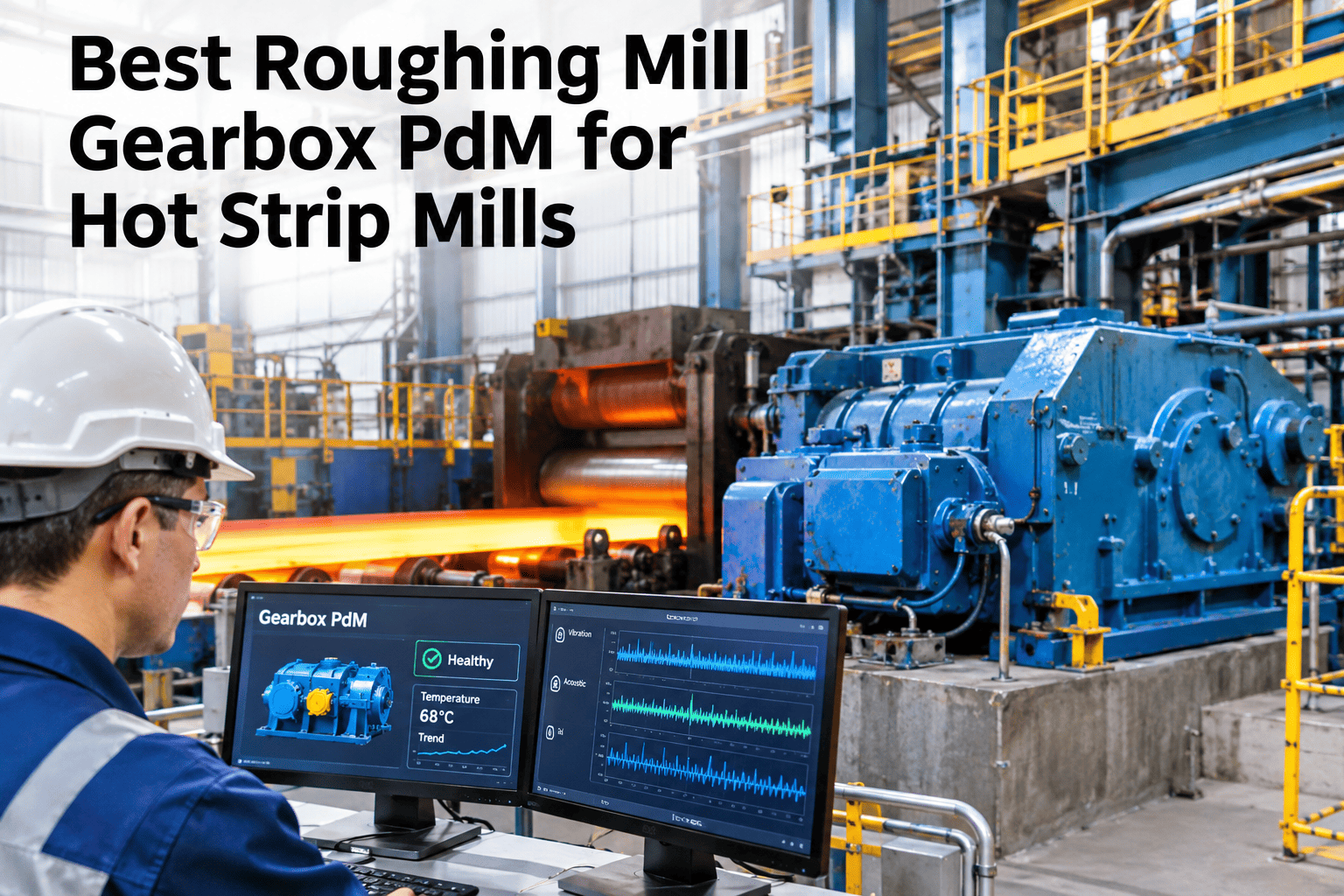
Roughing mill gearbox predictive maintenance (PdM) for a hot strip mill watches the most shock-loaded drive train in the plant. When a slab bites, peak torque has been reported to exceed four times rated motor torque, and slabs reach the stand above 1,100°C. Online vibration, oil, temperature and torque monitoring show damage building in gear teeth, bearings and couplings before one failure stops the whole mill. The aim is to see overloads and early wear, not to wait for a hot bearing alarm. Reliability teams can see a roughing drive train model built from their own torque and vibration data in a short session.
Count Every Slab Bite Against the Gearbox, Not Just the Hot Bearing Alarm
iFactory AI, an on-premise industrial AI platform, joins torque peaks, vibration, oil and temperature so roughing gearbox damage is trended before a stand stops.
What Is Roughing Mill Gearbox PdM?
It is condition-based care for the gearbox, bearings, spindles and couplings of a roughing stand. It adds measured shock load to the usual vibration and oil data. Three published facts show why.
Why Is the Roughing Stand So Hard on a Gearbox?
Four stresses act together. Teams can ask for a stress map of their own roughing drive.
Bite impact
The pinion bounces within the tooth space, causing high dynamic tooth loads (Machine Design, 2000).
Torque reversal
Slow control caused severe torque swings and fatigue cycling in a reversing rougher (AIST, 2015).
Heat
Slabs arrive above 1,100°C, so thermal cycling stacks on mechanical load (Oxmaint, 2026).
Heavier slabs
One mill raised slab thickness from 90 to 103 mm and saw unexplained bearing and coupling failures (Emerson).
What Should You Monitor on a Roughing Drive Train?
Match each component to its failure mode and signal. No single measurement shows the whole picture.
| Component | Main Failure Mode | Best Signals |
|---|---|---|
| Gear teeth | Pitting, wear, root cracking from impact | Vibration with order tracking, oil debris |
| Gearbox bearings | Fatigue and lubrication loss | Envelope vibration, temperature trend |
| Spindles and couplings | Alignment drift and overload damage | Torque capture, spindle vibration |
| Motor and drive | Winding stress from repeated overload | Current signature, winding temperature |
| Lubrication | Contamination and degradation | Oil analysis, flow and pressure |
See What the Last Hundred Bites Did to Your Gearbox
Share torque, vibration and oil records for one roughing stand. iFactory AI's team will show shock load counted against gearbox condition over time.
How Do You Measure Shock Load on the Drive?
Compare the peak torque of each bite with rated torque. The ratio is a simple shock factor that can be counted, trended and set against design limits.
How Do You Separate Thermal Stress From Wear?
Temperature rises with load, so a raw threshold alarm confuses the two. Compare readings at the same load and speed. Teams can see load-matched temperature trends on their own stand.
How Should the Mill Respond to an Overload?
Decide the response in advance, so an operator does not improvise at the moment of a cobble or stall.
What Should Every Overload Record Hold?
An overload with no context cannot be learned from. Teams can ask for an overload record template to adapt to their stand.
How Do You Judge Roughing Mill Gearbox PdM Options?
No honest ranking can name one best product for every mill. Judge the approach against the criteria that matter for a roughing stand.
| Approach | Strength | Gap to Check |
|---|---|---|
| Stand-alone vibration system | Deep spectrum tools | No shock load or work order link |
| Machinery health with torque meters | Captures overload events | Often separate from maintenance records |
| Enterprise APM suite | Broad asset coverage | Cloud-first, so check on-premise needs |
| On-premise unified AI platform | Torque, vibration, oil and work orders together | Needs good sensor data and baselines |
Where Does iFactory AI Fit in Roughing Gearbox PdM?
iFactory, an on-premise AI platform for manufacturing, offers drive analytics for rolling mills that combine current signature, oil health, vibration and torque peak analysis.
Torque Peak Analytics
High-speed capture of slab entry loads, counted against rated torque.
Gearbox Vibration and Oil
Vibration diagnostics joined with oil particle and chemistry data.
Coupling and Spindle Drift
Spindle vibration and thermal gradients flag alignment drift.
Automatic Work Orders
A flagged stand opens a planned inspection with its evidence attached.
Expert Review: Judging a Roughing Gearbox Program
Frequently Asked Questions
Why do roughing mill gearboxes fail early?
Slab bite causes sudden torque peaks that have exceeded four times rated motor torque, and the pinion bounces in the tooth space, raising dynamic tooth loads (Machine Design, 2000). Heat and reversing add fatigue. See where your stand takes the most load in a short session.
What should be monitored on a roughing stand drive train?
Monitor gear and bearing vibration, oil condition, temperature at matched load, spindle and coupling vibration, motor current and, above all, transient torque at slab entry. Ask support for a monitoring map for your stand layout.
Can couplings reduce shock load on the gearbox?
They can. One hot strip mill cut torque amplification by 23 percent with rubber-in-compression couplings on two reversing roughing stands and a finishing stand (Process Engineering). Review coupling and spindle data with our team.
Is there one best roughing mill gearbox PdM product?
No single product fits every mill. Judge options on torque capture, load-matched trends, on-premise support, sensor integration and work order links. Score your shortlist against these criteria with us.
Does iFactory AI replace existing mill monitoring sensors?
No. iFactory AI connects to existing sensors, torque meters and drives, joins their data on an on-premise server and opens work orders from the findings. See the integration on one stand.
Protect the Gearbox You Cannot Afford to Lose
See iFactory AI count shock load, trend gearbox wear and open work orders before a roughing stand stops. Book a walkthrough using your own mill data.