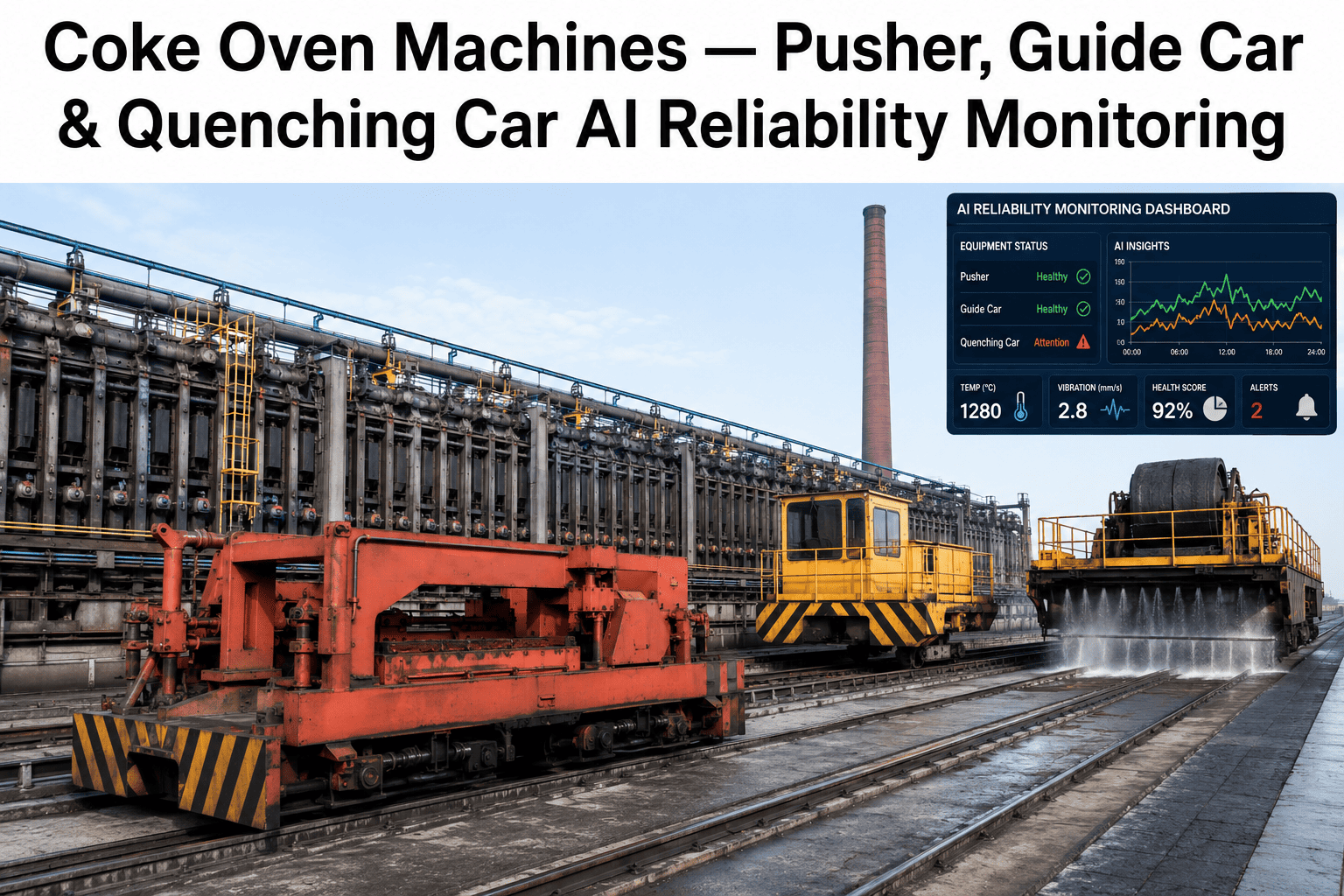
A pushing cycle that runs late by even ninety seconds ripples through the whole battery schedule, and the machine most likely to cause that delay isn't the oven — it's the pusher car, the guide car, or the quenching car it depends on. These three machines move on a fixed schedule dozens of times a day, and when one breaks down mid-shift, the fix is rarely simple: a jammed ram, a misaligned guide, or a quenching car that can't complete its cycle all become battery-wide problems within the hour. AI-based condition monitoring watches the wear patterns that lead to these failures long before they take a machine down. See how it tracks your pusher fleet when you book a demo.
Three machines run the whole pushing cycle. One unplanned failure stalls the battery.
Pusher rams, guide car alignment, and quenching car condition determine whether coke moves out of the oven on schedule or the whole battery backs up. AI condition monitoring catches the wear signature before a breakdown does.
The three machines behind every push
Coke doesn't leave the oven on its own. Three purpose-built machines coordinate a sequence measured in seconds, and each one carries its own failure modes that a maintenance manager needs to track separately, even though the machines depend on each other completing their part on time. A delay in any one of the three shows up first as a slower cycle time, then as a scheduling ripple across the rest of the battery, which is why reliability planning for this fleet works best when it treats the three machines as one interdependent system rather than three separate maintenance programs.
The pushing cycle, sequence by sequence
A single pushing event is a tightly choreographed sequence across all three machines. Each step has its own timing budget, and a delay or fault at any step pushes the whole battery schedule behind, which is why monitoring the sequence — not just each machine in isolation — matters for reliability planning.
What an unplanned machine stoppage actually costs
When a pusher machine goes down mid-shift, the cost isn't limited to the repair itself. Every oven scheduled behind the stalled machine sits waiting past its optimal coking time, and coke left in the oven too long or pushed on a delayed schedule can shift quality outside spec even when the oven itself is working perfectly. Depending on how much buffer exists in the battery schedule, a single extended stoppage can push the entire day's pushing sequence into overtime, straining crew scheduling on top of the direct maintenance cost.
Guide car and quenching car failures carry a related but distinct risk. A guide car that loses alignment mid-cycle can let hot coke spill outside the intended trough, creating both a safety hazard for coke side personnel and a cleanup delay that stalls the next scheduled push. A quenching car that can't complete its transport cycle — because of a wheel or rail issue — often has to be pulled from rotation entirely, reducing the fleet's effective capacity for the rest of the shift and forcing remaining cars to absorb a heavier cycle load than they're rated for.
Predictive monitoring changes the shape of these costs by moving the intervention point earlier. A ram seal replacement scheduled into a planned maintenance window costs a fraction of an emergency repair mid-shift, and it doesn't carry the downstream cost of a stalled battery schedule at all. Maintenance managers running predictive programs on their pusher fleet typically describe the shift less as "fewer breakdowns" and more as "breakdowns that no longer happen during a shift" — the same underlying wear still gets addressed, just on a schedule the plant controls instead of one the machine forces.
iFactory maps cycle timing against machine condition data so maintenance managers can see exactly which machine and which step is driving schedule slip.
Reactive repair versus predictive machine reliability
Most coke oven machine maintenance programs are still built around scheduled overhauls and breakdown response. That model tolerates a certain amount of unplanned downtime as the cost of doing business, and for decades it was simply the only option available since the wear patterns inside a ram housing or a wheel assembly weren't visible without disassembly. Predictive monitoring changes that math by catching the wear pattern before it becomes a stoppage, using sensor data the machine is already generating during normal operation.
| Reliability dimension | Reactive maintenance | AI-based predictive monitoring |
|---|---|---|
| Ram alignment issues | Found after a stalled push | Trended from vibration and load signature |
| Guide car misalignment | Found after a spillage incident | Flagged from positioning drift trend |
| Quenching car structural wear | Found during scheduled overhaul | Tracked continuously against baseline |
| Unplanned downtime | Absorbed into battery schedule buffer | Reduced by addressing wear pre-failure |
| Spare parts planning | Reactive ordering after failure | Ordered ahead based on wear trend |
The reliability checklist behind every machine
Condition monitoring on pusher fleet machines comes down to tracking a small set of parameters continuously rather than checking them on a fixed inspection interval. Each one maps to a specific failure mode that shows up as a stalled or delayed pushing cycle if left unaddressed. None of these parameters is exotic — most maintenance teams already know these are the things that eventually cause a stoppage. What changes with continuous monitoring is catching the trend while it's still a gradual drift rather than discovering it the moment a machine fails to complete its cycle.
The machine monitoring stack
Reliability monitoring across pusher, guide car, and quenching car is built from sensing on the machines themselves combined with cycle timing data pulled from the battery control system, unified into a single reliability view.
Connecting machine condition to the battery schedule
Machine reliability data becomes most useful when it's connected directly to the battery pushing schedule rather than reviewed as a standalone maintenance report. A guide car showing an early alignment drift trend matters differently depending on how many high-priority ovens are scheduled through it in the coming days — a machine with a developing issue and a light schedule ahead can often run safely to its next planned maintenance window, while the same trend on a machine carrying a heavy near-term schedule may warrant moving the inspection up.
This is why iFactory ties machine condition trends into the same view as the battery's pushing schedule, rather than treating maintenance planning and production scheduling as separate systems that only intersect after something breaks. A maintenance manager reviewing the fleet in the morning sees not just which machines have a developing condition, but which of those machines are carrying schedule risk in the days immediately ahead — the combination that actually determines whether a repair should be pulled forward or can wait for the next planned window.
Over time, this connected view also improves how overhaul intervals themselves get planned. Instead of a fixed calendar-based overhaul schedule applied uniformly across the fleet, machines that are wearing faster than their peers — because of duty cycle, oven condition on their assigned ovens, or age — get identified individually, and the overhaul calendar adjusts to reflect actual condition rather than a generic interval that either services healthy machines too early or lets heavily worn ones run too long.
Frequently asked questions
iFactory brings pusher, guide car, and quenching car condition data into one reliability view built for coke oven maintenance teams. Book a demo and see it against your own pushing cycle data.