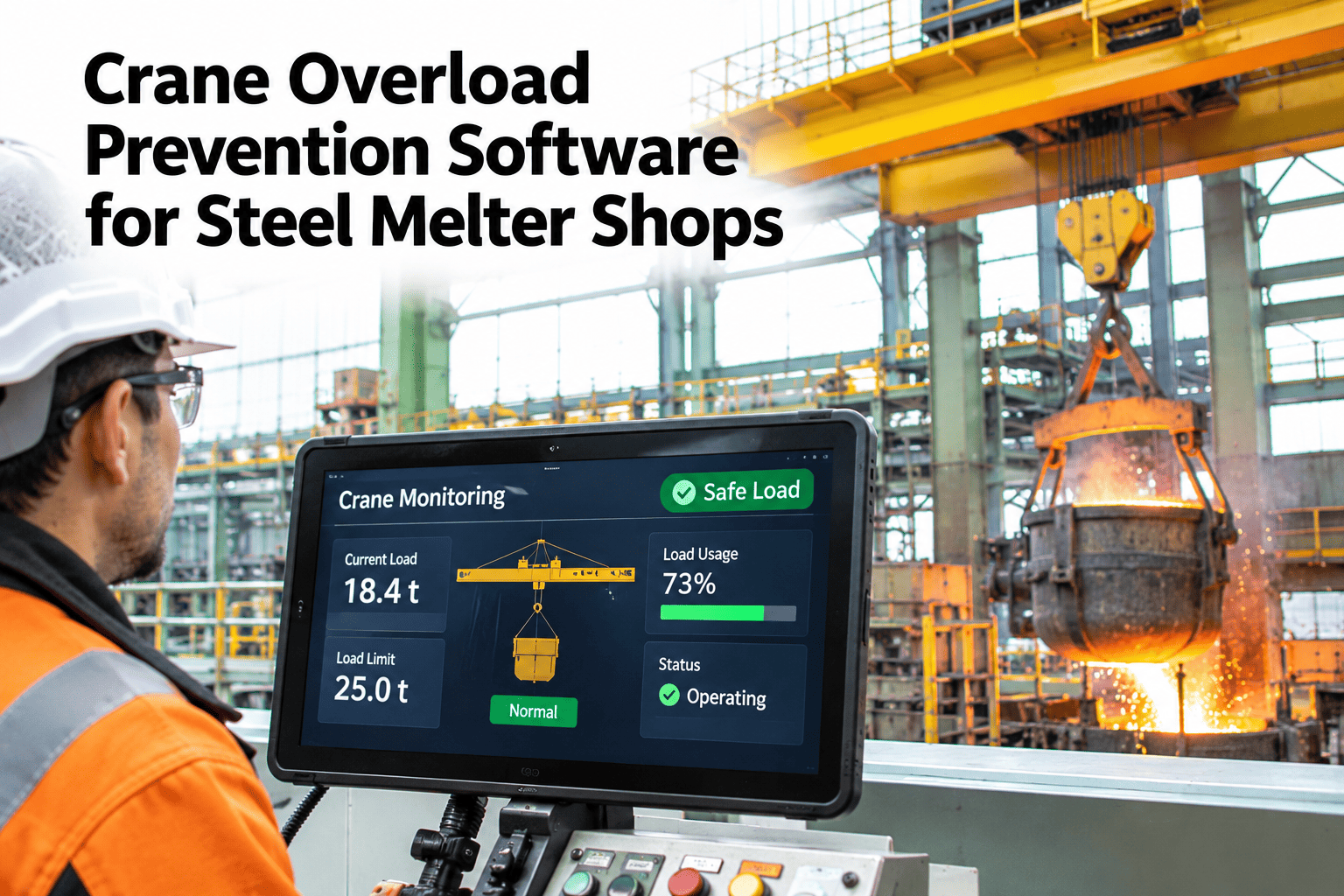
A load cell that only reads against one fixed rated-capacity limit misses the reality that a crane's safe load varies by boom angle, wire rope condition, duty cycle and even ambient temperature in a melter shop. Dynamic limit calculation accounts for those variables in real time, so the system protecting the crane from overload is checking against what's actually safe right now, not a number printed on a plate years ago. iFactory AI's steel operations team can review your current overload protection against dynamic limit logic before your next load test.
A Fixed Rated Capacity Isn't the Same as a Safe Load Right Now
Load-cell monitoring, dynamic limit calculation and operator alerting together stop crane overload before it causes mechanical damage, accounting for conditions a fixed capacity plate never captures.
Why a Static Limit Isn't Protective Enough in a Melter Shop
A crane rated for a fixed capacity on a clean specification sheet is operating in a melter shop environment with extreme heat, a wire rope already carrying some fatigue, and a duty cycle running near continuous — all of which change what load the crane can actually handle safely at any given moment. A load monitoring system checking only against the static rated number will miss the gap between "technically under the rated limit" and "actually safe given current condition."
A fixed number that doesn't account for current rope condition or duty cycle.
Adjusts in real time for rope condition, boom angle and ambient factors.
Repeated near-limit lifts under degraded conditions accelerate structural fatigue.
A clear, real-time alert lets an operator adjust before a limit is actually reached.
Building Overload Prevention in Layers
Each layer adds protection the one below it can't provide alone. Our team can review your current load-cell setup against these layers.
Continuous, calibrated load measurement, not a periodic spot check.
Current rope condition, duty cycle and operating angle factored into the real-time safe limit.
A clear warning as the load approaches the dynamic limit, with time to react.
Hard limit enforcement if the load crosses the safe threshold despite the warning.
Static Limit vs Dynamic Limit: What Changes
| Factor | Static Limit Approach | Dynamic Limit Approach |
|---|---|---|
| Wire rope condition | Not factored in | Degraded rope lowers the safe limit automatically |
| Duty cycle | Not factored in | Sustained heavy use adjusts the limit downward |
| Operating angle | Assumes ideal geometry | Actual boom or hoist angle factored into the calculation |
| Ambient conditions | Not factored in | Extreme heat exposure can factor into structural limit adjustments |
Find Out Where Your Current Limit Falls Short
Share your current load monitoring setup and recent load history, and see where a dynamic limit would have adjusted the safe threshold.
A Composite Scenario: The Lift That Was Technically Within Limits
Picture a melter shop crane lifting a load comfortably under its static rated capacity, on a wire rope that recent inspection data showed was approaching its discard threshold for internal wear.
A static limit check would have cleared the lift without hesitation, but a dynamic limit calculation factoring in the rope's documented condition would have flagged the same load as approaching the rope's actual current safe capacity, not just the crane's. The scenario illustrates why condition-aware limits matter beyond the crane's rated number alone; actual risk depends on each crane and rope's specific condition.
Where iFactory AI Fits
iFactory AI combines continuous load-cell monitoring with dynamic limit calculation that factors in current rope condition, duty cycle and operating angle, alerting operators in real time and enforcing automatic intervention if a load approaches the actual safe threshold.
The safe threshold reflects current rope and duty-cycle condition, not just a rated plate.
A warning with enough lead time to adjust before the limit is reached.
A hard stop if the dynamic limit is crossed despite the warning.
Frequently Asked Questions
It combines the crane's rated capacity with current inputs — wire rope condition from recent inspection or magnetic testing data, duty cycle history and operating geometry — to produce a safe threshold that reflects present condition rather than a fixed specification. Review the calculation inputs for your crane fleet.
Many installations can use existing calibrated load cells as the measurement input, with dynamic limit calculation added as a software layer on top rather than requiring new load-sensing hardware. Check compatibility with your current load cells.
The warning gives the operator time to ease off, adjust the lift angle or reassess the load before any automatic intervention engages, with a hard stop reserved for cases where the load genuinely crosses the dynamic safe threshold. Review the alert and intervention sequence.
Rope inspection and magnetic testing results are logged against the rope's own record, and that condition data feeds into the dynamic limit calculation so a degraded rope automatically lowers the crane's effective safe capacity. See how rope data connects to limit calculation.
Yes, since a dynamic limit accounts for accumulated duty cycle and current condition, it can flag a load as effectively near-capacity even when it's comfortably under the static rated number, reducing the structural fatigue that repeated near-limit lifts under degraded conditions can cause. Discuss fatigue reduction benefits for your fleet.
Protect Against What's Actually Safe, Not Just What's Rated
iFactory AI combines load-cell monitoring with dynamic limit calculation and real-time operator alerting, so overload protection reflects current condition.