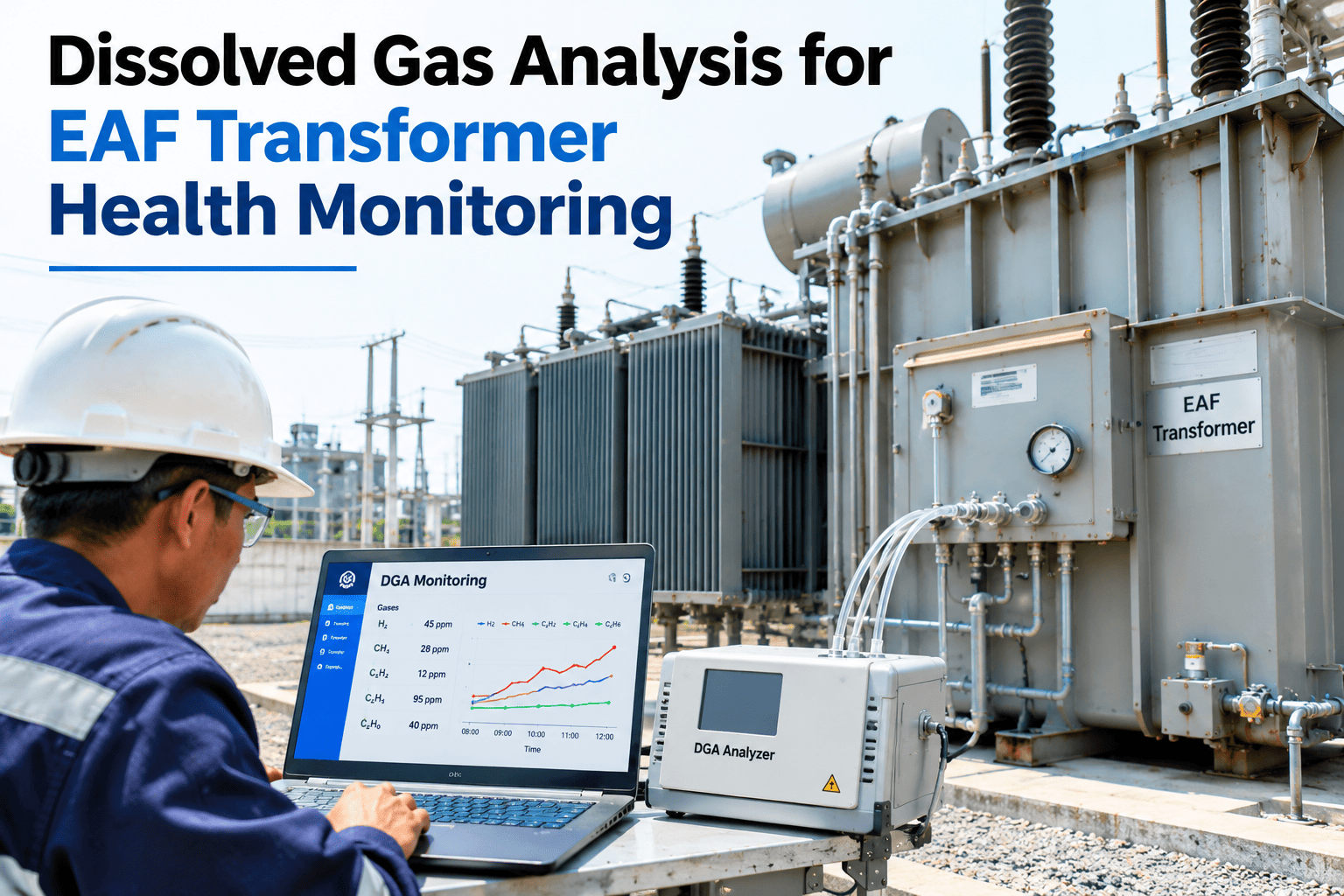
Every fault developing inside an oil-filled transformer leaves a chemical trace behind, specific gases forming in specific ratios depending on whether the stress is thermal, electrical or a mix of both, which is exactly what dissolved gas analysis reads. Tracking hydrogen, methane, ethylene and the rest of the key gas set against the established IEC 60599 diagnostic framework, continuously rather than from an occasional lab sample, turns that chemical trace into an early, specific warning. iFactory AI, an on-premise AI platform for manufacturing, runs this analysis continuously on a plant's own transformers, and electrical teams can see their own transformer oil gas trends diagnosed against IEC 60599 with our team.
Dissolved Gas Analysis, 2027
The Oil Already Knows What's Developing Inside
Dissolved gas analysis for EAF transformer health monitoring tracks hydrogen, methane and ethylene concentrations with IEC 60599 diagnosis, continuously and online.
What DGA actually reads
What the Gas in the Oil Is Actually Telling You
When insulation or oil breaks down under thermal or electrical stress inside a transformer, it produces specific gases, hydrogen, methane, ethane, ethylene, acetylene and carbon oxides among them, at rates and in ratios that depend on the type and severity of the underlying fault. A snapshot gas sample tells you those gases are present; a continuous trend tells you whether they're climbing, how fast, and whether the ratio pattern matches a known fault signature.
The key gases
Four Gases and What Each One Points Toward
Hydrogen
Often an early indicator of partial discharge activity.
Methane
Associated with lower-temperature thermal faults in the oil.
Ethylene
Rises with higher-temperature thermal stress, often in the winding region.
Acetylene
A strong signal of high-energy arcing, the most urgent fault type.
From gas to diagnosis
How a Trend Becomes a Specific Diagnosis
1
Continuous sampling
An online sensor reads gas concentrations around the clock, not on a periodic lab schedule.
2
Ratios calculated
Gas ratios are calculated against the IEC 60599 diagnostic framework.
3
Fault type matched
The ratio pattern is matched to a known fault category, thermal, electrical or arcing.
4
Severity tracked
The rate of gas increase indicates how urgently the fault needs attention.
See Your Own Gas Data Diagnosed
Share recent DGA lab results or your online monitoring data, and iFactory AI will show how it maps to the IEC 60599 framework.
Periodic vs continuous
A Quarterly Lab Sample Against Continuous Online Monitoring
Periodic lab sampling
A snapshot every few months at best
A fast-developing fault can be missed between samples
Trend data is sparse and hard to interpret
Continuous online monitoring
Readings taken constantly, not periodically
A fast-developing fault is caught as it accelerates
A dense trend reveals the true rate of change
A composite scenario
The Acetylene Spike Caught Between Scheduled Samples
Picture a transformer on a quarterly lab-sampling schedule that showed clean results in Q1, well within normal range for every tracked gas. A high-energy arcing fault began developing in Q2, and acetylene levels climbed rapidly over just a few weeks, a textbook signature of serious arcing. On a quarterly sampling schedule, that rise would not have been caught until the Q2 sample, potentially months after the fault began accelerating, and arcing faults are exactly the type that can progress to catastrophic failure fastest.
With continuous online monitoring in place instead, the acetylene spike was flagged within days of the rate of change crossing a meaningful threshold, giving the electrical team time to schedule an inspection and, in this case, an internal repair during a planned outage rather than discovering the fault only after a failure.
Why EAF duty changes the baseline
Why a Furnace Transformer's Normal Gas Levels Run Higher
The repeated electrical and thermal stress of furnace duty means an EAF transformer's oil naturally carries somewhat higher baseline gas levels than a steady-load transformer would, simply from normal operation. Applying a generic DGA threshold built for standard transformers to a furnace unit risks either constant false alarms or, worse, missing a real fault because the generic threshold sits too high relative to what a genuine problem looks like against this transformer's own elevated baseline.
Common mistakes
Mistakes That Weaken a DGA Program
1
Relying on infrequent lab samples alone
A fast-developing fault can progress significantly between scheduled samples.
2
Applying generic thresholds to furnace transformers
Normal furnace-duty gas levels can trigger false alarms against a generic standard.
3
Reading individual gases in isolation
The ratio between gases, not any single reading alone, is what identifies the fault type.
Expert review
What an Electrical Engineer Would Check First
DGA is only as reliable as its baseline and sampling frequency. Confirm continuous online sampling and a furnace-duty-specific baseline before trusting any diagnosis it produces.
Watch for
A DGA program relying only on quarterly lab samples for a transformer under daily furnace stress.
Do next
Pull your last two years of DGA lab results to establish your own transformer's trend first.
FAQ
What Electrical Teams Ask About DGA Monitoring
Do we need to install new sensors for continuous online DGA?
If your transformer doesn't already have an online DGA monitor installed, that's typically the first step, since periodic lab sampling alone can't provide the continuous trend data needed.
Ask about your current DGA capability.
How does IEC 60599 actually help interpret the gas data?
It provides an established set of gas ratio calculations and fault-type categories, giving a standardized way to turn raw gas concentrations into a specific diagnosis rather than relying on individual judgment each time.
Ask about applying IEC 60599 to your data.
Why would our furnace transformer show higher baseline gas levels than normal?
The repeated thermal and electrical stress of furnace duty itself generates some gas even under completely normal operation, which is why a furnace-specific baseline matters more than a generic transformer standard.
Discuss your transformer's expected baseline.
Can DGA alone tell us exactly what's wrong inside the transformer?
DGA narrows the fault category significantly, thermal, electrical or arcing, and its severity, though a full confirmation sometimes requires an additional test such as further electrical diagnostics during a planned inspection.
Ask about confirming a DGA finding.
How quickly can a rising gas trend turn into an actionable alert?
Once continuous monitoring and a baseline are established, a meaningful upward trend can generate an alert within days of the rate of change becoming statistically significant against normal variation.
Ask about alert timing for your setup.
The oil is already telling the story
Read Your Transformer Oil's Early Warning
Book a session with iFactory AI to see continuous dissolved gas analysis running on your own EAF transformers.