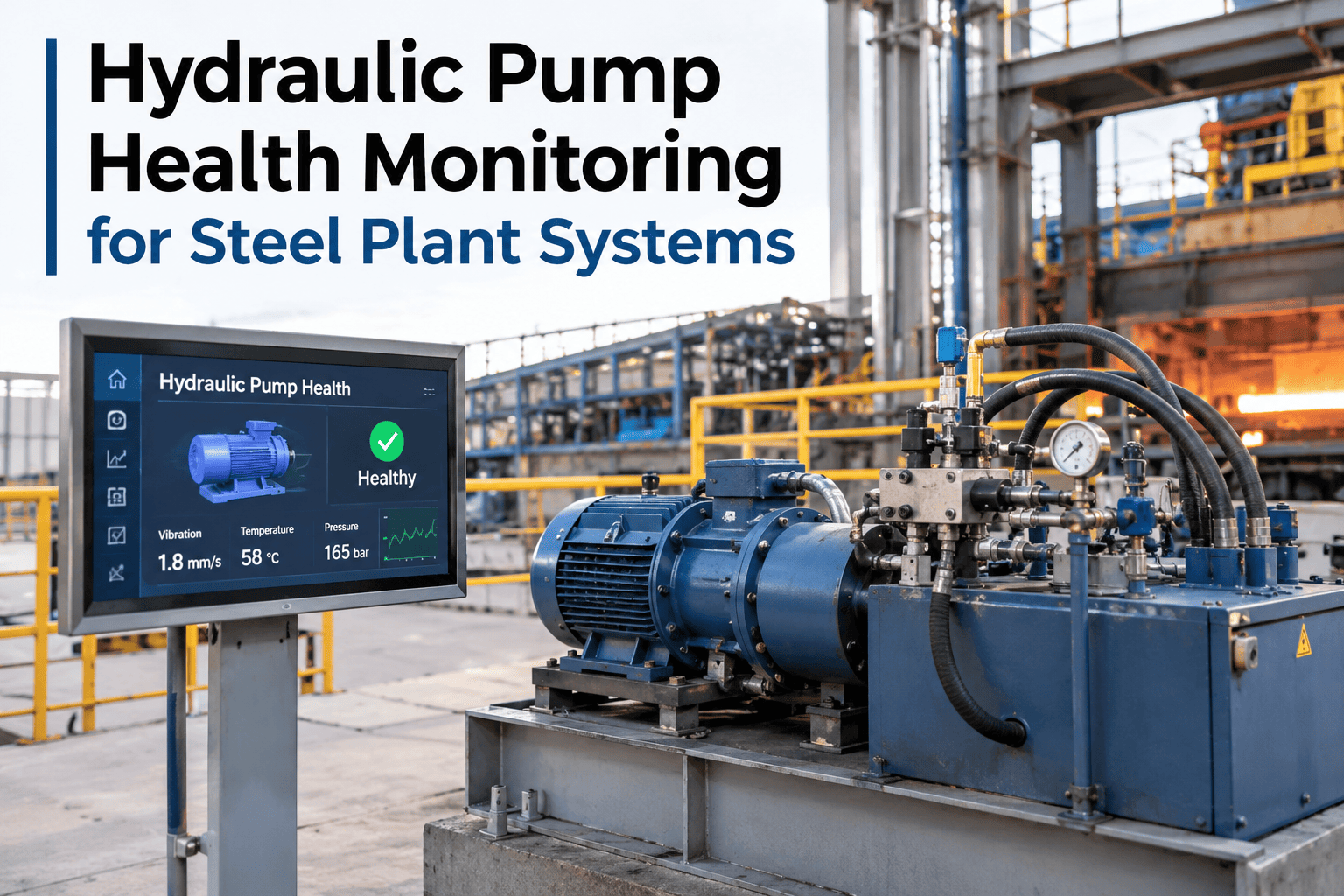
A hydraulic pump rarely fails without warning, it degrades first, through gradually declining flow output, a developing pressure ripple pattern, or the telltale signature of cavitation building inside the pump housing. The problem is that these signals are easy to miss in routine operation unless someone is specifically watching for them, which is exactly why pumps so often get replaced reactively after a catastrophic failure rather than proactively once a clear warning sign appears. Surfacing these three signals continuously is what turns an unpredictable pump failure into a scheduled replacement, and our team can walk you through how this monitoring works on your own pump fleet.
Steel plant hydraulic systems, pump reliability
Catch Hydraulic Pump Degradation Before It Becomes Catastrophic Failure
iFactory AI tracks flow degradation, pressure ripple and cavitation signals continuously, surfacing pump issues while there is still time to plan the fix.
Why pump failure feels sudden
Degradation Builds Quietly Until the Pump Finally Gives Out
A pump losing flow efficiency or developing early cavitation can still function well enough that nobody notices, until the degradation finally crosses a threshold and the pump fails outright during operation.
Flow slowly declines
Output drops gradually below rated performance
Pressure ripple develops
An irregular pressure pattern starts to appear
No one is watching closely
Routine operation masks the gradual change
Catastrophic failure occurs
The pump fails outright, appearing sudden to everyone involved
Three warning signals
What Pump Health Monitoring Actually Tracks
Flow degradation
Declining output relative to the pump's rated and historical performance.
Pressure ripple
Irregular pressure patterns indicating internal wear or developing faults.
Cavitation detection
Signatures indicating cavitation forming inside the pump, a fast-progressing damage mechanism.
Review Your Current Pump Replacement History
Share your past pump failures and current monitoring setup and see what continuous tracking would reveal.
Signal table
What Each Signal Reveals and How Urgently
| Signal | What it reveals | Typical urgency |
|---|
| Flow degradation trend | Gradual internal wear or efficiency loss | Plan replacement within weeks to months |
| Pressure ripple pattern | Developing mechanical fault | Investigate within days to weeks |
| Cavitation signature | Fast-progressing internal damage | Address urgently, within days |
Monitoring pipeline
Four Steps From Signal to Scheduled Pump Replacement
1
Track continuously
Flow, pressure and cavitation signals are monitored through normal operation.
2
Compare to baseline
Each pump is checked against its own rated and historical performance.
3
Flag by urgency
Signals are prioritized based on how quickly the issue typically progresses.
4
Schedule the fix
Replacement or repair is planned around production rather than reacting to failure.
Common pitfalls
Three Problems With Reactive Pump Replacement
1
No baseline flow measurement
Without a known normal, gradual degradation is hard to distinguish from day-to-day variation.
2
Cavitation treated the same as general wear
Cavitation progresses faster and needs a quicker response than typical flow degradation.
3
Pumps replaced only after failure
Reactive replacement means unplanned downtime instead of a scheduled fix.
Expert review
Cavitation deserves special attention among these three signals because it can progress from a minor issue to significant internal damage much faster than general wear. Treating all three signals with the same response timeline misses this distinction.
Watch for
A pump failure history dominated by sudden, unplanned replacements rather than scheduled ones.
Do next
Pilot continuous monitoring on your most critical pumps and establish individual baselines before expanding.
— iFactory steel specialists
Frequently asked questions
What Plants Ask About Hydraulic Pump Health Monitoring
Can this be added to our existing pumps without replacing them?
Yes, monitoring is typically added through sensors on the existing pump installation and its associated piping, rather than requiring a different pump, so your current fleet can be instrumented directly.
Ask about your current pump setup.
How is cavitation actually detected before it causes damage?
Cavitation produces a distinct signature in pressure and sometimes acoustic data that can be identified before it has caused significant internal damage, giving a window to adjust operating conditions or schedule a repair.
Discuss cavitation detection.
Does each pump need its own baseline?
Yes, since pumps of different ages, models or operating conditions have different normal performance ranges, so comparing a pump against its own history gives a more reliable signal than a shared fleet-wide threshold.
Talk through baseline setup.
How much warning does flow degradation typically give?
Flow degradation often develops over weeks to months, giving considerably more lead time than cavitation, which is part of why these two signals warrant different response timelines.
Ask about typical warning windows.
How many pumps should a pilot program start with?
Starting with your most critical pumps, those supporting the highest-impact operations, gives the clearest value before deciding whether to extend monitoring across the full pump fleet.
Discuss your pilot scope.
From sudden failure to scheduled replacement
Turn Pump Failure From a Surprise Into a Planned Event
Book a session with iFactory AI to review your pump fleet and see how continuous health monitoring fits your plant.