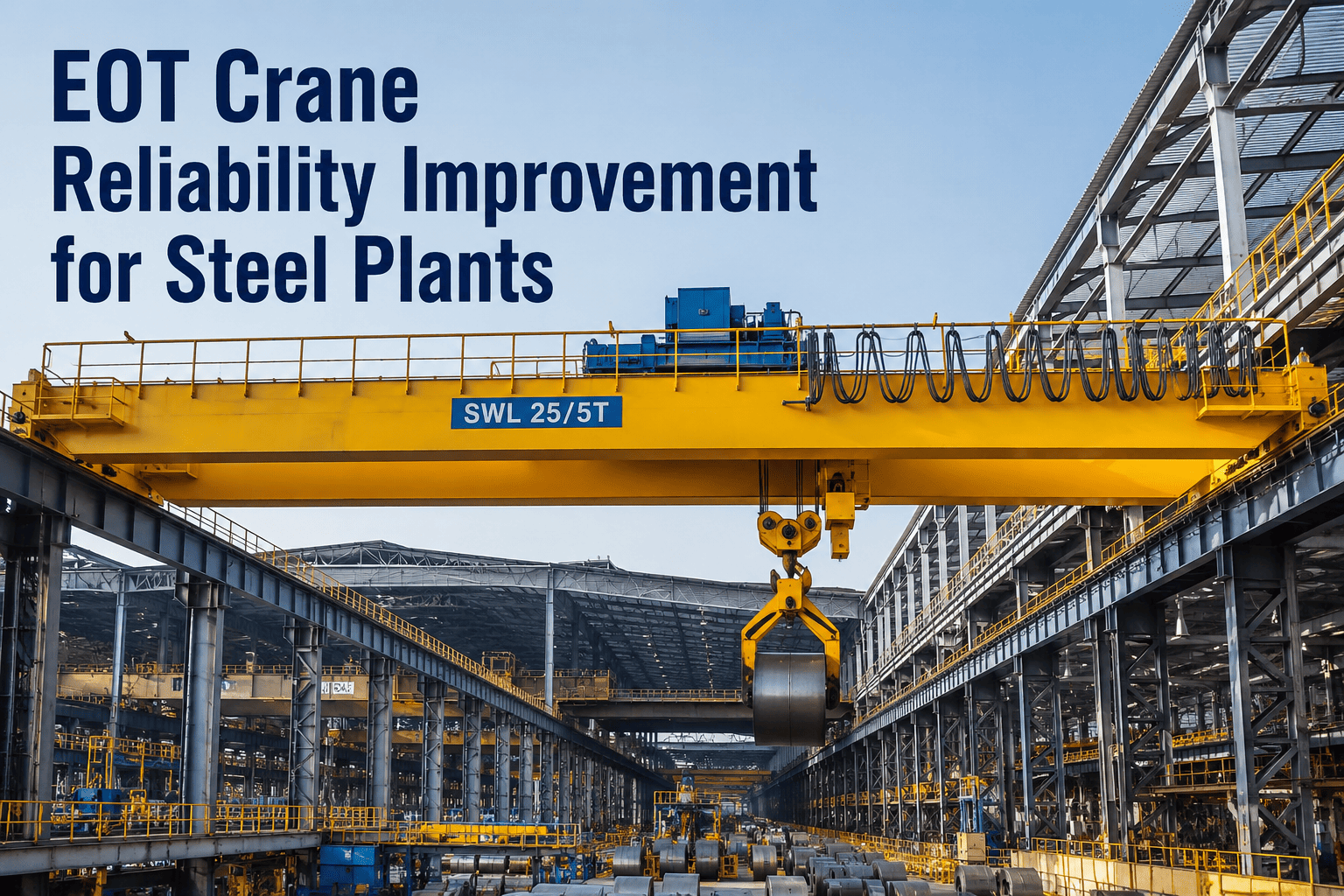
An overhead crane going down in a steel plant is never a small event — it stops ladle movement, stalls charging, and backs up an entire bay because there is rarely a second crane sitting idle to pick up the slack. Most reliability programs treat cranes as an afterthought next to rolling mill equipment, running on calendar-based PMs that check the same items whether the brake is genuinely wearing or not. A structured crane reliability program flips that logic around, tracking brake wear, wire rope condition, and gearbox health as continuous signals rather than a checklist ticked once a month, and if your last crane failure caught maintenance by surprise, it is worth walking through what continuous monitoring would have shown you before it happened.
Stop Losing Bays to Crane Downtime You Could Have Seen Coming
Brake wear tracking, wire rope condition monitoring, and gearbox health signals turn crane maintenance from a fixed calendar into a program that reacts to how the machine is actually wearing.
Why Crane Reliability Gets Less Attention Than It Should
EOT cranes rarely get the reliability engineering budget that rolling mill drives or continuous casters receive, even though a single crane failure can stall an entire bay for hours.
Treated as fixed infrastructure
Cranes are budgeted like building assets rather than production equipment with real failure modes.
Calendar-based PM only
Brake and rope inspections happen on a fixed schedule regardless of actual duty cycle or load history.
No condition data captured
Brake torque, rope diameter, and gearbox vibration are checked visually and rarely logged as trendable data.
Single point of failure per bay
Most bays run one crane for critical lifts, so any downtime cascades directly into production loss.
Three Failure Modes That Drive Most Unplanned Crane Downtime
Brakes, wire rope, and gearboxes account for the overwhelming majority of unplanned EOT crane stoppages in steel plant service, and each has a distinct wear signature that condition monitoring can track before failure.
Lining wear & torque drift
Brake lining thins gradually with every stop-start cycle, and holding torque drifts below spec well before visual wear looks severe.
Broken wire accumulation
Fatigue and abrasion break individual wires progressively, with failure risk rising steeply once discard thresholds are crossed.
Bearing & gear tooth wear
Vibration signatures shift measurably weeks before an audible or visible gearbox fault appears on the hoist mechanism.
Turn Your Crane Fleet Into a Predictable Asset
Walk through a live example of brake torque, rope condition, and gearbox vibration trending on a crane matching your fleet's duty cycle and lift profile.
How a Crane Reliability Program Is Built
A structured program layers sensing, data collection, and analysis on top of the existing PM structure rather than replacing it, so the transition does not disrupt current maintenance routines.
Baseline the fleet
Every crane's duty cycle, load history, and current PM records are captured as a starting reference point.
Instrument critical components
Brake torque sensors, rope condition monitors, and gearbox vibration sensors are fitted to the highest-risk cranes first.
Establish trend baselines
Several weeks of data establish what normal wear looks like for each crane's specific duty cycle.
Set alert thresholds
Warning and action thresholds are calibrated against discard criteria and manufacturer torque specifications.
Shift PM to condition-based
Inspection intervals adjust based on actual wear trend rather than a fixed calendar for the full fleet.
What Changes After a Crane Reliability Program Goes Live
Results below reflect typical outcomes reported within the first two quarters of moving from calendar-based to condition-based crane maintenance.
Monitoring Signal by Component
Each critical crane component has a distinct signal type, sampling frequency, and alert basis suited to how it actually degrades.
Frequently Asked Questions
Do we need to retrofit our entire crane fleet at once?
No. Most programs start with the two or three cranes carrying the highest duty cycle or the worst downtime history, since that is where monitoring pays back fastest. Sensors are added during a scheduled maintenance window rather than requiring a dedicated shutdown, and the program expands to additional cranes once the initial fleet demonstrates results. Book a demo to talk through a phased rollout for your specific fleet.
How does condition-based monitoring interact with statutory crane inspection requirements?
Condition monitoring supplements statutory inspections rather than replacing them — periodic certified inspections still occur on their required schedule. What changes is that the inspector arrives with weeks of trend data already available, making the inspection faster and more targeted, and any component approaching a threshold is already flagged before the inspection date arrives.
What sensors are actually fitted to the crane, and does it affect crane duty rating?
Brake torque sensors, rope condition sensors, and vibration accelerometers are compact, non-intrusive additions mounted at existing access points on the brake assembly, rope reeving, and gearbox housing. None of these additions affect the crane's rated capacity or duty classification, since they monitor rather than modify any load-bearing component. Talk to our team about sensor placement for your specific crane model.
How quickly can we expect to see a reduction in unplanned downtime?
Most plants see the first meaningful reduction within 60 to 90 days of go-live, once enough trend data exists to catch a wear pattern before it becomes a failure. The full benefit compounds over the following two quarters as alert thresholds are tuned to each crane's actual behavior and maintenance scheduling shifts fully to a condition-based rhythm.
Can this integrate with our existing CMMS for work order generation?
Yes. When a monitored component crosses a warning threshold, a work order can be generated automatically in your existing CMMS with the relevant trend data attached, so the maintenance team sees exactly why the work order was raised rather than a generic inspection reminder. This keeps your current work order workflow intact while adding the condition-based trigger underneath it.
Build a Reliability Program for Your Crane Fleet
Book a 30-minute call. Bring your current crane count, duty cycle, and last twelve months of downtime history, and we will map out where monitoring would have caught your last failure.


-for-steel-plants-digital-compliance-framework.png)