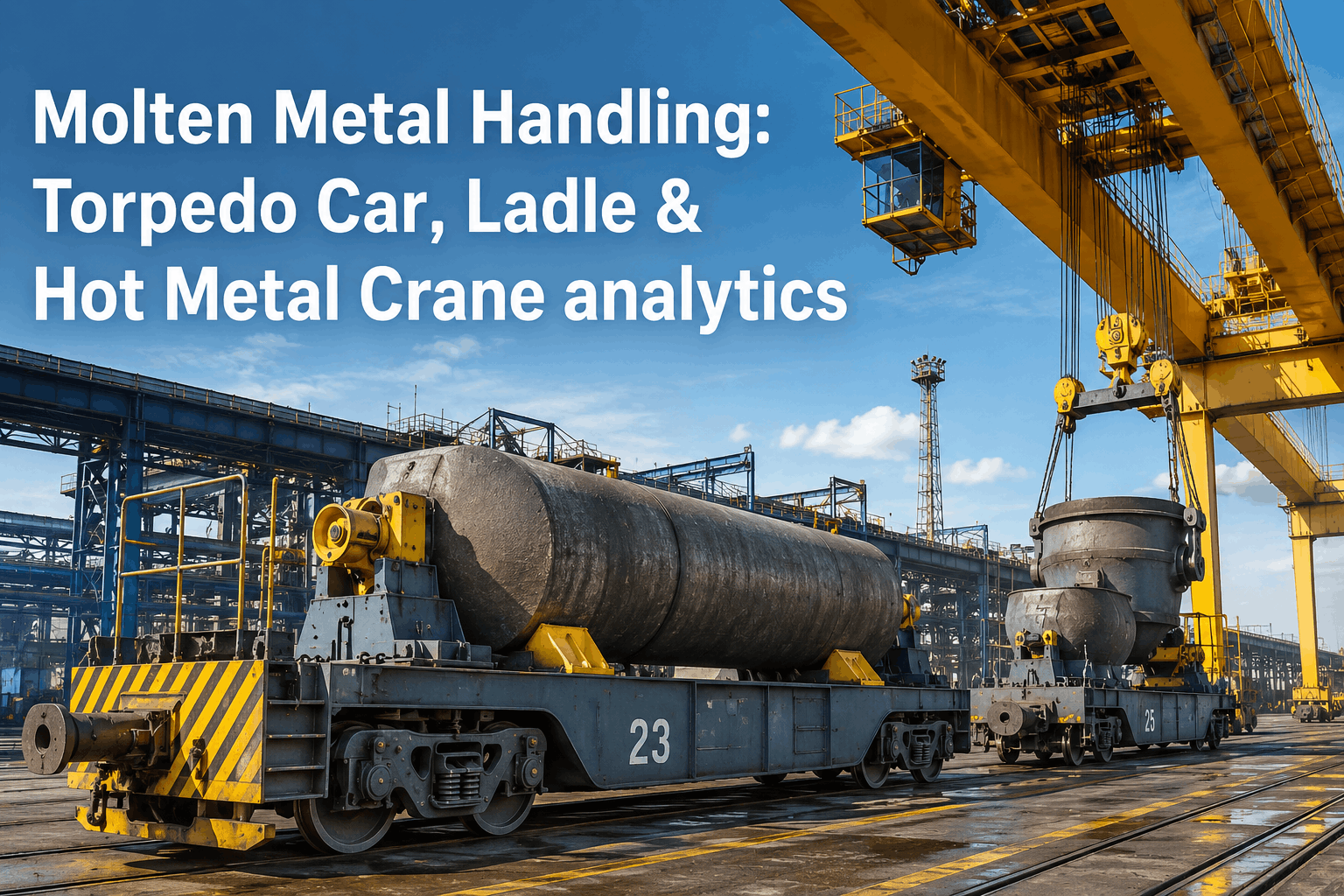
Hot metal cranes — torpedo cars, ladle cranes, and charge cranes moving molten iron and steel at temperatures well above 1,200°C — operate in a thermal environment that turns a standard overhead crane maintenance schedule into dangerous guesswork. A wire rope rated for a general-purpose gantry crane degrades at a completely different rate when it spends every shift a few meters from a radiating ladle, and a maintenance plan copied from a bridge crane manual will consistently miss the failure modes unique to sustained radiant heat. The components most likely to fail first on a hot metal crane — hoist ropes, brake linings, hydraulic seals, and bearing grease — behave nothing like their counterparts on an ambient-temperature crane, which is exactly why generic intervals leave plants exposed. See how iFactory's reliability team builds thermal-specific maintenance programs for hot metal crane fleets that catch degradation before it becomes an unplanned outage.
Special Maintenance for Hot Metal Cranes in High-Temperature Duty
Heat shielding, specialized lubrication, and component degradation monitoring for torpedo cars, ladle cranes, and converter cranes operating in continuous radiant heat — practical guidance for plants that cannot afford an unplanned hot metal handling outage.
A Hot Metal Crane Is Not a Bridge Crane With a Higher Duty Rating
Most crane maintenance manuals assume ambient shop temperature, with heat treated as an occasional exception rather than a constant operating condition. A hot metal crane inverts that assumption entirely: heat is not the exception, it is the baseline condition every component is designed against, and every interval published for a standard-duty crane needs to be re-derived for a machine that spends its working life a few meters from molten metal. The manufacturer's baseline maintenance manual is written for a general industrial environment because that is the only environment a manufacturer can reasonably assume before the crane is installed — it has no way of knowing whether the finished machine will spend its life in a climate-controlled warehouse or three meters from an open ladle radiating heat for an entire shift, so the published intervals default to the safer, more conservative ambient assumption and leave the thermal adjustment entirely to the plant. Four failure modes drive this gap, and each one accelerates on a curve that a calendar-based schedule simply cannot track, which is precisely why plants that rely on manufacturer-default intervals for hot metal duty consistently discover degradation later than plants that have built a thermal-adjusted schedule from their own exposure data.
Each of these four mechanisms accelerates independently of hours-run or calendar time, the two variables most maintenance schedules are actually built around. A torpedo car crane that logs the same operating hours as a standard bridge crane elsewhere in the plant is not experiencing the same wear — it is experiencing a fundamentally different degradation curve, and the maintenance program has to be built around exposure and temperature history rather than hours alone to have any predictive value at all.
Mapping Heat Exposure Across the Crane
Not every component on a hot metal crane experiences the same thermal load. A maintenance program that treats the whole machine as a single exposure zone over-services parts that barely see radiant heat and under-services the parts closest to the source. The table below breaks the crane into its real exposure zones.
| Crane Zone | Typical Ambient Range | Primary Risk | Interval Adjustment |
|---|---|---|---|
| Hook Block / Lower Sheaves | 200–450°C | Rope wire embrittlement, sheave lubricant loss | 3–4x standard frequency |
| Rope Reeving / Drum Area | 120–250°C | Lubricant dry-out, strand fatigue | 2–3x standard frequency |
| Hoist Gearbox & Motor | 80–160°C ambient | Grease breakdown, bearing wear | 2x standard frequency |
| Brake Assembly | 100–220°C | Lining hardening, reduced torque | 2–3x standard frequency |
| Trolley & Bridge Structure | 60–120°C ambient | Thermal cycling fatigue at welds | 1.5x standard frequency |
| Cab / Electrical Enclosures | 40–90°C (shielded) | Insulation degradation, connector fatigue | 1.5x standard frequency |
The pattern across every zone is consistent: proximity to the molten source is the dominant variable, more so than the crane's rated capacity or duty classification. A hook block that spends the shift descending toward an open ladle needs an inspection and relubrication interval several multiples tighter than a trolley structure shielded by a control cab, even though both belong to the same crane and the same duty cycle on paper. Building this zone map is a one-time exercise that pays off continuously afterward — once a plant has walked the crane and recorded realistic ambient temperature ranges at each component location during actual production, that map becomes the basis for every future interval decision, replacement evaluation, and lubrication specification, rather than each decision being made in isolation from whatever the last technician happened to assume about how hot that particular area really gets.
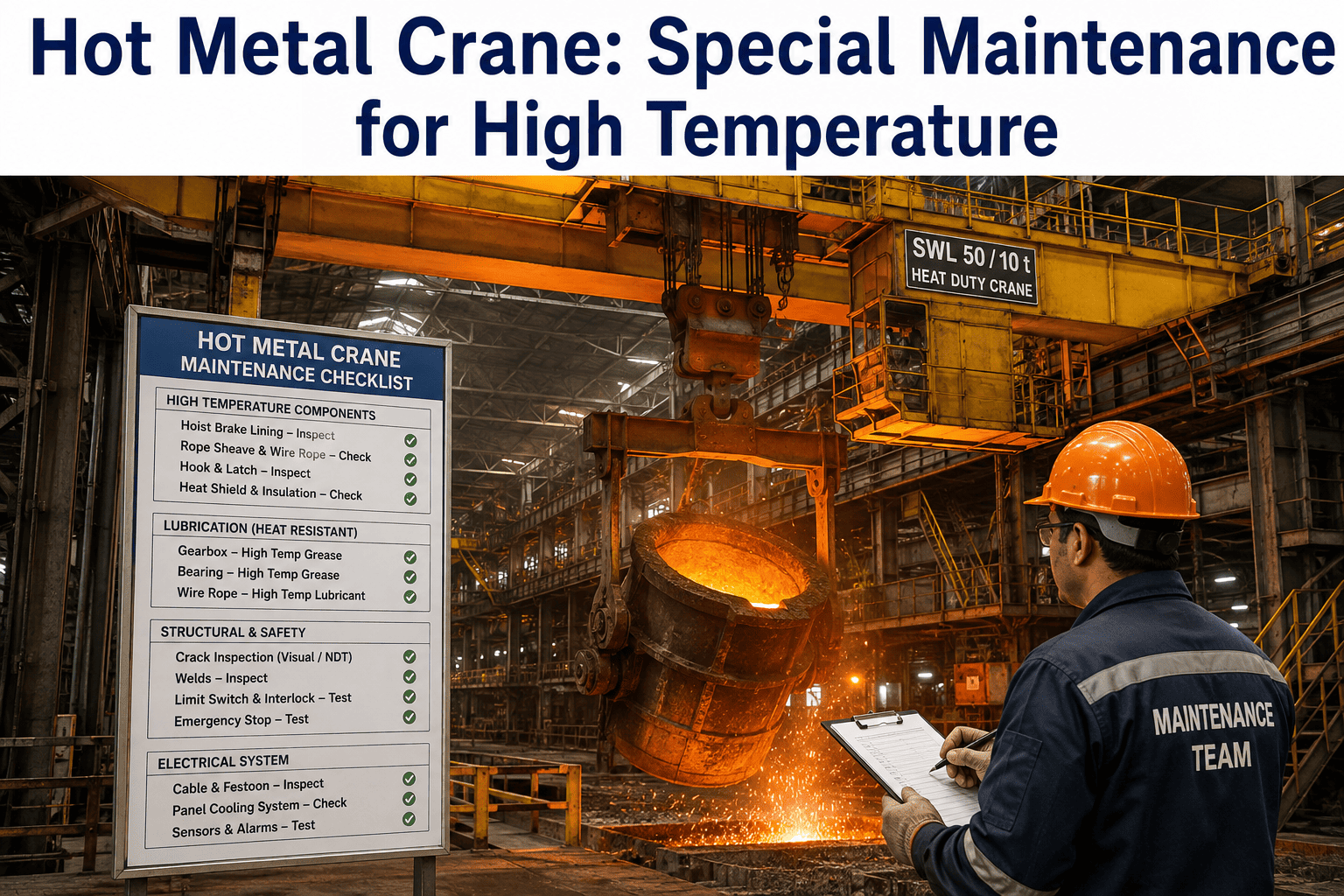
Heat Shielding and Inspection Points on a Ladle Crane
Six Components That Fail First in High-Temperature Duty
These six components consistently top the failure list across hot metal crane fleets because each one has a specific material property — flexibility, friction coefficient, seal integrity, lubricant film strength, insulation resistance, or fatigue tolerance — that degrades disproportionately fast under sustained heat compared to how it degrades under load cycling alone. Watching all six as a group, rather than reacting to whichever one happens to fail first, is what separates a mature hot metal crane maintenance program from one that is still discovering its failure modes one incident at a time.
The Real Cost of a Hot Metal Crane Going Down Mid-Heat
A hot metal crane failure is rarely a routine maintenance event, because the crane is usually holding, positioning, or transferring molten material at the moment something goes wrong. Unlike a standard-duty crane that can typically be safely parked mid-fault while a technician investigates, a hot metal crane carrying a torpedo load or a full ladle has to complete its transfer or reach a safe set-down point regardless of what the fault indicator is showing, which turns a component failure into an active safety event rather than a scheduling inconvenience.
None of this is presented to argue that hot metal cranes are inherently more dangerous than any other class of overhead lifting equipment — they are not, when maintained against the correct thermal-adjusted schedule. The argument is narrower and more practical: because the consequences of a missed failure are higher and the repair window is more constrained, the return on investment in zone-based, exposure-driven maintenance planning is measurably higher for a hot metal crane than for almost any other crane class in a typical steel mill or foundry, which is exactly why reliability teams increasingly treat this as a distinct maintenance category rather than a variant of general crane upkeep.
A Hot Metal Crane Needs a Maintenance Program Built for Its Actual Thermal Load
iFactory helps reliability teams map exposure zones, relubrication intervals, and component watchlists specific to torpedo cars, ladle cranes, and converter cranes — before heat-driven wear turns into an unplanned outage.
Why Standard Grease Doesn't Survive Near a Ladle
Lubrication is the single most consistently under-specified item on a hot metal crane maintenance plan, because a standard-duty grease specification looks correct on paper right up until ambient temperature near the component exceeds the grease's actual dropping point. The gap is rarely caught during initial commissioning, since a newly greased bearing performs identically whether the grease is rated for the environment or not — the difference only shows up months later as accelerated wear, and by then the maintenance team is troubleshooting a bearing or gearbox failure without an obvious root cause, because the lubrication log shows the relubrication happened on schedule with a grease that simply was not rated for the zone it was applied in.
The margin between a grease's rated dropping point and the component's actual operating temperature is what determines service life, not the grease's general reputation or its performance on a different crane elsewhere in the plant. A synthetic, high-temperature-rated grease with meaningful headroom above the zone's peak ambient temperature, combined with a relubrication interval set from that zone's exposure data rather than a generic calendar figure, closes the gap that standard specifications consistently leave open on hot metal cranes.
What to Verify at Each Interval
Turning the exposure zone map and lubrication schedule into a working inspection routine means assigning each check to a realistic frequency the maintenance team can actually sustain across every shift, not an idealized interval that looks thorough on paper but quietly gets skipped when production pressure is high. The four-tier structure below is built to be sustainable first and comprehensive second, because a checklist that gets followed consistently at a slightly lower frequency outperforms an exhaustive one that gets skipped under time pressure.
Zone maps, lubrication specifications, and inspection intervals are only as good as the discipline behind following them shift after shift. The perspective below, from an engineer who has investigated hot metal crane failures across multiple mills, captures why the visual-inspection habit that works for most cranes quietly fails for this one.
The rope failures I've investigated on hot metal cranes almost never come from wear anyone could see coming — they come from a rope that looked fine on the last visual check because dry, heat-embrittled strands don't announce themselves the way a worn ambient-duty rope does. The plants that get this right stopped scheduling rope replacement by hours-run years ago and started scheduling it by cumulative thermal exposure logged per zone. It's a small change on paper, but it's the difference between catching embrittlement on a scheduled inspection and finding it on a failed lift.
Frequently Asked Questions
Build a Maintenance Program That Matches How Your Hot Metal Cranes Actually Degrade
iFactory works with reliability teams to map heat exposure zones, set lubrication and inspection intervals from real thermal data, and catch component degradation before it becomes an unplanned outage on your hot metal handling fleet.