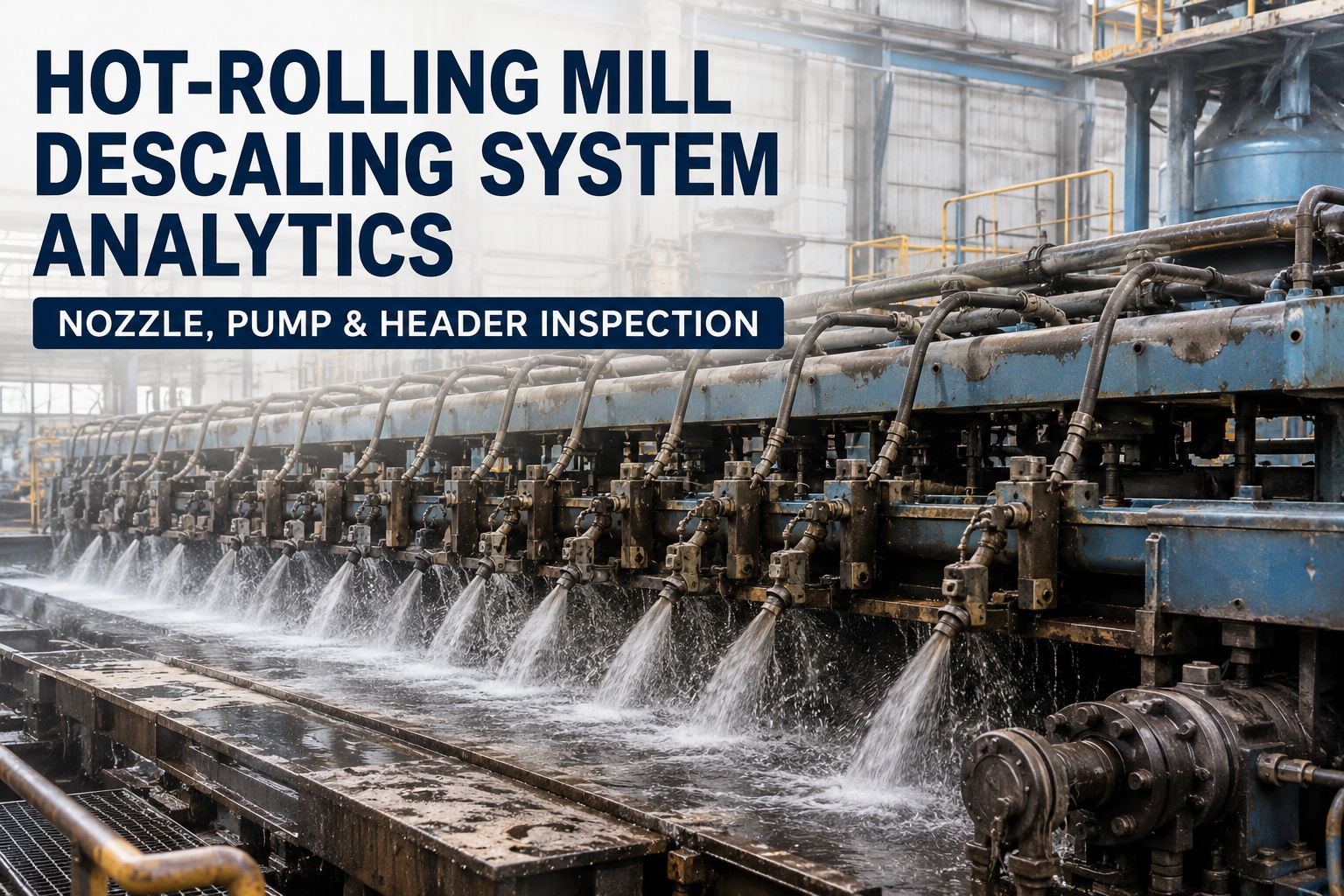
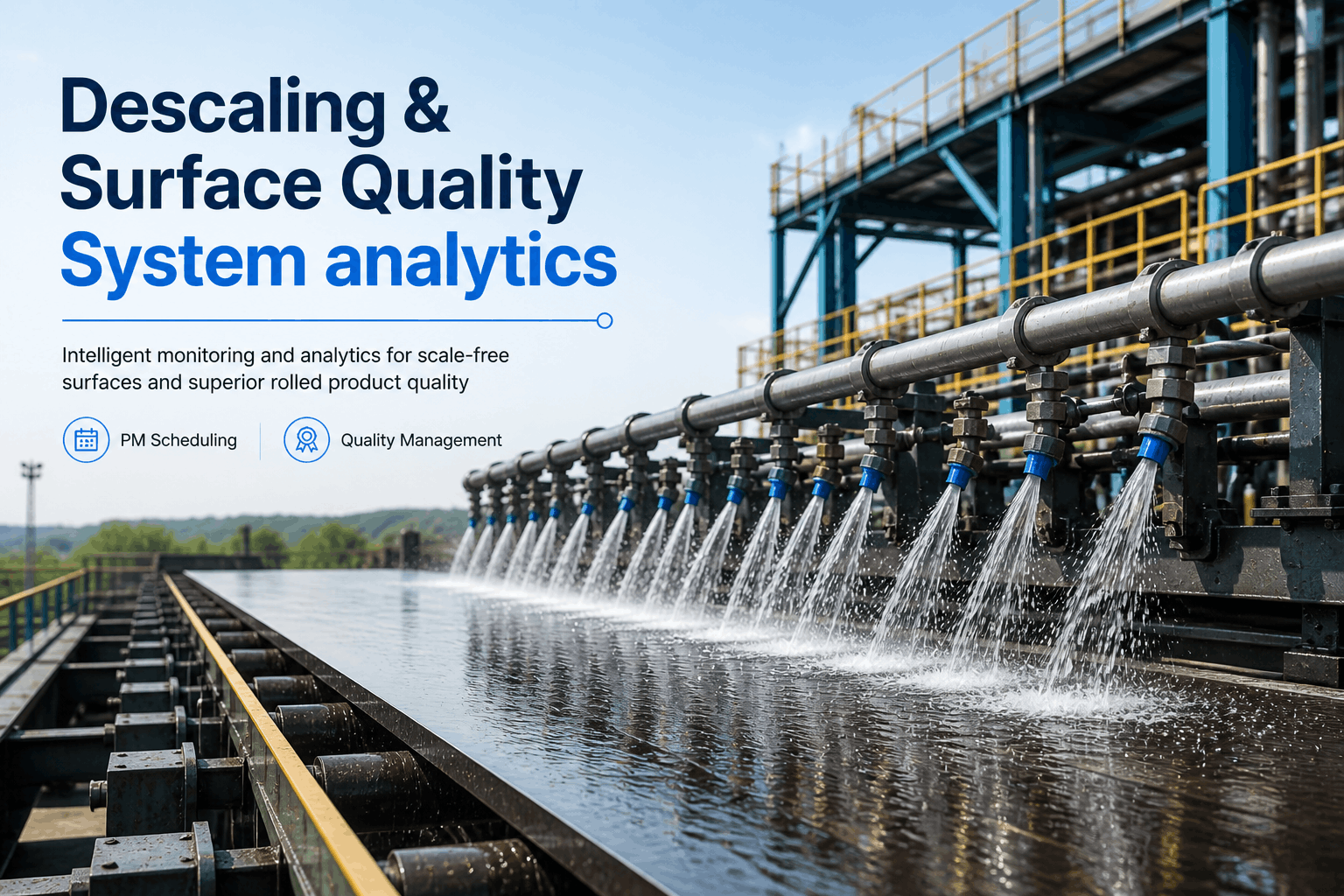
A 15-second gap in descaling coverage on your hot strip mill does not show up on any gauge in the pulpit — it shows up three weeks later as a customer claim for pitted surface on a coated automotive panel, long after the coil has left the plant and the root cause is buried under a dozen shift changes. High-pressure descaling headers run at 300-450 bar to blast mill scale off the slab before it gets rolled into the surface permanently, and the system has exactly one job: deliver full, even coverage across the strip width, pass after pass, shift after shift. When a nozzle wears, a pump loses pressure, or a header partially clogs, the loss is invisible to an operator watching from 40 feet away through a heat shimmer. AI-based condition monitoring on the pump, nozzle array, and header closes that blind spot by reading pressure, flow, and vibration signatures continuously and flagging degradation while it is still a maintenance ticket, not a customer claim you have to explain.
Four Ways a Degraded Descaling System Drains Margin
Most mills track descaling failures as pump breakdowns. The bigger loss happens quietly, long before a pump actually fails, and it rarely shows up on a maintenance dashboard until it has already become a quality problem downstream.
Nozzles Below Spray Pattern Spec
Worn or partially blocked nozzles hold their fan angle just enough to pass a visual check, but the actual impact pressure on the strip drops well below what full scale removal needs.
Surface Downgrades Traced to Scale Pull-In
Residual scale rolled into the strip surface shows up as pitting or streaking downstream, and the coil gets sold at a discount or rerouted away from exposed-panel customers.
Unplanned Stoppage per Header Failure
A cracked header or a seized isolation valve on a live descaling box means an emergency stop, a lockout, and a mill-wide throughput hit that ripples into the finishing schedule.
Cost Multiplier for Reactive HP Pump Rebuilds
A plunger pump rebuilt after a catastrophic seal or valve failure costs several times more in parts and downtime than the same rebuild done on a planned maintenance window.
Want a fast read on how your descaling losses compare? Talk to an iFactory reliability specialist about running a two-week diagnostic pass on your header pressure logs.
What AI Monitoring Watches Across the Descaling Loop
A descaling system is really three subsystems working together — the high-pressure pump station, the nozzle array on the header, and the water circuit that keeps both clean and pressurized. Each one degrades differently, on its own timeline, and each one needs a different signal to catch the failure early. iFactory's monitoring layer pulls existing pressure transmitters, flow meters, and vibration sensors into a single model trained on your specific pump and nozzle configuration, so alerts reflect your equipment, not a generic threshold. Mills running mixed grade slates, where campaign length and water hardness both shift week to week, benefit the most, because a fixed threshold set for one operating condition inevitably misses failures under another.
Curious which sensors on your existing pump skid are already usable? Book a sensor audit call and iFactory will map your current instrumentation against the monitoring model.
From Pressure Drop to Work Order: The Alert Chain
Catching a degrading nozzle or a weakening pump valve only matters if the signal turns into a scheduled work order before it turns into a surface claim or an emergency stop. Reliability teams that already run a CMMS-driven PM program tend to see the fastest adoption, because the alert chain plugs into a workflow the planner already trusts rather than introducing a parallel process. iFactory's alert chain is built to hand off cleanly between the AI model, your CMMS, and the maintenance planner — no dashboard that nobody checks, no alert that dies in an inbox.
Continuous Signal Capture
Pressure, flow, and vibration streams are read at the same sampling rate as your process historian — no new wiring, no new PLC logic required.
Pattern Comparison Against Baseline
Each component's live signature is compared against its own healthy baseline, not a generic industry threshold, so the model learns your pumps and your water chemistry.
Severity-Scored Alert
A drifting signal generates a watch-list entry; a signal crossing the failure-precursor band generates a scored alert with the specific component and likely failure mode named.
Work Order Pushed to CMMS
The alert writes a work order directly into your CMMS with the component, the signal trend, and a recommended action window, so the planner schedules it into the next outage.
Where This Data Lives: Historian, CMMS, and Quality Systems
A monitoring model is only useful if its output lands where the people who act on it already work. iFactory does not ask your maintenance team to check a new screen on top of everything else — the goal is for a descaling alert to look and feel like any other maintenance notification, just earlier and more specific than what a visual check or a vibration route could produce on its own, and traceable back to the exact signal that triggered it.
Process Historian
Pressure, flow, and vibration tags are read from your existing historian (PI, Wonderware, or equivalent) at the same sampling cadence already in use, so no new data infrastructure is required on the plant floor.
CMMS Work Orders
Scored alerts are pushed as structured work orders with component, signal trend, and recommended action window pre-filled, so the planner spends time scheduling the fix instead of diagnosing the problem from scratch.
Quality & Surface Inspection
When available, downstream surface inspection data is correlated back to descaling performance windows, closing the loop between a nozzle degradation event and the specific coils that were rolled during that window.
Running a homegrown or legacy CMMS? Talk to a specialist about the integration path for your specific system.
Stop Losing Surface Quality to a System You Cannot See
iFactory adds AI condition monitoring to your existing descaling pumps, nozzles, and header instrumentation — no new hardware required for most mills, and no disruption to your current production schedule. Get alerts scored by failure mode, routed straight to your CMMS, weeks before a nozzle or a pump seal actually lets go, so repairs happen on your terms instead of during an unplanned stop.
What Changes in the First 90 Days
Mills that add AI monitoring to their descaling system typically see the biggest shift not in pump uptime alone, but in how much earlier a problem is caught relative to when it would have surfaced as a customer-facing defect. The comparison below reflects typical results from hot strip mills after a 90-day monitoring window on the pump station and nozzle array, drawn from facilities running a mix of exposed automotive, structural, and commodity hot-rolled grades.
Visual Checks + Run-to-Failure Pumps
- 2-3 unplanned pump stoppages per quarter
- 21% of nozzles operating below spray spec at any time
- 7% surface-related downgrade rate on exposed grades
- 45 min average unplanned stoppage duration
Signal-Based Scheduled Maintenance
- 0-1 unplanned pump stoppages per quarter
- 4% of nozzles operating below spray spec at any time
- 2% surface-related downgrade rate on exposed grades
- 0 min unplanned stoppage tied to descaling — repairs planned into scheduled outages
Want the ROI math built from your actual pump age and nozzle replacement cadence? Book a 30-minute scoping call for a fixed-price proposal.
Getting Monitoring Live: A Six-Week Path
Adding AI monitoring to an existing descaling system does not require replacing pumps, nozzles, or the header itself. Most of the work is connecting to instrumentation that is often already installed but underused, plus a short training window for the model to learn your equipment's healthy baseline across the full range of grades, campaign lengths, and seasonal water conditions the mill actually runs — not just a single idealized operating point.
Instrumentation Audit & Data Tap
iFactory engineers review existing pressure transmitters, flow meters, and vibration sensors on the pump skid and header, and establish a read-only data connection to your historian or PLC.
Baseline Model Training
The model learns healthy signal patterns for your specific pumps, nozzle count, and water chemistry across a full range of grades and campaign lengths.
Alert Tuning & CMMS Integration
Alert thresholds are tuned against maintenance team feedback, work-order fields are mapped, and go-live begins with daily review of the first scored alerts.
Expert Perspective
We used to find out our nozzles were worn when a coil came back from the customer with pitting across a two-foot band. Now we get a work order three weeks before that same nozzle would have failed, and it gets swapped during a scheduled roll change instead of during an emergency stop. That shift alone paid for the monitoring program in the first quarter.
— Maintenance Manager, integrated hot strip mill (Indiana, 2.1M tons/year)
from instrumentation audit to live scored alerts on the pump and nozzle array
reduction in unplanned descaling-related stoppages within two quarters of go-live
Give Your Descaling System the Monitoring It Deserves
Surface quality is decided in seconds at the descaler, long before the strip reaches the finishing line. iFactory turns your existing pump and nozzle instrumentation into an early-warning system that protects both throughput and coil surface grade, without adding another dashboard your team has to remember to check.
Frequently Asked Questions
Do we need to install new sensors on the descaling pump and header?
In most cases, no. Descaling pump skids already carry discharge pressure transmitters, flow meters, and often motor current sensors, and the header typically has isolation valve position feedback. iFactory connects to this existing instrumentation through a read-only data tap, so there is no interruption to production while the connection is established. New sensors are only recommended when a specific signal, such as per-zone nozzle flow, is not currently measured and the mill wants zone-level resolution rather than header-level resolution, and even then the addition is scoped to a single header rather than the full mill.
How early does the system catch a nozzle wearing out of spec?
Typical lead time for nozzle degradation is three to six weeks before the spray pattern would fall far enough out of spec to leave residual scale on the strip. This depends on your water chemistry, campaign length, and nozzle material, and the model refines its lead-time estimate as it accumulates more cycles of your specific operating pattern. Mills with harder water or higher scale loads generally see a shorter lead time and are flagged for tighter monitoring intervals accordingly.
Can this distinguish between a pump problem and a downstream header problem?
Yes. The model tracks pump discharge signatures, header differential pressure, and per-zone flow balance separately, so an alert names the specific subsystem and likely failure mode rather than a generic low-pressure warning. This matters because a pump valve issue and a clogged header respond to very different repair actions, and a planner who has to guess between the two often ends up scheduling the wrong crew or ordering the wrong parts.
How does this integrate with our existing CMMS?
iFactory pushes scored alerts as work orders directly into CMMS platforms including SAP PM, Maximo, and most other standard systems via API, with the component, signal trend, and recommended action window populated automatically. Your planners keep working inside the CMMS they already use, with descaling alerts appearing alongside every other maintenance work order.
What does a typical pilot cost and how long does it run?
Pilots are scoped to a single descaling header or pump station and priced as a fixed engagement rather than an open-ended subscription, with most mills seeing a full baseline-to-alert cycle within six weeks from the first instrumentation review to the first scored alert reaching the CMMS. Book a scoping call to get a fixed-price proposal built around your specific pump count, nozzle configuration, and existing instrumentation, with no long-term commitment required to see the first results.