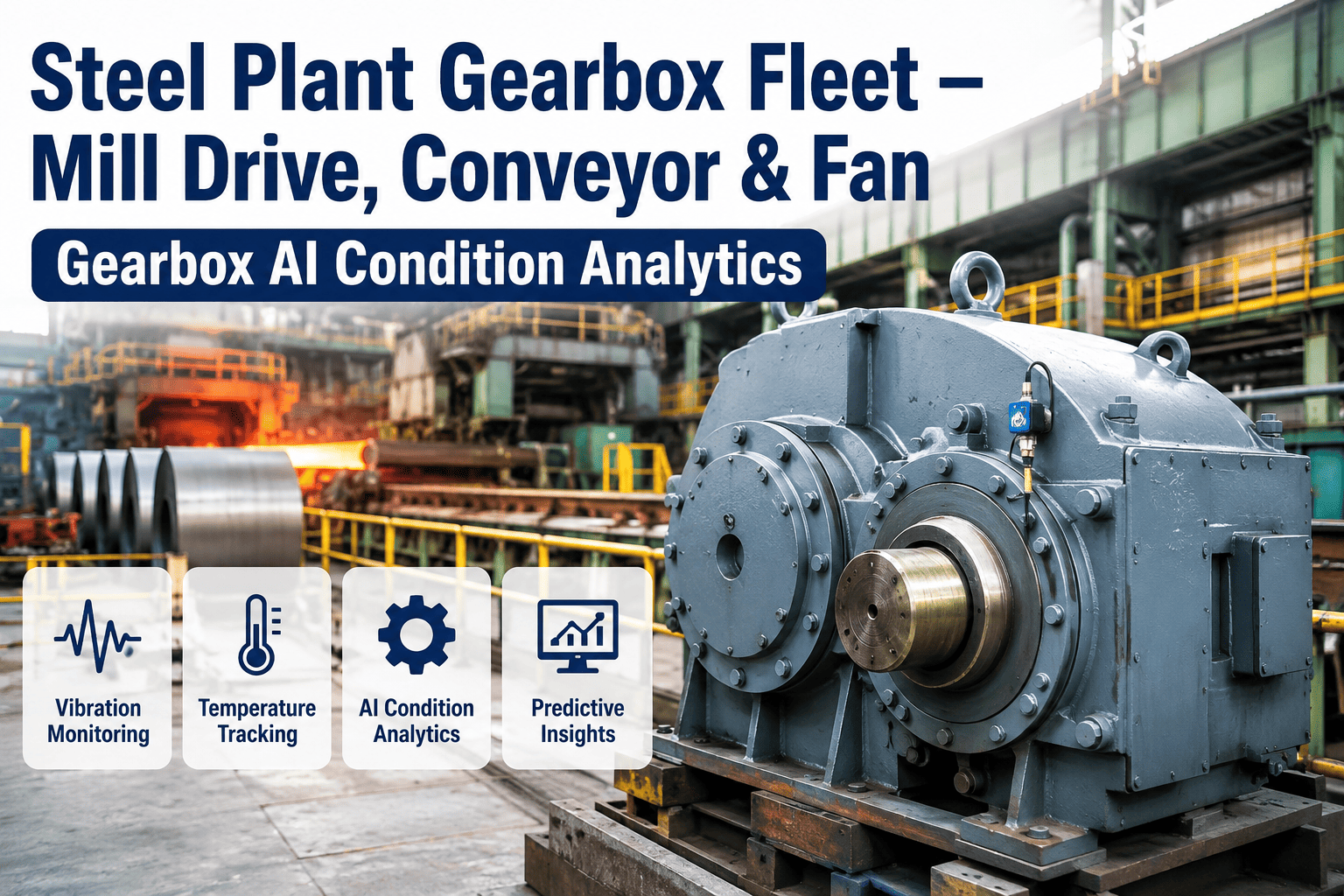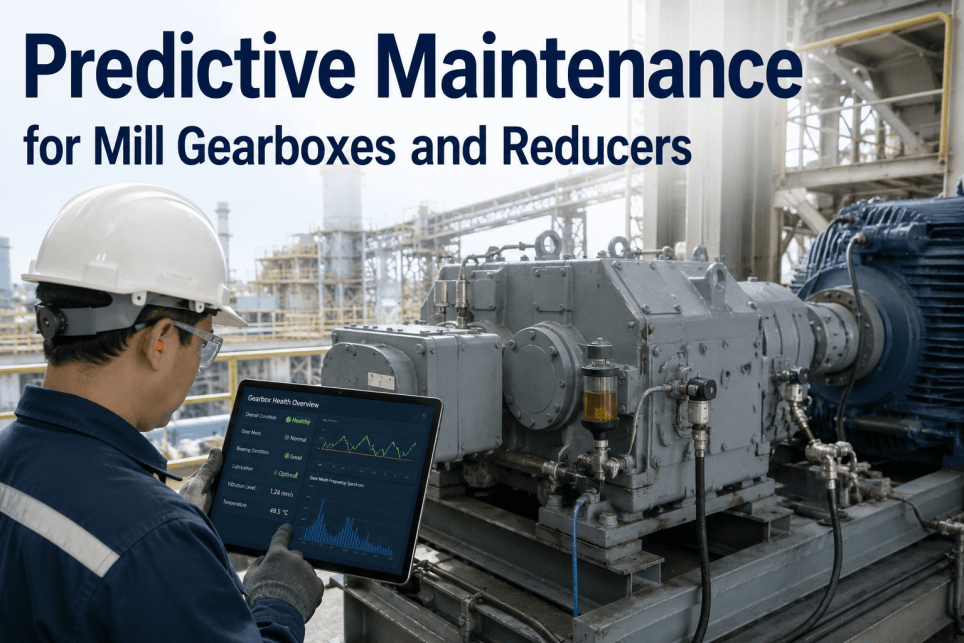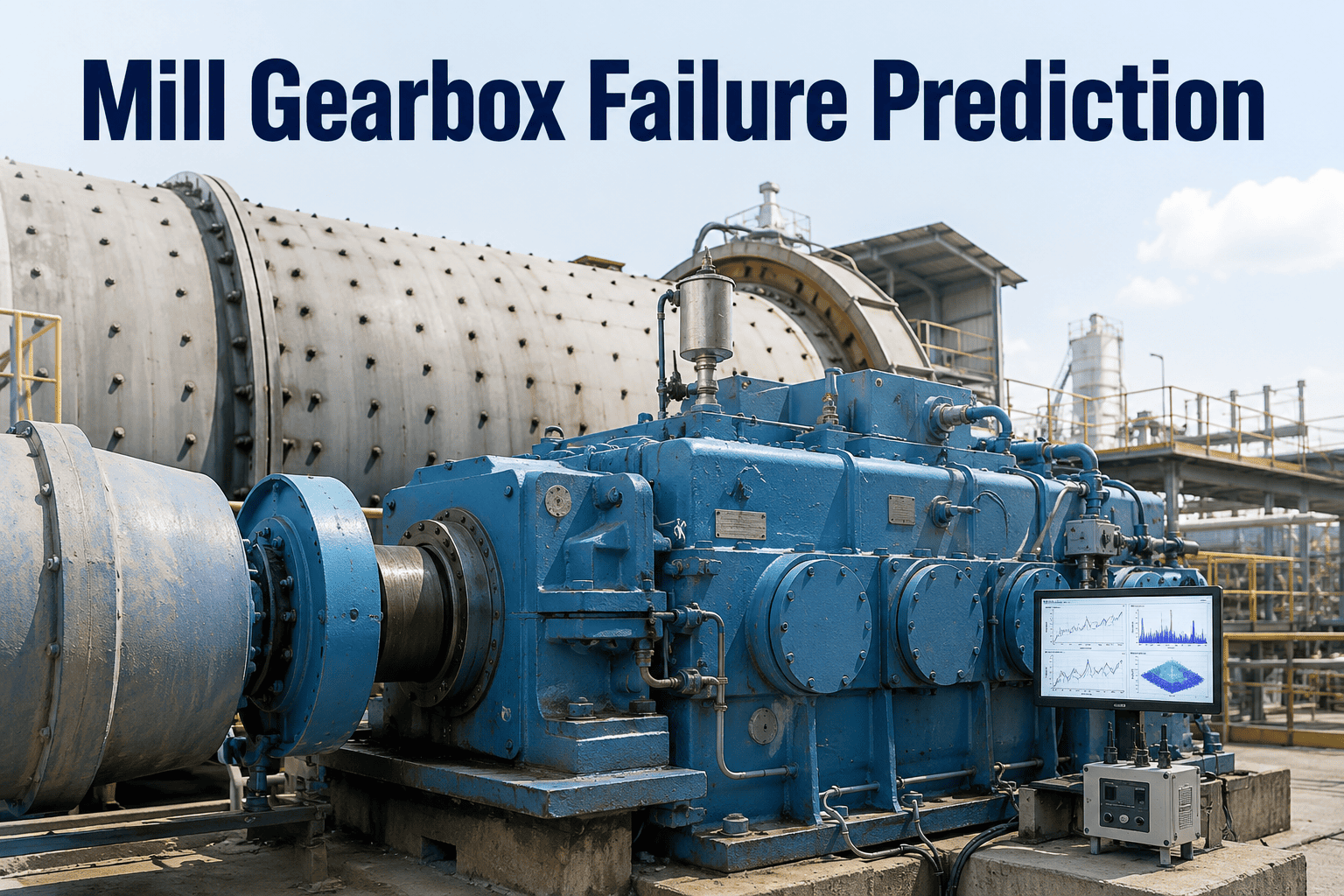
A single mill stand gearbox can weigh over 40 tonnes and drive thousands of horsepower into a rolling stand around the clock. When one fails without warning, the plant is not looking at a few hours of downtime — it is looking at a crane mobilisation, a spare parts search, and a production line sitting idle for days while a replacement is sourced or a rebuild is rushed. Most mills still rely on scheduled oil changes and periodic vibration checks that catch a fraction of developing faults, which is why unplanned gearbox failures remain one of the costliest line items in any mill maintenance budget. Mill maintenance leads evaluating a way to see failures coming can book a demo to see how AI-based condition monitoring changes this picture.
Stop Mill Gearbox Failures Before They Stop the Line
AI models trained on vibration, oil analysis, and acoustic data give mill maintenance teams weeks of advance warning on gear wear, bearing degradation, and lubrication failure — instead of a catastrophic breakdown with no notice at all.
Why Gearboxes Fail Without Warning
Mill gearboxes run at high torque, variable load, and constant thermal cycling. Failures rarely start as a sudden crack — they start as a slow drift in gear mesh condition, bearing clearance, or oil chemistry that manual inspection schedules are simply too infrequent to catch in time.
Three Data Streams, One Health Score
No single sensor tells the whole story. iFactory combines vibration, oil condition, and acoustic emission data into a single AI-driven health score for each gearbox, so maintenance teams get one clear signal instead of three separate reports to interpret manually.
| Data Source | What It Detects | Manual Monitoring Interval | AI Monitoring Interval |
|---|---|---|---|
| Vibration Analysis | Gear mesh faults, bearing spall, imbalance | Monthly or quarterly | Continuous, real time |
| Oil Analysis | Wear metals, oxidation, water content | Every 30–90 days | Continuous inline sensors |
| Acoustic Emission | Early-stage micro-cracking, surface fatigue | Rarely performed manually | Continuous, real time |
| Thermal Signature | Bearing friction, lubrication failure | Weekly spot checks | Continuous, real time |
See What Your Gearbox Data Is Already Telling You
Most mills already collect vibration or oil data — it just isn't being analysed continuously. iFactory engineers can review a sample of your existing data and show you what an AI model would have flagged.
From Vibration Spike to Work Order
The value of predictive monitoring depends entirely on what happens after a fault is detected. iFactory closes the loop from raw sensor data to a scheduled repair, so a flagged anomaly never sits unread in a dashboard.
What Early Warning Is Actually Worth
The cost of a gearbox failure is not just the part. It is the crane time, the rushed logistics, the overtime labour, and every hour the mill stand sits idle instead of producing coil. Catching the same fault three weeks earlier changes the entire cost profile.
Building the Business Case for Continuous Monitoring
Most mill maintenance leads already know continuous monitoring makes sense in principle. The harder part is building a case that survives a capital review, especially when the plant is already running on a tight maintenance budget with competing priorities across dozens of asset classes. The strongest business cases start narrow rather than broad — a handful of gearboxes with a documented failure history, or units whose replacement lead time alone justifies earlier warning, make a far more convincing pilot than an attempt to instrument the entire fleet on day one.
Start by pulling the last two to three years of maintenance records for the gearboxes on your highest-consequence stands. Look specifically at unplanned failures, the parts and labour cost of each event, and how much production time was lost while a replacement was sourced or a rebuild was rushed. This history does two things: it identifies which gearboxes are the best pilot candidates, and it gives you a real cost baseline to measure against once monitoring is in place, rather than relying on industry averages that may not reflect your plant's specific equipment and duty cycle.
Budget conversations tend to go better when framed around avoided downtime rather than sensor cost alone. A single unplanned gearbox failure on a critical mill stand can cost more in lost production than a full year of monitoring across the entire gearbox fleet. Framing the investment against that asymmetry — a relatively small, predictable monitoring cost against a rare but very expensive failure event — is usually more persuasive to a finance stakeholder than a generic efficiency argument.
Change management matters as much as the technology itself. Maintenance technicians who have spent years relying on scheduled oil changes and periodic vibration routes need to see the new alerts prove themselves before they fully trust a dashboard over their own experience. Running the AI system alongside existing practices for the first several months, rather than replacing scheduled maintenance outright, gives the team time to build confidence in the alerts as they start correctly flagging real developing faults.
Finally, plan for what happens after the pilot succeeds. A common mistake is treating a successful two-gearbox pilot as the finish line rather than the starting point. Before the pilot even begins, it helps to have a rough plan for what fleet-wide rollout would look like — how sensor procurement scales, how the CMMS integration extends to more assets, and who owns model tuning as coverage grows — so a successful result can move into expansion quickly instead of stalling while a second round of approvals gets arranged.
Common Mistakes Plants Make When Getting Started
A recurring pattern across mill maintenance teams adopting condition monitoring for the first time is trying to cover too much ground too quickly. Enthusiasm after a successful demo often leads to a plan for instrumenting the entire gearbox fleet in the first quarter, which stretches both the vendor's onboarding capacity and the maintenance team's ability to absorb a new workflow at the same time. Programmes that start with two to four carefully chosen gearboxes and expand only after the first units are producing reliable alerts consistently outperform those that try to scale immediately.
Another common mistake is underestimating how long model tuning takes for equipment with an unusual duty cycle or a non-standard gearbox configuration. Generic failure signature libraries provide a reasonable starting point, but a model reaches its full accuracy only after it has seen enough of a specific gearbox's own vibration and thermal behaviour across a range of operating conditions. Plants that expect near-perfect accuracy in the first two weeks are often disappointed, while plants that budget six to eight weeks for the model to learn each unit's baseline see far better long-term results.
Skipping the CMMS integration step in favour of manually reviewing a dashboard is another pattern that tends to undermine a programme's long-term success. Alerts that require a maintenance planner to remember to check a separate system, rather than arriving automatically as a work order in the tool the team already uses daily, get missed far more often than anyone expects, especially during busy periods when attention is stretched across competing priorities. The integration step often gets deprioritised early in a rollout because it takes coordination with IT, but skipping it is one of the most common reasons a promising pilot quietly loses momentum.
Finally, some plants treat a successful pilot as proof that no further investment is needed, missing the fact that the value of continuous monitoring compounds as more of the fleet is covered and as the maintenance team builds more experience acting on early alerts. A single prevented failure on one gearbox is a good result. A maintenance culture that has learned to trust and act on predictive alerts across the full fleet is a far more durable competitive advantage, and it only comes from treating the first pilot as a foundation rather than a finish line.
Frequently Asked Questions
Questions mill maintenance leads typically raise before rolling out condition monitoring across a full gearbox fleet.
Get a Free Gearbox Risk Review
Share your gearbox fleet list and current monitoring data. iFactory engineers will identify which units carry the highest failure risk and outline exactly what sensor coverage and model tuning would look like for your mill.