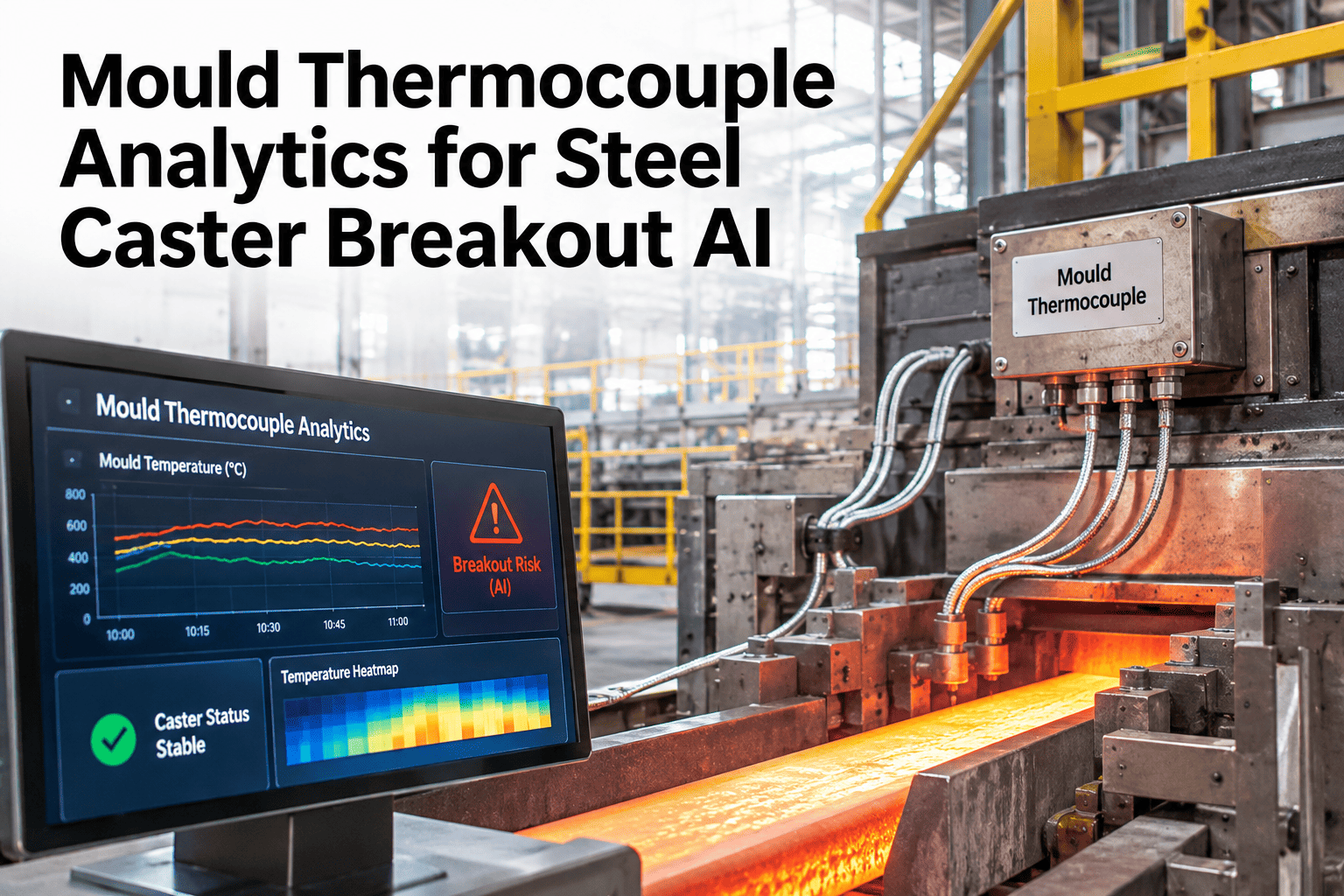
A slab caster mold typically carries several dozen to well over a hundred embedded thermocouples arranged in rows across its copper plates, and most of what those thermocouples report is routine thermal noise — until a specific pattern among them signals something developing. Sticker formation, mold friction breakdown and shell thinning each leave a distinct thermal signature, and classifying which signature is firing, not just flagging that something deviated, is what separates an early warning operators trust from one they learn to ignore. iFactory AI's continuous casting team can run anomaly classification against your own mold thermocouple history before your next campaign.
Not Every Thermocouple Deviation Is the Same Kind of Problem
Hot spots, sticker signals and thermal gradient anomalies each have a distinct signature across the mold's thermocouple array, and classifying which one is firing is what turns a deviation into an early, actionable warning.
Why a Single "Deviation" Alert Isn't Enough
A sticker-type shell tear shows up as thermocouple cluster deviation from baseline across adjacent mold rows, while mold friction breakdown shows up as a rising oscillation friction trace alongside an oil film pressure drop — two genuinely different precursors that a single generic deviation threshold cannot distinguish. An operator who gets the same alert for both learns quickly that the alert doesn't tell them what to do next, which is exactly the condition that leads to alerts being dismissed right before the one that mattered.
A localized heat flux rise that may or may not be developing into a sticker.
A specific adjacent-row divergence pattern with the highest breakout risk.
A broader asymmetry across the mold face, often tied to taper or level issues.
A slow or non-responsive thermocouple that looks like an anomaly but isn't one.
How Classification Actually Narrows the Response
Each classified signature should map to its own response, not one generic "investigate" instruction. Our team can map your current alert thresholds to these signature classes.
Normal heat flux pattern established per row, per steel grade and casting speed.
Hot spot, sticker signature, thermal gradient or sensor drift — each pattern is distinct.
A sticker signature triggers immediate speed reduction; a hot spot triggers closer watch.
A drifting sensor gets flagged for replacement, not mistaken for a process anomaly.
Signature Classes and Typical Response Windows
| Signature Class | What It Looks Like | Typical Response Window |
|---|---|---|
| Sticker signature | Adjacent-row thermal divergence | Seconds — immediate speed reduction |
| Hot spot | Localized heat flux rise, single zone | Minutes — closer monitoring, review at sequence end |
| Thermal gradient anomaly | Asymmetry across the mold face | Review against taper and level settings |
| Sensor drift | Slow or non-responsive reading | Flagged for replacement at next opportunity |
See Which Signature Classes Your Current System Already Distinguishes
Bring thermocouple trend data from a recent cast and see how your current alerts map against these four signature classes.
A Composite Scenario: The Alert Operators Had Learned to Second-Guess
Picture a caster where a single generic "thermal deviation" alert fired several times a week, most often for hot spots that resolved on their own, leading operators to treat every instance of the alert with the same reduced urgency.
Splitting the alert into distinct signature classes meant operators could trust that a sticker-classified alert was genuinely different from the routine hot-spot alerts they'd learned to deprioritize, restoring the urgency a true precursor deserved. The scenario illustrates why classification matters for trust, not just accuracy; actual signature patterns vary by mold design and steel grade.
Where iFactory AI Fits
iFactory AI classifies mold thermocouple deviations into distinct signature classes — sticker, hot spot, thermal gradient and sensor drift — using your existing thermocouple array, so each alert carries its own appropriate response instead of one generic warning.
Each anomaly class routes to the response it actually warrants.
No new thermocouple hardware required to add classification.
Drift gets flagged as a maintenance item, not confused with a process anomaly.
Frequently Asked Questions
A sticker signature shows a specific divergence pattern between adjacent thermocouple rows that differs from the localized, single-zone rise typical of an ordinary hot spot, and that distinction is what the classification model is trained to recognize. Review sample signature patterns from your own mold data.
No, classification works against the existing thermocouple array most casters already have installed, using pattern recognition across the current sensor layout rather than requiring denser instrumentation. Confirm compatibility with your current array.
A drifting or slow-responding thermocouple shows a characteristic signal pattern distinct from heat flux changes driven by the casting process itself, which is why sensor health is tracked as its own category rather than folded into process anomaly alerts. Ask how sensor health tracking works.
Several months of data across the steel grades and casting speeds a mold normally runs is typically enough to establish a reliable baseline, since heat flux patterns differ meaningfully between grades and speeds. Scope a baseline window for your mold's product mix.
Yes, signature classification is designed to layer onto an existing breakout detection system's thermocouple feed, adding classification detail rather than replacing the detection logic already protecting the strand. Discuss how this complements your current BODS.
Give Every Thermocouple Alert Its Own Appropriate Response
iFactory AI classifies mold thermocouple anomalies into sticker, hot spot, thermal gradient and sensor-drift signatures, so operators trust the alert enough to act on it.