Knowing that a gearbox will fail in three weeks is useful. Knowing that reducing its load by fifteen percent for the next two shifts and rescheduling the replacement for Sunday's planned outage will avoid that failure entirely is what actually changes what happens on the plant floor. This is the gap between predictive maintenance and prescriptive maintenance, and it is a gap most steel plants have not yet closed. Predictive systems raise an alert; prescriptive systems tell a maintenance planner exactly what to do about it, in what order, and by when, closing the loop between detection and action. iFactory's prescriptive engine goes beyond the alert to deliver the recommendation itself, and you can book a demo to see how it turns a raw anomaly into a scheduled work order.
An Alert Tells You Something Is Wrong. A Prescription Tells You Exactly What to Do About It.
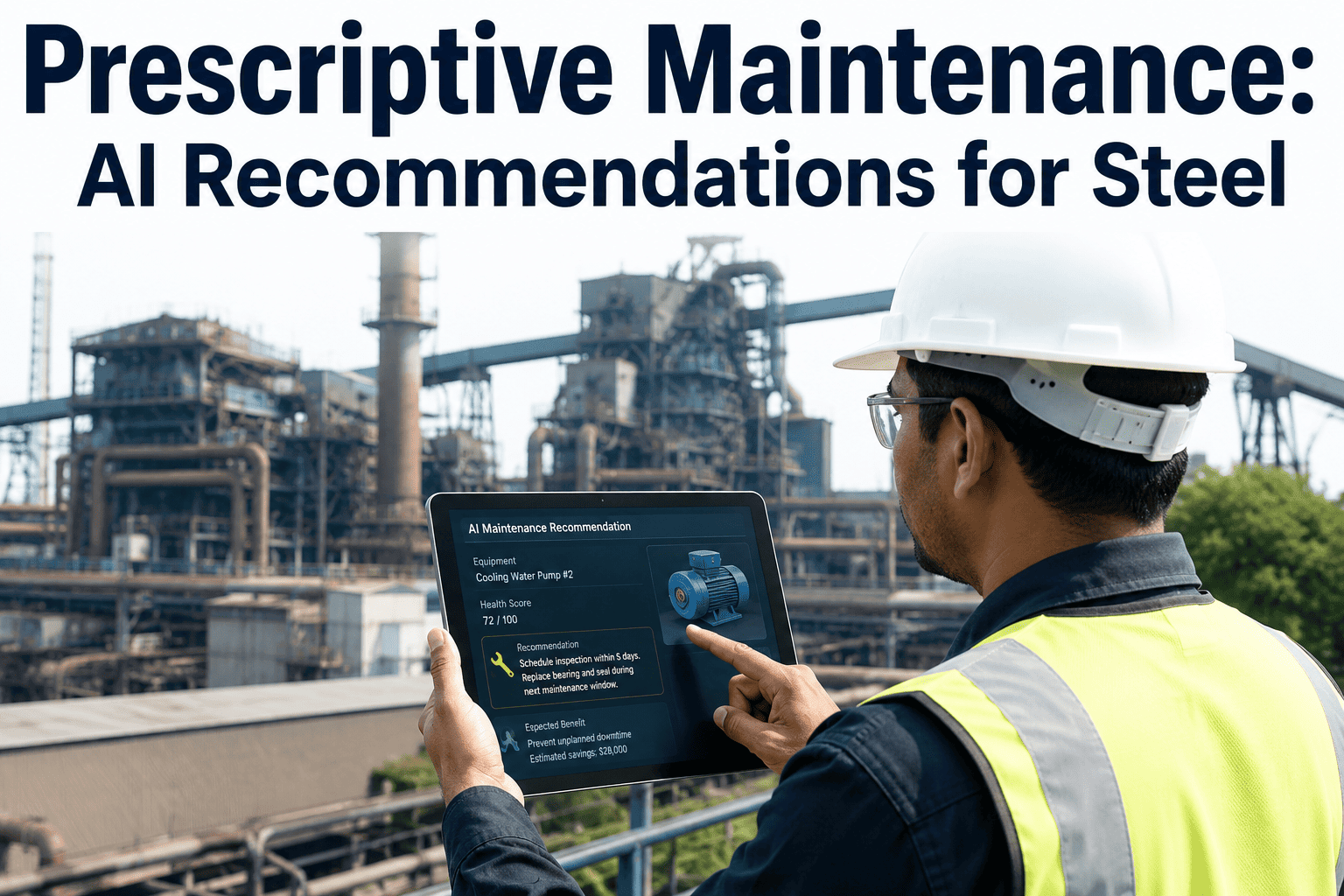
iFactory's prescriptive maintenance engine evaluates equipment condition against your production schedule, crew availability, and spare parts stock, then recommends the specific action that avoids failure with the least disruption to output.
Most Plants Stopped at Prediction. That Is Only Half the Value.
Predictive maintenance answers one question: is this asset likely to fail, and roughly when. That is a genuine improvement over calendar-based maintenance, but it still leaves the hardest part of the decision to a human under time pressure. A planner receiving a predictive alert still has to figure out what specifically is wrong, whether it is safe to keep running the equipment, how urgently to schedule the repair, whether the right parts are in stock, and which technician has the right skill set available. Prescriptive maintenance answers all of those questions inside the alert itself, evaluating multiple possible interventions and recommending the one that minimizes downtime, cost, and disruption while accounting for the operational constraints your team is actually working within, and doing so consistently across every shift rather than depending on whichever planner happens to be on duty when the alert fires.
The distinction matters more in a steel plant than in almost any other manufacturing environment, because the cost asymmetry between a planned repair and an unplanned failure is unusually large. A bearing replaced during a scheduled roll change might take a few hours and cost the price of the part and labor. The same bearing failing mid-campaign on a hot strip mill can take an entire line down for the better part of a day, produce off-gauge scrap in the hours leading up to the failure, and force an emergency parts order at a significant premium over standard procurement pricing. A predictive alert alone does not close that gap, because it still depends on a human correctly interpreting the data, checking multiple disconnected systems for parts and crew availability, and making the right call fast enough to matter. Prescriptive maintenance closes the gap by doing that reasoning automatically and consistently, every time an anomaly is detected, regardless of which planner is on shift or how busy the maintenance office happens to be that day.
Predictive Maintenance
- Flags that a failure is likely within a time window
- Leaves diagnosis and action planning to the technician
- Does not account for production schedule or parts availability
- Requires human judgment to translate data into a decision
Prescriptive Maintenance
- Identifies the specific failure mode and affected component
- Recommends the exact corrective action and timing
- Weighs production schedule, crew, and spare parts before recommending
- Generates a ready-to-approve work order automatically
From Anomaly to Recommendation in Four Steps
Prescriptive recommendations are only genuinely useful if they reflect real constraints on your plant floor, not a generic best practice pulled from a manual. iFactory builds every recommendation from your actual operating data, and the four steps below run continuously in the background rather than waiting for a human to initiate an analysis. That continuous loop is what allows the system to catch a developing failure days before a planner would typically start investigating a raw sensor trend on their own, and it means the recommendation is already sitting in the work order queue by the time anyone would have manually noticed something looked off, which is the practical advantage that separates a genuinely predictive-prescriptive system from a dashboard that still requires someone to go looking for trouble.
Detect the Deviation
Sensor data is compared against the asset's established baseline to confirm a genuine anomaly rather than normal operating variance.
Diagnose the Cause
Pattern matching against historical failure signatures identifies the specific failure mode, whether bearing wear, misalignment, or electrical imbalance.
Evaluate the Options
Multiple intervention scenarios are scored against downtime cost, parts availability, crew capacity, and production impact.
Recommend and Schedule
The lowest-disruption option is surfaced as an approvable work order with the reasoning attached for planner review.
Stop Making Your Best Planners Re-Solve the Same Problem Every Time
iFactory's prescriptive engine does the diagnostic and scheduling work automatically, so your team spends time executing repairs instead of debating them.
The Engine Weighs Real Operational Constraints, Not Just Equipment Condition
A recommendation that ignores your production schedule or spare parts position is not actually actionable, no matter how accurate the underlying failure prediction is. iFactory's prescriptive layer pulls in the operational context a human planner would normally have to gather manually before making a call, and it re-evaluates that context continuously rather than treating it as a one-time input, so a recommendation made on Monday reflects Monday's actual parts and crew position rather than a stale snapshot from whenever the underlying model was originally trained or last refreshed.
Production Schedule
Recommends interventions timed around planned stops, changeovers, or low-demand windows rather than forcing an unplanned line stop.
Spare Parts Position
Checks current stock and lead time for the required part before recommending immediate action versus a monitored wait.
Crew Availability
Matches the recommended repair to technicians with the right certification and schedules around shift coverage gaps.
Failure Consequence
Weighs the cost and safety implications of the specific failure mode against the cost of the recommended intervention.
How a Gearbox Alert Becomes a Scheduled Work Order
Vibration sensors on a hot strip mill drive gearbox begin showing a slow rise in high-frequency energy consistent with early-stage bearing wear. A purely predictive system would generate an alert stating that failure is likely within roughly three weeks. iFactory's prescriptive engine goes several steps further: it identifies the specific bearing location based on the vibration signature, checks that a replacement bearing is in stock at the local storeroom, confirms that a qualified millwright is scheduled on the shift that overlaps with the next planned line stop, and calculates that reducing the mill's feed rate by a modest margin for the intervening period will keep the bearing within safe operating limits until that planned window arrives. The resulting recommendation is not "schedule maintenance soon." It is a specific work order naming the bearing, the technician, the parts already reserved, the load reduction to apply in the interim, and the exact planned stop during which the swap should happen, ready for a maintenance planner to review and approve in minutes rather than build from scratch.
Compare that outcome against how the same scenario typically plays out without a prescriptive layer in place. A vibration alert lands in a shared inbox or dashboard, and a planner has to interpret the trend, decide whether it warrants urgent action, separately check the storeroom system for parts, separately check the workforce scheduling tool for available millwrights, and separately estimate a safe interim operating margin, often relying on personal experience rather than a documented calculation. Each of those steps takes time, and each one introduces a chance for a mistake or an oversight, particularly on a busy shift when the planner is juggling several other issues at once. Collapsing that entire process into a single reviewable recommendation is not just a convenience; it is the difference between a bearing that gets swapped calmly during Sunday's planned stop and one that fails unpredictably on a Wednesday afternoon because the alert sat unactioned for two days behind a dozen other priorities.
What Steel Plants Report After Adding Prescriptive Recommendations
These figures reflect outcomes reported by plants that moved from alert-only predictive maintenance to a prescriptive recommendation layer that ties condition data to scheduling and parts availability. The consistent theme across deployments is that the financial return comes primarily from the gap between the cost of a planned repair and the cost of the catastrophic failure it replaces, not from the underlying sensor technology, which is often already in place before the prescriptive layer is added.
Most Facilities Have the Sensors. Few Have the Decision Layer.
A large share of manufacturers now have some form of AI-driven condition monitoring in place, yet only a small fraction have moved past the pilot stage to full prescriptive automation. The gap is rarely the sensors or the data pipeline. It is the decision layer that turns raw anomaly detection into a recommendation a planner can trust and act on without re-verifying every input manually. Budget uncertainty is a common barrier, since prescriptive systems can be harder to justify on ROI terms than a straightforward predictive alert, and skills gaps compound the problem as experienced maintenance staff retire and take undocumented diagnostic judgment with them. iFactory addresses this directly by making every recommendation explainable, showing the sensor evidence, the failure mode match, and the constraint calculations behind each suggestion, so planners can build trust in the system incrementally rather than being asked to hand over scheduling decisions to a black box on day one.
The skills gap in particular deserves attention because it is often the least visible driver of maintenance risk across the industry as a whole. A significant share of experienced maintenance professionals are approaching retirement age, and the diagnostic judgment they have accumulated over decades, the ability to hear that a bearing sounds wrong or recognize a subtle vibration pattern as an early warning sign, rarely gets written down anywhere in a format anyone else can use. When that person leaves, the plant does not just lose a headcount; it loses an unwritten diagnostic playbook that took years to build. Prescriptive AI does not replace that judgment, but it does capture the pattern recognition embedded in historical failure data and makes it available to every technician on every shift, which is a meaningful hedge against the workforce transition every heavy industry is currently navigating.
Questions Maintenance Planners Ask About Prescriptive AI
Do we need existing predictive maintenance in place before adding prescriptive recommendations?
Prescriptive capability builds on the same sensor and condition data used for predictive maintenance, so having a predictive foundation in place makes the transition faster, but it is not a strict prerequisite. iFactory can deploy both layers together for plants starting from scratch, with the prescriptive engine learning constraint patterns as production and parts data accumulates. Book a demo to discuss the right starting point for your current maintenance maturity.
How does the system know our spare parts stock and crew schedule?
The engine integrates with your existing CMMS and inventory records to pull real-time parts availability, and with your workforce scheduling system to understand crew certifications and shift coverage, rather than requiring a separate data entry process. Where those systems are not yet connected, iFactory's team works with your IT group to establish the integration during onboarding. Contact our support team for a list of supported CMMS and ERP integrations.
Can a planner override a recommendation if they disagree with it?
Yes, every recommendation is presented as a proposed work order for planner review and approval rather than an automatically executed action, and planners can adjust timing, technician assignment, or scope before confirming. The system also learns from override patterns over time, which helps refine future recommendations to better match real operational judgment. Book a demo to see the approval workflow in action.
What happens if the recommended part is not in stock?
The engine flags the stockout as part of the recommendation itself, offering an interim mitigation such as a load reduction or increased monitoring frequency while the part is expedited, rather than simply recommending an action that cannot actually be executed. This is one of the core advantages of factoring real inventory data into the recommendation rather than treating condition monitoring and parts management as separate systems. Contact our support team to see how parts constraints are handled in your specific inventory setup.
How long does it take before recommendations become reliable enough to trust?
Most plants see the engine's diagnostic accuracy improve meaningfully within the first two to three months as it accumulates baseline data across a full range of operating conditions and production cycles, and confidence typically builds fastest when planners can see the underlying reasoning behind each early recommendation rather than a bare instruction. Many teams start by running prescriptive suggestions alongside their existing decision process before shifting primary reliance onto the engine. Book a demo to see accuracy benchmarks from comparable steel plant deployments.
Prescriptive AI Does Not Replace Your Planners. It Removes the Repetitive Part of Their Job.
The goal of a prescriptive layer is not to take decision-making authority away from experienced maintenance planners, but to remove the repetitive, time-consuming diagnostic legwork so their judgment gets applied where it matters most. A planner reviewing a fully assembled recommendation, complete with the sensor evidence, the parts check, and the proposed schedule, can approve, adjust, or reject it in a fraction of the time it would take to build that same picture from scratch across three or four disconnected systems. Over time, most teams report that this frees senior planners to focus on the judgment calls that genuinely require experience, such as weighing a marginal case where the data is ambiguous, while routine recommendations move through approval quickly because the underlying analysis is already sound and transparent. This is also where the workforce transition benefit becomes tangible day to day: a newer planner working alongside the prescriptive engine has access to the same quality of diagnostic reasoning a twenty-year veteran would apply, narrowing the experience gap that normally takes years to close on the job.
Turn Every Maintenance Alert Into a Ready-to-Approve Work Order
iFactory's prescriptive engine tells your team exactly what to fix, when, and with which parts and technician. Book a demo and see it built around your own equipment and constraints.