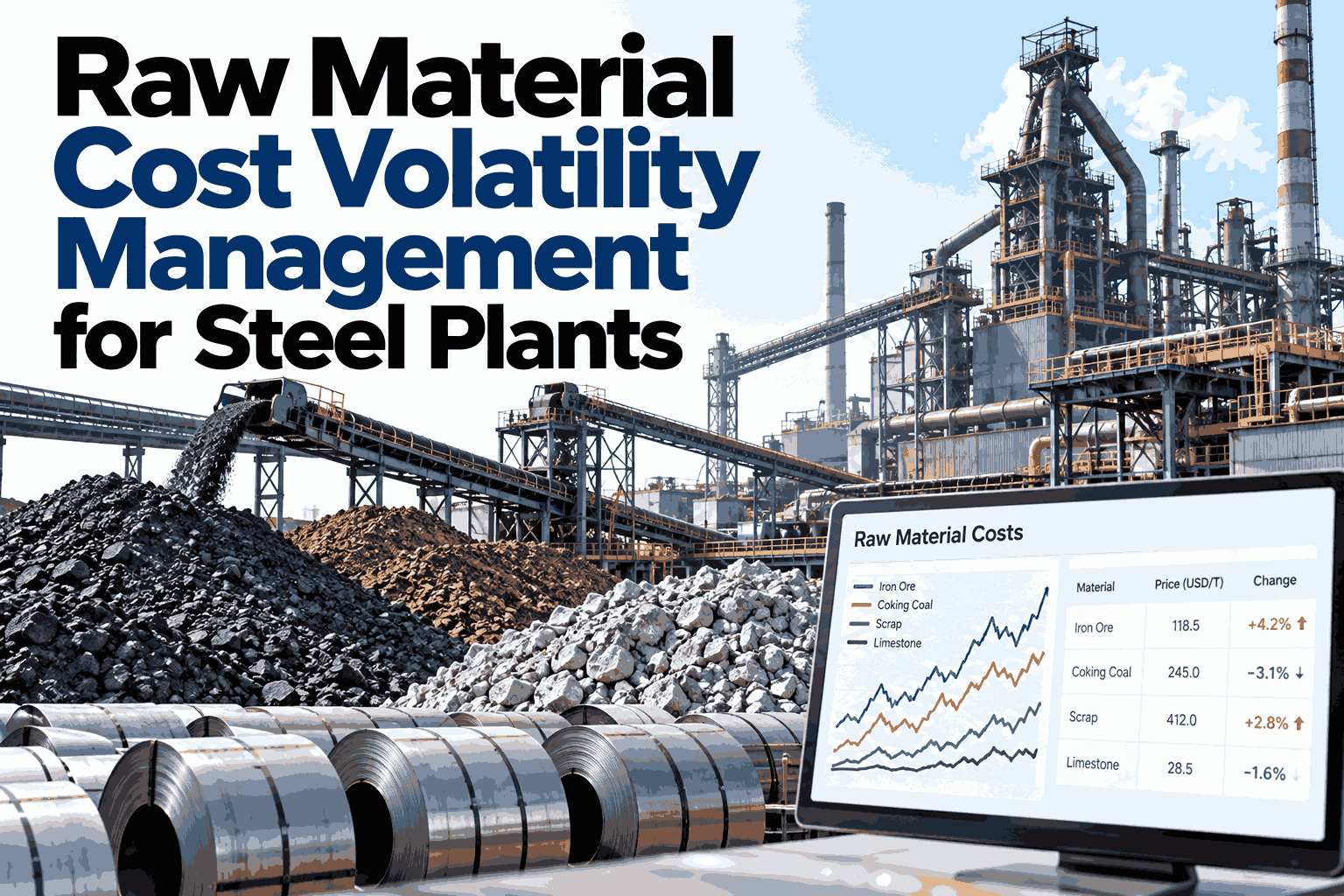
Steel prices and raw material prices rarely move together, and the gap between them is where margin is made or lost. Iron ore, coking coal, scrap and alloys can each swing sharply within a quarter, while selling prices adjust slowly and often after the fact. Plants that only see the damage in the month-end cost sheet are always a step behind the market. Teams that want to see exposure as it builds can ask iFactory AI's team to map their raw material exposure against live cost per tonne.
Stop Letting Commodity Swings Decide Your Margin
iFactory AI turns iron ore, coking coal, scrap and alloy price moves into a live margin view, so the response starts in week one, not after month close.
The Squeeze: When Inputs Run Ahead of Price
Volatility hurts most when input cost rises quickly and selling price follows slowly. The chart shows an illustrative six-month squeeze, with both series indexed to 100 at the start.
Exposure by Input
Each input carries a different risk profile and a different toolset. The table ranks them with illustrative ratings, and your plant's route and contracts will shift the picture.
| Input | Cost Weight | Price Swing | Main Protection |
|---|---|---|---|
| Iron ore | High | Medium to high | Index-linked contracts, stock cover, derivatives where liquid |
| Coking coal | High | High | Multi-source supply, blend flexibility, forward cover |
| Scrap | Medium to high | High | Yard blending, supplier spread, price-linked sales terms |
| Alloys | Low | High | Recovery control, addition models, grade-wise substitution |
See Which Input Is Costing You Margin Right Now
Book a 30-minute session and iFactory AI will show how each raw material move flows through to cost per tonne on your own data.
A Response Lane for Every Input
Managing volatility is not one strategy. Each input follows the same three steps of detect, decide and protect, but the tools inside each step differ.
A Price Shock, Week by Week
The same market move plays out very differently depending on when the plant sees it.
The Readiness Staircase
Most plants sit on one of three steps. Knowing which one you are on shows what to build next.
A Composite Scenario: The Same Shock, Two Responses
Two plants faced the same sharp rise in coking coal and scrap. The bars show margin per tonne, indexed to 100 before the shock, with illustrative figures.
Where iFactory AI Fits
Price feeds, purchase records, heat data and sales orders sit in different systems. iFactory AI joins them and shows the effect on cost per tonne.
Live Exposure Map
See open volume, stock and contract cover for every input in one view.
Price-to-Cost Link
Every price move is converted into cost per tonne by grade and furnace.
Mix Comparison
Compare scrap grades, coal blends and alloy routes on net cost, not list price.
Trigger Alerts
Set threshold levels so the right owner is told when margin starts to compress.
Frequently Asked Questions
Should a steel plant hedge raw materials financially?
It depends on the input, the liquidity of the instruments and the plant's risk policy. Iron ore and some other inputs have usable derivatives, while scrap and many alloys rely more on physical measures. Financial hedging decisions belong with treasury and finance, not with the plant alone. iFactory AI supplies the exposure and margin numbers those teams need. Support can share an exposure report format for that conversation.
What is the cheapest way to reduce volatility risk?
Usually it is using less of the volatile input for every tonne of steel. Better alloy recovery, tighter charge control and blend optimisation reduce exposure without any financial contract. These gains also help when prices are calm, so they are never wasted. Once consumption is under control, contracts and cover levels can be set on a smaller and more predictable volume.
How quickly can we see the effect of a price change?
Once price feeds and purchase records are connected, the effect on cost per tonne can be shown within the same shift. The value is not only speed. The view shows which grades, furnaces and orders are affected, so the response can be targeted. See this on a live walkthrough with a price move from your own recent history.
Can selling prices be linked to input costs?
In many cases, yes. Price-linked terms, surcharges and shorter quote validity all reduce the lag between input and selling price. Which of them is possible depends on the product, the customer and the market. To negotiate from a position of strength, sales teams need a reliable figure for the cost impact by grade, which is exactly what a live cost view provides.
Do we need to replace our ERP to do this?
No. iFactory AI connects to the ERP and MES you already run and reads purchase, stock, heat and order data from them. Nothing is replaced. The work in the first weeks is mapping materials, grades and cost centers so the numbers reconcile with finance. Ask the support team about integration for your systems before you plan the rollout.
Protect Margin Before the Month-End Report Shows the Damage
iFactory AI links every raw material move to cost per tonne and margin. Book a walkthrough to see it against your own purchase and heat data.