Choosing a refractory grade by copying whatever the last vessel used, or whatever the supplier's sales rep recommended most enthusiastically, is how plants end up paying premium prices for chemical resistance they do not need while under-specifying the mechanical toughness they do. Material selection done properly starts from the actual operating conditions a specific vessel and zone will see — thermal cycling frequency, slag chemistry, mechanical stress, and atmosphere — and works forward to the grade that matches those conditions, not backward from habit. Plants building that matching discipline into their procurement process can Book a Demo to see how selection criteria connect to campaign outcomes.
REFRACTORY SELECTION · MgO · Al2O3 · SiC · MATERIAL MATCHING
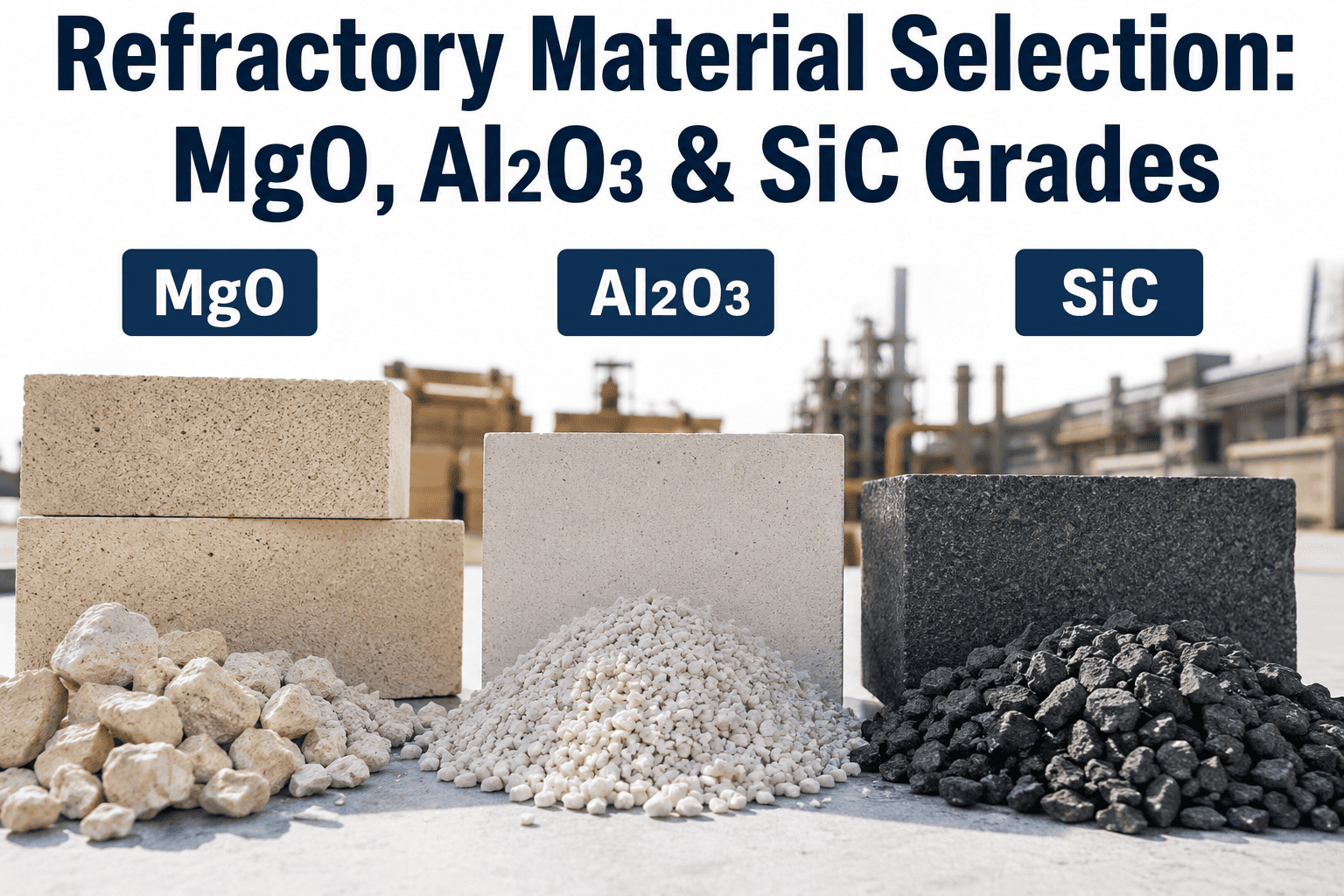
Refractory Material Selection: MgO, Al2O3 & SiC Grades
A structured approach to matching refractory material grade to actual operating conditions — thermal, chemical, and mechanical demands — across BOF, EAF, ladle, and tundish applications.
Why Grade Selection Starts With Conditions, Not With Habit
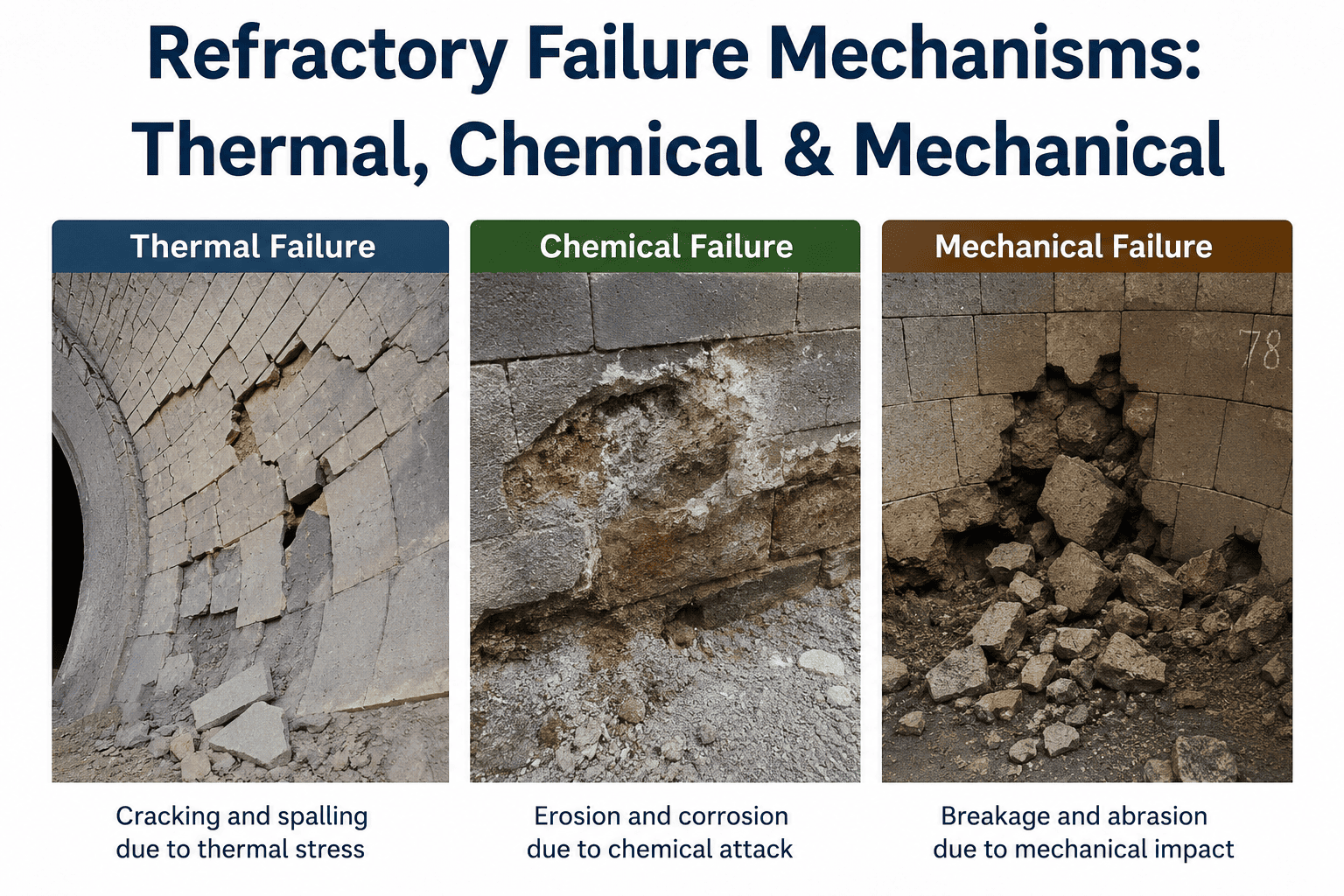
The single most consistent finding across refractory failure investigations is that a meaningful share of premature failures trace back to a grade selected for the wrong dominant condition — chemical-resistant grade specified where mechanical erosion was actually the primary threat, or a high-strength grade specified where chemical attack was the real driver. Both mismatches waste money, just in different directions: over-specifying chemical resistance where it is not the limiting factor pays a premium for a property the vessel does not need, while under-specifying mechanical toughness where erosion dominates produces a campaign shorter than the material's rated life would suggest.
Correct selection starts by characterizing the zone's actual dominant stress — is this a slag-line zone where chemical attack is the limiting condition, a tap-hole area where mechanical erosion dominates, or a working lining exposed to frequent thermal cycling — and then matching material properties to that specific dominant condition rather than selecting one grade uniformly across an entire vessel. Zone-specific selection, using different grades in different areas of the same vessel based on their actual local condition, is standard practice in mature refractory programs and one of the more overlooked cost-and-performance levers available.
The Three Core Material Families
Magnesia (MgO)
Strong resistance to basic slag chemistry, making it the standard choice for BOF and EAF hot-face applications and ladle slag lines where basic slag chemistry dominates. Comparatively lower mechanical toughness and thermal shock resistance than alternatives, which limits its fit in zones with high mechanical stress or aggressive thermal cycling.
Alumina (Al2O3)
Balanced general-purpose performance with good thermal shock resistance and moderate chemical resistance, making it a common choice for tundish linings and ladle working linings where thermal cycling is significant but slag chemistry is less extreme than a BOF or EAF hot face.
Silicon Carbide (SiC)
High thermal conductivity and excellent mechanical toughness and erosion resistance, making it well suited to zones with high mechanical stress from metal or slag flow, though typically at a higher material cost than the other two families.
MATERIAL SELECTION · GRADE MATCHING · REFRACTORY PROCUREMENT
Match Grade to Zone Condition, Not to Habit
iFactory connects each vessel zone's actual thermal, chemical, and mechanical history to grade performance data — so material selection is a matched decision, not a copied one.
Grade Comparison Across Selection Criteria
| Property | Magnesia (MgO) | Alumina (Al2O3) | Silicon Carbide (SiC) |
|---|
| Basic slag resistance | Excellent | Moderate | Moderate |
| Thermal shock resistance | Moderate | Good | Excellent |
| Mechanical toughness | Moderate | Good | Excellent |
| Thermal conductivity | Moderate | Moderate | High |
| Typical relative cost | Moderate | Lower | Higher |
| Common application | BOF/EAF hot face, ladle slag line | Tundish, ladle working lining | High-erosion mechanical zones |
The Zone-by-Zone Selection Approach
A single vessel typically has several distinct zones, each experiencing a different dominant stress, and specifying one grade uniformly across all of them is a common source of both wasted spend and premature localized failure. The categories below outline the zone-based approach mature refractory programs use to match grade to condition rather than applying a blanket specification.
01
Map the Vessel Into Distinct Zones
Identify hot face, slag line, tap-hole, and working lining zones separately, since each typically experiences a meaningfully different combination of thermal, chemical, and mechanical stress.
02
Characterize the Dominant Stress Per Zone
Use historical wear pattern and failure mechanism data specific to that zone, not vessel-wide averages, to determine which of thermal, chemical, or mechanical stress dominates locally.
03
Match Grade Properties to the Dominant Stress
Select the material family whose strongest property aligns with the zone's dominant stress, rather than defaulting to a single grade specified uniformly for simplicity.
04
Validate Against Total Installed Cost, Not Material Cost Alone
Weigh material cost against expected campaign life extension for that zone specifically, since a higher-cost grade in the right zone often produces a lower total cost per ton of throughput.
05
Track Actual Performance Against the Selection
Record how each zone-grade combination actually performs across campaigns to refine future selection decisions with real outcome data instead of catalog specification alone.
Frequently Asked Questions: Refractory Material Selection
Is a higher-cost refractory grade always the better long-term choice?
Not necessarily — the correct comparison is total installed cost per unit of campaign life or throughput, not material price alone. A higher-cost grade specified in a zone where its strongest property matches the dominant local stress often produces a lower effective cost through extended campaign life, but the same grade specified in a zone where that property is not the limiting factor is simply an unnecessary premium. Teams evaluating this tradeoff can
Book a Demo to see zone-specific cost modeling.
Can different refractory grades be mixed within the same vessel?
Yes, and zone-specific mixing is standard practice in mature refractory programs rather than an unusual approach. Using a chemically resistant grade at the slag line, a thermal-shock-resistant grade in the working lining, and an erosion-resistant grade at high-flow impact points is a common configuration, since each zone experiences a genuinely different dominant stress that a single uniform grade would not serve equally well.
How do I know if my current refractory grade is actually mismatched to the zone condition?
The clearest signal is a consistent gap between the grade's rated campaign life and the actual campaign life achieved, especially when the wear pattern points to a mechanism the grade was not primarily selected to resist. If a chemically resistant grade is showing primarily mechanical erosion wear, for example, that is a strong indicator the zone's dominant stress does not match what the grade was optimized for, regardless of its overall quality.
Does refractory grade selection need to be revisited if operating conditions change?
Yes — a grade selected correctly for one operating condition can become mismatched if slag chemistry, product mix, or thermal cycling frequency shifts meaningfully afterward. Selection is a matching exercise tied to specific conditions, not a permanent specification, and plants that revisit grade selection when operating conditions change materially typically avoid the gradual performance drift that comes from an outdated specification quietly becoming mismatched over time.
What is the biggest mistake plants make when comparing refractory grades?
Comparing grades primarily on a single headline property — often chemical resistance — without weighing it against the zone's actual full stress profile including thermal cycling and mechanical demand. A grade that excels at the one property compared is not automatically the best match if a different property is actually the limiting factor for that specific zone. Structured zone-by-zone comparison against all relevant properties avoids this trap; contact
iFactory Support for help building that comparison framework.
REFRACTORY SELECTION · GRADE MATCHING · CAMPAIGN COST
Select Refractory Grade by Zone Condition, Not by Default
iFactory ties zone-specific wear history, thermal cycling, and slag chemistry to material grade performance — so every refractory purchase decision is matched to the condition it will actually face.