A refractory lining rarely fails from one cause acting alone — it fails from thermal cycling weakening a structure that chemical attack was already thinning, finished off by mechanical impact that a healthy lining would have shrugged off without damage. Treating refractory failure as a single category obscures this, and it is the reason so many BOF, EAF, ladle, and tundish lining failures get logged simply as "end of campaign" without ever identifying which mechanism actually drove the wear. Separating thermal, chemical, and mechanical failure mechanisms and tracking each independently is what lets a plant extend campaign life instead of just replacing linings on schedule, and teams ready to build that tracking can Book a Demo to see it in practice.
REFRACTORY FAILURE · THERMAL · CHEMICAL · MECHANICAL
Refractory Failure Mechanisms: Thermal, Chemical & Mechanical
A working reference for identifying how refractory linings actually fail across BOF, EAF, ladle, and tundish applications — thermal shock, chemical attack, erosion, and structural failure, and how to tell them apart before the campaign ends unexpectedly.
Why Every Refractory Failure Is Actually a Combination
Pure single-mechanism refractory failure is rare in practice. What plants actually experience is a dominant mechanism accelerated by one or two contributing mechanisms — a lining primarily worn by chemical slag attack that fails earlier than its chemical-attack rate alone would predict because thermal cycling had already introduced microcracks the slag could penetrate faster. Identifying only the dominant, most visible mechanism and ignoring the contributing ones is the most common reason refractory failure investigations produce a diagnosis that does not actually extend the next campaign's life.
The practical approach mature refractory programs use is scoring each failure event against all three mechanism categories rather than picking one label, because the mitigation strategy differs meaningfully depending on which combination is at play. A lining failing primarily from thermal shock with minor chemical contribution needs a different fix — better preheating discipline, slower heat-up ramps — than one failing primarily from chemical attack with thermal cycling as a secondary accelerant, which needs a different refractory grade or slag chemistry control instead.
The Three Failure Mechanism Categories
T
Thermal Mechanisms
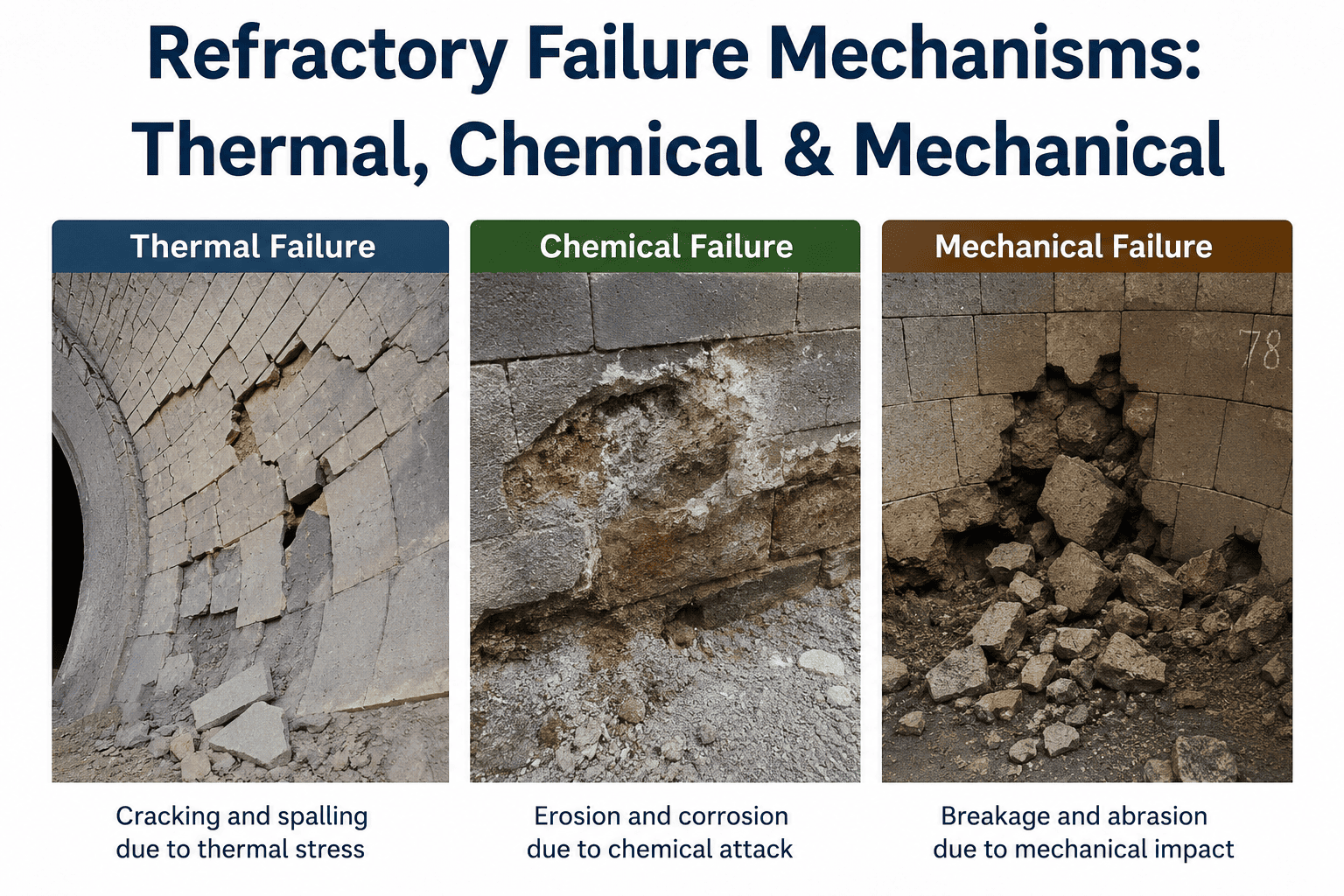
Thermal shock from rapid temperature change induces microcracking; repeated thermal cycling propagates those cracks over successive heats until spalling removes lining material in sheets rather than gradual wear.
C
Chemical Mechanisms
Slag, metal, and gas chemically attack the refractory matrix, dissolving bonding phases and altering mineralogy at the hot face, progressively weakening the structure and accelerating other wear mechanisms.
M
Mechanical Mechanisms
Erosion from flowing metal and slag, impact from charging or tapping operations, and structural stress from thermal expansion mismatch physically remove or crack refractory material.
REFRACTORY DIAGNOSTICS · FAILURE MECHANISM TRACKING
Stop Logging Refractory Failure as "End of Campaign"
iFactory scores every refractory failure event against thermal, chemical, and mechanical mechanisms — so mitigation targets the actual combination driving wear instead of a single generic label.
Failure Mechanism Signatures by Equipment Type
The dominant failure mechanism shifts significantly by vessel type and operating condition. Recognizing the typical signature for each equipment category speeds up diagnosis considerably, since it tells the investigation team where to look first rather than starting from a blank slate on every campaign.
| Equipment | Dominant Mechanism | Typical Contributing Factor |
| BOF (Basic Oxygen Furnace) |
Chemical slag attack |
Thermal cycling from batch operation |
| EAF (Electric Arc Furnace) |
Thermal shock & erosion |
Arc flare localized heating |
| Ladle |
Thermal cycling & chemical attack |
Slag line chemical concentration |
| Tundish |
Erosion from metal flow |
Thermal gradient across working lining |
Reading the Wear Pattern: What the Damage Looks Like
Visual wear pattern is one of the fastest diagnostic signals available, since each mechanism tends to leave a physically distinct pattern on the hot face even before laboratory analysis confirms the mechanism definitively.
SPALLING
Sheet-like loss of material, often with visible crack networks at the boundary — the classic signature of thermal cycling fatigue rather than gradual surface loss.
SMOOTH DISSOLUTION
Gradual, smooth loss of hot-face material with a discolored reaction layer visible at the interface — characteristic of chemical slag or metal attack progressing steadily.
LOCALIZED GOUGING
Concentrated material loss at flow-impact points such as ladle shroud areas or tundish impact pads — the signature of mechanical erosion from directional flow.
STRUCTURAL CRACKING
Cracks running through the full lining thickness rather than surface-only, often from thermal expansion mismatch or mechanical impact stress concentrated at joints.
The Investigation Sequence: From Symptom to Mechanism
01
Document Wear Pattern Visually
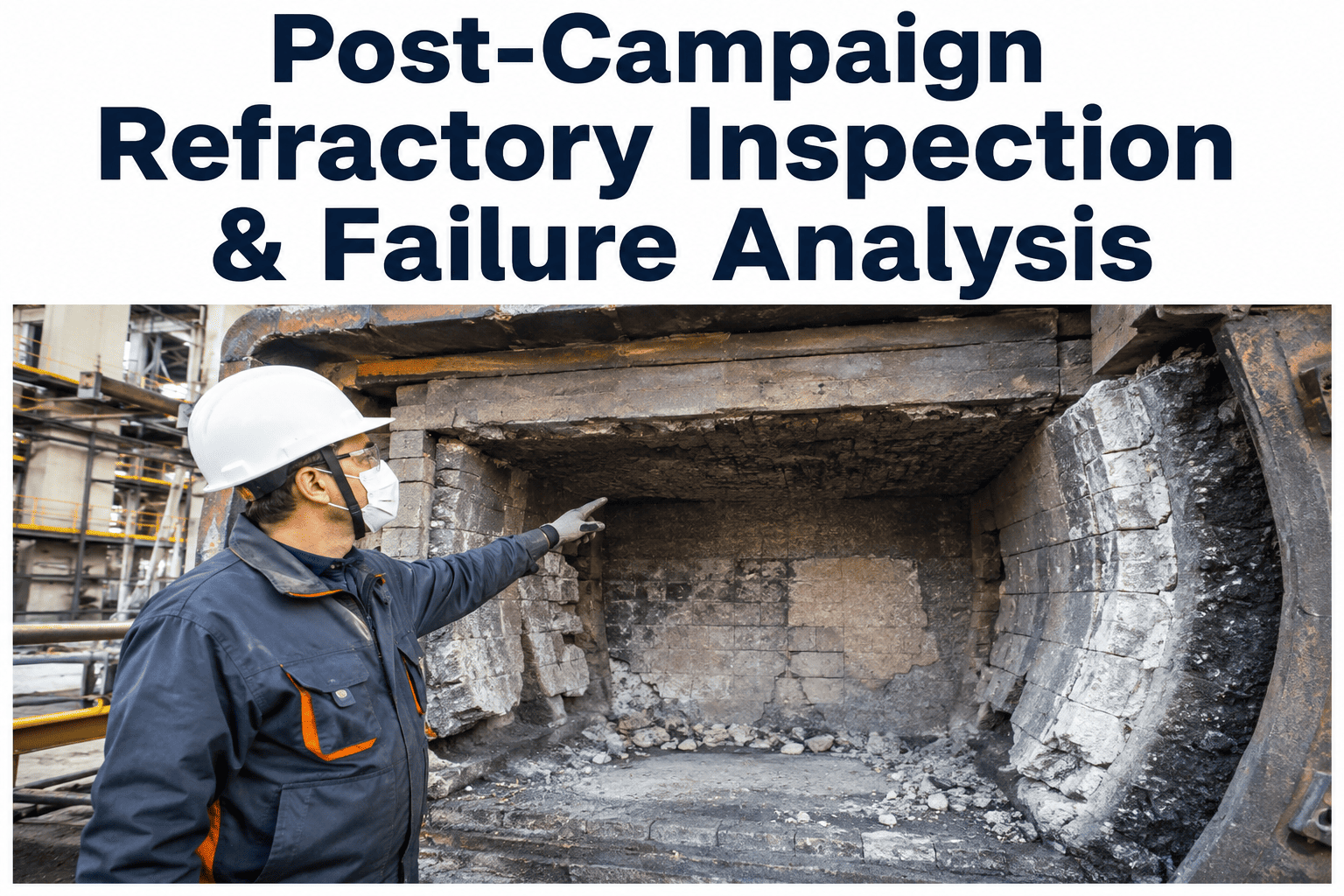
Photograph and map the wear pattern location and shape before any further processing, since this visual record is the fastest early indicator of dominant mechanism.
02
Correlate Against Campaign Thermal History
Review heat-up rate, cycling frequency, and any recorded thermal excursions during the campaign to identify whether thermal stress contributed meaningfully to the observed pattern.
03
Review Slag & Metal Chemistry History
Check whether slag basicity, metal chemistry, or gas composition during the campaign fell outside the refractory grade's designed resistance range.
04
Assess Mechanical Operating Factors
Evaluate charging impact, flow velocity, and any operational events like tap-hole issues or fill-rate changes that could have contributed mechanical stress.
05
Score the Combination and Assign Mitigation
Rank the relative contribution of each mechanism and target mitigation at the combination — grade change, operating procedure change, or both — rather than a single generic fix.
Frequently Asked Questions: Refractory Failure Mechanisms
How can I tell if a refractory failure was primarily thermal or primarily chemical?
Wear pattern is the fastest early indicator — thermal cycling failures typically show sheet-like spalling with visible crack networks, while chemical attack shows smoother, more gradual material loss with a discolored reaction layer at the hot face. Confirming the mechanism definitively usually requires correlating the wear pattern against the campaign's thermal history and slag or metal chemistry record, since visual inspection alone can be ambiguous in mixed-mechanism failures. Teams building this correlation capability can
Book a Demo to see campaign data tied directly to wear diagnosis.
Why do refractory linings often fail earlier than their designed campaign life predicts?
Designed campaign life is typically calculated against a single dominant mechanism under expected operating conditions, but real campaigns almost always involve some combination of thermal, chemical, and mechanical stress acting together. When a secondary mechanism accelerates the primary one — thermal microcracking making chemical penetration faster, for example — actual campaign life falls short of the single-mechanism prediction. This is why mixed-mechanism scoring produces more accurate campaign life forecasts than single-mechanism design assumptions alone.
Does upgrading to a higher-grade refractory always solve chemical attack failures?
A higher chemical-resistance grade helps when chemical attack is genuinely the dominant mechanism, but if thermal cycling or mechanical erosion is a significant contributing factor, upgrading grade alone will underperform expectations because it does not address the accelerating mechanism. This is exactly why mechanism scoring across all three categories matters before selecting a mitigation strategy — grade upgrades are effective but not a universal fix for every failure labeled generically as chemical wear.
What operating changes reduce thermal cycling damage to refractory linings?
Controlled, gradual preheating and heat-up ramps, minimizing unnecessary thermal excursions between heats, and reducing idle-time temperature swings are the primary levers available without a material change. Consistency matters as much as the absolute ramp rate — a lining that experiences the same moderate ramp every cycle typically outlasts one experiencing a mix of fast and slow ramps even if the average rate is similar, because inconsistency is what drives the differential stress that initiates microcracking.
How often should refractory wear be measured during a campaign, not just at relining?
Interim wear measurement — through laser profiling, manual gauging, or thickness sensors depending on the vessel — at regular intervals during the campaign, rather than only at the end, is what allows a plant to catch an accelerating wear rate early enough to adjust operating practice before the lining reaches critical thinning. Waiting until relining to assess wear pattern means the diagnostic information arrives too late to protect the current campaign, only the next one. Contact
iFactory Support for guidance on interim monitoring approaches by vessel type.
REFRACTORY RELIABILITY · MECHANISM TRACKING · CAMPAIGN LIFE
Diagnose the Real Combination Behind Every Refractory Failure
iFactory connects wear pattern, thermal history, and slag chemistry into one failure investigation record — so mitigation targets what's actually driving wear, not a generic end-of-campaign label.