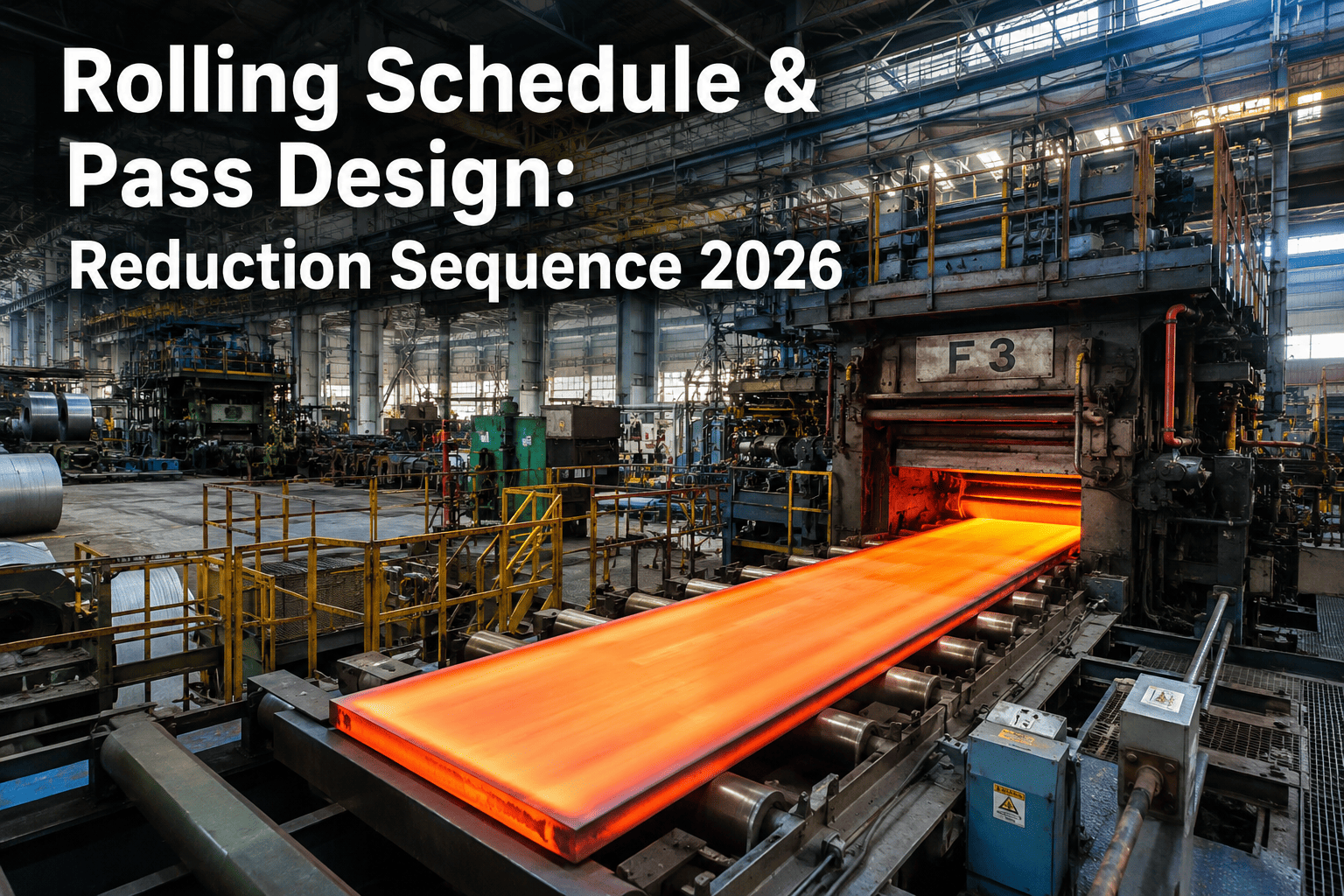
A rolling schedule is really a series of small decisions made once and then repeated thousands of times, how much reduction each pass takes, what temperature the material sits at when it reaches the next stand, how much clearance sits in the roll gap. Get those decisions right and a coil comes off the mill with the dimensional accuracy and surface finish the customer specification demands, get them wrong and the same equipment produces a coil that fails inspection despite nothing being mechanically broken. Pass design is one of the more technical, less visible disciplines in rolling mill operation, and it deserves more attention than it typically gets, because it directly determines product quality without ever showing up as a highlighted line item on a maintenance report. Seeing how your current pass schedules compare against a more rigorously modeled sequence starts with looking at the actual data, and the fastest way to do that is to book a demo with our team.
Every Coil's Final Dimension Was Decided Long Before It Reached the Last Stand
Reduction ratio, interpass temperature, and roll gap setting at each stand compound across the full rolling schedule, and small errors early in the sequence show up as dimensional and surface defects at the end. iFactory helps rolling teams model and validate pass schedules against real production outcomes.
A Rolling Schedule Is a Sequence of Compounding Decisions, Not a Single Setting
Each stand in a rolling mill reduces the material by a specific amount, and that reduction is not an isolated decision, it directly determines the temperature, width, and internal condition of the material entering the next stand. An overly aggressive reduction early in the sequence can generate excess heat or induce internal stresses that a later stand cannot fully correct, while an overly conservative reduction wastes available mill capacity and extends cycle time unnecessarily.
Getting this sequence right requires balancing multiple constraints simultaneously, target final dimension, required surface quality, mill capacity limits, and the metallurgical behavior of the specific grade being rolled. A pass schedule that ignores any one of these constraints tends to produce a product that technically meets the target gauge but fails on a secondary quality requirement, which is a far more common and far less visible failure mode than an outright equipment issue.
Reduction Ratio, Interpass Temperature, and Roll Gap, Explained Together
Why These Three Variables Cannot Be Optimized Independently
Treating reduction ratio, interpass temperature, and roll gap as three separate settings to optimize one at a time is a common mistake in pass schedule design, because each one directly influences the other two. A higher reduction ratio at a given stand generates more heat through deformation, which changes the interpass temperature the material carries into the next stand, which in turn changes how much roll force is needed to achieve the planned reduction at that next stand.
This interconnection is exactly why pass schedule design benefits so heavily from a model that accounts for the full sequence at once, rather than a stand-by-stand manual calculation that treats each pass in isolation. A schedule validated against the complete thermal and mechanical sequence catches compounding errors that a single-stand review would miss entirely.
Validate Your Pass Schedule Against Real Production Outcomes
iFactory models the full reduction sequence across your rolling schedule, connecting pass design directly to the dimensional and surface quality results you actually measure.
What a Well-Balanced Reduction Sequence Looks Like in Practice
The table below illustrates the general shape of a typical multi-stand reduction sequence, where reduction ratio tends to be highest in the early stands and progressively decreases as the material approaches final gauge, allowing tighter dimensional control precisely where it matters most.
| Stand Position | Typical Reduction Emphasis | Primary Design Priority |
|---|---|---|
| Early Stands | Higher reduction ratio per pass | Rapid gauge reduction while temperature margin is highest |
| Middle Stands | Moderate, evenly distributed reduction | Maintaining consistent interpass temperature across the sequence |
| Final Stands | Lower, precisely controlled reduction | Dimensional accuracy and surface finish on the final product |
Common Symptoms of a Poorly Balanced Pass Schedule
What Changes With a Properly Modeled Pass Schedule
Questions Rolling Engineers Ask About Pass Schedule Design
Model a Pass Schedule Built for Dimensional Accuracy and Surface Quality
iFactory helps rolling engineers validate reduction ratio, interpass temperature, and roll gap settings against real production outcomes across your full product mix.