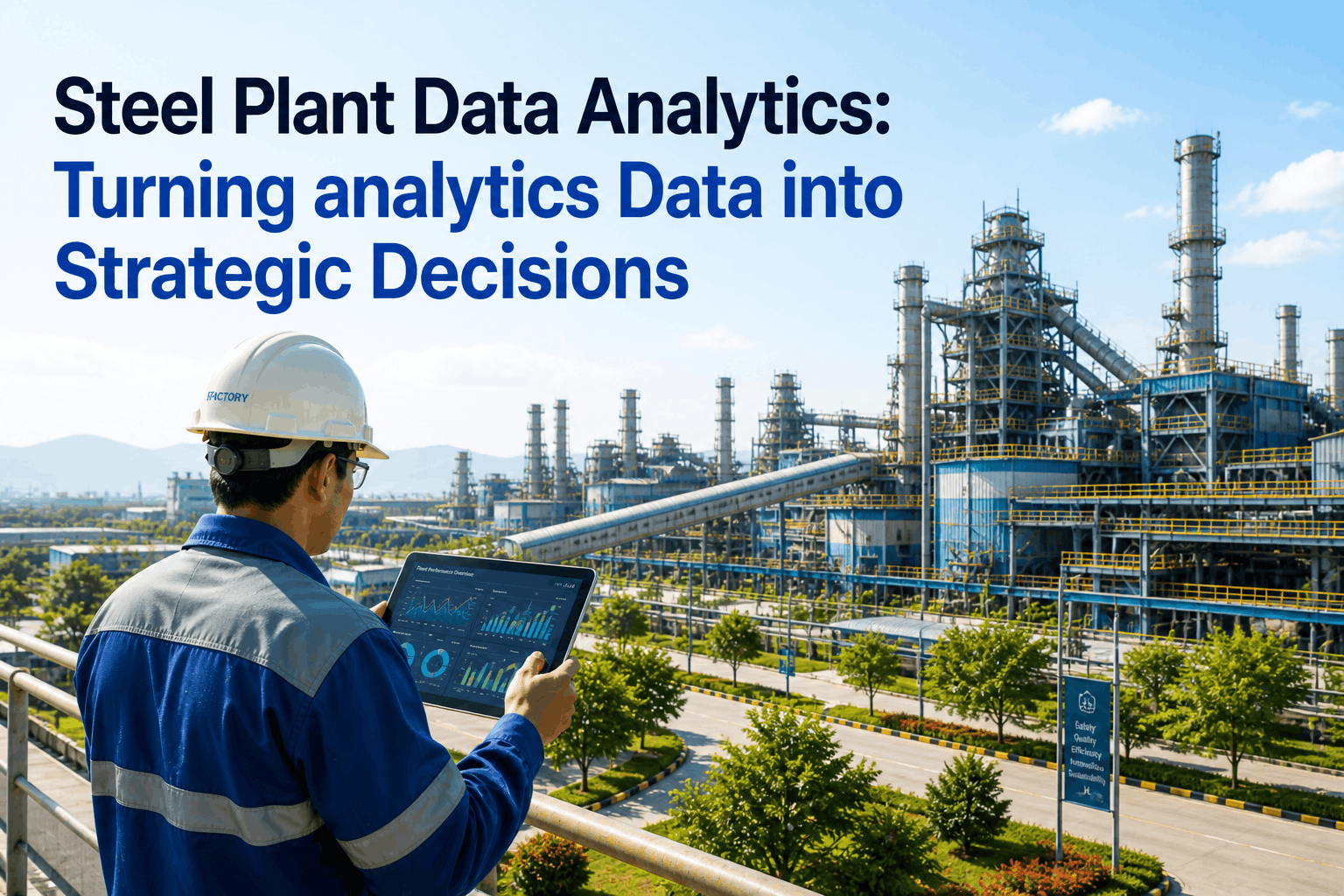
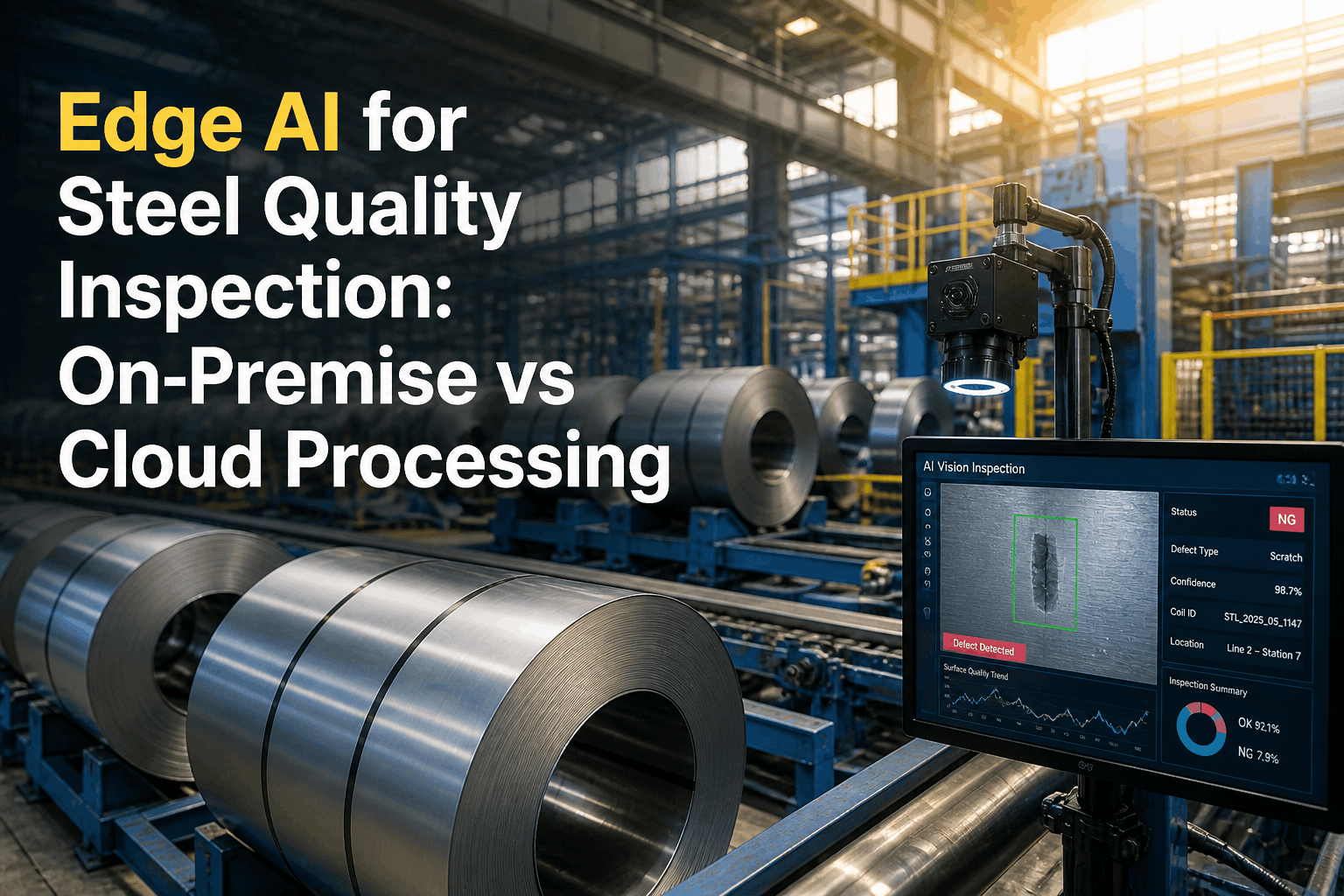
Your steel plant generates 2.4 terabytes of sensor data every single day. Temperature readings from blast furnaces, vibration signals from rolling mills, pressure logs from hydraulic systems, chemical composition data from ladle furnaces — all streaming in from 50,000+ sensors simultaneously. Yet most steel plants use less than 5% of this data for actual decision-making. The rest? It sits in disconnected historians, siloed SCADA systems, and overwritten log files — invisible, inaccessible, and worthless. The plants that figure out how to collect, structure, and act on this data flood are pulling ahead. The ones that do not are flying blind with million-dollar equipment. This guide lays out a practical data strategy for turning your steel plant's sensor network into an intelligence platform — from edge to cloud to actionable insight. Your plant is already generating the data. The question is whether you are capturing it, structuring it, and using it before it disappears. iFactory connects your sensor network to real-time analytics — book a 30-minute assessment to see what your data is trying to tell you.
50,000 Sensor Data Strategy
Building a Data Lake for Steel Plant Intelligence in 2026
2.4 TB
Data Generated Per Day by a Typical Integrated Steel Plant
<5%
Of Sensor Data Actually Used for Decision-Making
$1.4T
Annual Cost of Unplanned Downtime Across Top 500 Manufacturers
The Sensor Landscape: What 50,000 Data Points Actually Look Like
A modern integrated steel plant is not one operation — it is a chain of extreme environments, each generating distinct sensor signals at different frequencies, formats, and volumes. Understanding this landscape is the first step toward designing a data architecture that works.
Thermocouples (Type S/R)
800–1,200
Pressure Transducers
400–600
Gas Analyzers (CO, CO2, H2)
50–80
Burden Profile Meters
20–40
Sampling: 1–10 Hz
~180 GB/day
Mold Level Sensors
200–350
Spray Flow Meters
300–500
Strand Temperature Pyrometers
100–200
Oscillation Monitors
40–80
Sampling: 10–100 Hz
~320 GB/day
Vibration Sensors (Bearings, Drives)
2,000–4,000
Gauge & Flatness Sensors
500–800
Motor Current & Torque Sensors
600–1,000
Surface Inspection Cameras
30–60
Sampling: 100–5,000 Hz
~1.2 TB/day
Energy Meters (Power, Gas, Water)
1,500–3,000
Environmental Sensors (Dust, Emissions)
200–400
Coating Weight & Thickness Gauges
100–250
Hydraulic & Pneumatic Pressure
800–1,500
Sampling: 1–50 Hz
~700 GB/day
A single blast furnace alone can have 26+ distinct sensor parameters recording at hourly intervals — and that is just one asset. When you multiply across hundreds of motors, drives, pumps, and furnaces operating 24/7, the data volume becomes enormous. The challenge is not generating data — steel plants have been doing that for decades. The challenge is making it accessible, contextual, and actionable before it gets overwritten or archived into oblivion.
Why Most Steel Plant Data Strategies Fail
Before building a data lake, it helps to understand why previous approaches fell short. Most steel plants already collect sensor data — the problem is how it is stored, accessed, and used.
01
Siloed Historians
Each process area runs its own SCADA or DCS historian — blast furnace data lives on one server, rolling mill data on another. Cross-process correlation is impossible without manual data exports and spreadsheet gymnastics.
02
Legacy Protocol Fragmentation
PROFINET from Siemens PLCs, Modbus from older instruments, OPC-DA from Level 2 systems, proprietary protocols from specialty sensors. These were never designed to talk to each other — let alone to a cloud analytics platform.
03
Overwrite-and-Forget Storage
Many historians retain only 30–90 days of high-resolution data before downsampling or overwriting. By the time an engineer investigates a quality deviation, the granular data that could explain it is already gone.
04
No Context Layer
Raw sensor values without metadata — which asset, which product grade, which shift, which maintenance state — are just numbers. Without context, even perfect data is useless for AI models or root-cause analysis.
The 4-Layer Data Architecture for Steel Plant Intelligence
A steel plant data lake is not a single technology — it is a layered architecture designed to handle the unique demands of heavy industry: extreme data volumes, harsh environments, legacy systems, and the need for both real-time response and long-term analytics.
Layer 4
Intelligence & Action
AI/ML models, predictive maintenance, digital twins, automated work orders, executive dashboards, and natural language plant summaries. This is where data becomes decisions.
AI/ML Engines, CMMS Integration, Digital Twins, LLM-Powered Insights
Layer 3
Cloud Data Lake / Lakehouse
Long-term storage of contextualized sensor data in open formats. Supports batch analytics, historical trend analysis, and ML model training across months or years of operational data.
Apache Iceberg / Delta Lake, Object Storage, Data Catalog, Governance
Layer 2
Edge Computing & Protocol Translation
Industrial gateways at the plant floor that translate legacy protocols (Modbus, PROFINET, OPC-DA) into cloud-compatible formats. Performs local filtering, anomaly detection, and buffering when connectivity drops.
OPC-UA Bridge, MQTT Broker, Edge ML Inference, Local Buffering
Layer 1
Sensor & Control Network
The physical layer — 50,000+ sensors, PLCs, DCS, SCADA systems, and Level 2 automation already deployed across the plant. No rip-and-replace required.
PLCs, DCS, SCADA, Thermocouples, Vibration Sensors, Flow Meters
See Your Data Architecture in Action
iFactory deploys edge-to-cloud data pipelines that connect your existing SCADA, DCS, and sensor networks to a unified intelligence platform — no rip-and-replace, no six-month integration project.
Edge Computing: The Critical First Mile
In steel manufacturing, the edge is not optional — it is essential. You cannot stream 2.4 TB of raw sensor data to the cloud every day without massive bandwidth costs and unacceptable latency for safety-critical decisions. Edge computing solves this by processing data where it is generated.
Real-Time Processing
✓ Protocol translation: Modbus, PROFINET, OPC-DA to OPC-UA/MQTT
✓ Local anomaly detection on vibration and temperature streams
✓ Data filtering: send summaries to cloud, store raw locally
✓ Buffering during network outages — no data loss
Edge Hardware
✓ Industrial gateways with IP67+ ratings for harsh environments
✓ On-device ML inference for sub-second response
Batch Analytics
✓ Contextualized, time-stamped sensor data at optimized resolution
✓ Event logs, alarms, and anomaly flags from edge detection
✓ Quality records, production counts, and energy consumption
✓ Maintenance history and work order outcomes
Long-Term Value
✓ ML model training on months/years of historical data
✓ Cross-plant benchmarking and fleet-level analytics
From Data Lake to Data Lakehouse: Steel-Optimized Storage
A raw data lake quickly becomes a data swamp without governance. The modern approach — the data lakehouse — combines the flexibility of a data lake with the structure and query performance of a data warehouse, which is exactly what steel plants need.
Data Retention
30–90 days (full res)
Unlimited but unstructured
Unlimited + queryable
Cross-Process Queries
Not possible
Possible but slow
Fast, SQL-compatible
ML/AI Readiness
Manual export required
Raw data available
Feature-store ready
Data Governance
Vendor-locked schema
No governance (swamp risk)
Cataloged, lineage-tracked
Cost at Scale
Expensive license per tag
Cheap storage, expensive compute
Optimized storage + compute
5 Use Cases That Pay for Your Data Lake in Year One
A data strategy without ROI is a science project. These five use cases consistently deliver measurable returns within the first 12 months of deployment in steel plants.
Typical Savings
$1.5–3M/yr
Predictive Maintenance on Critical Drives
Vibration and motor current data from rolling mill drives, analyzed with ML models, detects bearing faults 1–6 months before failure. Shifts maintenance from calendar-based schedules to condition-based interventions — eliminating both premature replacements and catastrophic failures.
Typical Savings
$2–4M/yr
Blast Furnace Energy Optimization
Correlating blast temperature, gas composition, burden distribution, and coke rate across thousands of data points per hour. AI models identify thermal inefficiencies that human operators miss — a 2% improvement in coke rate on a 10,000 thm/day furnace saves over $2M annually.
Typical Savings
$800K–2M/yr
Quality Defect Root-Cause Analysis
Surface defects on finished coils traced back to upstream process parameters — casting speed, mold oscillation, roll gap settings — using correlated sensor data. Reduces prime-to-secondary downgrades and eliminates recurring quality escapes.
Typical Savings
$500K–1.5M/yr
Energy & Utility Optimization
Real-time visibility into power, gas, water, and compressed air consumption at the equipment level. AI identifies waste patterns — furnaces idling at full power, cooling systems overcooling, compressed air leaks — and triggers automated adjustments.
Steel plants with AI-powered monitoring of blast furnace operations report 15–25% reductions in energy consumption. The data to achieve this already exists in your sensor network — you just need the architecture to capture, contextualize, and analyze it continuously.
Implementation Roadmap: 0 to Intelligence in 12 Months
You do not need to boil the ocean. The most successful steel plant data strategies start narrow, prove value fast, and expand systematically.
Connect & Baseline
Deploy edge gateways on one critical process area (e.g., rolling mill main drives) — no disruption to existing automation
Translate legacy protocols via OPC-UA bridge, begin streaming to cloud data lake
Establish true data baseline: what sensors exist, what data is actually flowing, and what gaps remain
Contextualize & First AI Models
Add metadata layer: asset hierarchy, product grade, shift schedule, and maintenance state to every data point
Deploy first predictive maintenance models on highest-impact assets — vibration-based bearing fault detection
Integrate with CMMS to auto-generate work orders from anomaly detection
Scale Across Process Areas
Expand edge connectivity to melt shop, casting, and finishing lines
Enable cross-process correlation: trace quality defects from rolling mill back to casting parameters
Deploy energy optimization models for blast furnace and utilities
Full Intelligence Platform
Unified dashboard: OEE, energy, quality, and maintenance KPIs across the entire plant — real-time
Executive AI briefing: natural language plant summaries and audit-ready reports generated automatically
Continuous model improvement with 10+ months of structured historical data now available
Data Security & Cybersecurity: Non-Negotiable in 2026
Connecting operational technology to IP networks introduces attack vectors. In 2024, 31% of manufacturers experienced financial impact from cyberattacks affecting OT/IT systems. A steel plant data strategy without cybersecurity is a liability, not an asset.
Network Segmentation
Strict isolation between IT and OT networks. Edge gateways act as one-way data diodes — sensor data flows out, but no external commands flow in to the control layer.
Encrypted Transmission
TLS 1.3 encryption on all data in transit between edge, cloud, and analytics layers. No plaintext sensor data on the wire.
Role-Based Access Control
Operators see their process area. Engineers see cross-process data. Executives see aggregated KPIs. Nobody gets more access than they need.
IEC 62443 Compliance
Industrial cybersecurity standard for automation and control systems — the baseline framework for any steel plant connecting OT to IT infrastructure.
Frequently Asked Questions
How much data does a steel plant actually generate per day?
A typical integrated steel plant with 50,000+ sensors generates 1.5–3 TB of raw data daily. Rolling mills alone can produce over 1 TB due to high-frequency vibration and gauge sensors sampling at 100–5,000 Hz. Manufacturing companies collectively generate more data than nearly any other industry — approximately 1,800 petabytes annually across the sector.
Do we need to replace our existing SCADA and DCS systems?
No. The modern approach uses OPC-UA as a bridge protocol between legacy systems and cloud platforms. Industrial gateways translate Modbus, PROFINET, and OPC-DA data into cloud-compatible formats without replacing any existing infrastructure. This is often called "non-invasive connectivity" — you extract data without risking the uptime of your operational systems.
What is the difference between a data lake and a data lakehouse?
A data lake stores raw data in any format but offers poor query performance and governance. A data lakehouse adds structured metadata, ACID transactions, and SQL-compatible query engines on top — giving you the flexibility of a lake with the reliability of a warehouse. By 2026, 85% of organizations are using or planning to adopt lakehouse architectures.
How quickly can we see ROI from a sensor data strategy?
First measurable improvements typically appear within 90–120 days of deployment. Predictive maintenance on critical drives often delivers the fastest payback — detecting a single avoided catastrophic bearing failure can justify the entire investment. Most steel plants see 8–12 month payback through combined savings in energy, downtime, and quality.
Your Sensors Are Already Talking. Start Listening.
iFactory connects your existing sensor network to a unified intelligence platform — edge processing, cloud analytics, predictive maintenance, and automated work orders — all without replacing your current automation infrastructure.