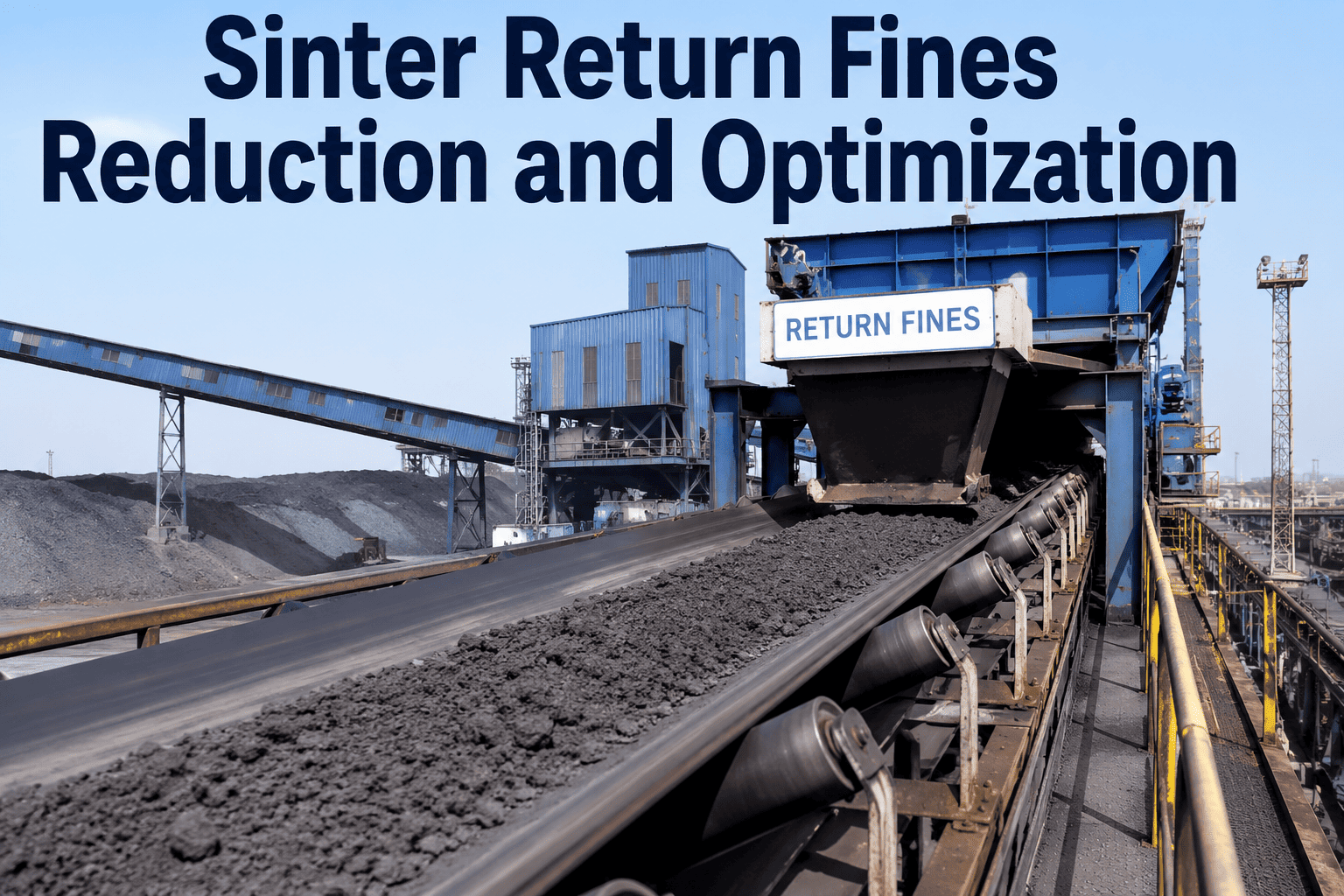
Return fines are the sinter plant's quietest form of waste — material that already consumed coke breeze, ignition energy, and strand time, only to break apart and get recycled back into the mix instead of shipping as product. A plant running a high return fines rate is effectively re-sintering the same material over and over, burning capacity that could be making new tonnes. Most teams treat the return fines rate as a fixed characteristic of the ore rather than a controllable outcome. iFactory's sinter AI tunes mix, moisture, and ignition specifically to minimize return generation. Book a return fines review to see how much strand capacity your current fines rate is quietly consuming.
Every 1% Cut in Return Fines Lifts Productivity 1.5%
AI-tuned mix moisture, ignition, and cooling minimize sinter breakdown at the source, so less material gets recycled and more strand capacity goes toward tonnes you can actually ship.
What Return Fines Actually Cost a Strand
Return fines rarely appear as a line item on a cost report, but the strand hours and energy spent re-processing the same material are very real and very recoverable.
typical productivity lift per 1 percentage point cut in return fines rate
of total sinter strand feed commonly made up of recycled return fines material
reduction in return fines rate commonly achievable through mix and ignition tuning alone
typical window to validate a sustained return fines reduction on live production
Where Return Fines Actually Come From
Return fines are not one uniform category — they come from distinct points in the process, and each source responds to a different corrective lever.
- Mix moisture inconsistent across the bed depth
- Ignition intensity mismatched to bed permeability
- Under-sintered zones breaking apart during screening
- Cooling rate too fast, causing thermal cracking
- Return fines simply re-added without root-cause tracking
- Moisture profile tuned for uniform granulation before sintering
- Ignition matched to actual bed permeability, zone by zone
- Under-sintered zones identified and corrected in real time
- Cooling rate tuned to avoid thermal-stress cracking
- Fines generation tracked back to a specific process cause
How the Model Minimizes Fines at the Source
Rather than managing return fines after the fact, the model works upstream, at the granulation, ignition, and cooling stages where fines are actually created.
Granulation moisture tuning
Mix moisture is set to achieve uniform pseudo-particle granulation, since poorly granulated mix is the single largest driver of downstream breakage.
Bed permeability matching
Ignition intensity and strand speed are matched to current bed permeability, avoiding the under-sintered pockets that break apart on screening.
Cooling rate control
Cooling airflow is tuned to avoid the thermal-stress cracking that fast, uneven cooling introduces into an otherwise well-sintered cake.
Fines source attribution
Screening data is correlated back to the specific batch and process conditions that produced it, closing the loop between cause and outcome.
See How Much Capacity Your Return Fines Rate Is Costing
iFactory analyzes your screening and process data to quantify exactly how much strand capacity is being spent re-processing material that could ship instead.
Return Fines Benchmarks by Strand Type
Return fines rates vary with ore fineness and strand design, but these ranges reflect what well-tuned operations typically hold as a baseline.
A Sinter Operations Lead's View on Fines Reduction
We always assumed our return fines rate was just a function of the ore we were buying and there wasn't much we could do about it. Watching the moisture and ignition adjustments correlate directly with next-batch fines percentage changed that completely. It wasn't the ore — it was how consistently we were granulating it before it ever hit the strand.
Four Overlooked Drivers of High Return Fines
Teams chasing return fines reduction often look at the obvious levers first and miss the quieter ones that compound over a full production run.
Uneven mix residence time
Granulation drums running below optimal residence time leave a portion of the mix under-granulated before it ever reaches the strand.
Bed depth inconsistency
Uneven bed depth across the strand width creates zones that are simultaneously over- and under-sintered in the same batch.
Screen deck wear
Worn screening equipment misclassifies borderline material, inflating the apparent return fines rate independent of actual sinter strength.
Cooling airflow imbalance
Uneven cooling airflow across the cooler bed introduces thermal stress cracking that shows up as fines well after the strand itself.
Frequently Asked Questions
How much return fines reduction is realistic without capital investment?
Most strands running standard mix and ignition practice carry 6 to 12 percentage points of avoidable return fines, recoverable through moisture, ignition, and cooling tuning alone. The exact figure depends on ore fineness and current granulation practice.
Does reducing return fines affect sinter strength?
When fines reduction comes from better granulation and ignition matching rather than simply screening less aggressively, sinter strength typically improves alongside the fines reduction rather than trading against it. Book a demo to see this relationship on data from a comparable strand.
Can this work with a high proportion of fine ore in the blend?
Yes, though the achievable floor is naturally higher with fine-dominant ore blends. The model adjusts its targets based on the actual granulation characteristics of your current blend rather than applying a fixed benchmark.
How is return fines source attribution actually done?
Screening data is timestamped and correlated against the process conditions — moisture, ignition, cooling rate — that were in effect when that specific batch was on the strand, allowing fines spikes to be traced back to a specific cause.
What data does iFactory need to start a review?
Three to six months of screening data alongside mix, moisture, and process logs is typically enough for an initial diagnostic. Talk to a specialist about what your plant's historian already captures.
Turn Return Fines Back Into Shippable Tonnes
Book a 30-minute scoping call and bring your last quarter of screening and process data. iFactory shows exactly how much strand capacity your current return fines rate is consuming.