Processing lines — including Slitting, Cut-to-Length (CTL), and Tension Leveling — represent the final "Precision Stage" of steel manufacturing, where dimensional tolerances and edge quality are definitively established. Effective immediately, the shift from manual tool tracking to AI-driven processing analytics is the mandatory standard for service centers and mills supplying high-precision automotive, appliance, and electrical steel sectors. For Operations and Plant Directors, the window for spreadsheet-based knife logs and "post-mortem" dimensional rejects is closed. Understanding your obligations around Tooling KDEs, Tension Tracking Events, and real-time mandrel health is the only way to eliminate "Edge Quality Erosion" and protect your margins from preventable tooling loss.
What Is AI-Driven Processing Line Analytics?
AI-driven processing analytics, codified within the iFactory precision framework, establishes a new digital recordkeeping standard for coil-processing assets. Unlike prior systems that only track linear meters or tons, this is a "Tool-Centric" intelligence system. It defines a mandatory, standardized approach to tracking the health of every slitter knife, leveler roll, and uncoiler brake through the entire production run. The system introduces a structured vocabulary of precision built around two foundational concepts: Diagnostic Tracking Events (DTEs) and Key Data Elements (KDEs). Every Operations Director must understand these two constructs in dimensional, not just mechanical, terms.
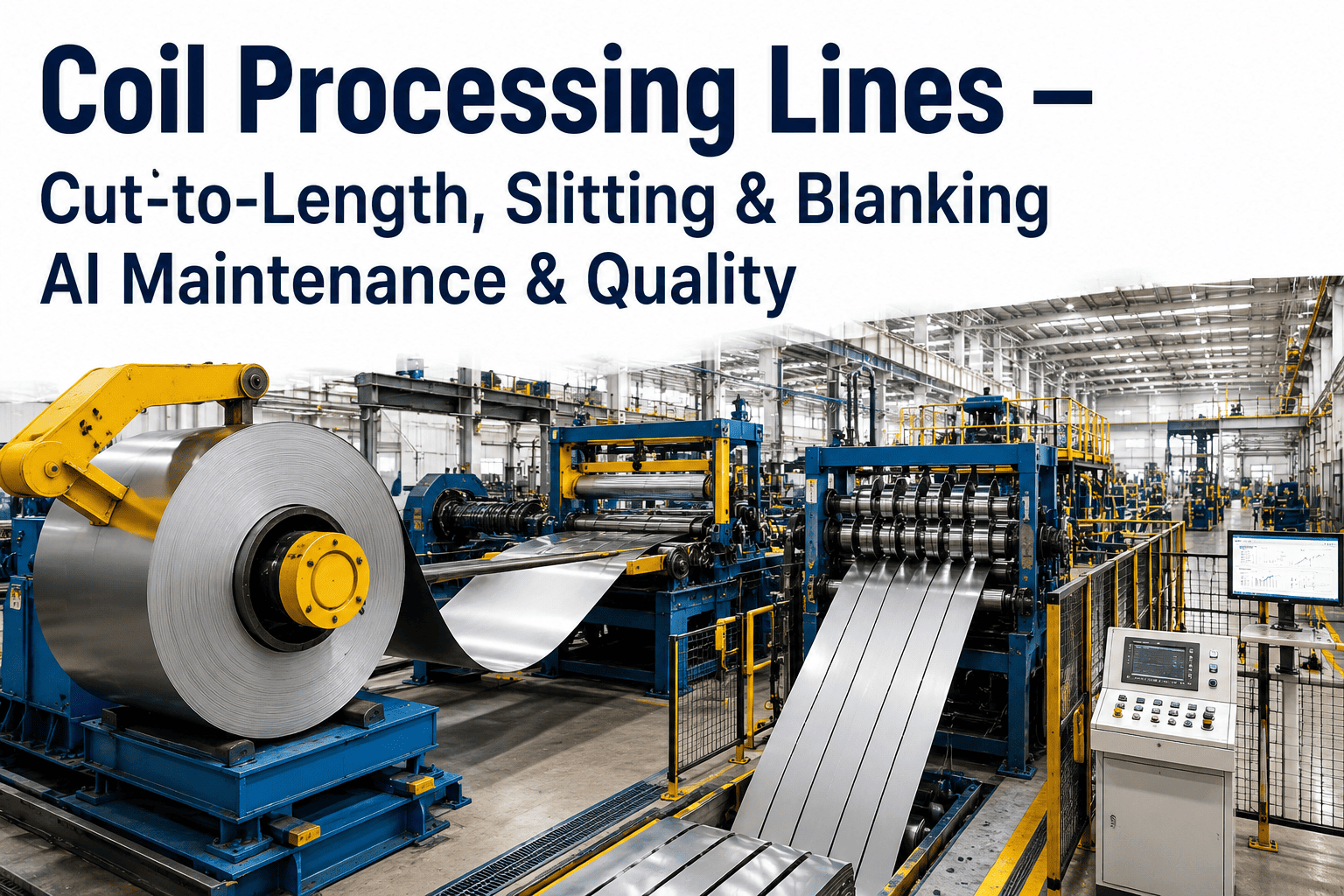
The Processing Scope — the baseline for service center excellence — covers high-speed slitting lines, heavy-gauge CTL lines, tension leveling stations, and multi-mandrel recoiling units. If your facility processes CR, HR, or Galvanized coils where edge burr, flatness, and length tolerance are customer-critical, iFactory's predictive precision logic applies to your operations.
Understanding DTEs: Diagnostic Tracking Events in Processing Lines
Diagnostic Tracking Events are the defined moments in the processing cycle where precision data must be created and analyzed. The iFactory platform has identified a structured set of DTEs that apply across the service center. For steel processing teams, the most operationally significant DTEs are:
Knife Dullness Signature (Detection)
The point at which cutting force harmonics indicate micro-chipping or radius expansion. Required data includes motor current harmonics and high-frequency vibration. iFactory identifies the 'burr-onset' signature before it affects the customer.
Tension Leveler Drift
The subtle shift in roll-gap pressure that leads to "center-buckle" or "edge-wave." AI identifies response lag in roll positioners, preventing thousands of meters of out-of-flat material.
Mandrel Expansion Hysteresis
The moment a recoiler mandrel begins to lose hydraulic expansion force during a build-up. This CTE is the primary indicator for imminent coil "telescoping" or collapse during removal.
Uncoiler Brake Thermal Stress
The detection of excessive heat-soak in the uncoiler braking system during high-tension slitting. AI correlates thermal DTEs with brake-wear KDEs to prevent emergency stops.
Side-Trimmer Clearance Drift
The final DTE where edge-trim quality data is linked back to trimmer clearance setpoints. Book a demo to see how iFactory creates the "Dimensional Thread" from uncoiler to CTL stacker.
Key Data Elements (KDEs): What Your Precision Twin Must Capture
Key Data Elements are the specific data points that must be recorded at each Diagnostic Tracking Event. iFactory has defined both required KDEs — which must always be captured — and reference document KDEs, which link tooling health to dimensional inspection records. The practical challenge is capturing "Cutting Energy" as a calculated variable in real-time. Book a demo to see how iFactory maps KDE capture to your slitting and CTL lines.
| Event (DTE) | Required KDEs (Diagnostic Data) | AI Inference Required? | Precision Outcome |
|---|---|---|---|
| Knife Wear | Cutting Force (kN), Line Speed, Strip Thickness, Total Cut Meters | Yes — Edge Model | Edge Burr Reject Prevention |
| Tension Drift | Uncoiler Tension, Leveler Power, Recoiler N-m, Strip Shape (Flatness) | Yes — Flatness Predict | Dimensional Stability |
| Mandrel Health | Hydraulic Pressure, Expansion Diameter, Load Cycles, Temperature | Yes — Pressure Decay | Coil Integrity / Safety |
| CTL Accuracy | Feed-Roll Encoders, Shear Timing (ms), Strip Tension, Knife Position | Yes — Length Model | Tolerance Compliance |
| Edge Mapping | Trimmer Clearance, Knife ID, Side-Trim Width, Scrap Baller Load | Yes — Trimmer Health | Zero-Defect Edge Trim |
The "Edge Quality" Transformation: The Most Complex Processing Challenge
For service centers producing automotive and appliance grades, the "Edge Quality Transformation" introduces the most complex reliability requirement. Edge burr is not just a function of knife sharpness, but the interaction between clearance, strip tension, and material hardness. At the point of transformation, the system must record all tooling KDEs and correlate them with real-time edge vision data to ensure the edge meets ASTM standards.
This linkage requirement — connecting cutting force transients to edge vision defects — is what makes AI-driven processing fundamentally different from simple meter-counting. It requires that your quality system captures data at the slitter head, not just at the control console. Book a demo to see how iFactory handles edge-to-vision linkage across high-speed slitting lines.
AI-Driven Precision: How Technology Closes the Processing Intelligence Gap
Manual and spreadsheet-based systems fail precision processing on three fronts: they cannot capture KDEs at high enough frequency, they cannot reliably link knife wear to edge burrs, and they cannot produce complete RCA chains within the required window. AI-driven platforms address each of these points through automated edge capture and intelligent precision linkage. Book a demo to see iFactory's AI-driven processing module in action across a live service center scenario.
Automated Tooling Edge Capture
Integrated with slitter head motors and encoder arrays, iFactory captures KDEs automatically at the edge — eliminating the "Spreadsheet Lag" that misses knife chipping and tension spikes.
Tension-Harmonic Quality Linkage
Intelligent diagnostic engines automatically link strip-path instabilities back to specific leveler roll-drifts — maintaining the "Traceability Chain" of precision from uncoiler to stacker.
Instant RCA Precision Compilation
On-demand precision reports compile complete processing histories for any coil — in seconds, not days. Records are formatted for Operations Directors and can be accessed on mobile devices during customer audits.
Predictive Knife Sharpening
Built-in Wear-Modeling tools allow Tooling Managers to sharpen knives based on actual "Cutting-Force-Work" rather than arbitrary tons, ensuring zero-defect slitting at minimum tooling cost.
Processing Reliability Gaps: Where Service Centers Are Most at Risk
Based on industry analysis of steel service center readiness assessments, the following reliability gaps appear most frequently in facilities approaching their digitalization deadline.
Building a Precision Roadmap: A Step-by-Step Approach
For Operations and Plant Directors leading their organization's digital transformation, the precision processing roadmap has five operational phases. Each phase has a defined output that feeds into the next, creating a structured pathway from current-state assessment to audit-ready operation.
Scope Determination: Map Your Processing Assets
Audit every slitting head, CTL shear, and recoiler mandrel. Document which assets trigger "High-Value" precision obligations (e.g., Appliance grades) and at which point in your process each DTE applies. Output: a facility-specific Processing Asset Map.
KDE Gap Analysis: Assess Tooling Data Capture
For each in-scope asset, compare the KDEs your current system captures against the high-frequency harmonics required by AI. Identify fields that are missing or recorded in formats that cannot be used for RUL prediction. Output: a KDE gap register.
Knife-Level Wear Model Design
Design a diagnostic structure that meets precision requirements: unique knife identification, linkage to KDE records, and cutting-force modeling for burr prevention. Integrate AI model triggers into production workflows. Output: a documented Tooling schema.
Technology Platform Selection and Integration (ERP/WMS)
Select and deploy a precision technology platform capable of automated KDE capture, tension linkage, and 24-second record production. Integrate with existing ERP systems to eliminate manual data entry. Output: a deployed precision system.
Mock Precision Exercise and Audit Readiness Validation
Conduct a minimum of two mock precision exercises — one forward trace from a tension harmonic to a flatness reject, and one backward trace from a customer reject to the original knife KDEs. Time the record production against the "Precision Standard." Output: validated audit-readiness certification.
"Before iFactory, our slitter maintenance was entirely reactive—we only knew a knife was dull after we saw the burrs at the packing station. By linking cutting force harmonics directly to our tooling logs, we've reduced edge-related rejects by 28% and extended our sharpening cycles by 2 weeks. It's the first time we've had a truly predictive view of our precision processing assets."
Frequently Asked Questions: Steel Slitting & CTL Analytics
Can iFactory detect slitter knife dullness in real-time?
Yes. By analyzing motor current harmonics and high-frequency vibration, the AI identifies the 'Burr-Onset' signature of a dulling knife before it affects strip edge quality.
How does the system link tension leveling to strip flatness?
We use mill-time synchronization to map tension transients to exact coil coordinates, correlating roll-gap pressure with flatness deviations like center-buckle.
What is the "Edge Quality" transformation challenge?
It is the proprietary AI logic that connects raw cutting force KDEs to the physical edge burr measurement, providing a visual 'Edge Twin' for every slit mult.
How long does it take to deploy iFactory on a slitting line?
Most service centers achieve full deployment on critical lines in 6–10 weeks, covering sensor installation, ERP integration, and predictive knife model validation.
Can iFactory predict recoiler mandrel expansion failure?
Yes. By monitoring hydraulic pressure decay and expansion hysteresis, the AI identifies seal degradation before it causes a coil collapse or telescoping.
Does the system provide energy optimization for high-speed processing?
Absolutely. iFactory optimizes motor-duty and uncoiler-braking based on real-time coil weights, reducing processing energy costs by up to 15%.
Is the system compatible with legacy slitter head controllers?
Yes. We use external power transducers and vibration sensors to bring legacy slitters into the digital age without requiring a complete controller replacement.
What is the typical ROI for AI-driven processing analytics?
Most facilities achieve full payback within 4-8 months through a 28% reduction in edge rejects and significant knife sharpening extensions.
Does iFactory handle different steel grades and thicknesses?
Yes. The AI correlates material hardness and gauge with cutting-force setpoints, ensuring optimal precision for everything from AHSS to electrical steels.
Can iFactory predict uncoiler brake thermal failure?
Yes. By monitoring brake temperature transients and tension-load profiles, the AI identifies thermal-soak risks that precede emergency stop failures.
Does the platform monitor CTL dimensional accuracy?
Yes. We track feed-roll encoder KDEs and shear timing to ensure every cut sheet meets length tolerances, preventing "Short-Sheet" customer rejects.
Can iFactory integrate with Surface Vision Systems on CTL lines?
Yes. We provide a bidirectional data bridge that allows processing analytics to be overlaid on vision maps for definitive root-cause analysis of scratches.
What is the "Precision Thread" in processing analytics?
It is the unbroken digital record connecting uncoiler tension, slitter knife health, recoiler mandrel integrity, and final coil dimensional finish.
How does the system handle different slitter knife brands?
iFactory is vendor-agnostic; we calibrate our wear models based on the specific metallurgical properties of your knives to ensure 100% diagnostic accuracy.
Does iFactory provide shift-level precision scorecards?
Yes. iFactory provides real-time processing performance data for every shift and order, surfacing variables that drive dimensional deviations.