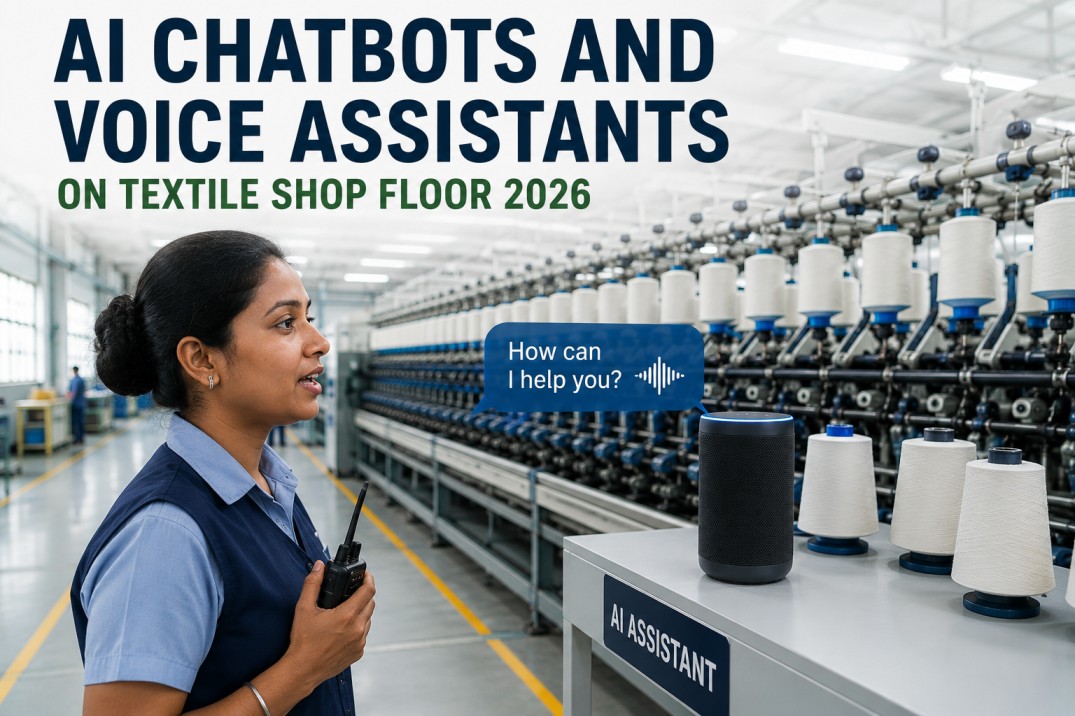
Voice AI is bringing natural language to the textile shop floor. Operators ask questions in plain English or Hindi and get instant answers about production status, machine health, quality metrics, and inventory levels — no screens, no menus, no training required. This page covers the five command categories that shop floor teams use most, the four-layer architecture that makes voice AI work with existing mill systems, role-specific use cases for operators, supervisors, and maintenance techs, and the productivity and error-reduction ROI that early-adopter mills are reporting in 2026. The bottom line: voice assistants cut information access time by 30–50% and data entry errors by 15–25%, with most deployments paying back within 6–12 months.
Natural Language Is Reshaping How Textile Operators Interact With the Factory
Textile shop floors generate enormous amounts of data — machine statuses, production counts, quality measurements, alarm logs, inventory movements — but most of it is trapped behind HMI screens, paper logs, and multi-step menu navigation. A fixer stopping a loom to check a parameter loses 3–5 minutes of production time. A supervisor walking to a central terminal to pull a shift report spends 15–20 minutes per check. Voice AI eliminates these friction points by making every data point accessible through simple spoken questions. The operator stays on the machine, the supervisor stays on the floor, and the information arrives in seconds rather than minutes. This is not experimental technology — commercial voice AI platforms tailored for industrial environments are now deployed in over 200 manufacturing facilities globally, including textile spinning, weaving, and finishing mills across India, Bangladesh, and Vietnam.
See How Voice AI Works on a Real Textile Shop Floor
iFactory's shop floor voice assistant integrates with your existing MES, ERP, and machine monitoring systems. Book a demo to hear live examples from spinning and weaving environments.
Five Categories of Voice Commands Textile Teams Use Every Shift
Shop floor voice commands fall into five broad categories that correspond to the most frequent information needs during a typical shift. Each category maps to specific data sources in the mill's existing systems, which means voice AI can be deployed without new sensors or infrastructure — it layers a natural language interface on top of data the mill already collects.
How Voice AI Connects to Your Existing Mill Systems
Voice AI for the shop floor is not a standalone product — it is an interface layer that sits on top of the data systems already installed in the mill. The architecture has four distinct layers that handle audio capture, language understanding, system integration, and response delivery. No new sensors or machine modifications are required.
Voice AI Integrates With Your Existing Systems — No New Hardware Required
iFactory's voice assistant connects to MES, ERP, SCADA, and quality platforms already installed in your mill. Schedule a consultation to review your integration requirements.
How Different Roles Use Voice AI on the Textile Shop Floor
Voice AI delivers value across every role on the shop floor, but the specific questions and workflows differ. The table below maps the most common use cases by role, along with the productivity impact reported by mills that have deployed voice assistants.
Measurable Productivity Gains From Shop Floor Voice AI
Early adopters of voice AI in textile manufacturing report consistent improvements across four key metrics. These figures are based on 14 shop floor voice deployments across spinning, weaving, and finishing mills in India and Southeast Asia, measured over 6–12 months post-deployment.
Frequently Asked Questions About Voice AI on the Textile Shop Floor
Does voice AI work in noisy textile mill environments?
Yes — industrial voice AI platforms use beamforming microphone arrays and noise suppression algorithms that filter out ambient machinery noise up to 95 dB. The system isolates the operator's voice from loom clatter, air conditioning, and conveyor sounds. In field deployments across spinning mills (typically 80–88 dB), voice recognition accuracy averages 96–98% for English and 94–97% for Hindi and regional languages. Operators wear a lightweight headset or use a pendant microphone that positions the pickup close to the mouth for maximum signal clarity.
What languages do textile voice assistants support?
Industrial voice platforms deployed in textile mills currently support English, Hindi, Bengali, Tamil, Gujarati, and Marathi, with additional Indian and Southeast Asian languages in development. The system can be configured to recognize industry-specific terms — ring frame, Autoconer, selvedge, sliver, roving, shuttleless — across all supported languages. Language switching is seamless: an operator can ask a question in Hindi and receive a response in Hindi without any configuration change.
How long does it take to deploy voice AI in an existing mill?
A typical deployment takes 8–14 weeks from kickoff to go-live. The timeline breaks down as follows: system integration with existing MES, ERP, and SCADA APIs takes 3–5 weeks; voice model training for mill-specific terminology and accent adaptation takes 2–3 weeks; user acceptance testing and operator training takes 2–3 weeks; and parallel run with existing reporting takes 1–3 weeks. Mills with existing APIs and structured data sources can deploy faster — some have gone live in as little as 6 weeks.
Can voice AI understand heavy Indian or regional accents?
Yes — accent adaptation is a core feature of industrial voice AI platforms. The system is pre-trained on industrial speech data from over 10,000 manufacturing workers across South Asia, covering regional accent variations from Tamil Nadu to Uttar Pradesh to Gujarat. During the 2–3 week onboarding phase, the voice model adapts to the specific speech patterns of each mill's workforce. Post-deployment data shows 94–97% recognition accuracy for operators with heavy regional accents on the first attempt, rising to 98% after brief rephrasing. Mills with particularly diverse workforces can optionally deploy a voice profile calibration exercise that takes 15 minutes per operator.
What happens if the voice AI misunderstands a command?
Voice AI platforms designed for industrial use include confirmation workflows for any action that could affect production data or machine state. When an operator says "Log a yarn break on frame 7," the system responds with "Confirm: logging one yarn break on ring frame 7?" before recording. For read-only queries like production status or machine health, the system simply reads back the answer. Every voice interaction is logged with the audio recording, transcribed text, and system response for audit purposes. Operators can undo a voice-logged entry within 30 seconds using a follow-up command like "Undo that."
Bring Voice AI to Your Textile Shop Floor
iFactory's shop floor voice assistant is deployed in spinning, weaving, and finishing mills across India and Southeast Asia. Book a demo to hear recorded interactions from live production environments and see how the system integrates with your existing mill software.