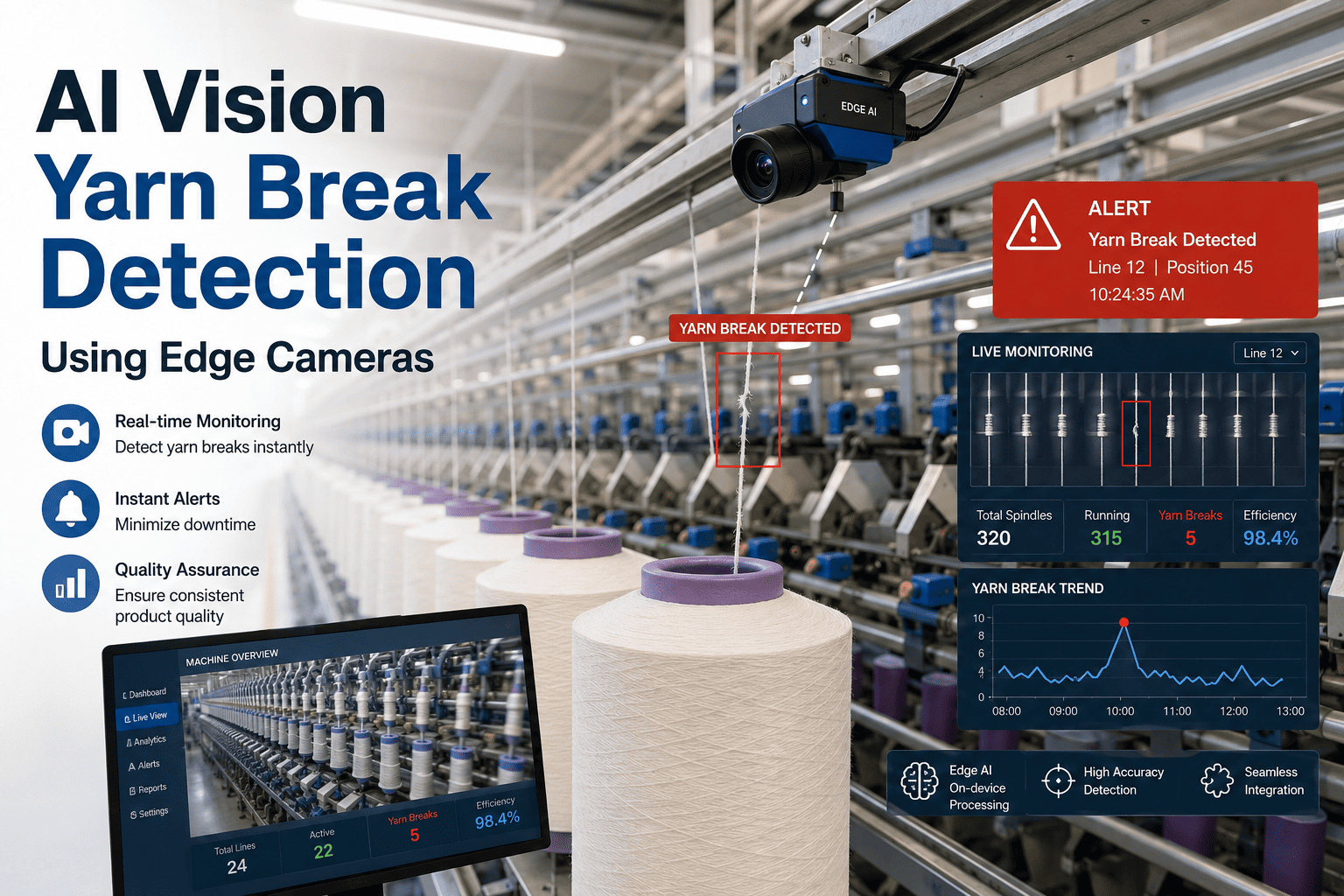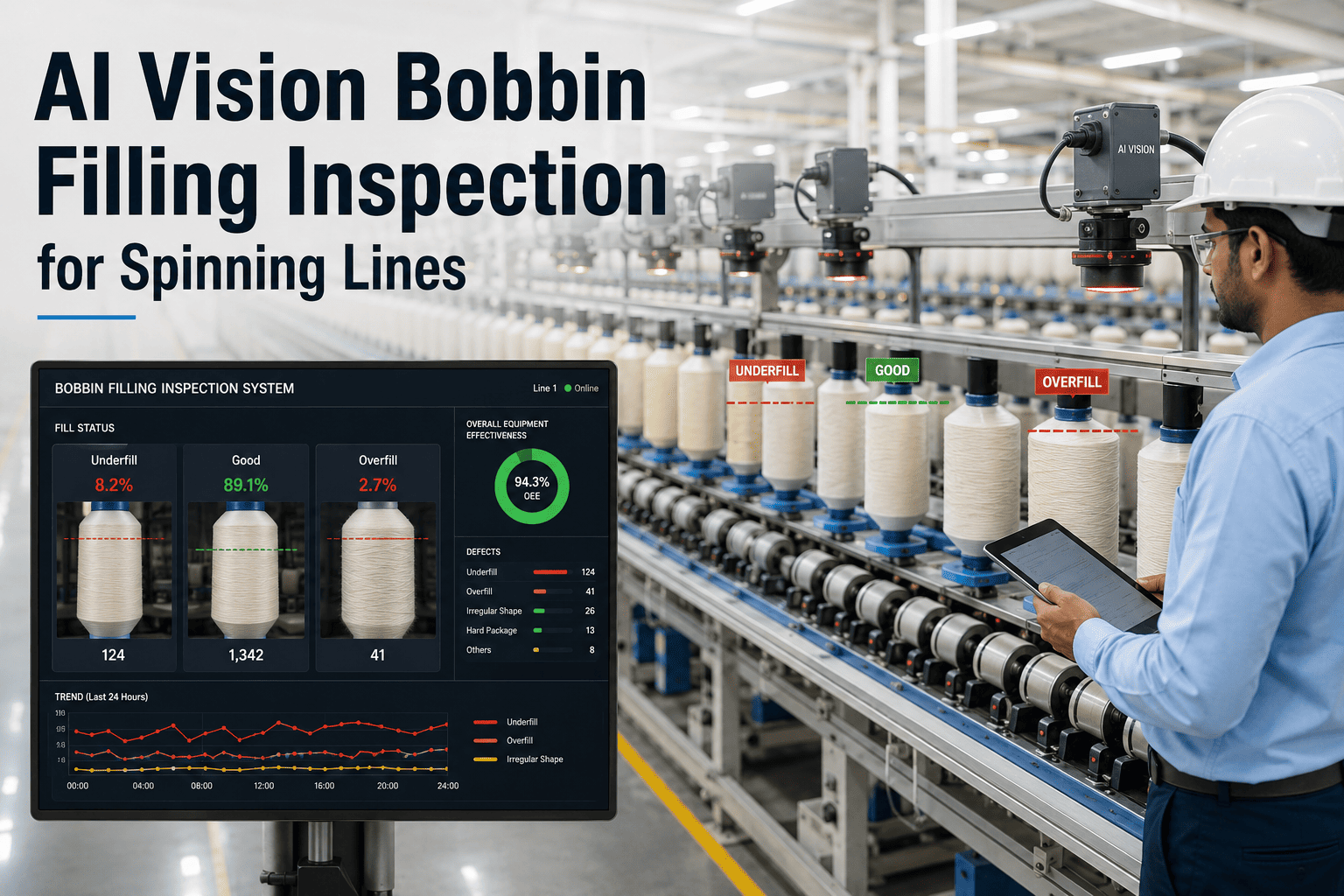
Bobbin filling quality directly determines downstream winding efficiency, yarn transfer reliability, and the consistency of package weight and density that dye house and weaving operations depend on. Uneven winding, underfill, overfill, and surface contamination on bobbins create cascading problems — from doffing delays and winding breaks to rework costs and customer weight complaints — that compound rapidly across high-speed spinning lines producing thousands of bobbins per shift. AI vision bobbin filling inspection from iFactory AI monitors every bobbin as it fills on the spinning frame, detecting winding defects, contamination, and process drift in real time before defective packages enter downstream operations. Book a Demo to see AI-powered bobbin inspection deployed on your spinning lines.
AI Vision Bobbin Filling Inspection for Spinning Lines
A complete technical guide to deploying AI vision systems for real-time bobbin filling quality inspection on ring spinning, open-end, and winding lines — covering defect detection, package density analysis, contamination identification, and integration with spinning production workflows.
The Hidden Cost of Poor Bobbin Filling Quality in Spinning Operations
Bobbin filling defects are often treated as minor quality issues in spinning mills, yet their cumulative financial impact across a high-volume spinning operation is substantial and frequently underestimated. A single underfilled bobbin that passes undetected through the spinning frame causes a weight shortage at the winding stage, triggers rework or supplemental winding, and if shipped to a customer, generates a weight complaint that carries commercial consequences far exceeding the value of the missing yarn. Overfilled bobbins create their own cascade of problems — yarn spillage, doffing difficulties, increased end breaks during doff handling, and potential damage to adjacent bobbins during package transfer.
The challenge is compounded by production volume. A spinning frame with 1,200 spindles producing 6 doffs per shift generates over 7,000 bobbins daily per frame — and a mill with 20 frames produces more than 140,000 bobbins per day. Manual bobbin inspection, where it exists at all, typically samples 2-5% of output, meaning the vast majority of bobbins are shipped without any filling quality verification. iFactory AI's vision system inspects 100% of bobbins at line speed, catching defects that manual sampling misses and generating the data needed to identify systemic process issues causing filling variation. Book a Demo to see full-production bobbin inspection in action.
AI Vision Detection Capabilities for Bobbin Filling Quality
The AI vision bobbin inspection system analyzes multiple quality dimensions simultaneously as each bobbin fills on the spinning frame, using a combination of geometric analysis, surface texture evaluation, and color consistency assessment to identify defects across six primary inspection categories. Each category addresses a specific failure mode that impacts downstream processing or customer acceptance.
AI models analyze the bobbin build profile in real time, detecting conical winding, bulging at mid-package, necking at top or bottom, and taper irregularities that indicate traveler, ring, or tension issues. The system compares each bobbin profile against the ideal cylindrical build and quantifies deviation magnitude for quality grading.
Through continuous diameter measurement during bobbin build, the system estimates final package weight and flags bobbins projected to fall outside acceptable weight tolerance. Underfill detection prevents weight complaints, while overfill detection enables early doff intervention before yarn spillage occurs.
Color and texture analysis identifies foreign fibers, oil spots, rust marks, lint accumulation, and fly contamination on the bobbin surface. The AI model distinguishes between contamination types to enable targeted corrective action — whether the source is mechanical lubrication, environmental dust, or upstream process contamination.
The system monitors winding density by analyzing surface texture uniformity and build rate consistency across the bobbin length. Density variations indicate tension fluctuations, ring condition changes, or yarn count variations that affect downstream unwinding performance and dyeing uniformity.
At doff completion, the system inspects the yarn end formation and pigtail for proper anchoring, length adequacy for downstream winding pickup, and absence of loose ends that could entangle during handling or transport between spinning and winding operations.
By aggregating bobbin quality data across all spindles on a frame over time, the system identifies gradual process drift — such as slowly increasing winding irregularity or declining fill consistency — that indicates ring wear, traveler degradation, or tension system deterioration before it causes widespread quality failures.
Bobbin Defect Types: Classification and Root Cause Correlation
Each bobbin defect type detected by the AI vision system correlates to specific root causes in the spinning process. Understanding these correlations enables mill quality and maintenance teams to move beyond defect detection to defect prevention by addressing the underlying equipment and process conditions that generate filling variation.
Traditional Bobbin Inspection vs AI Vision: Side-by-Side Comparison
Most spinning mills today rely on minimal or no automated bobbin filling inspection, depending instead on downstream winding break rates and customer complaints as indirect indicators of bobbin quality. The comparison below quantifies the inspection capability gap between conventional approaches and AI vision-based filling inspection.
| Inspection Parameter | Manual / No Inspection | AI Vision Bobbin Inspection | Business Impact of Gap |
|---|---|---|---|
| Inspection Coverage | 0-5% of bobbins sampled by visual check | 100% of bobbins inspected automatically | 95%+ of defects go undetected with manual sampling |
| Winding Profile Check | Visual estimate; no measurement data | Automated geometric profile with deviation quantification | Profile defects found only after causing winding breaks |
| Fill Level Verification | Occasional weight check on sampled bobbins | Real-time diameter tracking with weight estimation per bobbin | Weight complaints discovered at customer, not at mill |
| Contamination Detection | Visible contamination only on surface samples | AI detection of sub-visible contamination patterns | Contamination escapes to fabric, causing garment rejections |
| Process Drift Visibility | No trend data; issues discovered after batch failure | Continuous spindle-level and frame-level trend analytics | Preventive maintenance not triggered until widespread failure |
| Data and Traceability | Manual logs; no bobbin-level quality records | Digital record per bobbin with images and metrics | No root cause data for customer complaints or corrective action |
iFactory AI's bobbin filling inspection system delivers 100% coverage with 99.2% detection accuracy, real-time fill level monitoring, surface contamination detection, and process drift analytics — integrated with CMMS for maintenance-triggered corrective actions and MES for lot-level quality traceability.
Detection Performance by Spinning Line Configuration
Bobbin inspection performance varies by spinning line type due to differences in bobbin size, build speed, yarn characteristics, and the physical arrangement of spindles relative to camera positioning. The table below presents benchmark data from iFactory AI deployments across the four most common spinning line configurations in textile manufacturing facilities.
| Spinning Line Type | Bobbin Size | Defect Detection Rate | Fill Accuracy | Camera Coverage | Deployment Timeline |
|---|---|---|---|---|---|
| Ring Spinning (Short Staple) | Small-Medium | 99.2% | 98.5% | 48-72 spindles | 5-7 weeks |
| Ring Spinning (Long Staple) | Medium-Large | 98.8% | 98.1% | 36-48 spindles | 5-7 weeks |
| Open-End Rotor Spinning | Large | 97.5% | 97.8% | 24-36 positions | 4-6 weeks |
| Compact Spinning | Small-Medium | 99.4% | 98.9% | 48-72 spindles | 5-7 weeks |
Expert Review: Bobbin Filling Inspection on Ring Spinning Frames
Our ring spinning facility operates 15 frames with 1,440 spindles each, producing approximately 105,000 bobbins per day across a range of cotton and polyester counts from Ne 20 to Ne 60. Before installing iFactory AI's bobbin inspection system, our quality control for bobbin filling was essentially limited to a visual check by the doffing crew — who would flag obviously misshapen bobbins but had no way to detect subtle winding profile issues, slight underfills, or surface contamination that was not visible under mill lighting conditions. We were averaging 14 customer weight complaints per month and our winding break rate was running at 3.8 breaks per 1,000 meters, which we had accepted as normal for our product mix. Within three months of deploying the AI vision system, the data revealed that 8.3% of our bobbins had measurable winding profile deviations exceeding our internal standard, 4.1% were projected underfills based on build diameter tracking, and 1.7% had surface contamination that was not visible to the doffing crew. More importantly, the process drift analytics identified that frames 7, 11, and 13 were showing progressively worsening conical winding over a six-week period — which correlated with ring rail guide wear that our maintenance team had not detected through routine checks. After addressing the mechanical issues identified through the inspection data, our bobbin defect rate dropped from 14.1% to 2.3%, our winding break rate decreased to 2.4 breaks per 1,000 meters, and our customer weight complaints fell to 2 per month. The system paid for itself in approximately five months.
Frequently Asked Questions
AI vision inspection detects several defect categories that are practically invisible to manual visual checking under typical mill conditions. These include early-stage conical winding deviations that appear normal to the eye but exceed geometric tolerances, slight underfill conditions where the bobbin appears full but is 2-5% below target weight, surface contamination from light oil mist or fine foreign fibers that blend with yarn color under ambient lighting, and density variations across the bobbin length that indicate tension fluctuation but produce no visible surface abnormality. The AI system also tracks process drift — gradual changes in winding quality that occur over days or weeks and are impossible for operators to detect through periodic visual inspection because there is no consistent reference point for comparison. Book a Demo to see defect detection capabilities demonstrated on your bobbin types.
The AI vision system estimates bobbin fill level and projected weight through continuous measurement of the bobbin build diameter during the filling process. As the camera captures images of each bobbin throughout the build cycle, the system tracks the increasing diameter at multiple points along the bobbin length, computes the build volume using the measured diameter profile and known bobbin tube dimensions, and converts volume to estimated weight using the yarn count and packing density parameters configured for each spinning frame and yarn specification. The weight estimation accuracy of 98-99% is sufficient to flag bobbins that will fall outside customer weight tolerances, enabling pre-emptive sorting before bobbins leave the spinning department. For applications requiring higher weight precision, the vision estimates can be validated against periodic physical weight sampling to maintain calibration accuracy. Contact Support to discuss weight estimation configuration for your yarn specifications.
The number of cameras required depends on the spindle count, physical frame layout, bobbin size, and the desired inspection coverage level. For a standard 1,440-spindle ring spinning frame with small to medium bobbins, iFactory AI typically deploys 20-30 cameras to achieve full coverage with overlapping fields of view. Each camera monitors 48-72 spindles depending on bobbin diameter and frame geometry. For open-end rotor spinning with larger packages and fewer positions, the camera count is lower — typically 12-20 cameras for a 360-position frame. During the deployment assessment, iFactory AI engineers conduct a physical survey of the frame layout, lighting conditions, and spindle arrangement to determine the optimal camera positioning and count for complete coverage with minimum hardware investment. Book a Demo to receive a camera coverage plan for your spinning frames.
iFactory AI's bobbin inspection platform integrates directly with both CMMS and quality management systems through standard industrial connectivity protocols. When the inspection system detects patterns indicating equipment deterioration — such as increasing conical winding frequency on a specific spindle group correlating to ring wear, or rising contamination rates pointing to a lubrication leak — it automatically generates maintenance work orders in the CMMS with the defect data, spindle locations, and severity classification. For quality management, each bobbin receives a digital quality record including defect classification, fill level data, surface images, and a pass/fail grade that feeds into the MES for lot-level quality traceability. This integration enables quality managers to generate customer-specific quality certificates with actual inspection data rather than sampling-based estimates, and provides complete traceability from customer complaint back to the specific frame, shift, and spindle that produced the affected bobbins. Contact Support to discuss integration with your CMMS and MES platforms.
Spinning facilities implementing iFactory AI's bobbin filling inspection typically achieve positive ROI within 4-7 months of full deployment. The primary value drivers include 25-40% reduction in downstream winding breaks from improved bobbin surface quality, 60-80% reduction in customer weight complaints through fill level monitoring and underfill detection, 15-25% reduction in rework costs from catching contamination before it reaches downstream processes, and 10-20% reduction in unplanned maintenance through process drift detection that enables preventive intervention. For a mid-size spinning facility with 20 frames, annual savings typically range from $200,000 to $500,000 depending on yarn count mix, customer quality requirements, and the current cost of quality failures. The deployment investment is further reduced by the system's ability to leverage existing network infrastructure and integrate with installed CMMS and MES platforms without requiring replacement. Book a Demo to receive a customized ROI analysis for your spinning operation.
iFactory AI delivers 100% bobbin inspection coverage with AI-powered winding profile analysis, fill level monitoring, contamination detection, and process drift analytics that transform spinning quality from reactive complaint handling to proactive defect prevention. Schedule a demo to see the system configured for your frame types and yarn specifications.