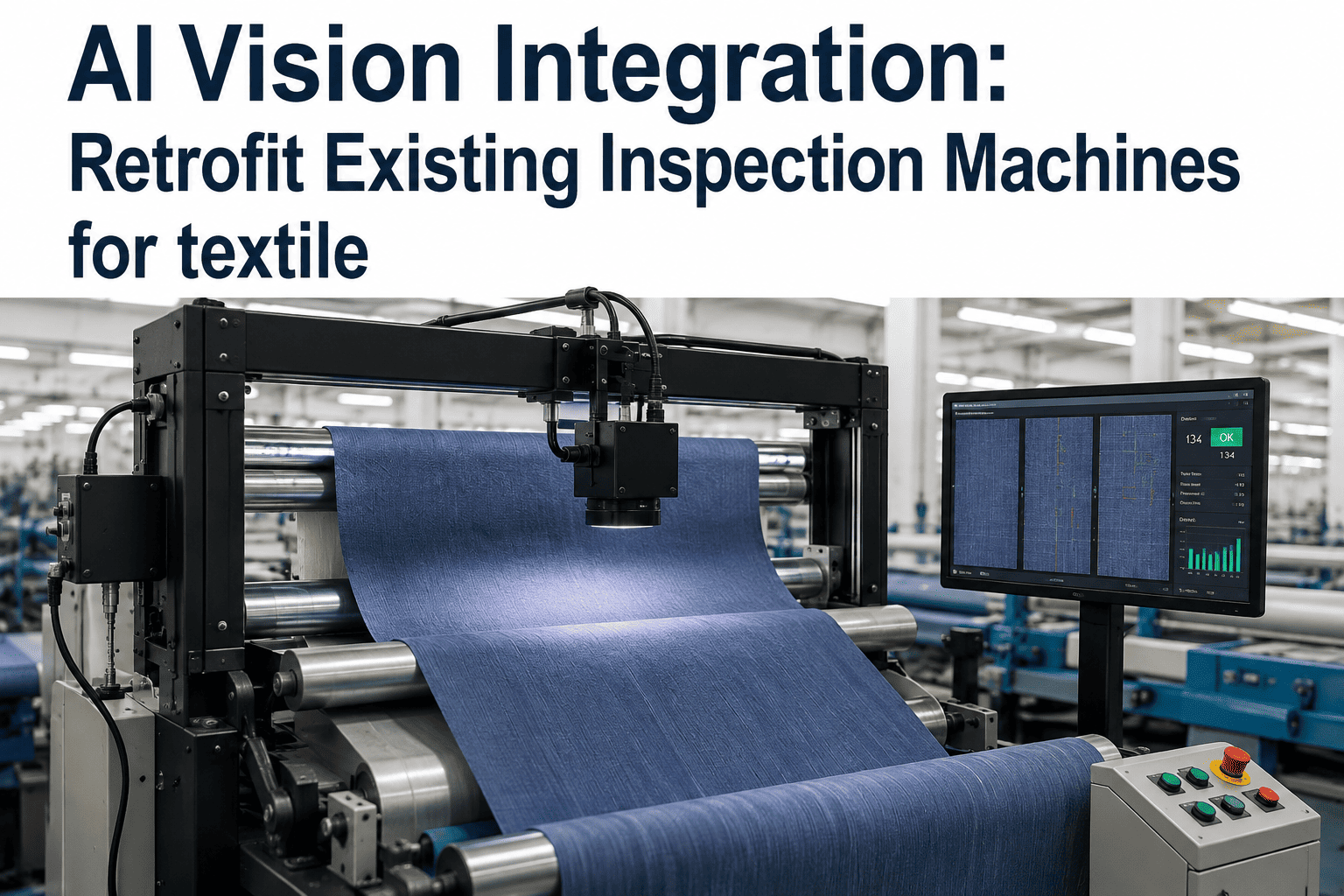
Replacing an entire fabric inspection machine to add AI-powered defect detection is rarely necessary, and it is almost never the fastest or cheapest path to better inspection accuracy. Most textile mills already own an inspection frame with the mechanical structure — fabric tensioning, roller path, lighting mounts — needed to support a camera and AI module addition. The question isn't whether to buy new equipment; it's how to retrofit what's already on the floor. To assess your specific inspection frame for retrofit compatibility, book a demo with iFactory AI.
Add AI Vision to Your Existing Inspection Frame — No Replacement Needed.
iFactory AI retrofits camera and edge AI modules onto your current inspection equipment, preserving your existing mechanical investment.
The Case for Upgrading, Not Replacing, Existing Equipment
A full inspection machine replacement typically costs several times more than a retrofit and can take months longer to procure, install, and commission — time during which the current inspection process, whatever its limitations, has to keep running unchanged. Retrofitting preserves the mechanical investment already made in fabric handling, tensioning, and roller systems, and focuses new spend specifically on the sensing and intelligence layer where the actual improvement is needed.
Retrofit is not universally possible — a frame in poor mechanical condition, or one running at a fabric speed the existing structure cannot safely support for the inspection task, may genuinely need replacement. But this is the exception. For the large majority of mills evaluating AI vision, the existing frame is mechanically sound and simply lacks the sensing and processing layer that AI vision adds.
What Determines Whether Your Frame Is Retrofit-Ready
Before committing to a retrofit plan, four specific aspects of the existing inspection frame need to be assessed to confirm compatibility and estimate integration effort.
Frame Stability & Mounting Points
Does the existing structure have stable mounting locations for a camera at the correct viewing angle and distance from the fabric path?
Lighting Conditions
Is current lighting adequate and consistent, or does the retrofit need to include supplemental illumination for reliable image capture?
Line Speed & Vibration
Does fabric speed and any mechanical vibration fall within the operating range the camera and processing hardware can reliably handle?
Network & Power Access
Is there accessible power and network connectivity near the frame, or does the retrofit need to include new cabling runs?
What Actually Changes on the Frame During Retrofit
The retrofit adds a sensing and intelligence layer on top of the existing mechanical system, without disturbing the fabric path or roller mechanism that already works. The comparison below shows exactly what is added versus what stays untouched.
Before Retrofit
After Retrofit
A Typical Retrofit Timeline From Assessment to Live Operation
A well-planned retrofit follows a predictable sequence, with most steps completed without requiring an extended production stoppage on the line being upgraded.
On-Site Assessment
Engineers inspect frame condition, mounting options, lighting, and network access to confirm the retrofit scope.
Hardware Installation
Camera, lighting supplement if needed, and edge AI module are mounted, typically during a scheduled maintenance window.
Model Training
AI model is trained on fabric samples specific to the line's material and known defect types, running alongside normal production.
Shadow Validation & Handover
System runs in shadow mode against manual inspection, then transitions to live operation once accuracy is validated.
Retrofit Without Extended Production Downtime.
iFactory schedules installation around your existing maintenance windows to minimize impact on production.
Retrofit Challenges and How They're Typically Resolved
No retrofit project is entirely without friction. The challenges below are the ones most commonly encountered during textile inspection frame retrofits, along with the standard approach used to resolve each one.
Legacy Frame Vibration
Older frames can carry more mechanical vibration than modern equipment, which can blur camera images at high fabric speeds. This is typically resolved with vibration-dampening camera mounts rather than requiring frame replacement.
Inconsistent Fabric Tension
Variable tension across a fabric roll can cause the material to sit at a slightly different distance from the camera, affecting focus consistency. Adjustable-focus camera modules or minor tensioning system tweaks usually address this.
Limited Physical Space Around the Frame
Tightly packed production floors sometimes leave little room for camera mounting hardware. Compact camera housings and creative mounting brackets typically resolve this without requiring floor layout changes.
Operator Skepticism During Transition
Floor staff accustomed to manual inspection may be hesitant to trust the new system's output initially. Running an extended shadow-mode period, with operators reviewing side-by-side comparisons, tends to build confidence faster than a rushed handover.
What to Look for When Choosing a Retrofit Partner
Not every AI vision vendor has genuine retrofit experience — some specialize exclusively in new equipment sales and treat retrofit as an afterthought, which shows up in the quality of the assessment and installation work. A few specific signals distinguish a vendor genuinely experienced in retrofit projects.
Ask to see examples of retrofits completed on inspection frames similar to yours, including the specific mounting and lighting solutions used — a vendor with real retrofit experience will have concrete examples rather than generic marketing materials. Ask how the on-site assessment is conducted and what specific criteria it evaluates; a thorough assessment process that examines frame stability, lighting, line speed, and network access in detail is a strong signal of genuine engineering rigor rather than a sales-driven approach that skips straight to a hardware quote. Finally, ask about the ongoing support relationship after installation, specifically who handles model retraining as your fabric mix evolves over time, since this determines whether the system's accuracy holds up or degrades as your product line changes.
When Replacement Actually Makes More Sense Than Retrofit
While retrofit is the recommended default path for most mills, there are specific conditions under which replacing an inspection frame outright is the more sensible decision, and being honest about these conditions during the assessment phase avoids forcing a retrofit onto equipment that genuinely isn't a good candidate.
| Condition | Recommended Path |
|---|---|
| Frame mechanically sound, standard mounting available | Retrofit |
| Frame near end of mechanical service life | Replace |
| Line speed requirement exceeds frame's rated capacity | Replace |
| Lighting and network access reasonably accessible | Retrofit |
| Frame already scheduled for capital replacement soon | Wait and specify AI-ready features in new equipment |
The last row is worth emphasizing — if a frame is already approaching a planned replacement cycle within the near term, it is usually more cost-effective to wait and specify camera mounting points, lighting infrastructure, and network access directly into the new equipment's procurement requirements, rather than investing in a retrofit for equipment that will be replaced shortly afterward.
Sequencing a Retrofit Across Multiple Inspection Frames
Mills with several inspection frames across different lines or departments generally benefit from a sequenced retrofit approach rather than attempting every frame simultaneously, both to manage internal resource capacity and to apply lessons learned from the first retrofit to subsequent ones.
Starting with the frame carrying the highest current defect-cost or highest manual inspection labor cost typically produces the clearest early return and the strongest internal case for continuing the rollout to additional frames. Each subsequent retrofit benefits directly from the first — the assessment process is faster once the team knows what to look for, the model training process is more efficient once a baseline defect taxonomy exists for similar fabric types, and the internal change management approach with floor staff is refined based on what worked and what didn't during the first deployment. Mills that attempt to retrofit every frame in a single coordinated push often find that unresolved issues from an early frame propagate uncorrected across the entire batch, whereas a sequenced approach catches and fixes these issues before they scale.
AI Vision Retrofit Integration — Common Questions
How do we know if our specific inspection frame can be retrofitted?
The only reliable way to confirm compatibility is a physical on-site assessment covering frame stability, mounting points, lighting, line speed, and network access. Photos and basic specifications can provide an initial estimate, but a proper assessment typically takes a few days on-site and produces a definitive retrofit scope and cost estimate. Most standard textile inspection frames — whether for grey fabric, dyed fabric, or finished goods — are compatible in some form, with the assessment mainly determining the specific mounting and lighting approach needed.
Will the retrofit installation require us to stop the production line for an extended period?
Most retrofit installations are scheduled around existing planned maintenance windows and completed within a few days of actual hands-on installation time, rather than requiring an extended dedicated shutdown. Model training and shadow-mode validation both run alongside normal production, since the AI system observes the fabric without needing to be the primary inspection method during this phase. The line only needs a brief window during the final camera mounting step itself.
What happens to our existing lighting if it's inadequate for camera-based inspection?
If the on-site assessment identifies inadequate or inconsistent lighting, supplemental illumination is added as part of the retrofit scope — this is a common and expected part of many retrofit projects rather than an unusual complication. The added lighting is typically LED-based, low-power, and mounted alongside the camera module, designed specifically to provide consistent illumination for reliable image capture regardless of ambient shop-floor lighting conditions. Contact our support team to discuss your specific lighting setup.
Can one retrofit approach work across multiple different inspection frame types in our plant?
Retrofit specifications are generally tailored to each frame type, since mounting points, lighting conditions, and fabric handling can vary significantly across grey fabric inspection, dyed fabric inspection, and finishing line equipment. However, the underlying camera and AI module technology is consistent across frame types, so once a mill has one successful retrofit deployment, subsequent retrofits on similar frame types are typically faster to plan and execute. Book a demo to review the specific frame types across your plant.
Upgrade Your Existing Inspection Frame With AI Vision.
iFactory AI assesses your current equipment and delivers a retrofit plan that adds intelligence without replacing what already works.