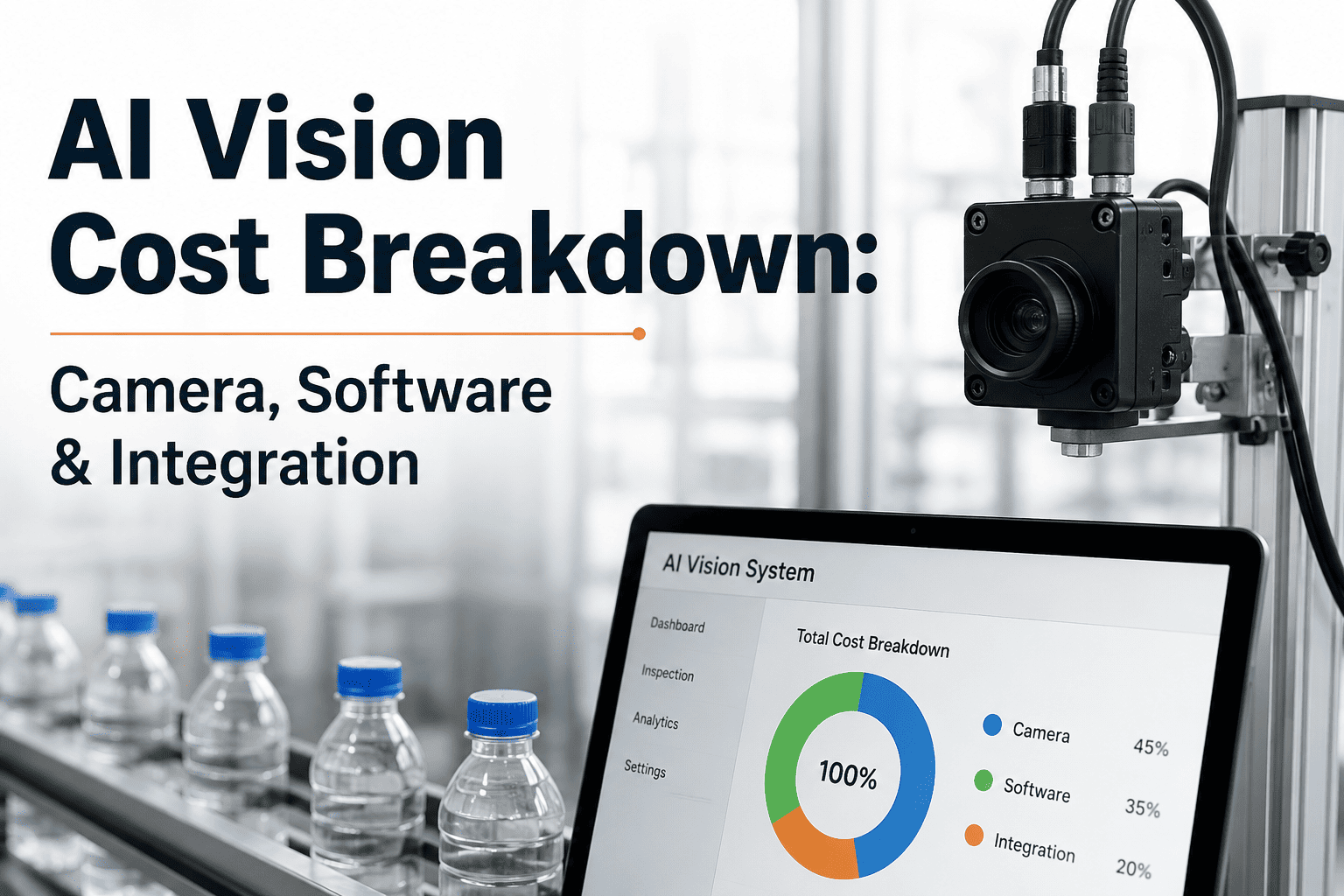
Ask three different AI vision vendors for a quote and you will likely get three different numbers with no way to compare them, because each one bundles hardware, software, and services differently. That opacity is the single biggest reason textile plant budgets stall before a purchase order is ever raised. A proper cost breakdown separates every dollar into a category that can be verified, compared, and defended to finance — no bundled black box. To get an itemized quote for your specific inspection line, book a demo with iFactory AI.
Every Cost Line, Itemized — Camera, Software, Integration, Support.
iFactory AI provides a full cost breakdown before any commitment, sized to your line speed, camera count, and fabric type.
Understanding What You're Actually Paying For
An AI vision deployment cost breaks into four distinct layers, each with its own pricing logic, its own vendor options, and its own long-term cost trajectory. Understanding each layer independently is what allows a plant manager to negotiate intelligently instead of accepting a single bundled figure.
Camera & Optics Hardware
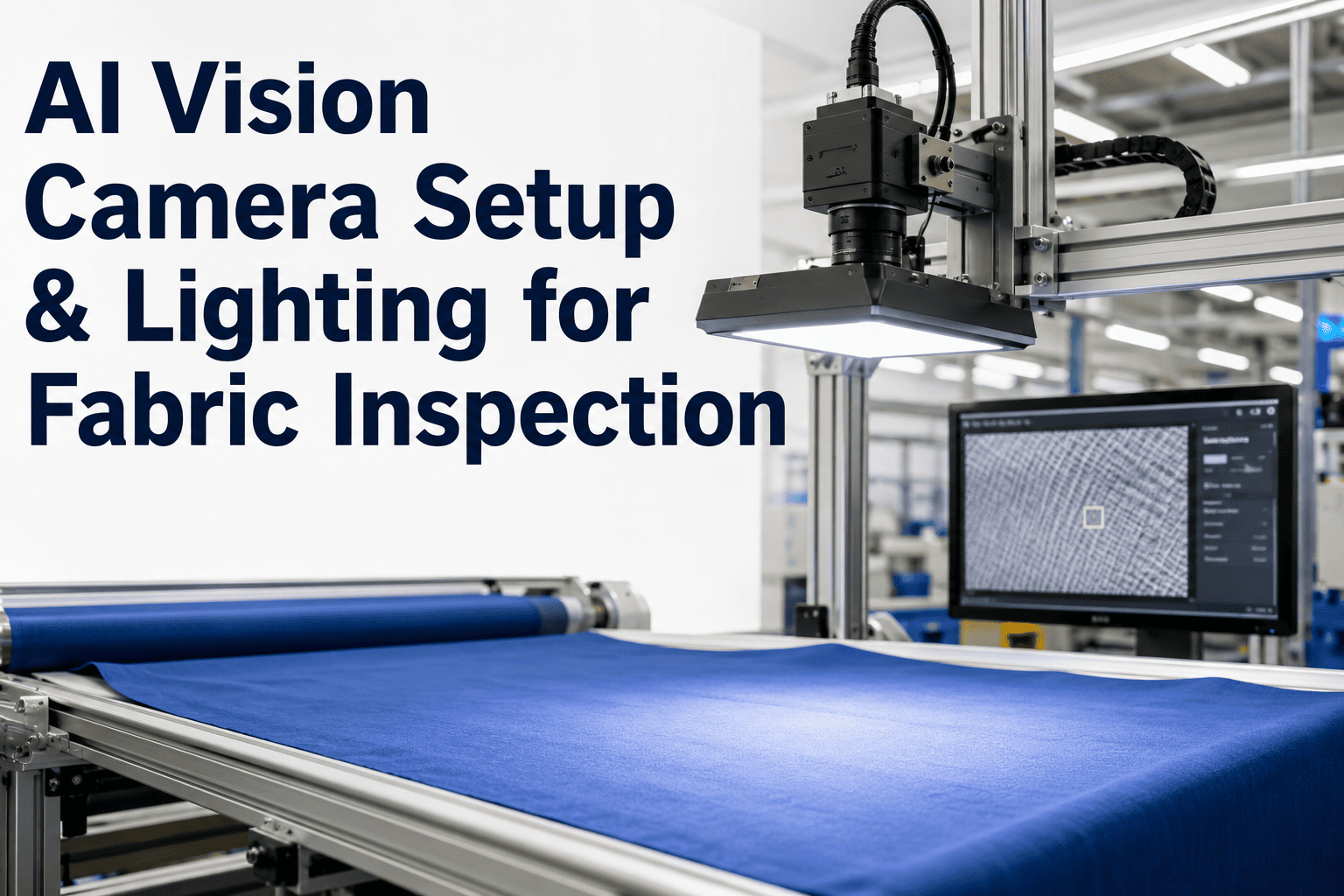
Line-scan or area-scan industrial cameras, lensing, and illumination sized to fabric width, line speed, and defect resolution requirements. This is typically a one-time capital cost.
AI Software Licensing
Model training, inference engine, and detection software, usually licensed per camera or per line on an annual or subscription basis rather than a one-time purchase.
Integration & Deployment
Mechanical mounting, network cabling, PLC or line-control integration, and initial model training on your specific fabric samples — a one-time services cost.
Ongoing Support & Maintenance
Model retraining as new defect types appear, hardware servicing, and technical support — typically structured as an annual maintenance agreement.
How Total Deployment Cost Typically Splits Across Layers
The relative weight of each cost layer shifts depending on deployment scale, but for a typical single-line textile inspection deployment, the distribution generally follows the pattern shown below across the first-year total cost of ownership.
Notice that hardware — the one-time camera and optics cost — is the largest single-year line item, but it is also the cost that does not recur. From year two onward, software licensing and support maintenance become the dominant ongoing spend, which is why negotiating the licensing model matters as much as negotiating the initial hardware price.
What Actually Moves the Price Up or Down
Cost per camera station is not fixed — it moves based on a handful of specific factors that a mill can often influence through how the deployment is scoped. Understanding these levers helps avoid over-specifying a system beyond what the actual defect detection requirement calls for.
| Factor | Increases Cost | Reduces Cost |
|---|---|---|
| Line speed | High-speed lines need faster sensors and processing | Slower lines allow standard camera specs |
| Fabric width | Wider fabric needs multiple camera stations | Narrow fabric covered by single station |
| Defect resolution needed | Sub-millimeter detection needs higher-res optics | Larger defect thresholds allow standard optics |
| Number of lines | — | Multi-line deployment reduces per-line integration cost |
| Existing frame compatibility | Custom mounting adds engineering cost | Standard frame retrofit lowers integration cost |
Building an Internal Budget Request That Finance Approves
A budget request built around the four-layer breakdown, rather than a single bundled figure, tends to move through approval faster because it lets finance evaluate the recurring versus one-time cost split clearly — which is exactly the distinction most capital committees look for before approving a new technology line item.
Separate one-time capital cost (camera, optics, integration) from recurring operating cost (software licensing, support).
Attach the itemized breakdown to a specific defect-cost or rework-cost baseline so the payback comparison is concrete.
Request a single-line pilot budget first — this is a materially smaller ask than a full-plant rollout and de-risks the larger decision.
Present projected multi-year cost, not just year-one cost, since software and support cost recur annually.
Get a Three-Year Total Cost of Ownership Projection.
iFactory builds the full multi-year cost view — not just year-one — so your budget request holds up under finance scrutiny.
Cost Items That Get Left Out of Initial Quotes
Beyond the four core cost layers, several secondary costs are frequently omitted from initial vendor quotes, only surfacing after a contract is signed. Asking about these directly during evaluation prevents budget surprises later.
Network Infrastructure Upgrades
High-resolution camera streams may require network bandwidth beyond what your current plant network provides, particularly if multiple camera stations feed data simultaneously.
Environmental Enclosures
Cameras and edge processing hardware deployed in dusty, humid, or high-vibration textile environments may need protective enclosures not included in a standard hardware quote.
Data Storage for Training and Compliance
Storing captured images for model retraining and quality audit trails accumulates storage cost over time, especially at high-resolution and high-throughput deployments.
Staff Training Time
Time spent training operators and quality staff to work with the new system's interface and escalation workflow represents a real, if often unbudgeted, labor cost.
Ways to Structure Payment Beyond a Single Upfront Purchase
For mills where a large upfront capital outlay is difficult to justify even with a strong payback case, several alternative financing structures are increasingly available in the industrial AI vision market and worth exploring during vendor negotiation.
| Structure | How It Works | Best Fit |
|---|---|---|
| Outright purchase | Full upfront payment for hardware, annual licensing thereafter | Mills with available capital budget seeking lowest long-term cost |
| Equipment leasing | Fixed monthly payment covering hardware over a lease term | Mills preferring to preserve capital for other investments |
| Vision-as-a-service | Single subscription covering hardware, software, and support | Mills wanting predictable operating cost with minimal upfront spend |
| Phased purchase | Pilot line purchased outright, expansion financed as ROI is proven | Mills wanting to validate before committing to larger financing |
Vision-as-a-service arrangements have become increasingly common specifically because they remove the upfront capital barrier that stalls many otherwise well-justified AI vision decisions, shifting the entire cost into an operating expense that can be directly compared against the quality and rework savings it generates each month.
How Deployment Cost Varies by Textile Process Stage
The four-layer cost model applies consistently across the textile production chain, but the absolute figures shift depending on which process stage is being inspected, since fabric width, line speed, and defect resolution requirements differ significantly between raw material inspection, in-process inspection, and finished goods inspection.
| Process Stage | Typical Camera Complexity | Relative Cost Level |
|---|---|---|
| Grey fabric inspection | Standard resolution, moderate line speed | Baseline |
| Dyed fabric shade inspection | Color-calibrated cameras, controlled lighting | Moderate premium |
| Finished goods inspection | Higher resolution for fine defect detection | Higher premium |
| High-speed weaving lines | Line-scan cameras, faster processing | Highest premium |
Color-calibrated inspection for dyed fabric carries a moderate cost premium over standard grey fabric inspection because shade-matching accuracy requires more controlled and consistent lighting conditions, along with camera sensors calibrated specifically for color fidelity rather than just shape and pattern detection. Understanding which category your specific inspection need falls into helps set realistic budget expectations before requesting vendor quotes.
Getting the Best Terms From an AI Vision Vendor
Once the itemized cost breakdown is understood, a few specific negotiation approaches tend to produce meaningfully better terms than accepting a vendor's first quoted figure across each of the four cost layers.
On the hardware layer, ask whether the quoted camera and optics can be reused if you later expand to additional lines, since hardware standardization across a deployment often unlocks volume pricing that isn't offered for a single-station purchase. On the software licensing layer, ask about multi-year licensing discounts versus annual renewal, and confirm whether the license is transferable if a camera station is relocated to a different line in the future. On the integration layer, ask whether the vendor's quote assumes your existing frame is retrofit-compatible or whether it includes a contingency for additional mechanical work — an unclear scope here is one of the most common sources of cost overrun during actual installation. On the support layer, negotiate a defined number of included model retraining cycles per year rather than accepting an open-ended "as needed" clause that can be interpreted narrowly once the contract is signed.
AI Vision Cost Breakdown — Common Questions
Is the software licensing cost per camera, per line, or per plant?
This varies by vendor and deployment model, but per-camera or per-line licensing is the most common structure in industrial vision deployments, since it scales predictably with the number of inspection points rather than requiring a plant-wide commitment upfront. When evaluating quotes, always confirm whether the licensing figure quoted covers one camera station or the full deployment, since this is the single most common source of budget surprise once a contract is signed. Book a demo to see exactly how licensing is structured for your camera count.
Does the integration cost change if we already have inspection frames installed?
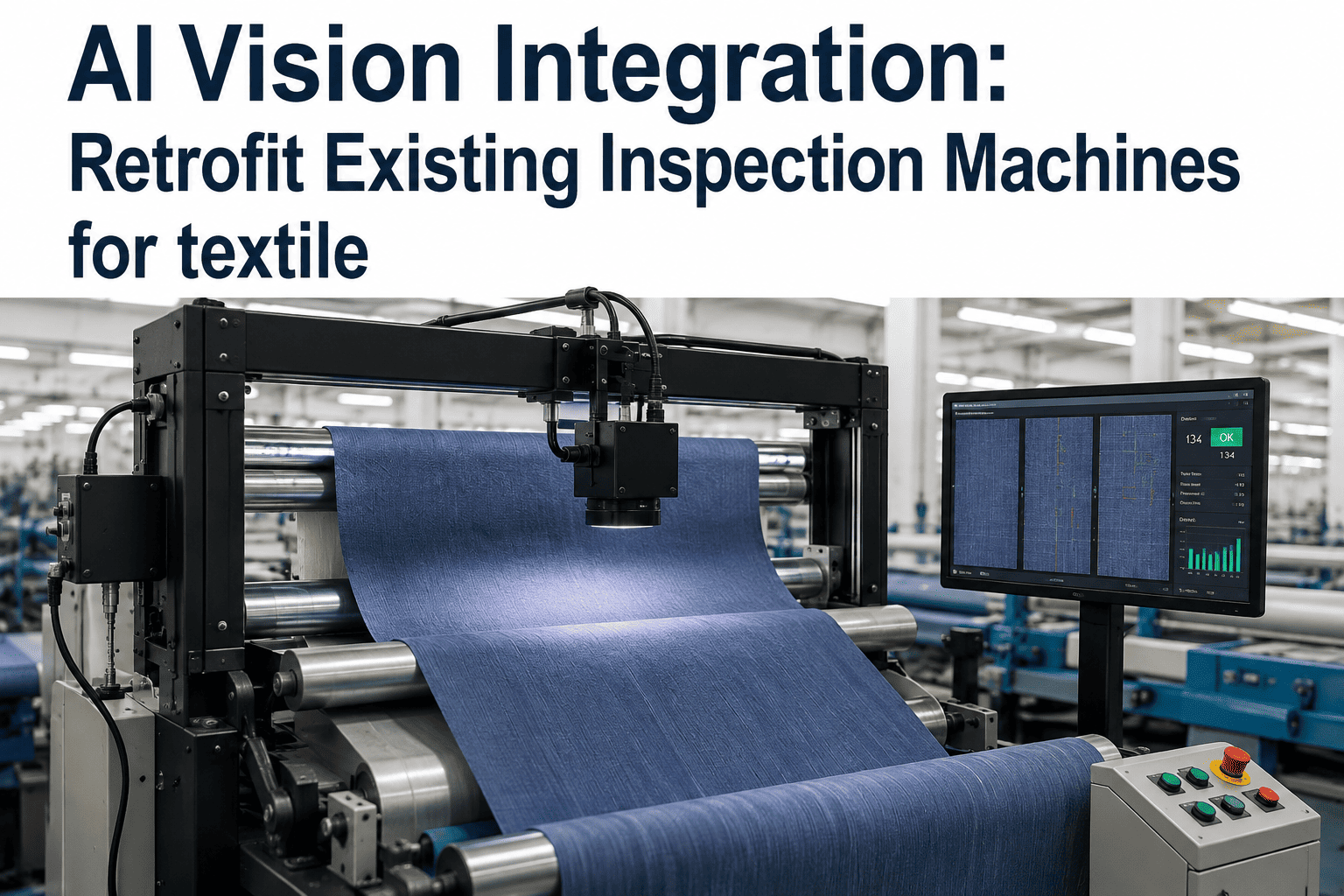
Yes, generally in a favorable direction. Retrofitting onto an existing inspection frame is typically less expensive than a greenfield installation because the mechanical structure, fabric path, and often the lighting infrastructure already exist. Integration cost in a retrofit scenario is mostly camera mounting, network connectivity, and initial model training rather than full mechanical engineering, which is why most textile mills pursue the retrofit path rather than replacing entire inspection stations.
What ongoing maintenance costs should we expect beyond the software license?
Beyond the software license itself, expect periodic model retraining costs as new fabric types or defect categories are introduced to your product line, occasional camera and lens cleaning or replacement due to the industrial environment, and a technical support agreement covering system uptime and troubleshooting. These are typically bundled into an annual maintenance agreement rather than billed separately, which simplifies budgeting once the initial deployment is complete.
Can we phase the cost across multiple budget cycles instead of one large purchase?
Yes — phasing the deployment starting with a single pilot line, then expanding camera-by-camera or line-by-line, is a common and recommended approach for mills managing capital constraints. This spreads the capital cost across budget cycles while allowing the software licensing and support costs to scale proportionally with the expanding deployment, rather than requiring the full multi-line investment upfront. Contact our team to discuss a phased rollout plan for your plant.
Stop Comparing Bundled Quotes You Can't Actually Evaluate.
iFactory AI gives you a clear, layer-by-layer cost breakdown for your specific line, so your budget decision is based on real numbers.