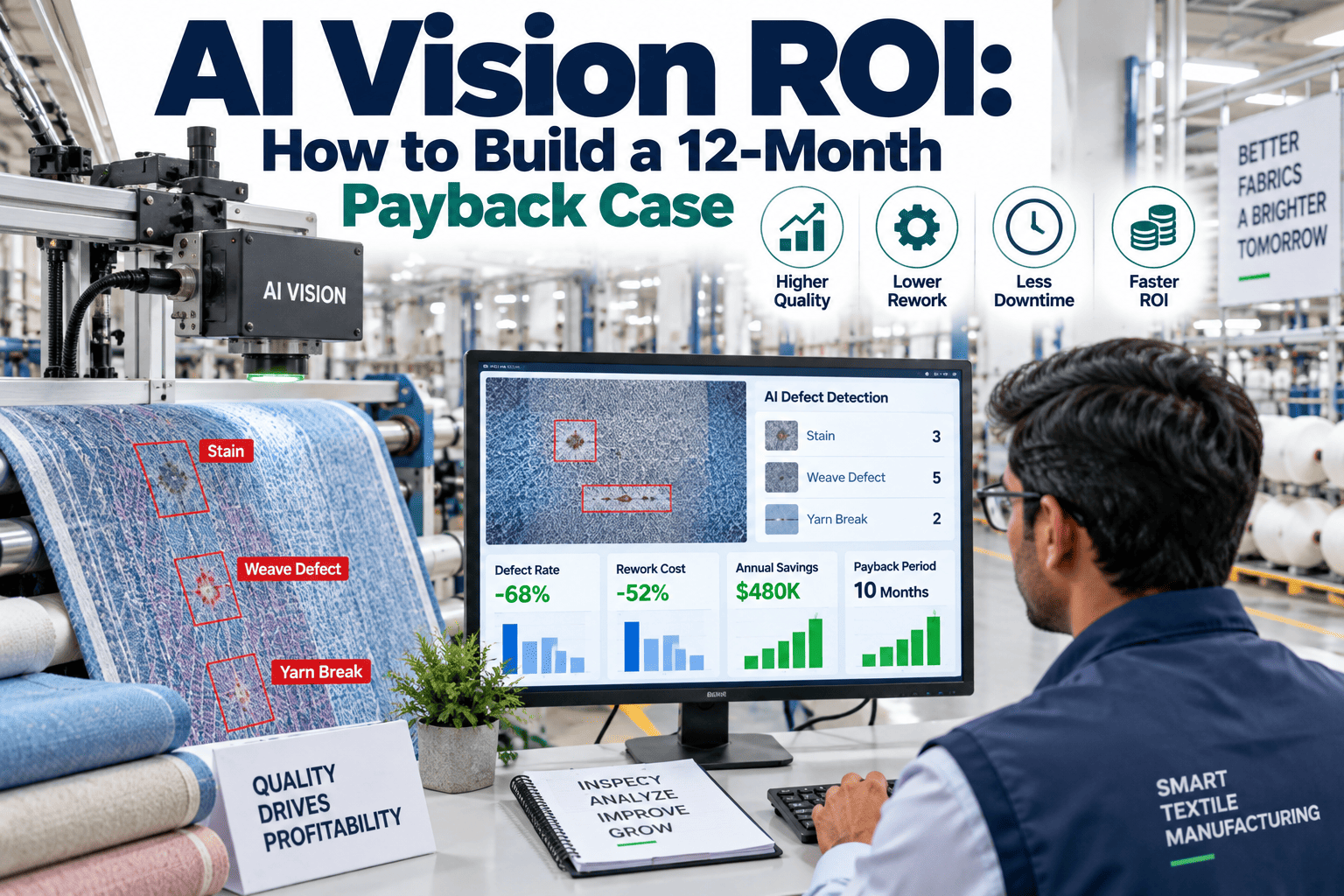
Every AI vision proposal eventually lands on the same desk, and the finance leader reading it wants one thing before signing off: a specific month when the investment stops being a cost and starts being a return. A credible payback case for textile AI vision inspection isn't built from a vendor's marketing average, it's built from a mill's own defect escape cost, current labor allocation, and rework rate, run through a straightforward calculation that shows the actual crossover point. Mills that build this case properly tend to find the payback window lands somewhere between six and eighteen months depending on production scale and defect cost, but the number that actually gets budget approved is the one grounded in the mill's own data, not an industry-wide claim. Mills ready to build their own specific payback case can start that process with iFactory's support team.
Finance Doesn't Want "AI Vision Pays for Itself." They Want the Month It Does.
iFactory builds your payback case from your own defect escape cost, labor allocation, and rework data, giving finance the specific month cumulative savings cross the investment line.
Why Generic ROI Numbers Don't Survive a Finance Review
A vendor's average payback figure describes their typical customer, not this specific mill's specific defect cost structure, labor rates, and production volume, and any finance leader worth their role will ask exactly that question the moment a generic number gets presented as justification.
Defect Escape Cost Rarely Gets Calculated Precisely
Most mills know a defect that reaches a customer costs more than one caught internally, but few have quantified exactly how much more in dollar terms.
Labor Savings Get Estimated Too Optimistically or Ignored Entirely
A payback case that assumes full inspector headcount elimination without a realistic redeployment plan tends to overstate savings finance won't believe.
Rework and Scrap Costs Stay Buried in General Overhead
Without isolating rework specifically tied to defects the new system would catch, the payback case misses one of its largest potential savings categories.
The Case Gets Built Once and Never Updated With Real Deployment Data
A projected payback case presented at approval time should be revisited against actual results once the system goes live, but rarely is.
The Three Savings Streams Behind a Credible Payback Case
A defensible business case breaks total savings into distinct, separately justified categories rather than a single blended estimate that's hard to audit or defend.
| Savings Category | What It Captures | Data Needed to Quantify It |
|---|---|---|
| Defect Escape Reduction | Avoided cost of claims, returns, and reputation damage | Historical claim data, average claim cost |
| Labor Reallocation | Inspector time redirected to higher-value tasks | Current inspection headcount and hourly cost |
| Rework and Scrap Reduction | Lower material waste and repair labor from earlier detection | Rework labor hours and material cost tied to specific defects |
Building the Payback Calculation Step by Step
A credible calculation follows a specific sequence, moving from cost baseline through to a defensible crossover month finance can actually approve against.
Quantify Current Defect-Related Costs Precisely
Real numbers pulled from claims, rework logs, and inspection labor records, not rough estimates.
Apply a Conservative Expected Improvement Rate
Using a realistic, defensible detection improvement figure rather than the most optimistic number a vendor might quote.
Include the Full Deployment Cost, Not Just the Hardware
Installation, training data collection, and integration time all belong in the investment side of the calculation.
Plot Cumulative Savings Against the Investment Month by Month
The specific month savings exceed the investment is the number finance actually wants to see, not an annualized average.
Get the Specific Month Your AI Vision Investment Pays Off
iFactory builds a payback model from your own defect, labor, and rework data, giving finance the specific crossover month instead of an industry average.
A Composite Scenario: The Business Case That Got Approved on the Second Try
A composite knit fabric mill's first AI vision proposal, built around a vendor-supplied average payback figure, was rejected by finance within a week, with the CFO noting the case didn't reflect the mill's actual claim history or labor structure. The quality team went back and rebuilt the case using eighteen months of the mill's own customer claim records, actual grading labor hours, and documented rework costs tied specifically to the defect types the new system would catch.
The revised case showed a payback crossover at month nine, grounded entirely in the mill's own numbers rather than a vendor's claim, and included a conservative sensitivity range showing payback held even under a less optimistic detection improvement assumption. Finance approved the investment on the second submission, and the team continued tracking actual results against the projected model after go-live to validate the case going forward.
Common Mistakes in Building an AI Vision Payback Case
Leaning on Vendor-Supplied Averages Alone
A payback figure from a case study at a different mill rarely survives scrutiny once finance asks how it applies to this specific operation.
Overestimating Labor Savings Without a Redeployment Plan
Assuming full headcount elimination without a realistic plan for where that labor goes tends to undermine the case's credibility.
Leaving Out the Full Deployment Cost
A case that counts only hardware cost while omitting installation, training, and integration time understates the true investment side of the equation.
Never Validating the Projected Case Against Real Results
A payback model presented once at approval and never checked against actual post-deployment savings misses the chance to prove or refine the case.
Is Your Mill Ready to Build a Defensible Payback Case
You have historical claim and rework data by defect type
Specific, categorized cost data is what turns a generic estimate into a defensible calculation.
You know your current inspection labor cost precisely
Accurate labor figures are essential for the reallocation savings stream to hold up under review.
You're willing to use conservative improvement assumptions
A case that holds up even under a modest improvement estimate is far more persuasive than one that only works optimistically.
Leadership is prepared to track actual results after go-live
Validating the case against real data strengthens the argument for future investment decisions.
Frequently Asked Questions
What payback period should a textile mill realistically expect from AI vision inspection?
Reported payback periods commonly range from six to eighteen months depending on production scale, defect cost structure, and how much of the labor savings gets realized through actual redeployment rather than just theoretical headcount reduction. Mills with larger production scale and stable order volumes tend to see faster payback than smaller, lower-volume operations, which is exactly why a case built from a mill's own specific numbers matters more than any general industry figure. Mills wanting help building their own specific calculation can talk to iFactory support.
How do we estimate defect escape cost if we've never tracked it separately before?
Start with documented customer claims and returns tied to specific defect types over the past twelve to eighteen months, including any compensation, replacement shipments, or expedited freight costs associated with each claim. Even an imperfect starting estimate, clearly labeled as conservative, is more useful to a payback case than omitting the category entirely, since defect escape cost is often the single largest savings stream once quantified honestly.
Should the payback case assume inspector headcount will be reduced?
Not necessarily, and assuming immediate headcount reduction without a realistic transition plan often weakens the case's credibility with both finance and the floor. Many successful cases instead model labor reallocation, where inspection time shifts toward higher-value tasks like root cause investigation or supplier quality management, which is both more defensible and better for adoption than presenting the case as a straightforward layoff plan.
How much should the deployment cost estimate include beyond the camera hardware itself?
A complete investment figure includes installation, lighting setup, training data collection, model training and validation time, and integration with existing systems, all of which add meaningfully to the total cost beyond just the camera and compute hardware. Book a demo to see a complete deployment cost breakdown built around your specific line configuration.
Should we revisit the payback case after the system actually goes live?
Yes, tracking actual savings against the projected model for the first several months after go-live both validates whether the original case was accurate and provides a stronger, evidence-backed foundation for justifying future expansion to additional lines. A case that's never checked against real results loses the opportunity to prove its own credibility for the next investment decision.
Build a Payback Case Finance Will Actually Approve
iFactory grounds your AI vision business case in your own defect, labor, and rework data, giving you the specific month your investment pays off.