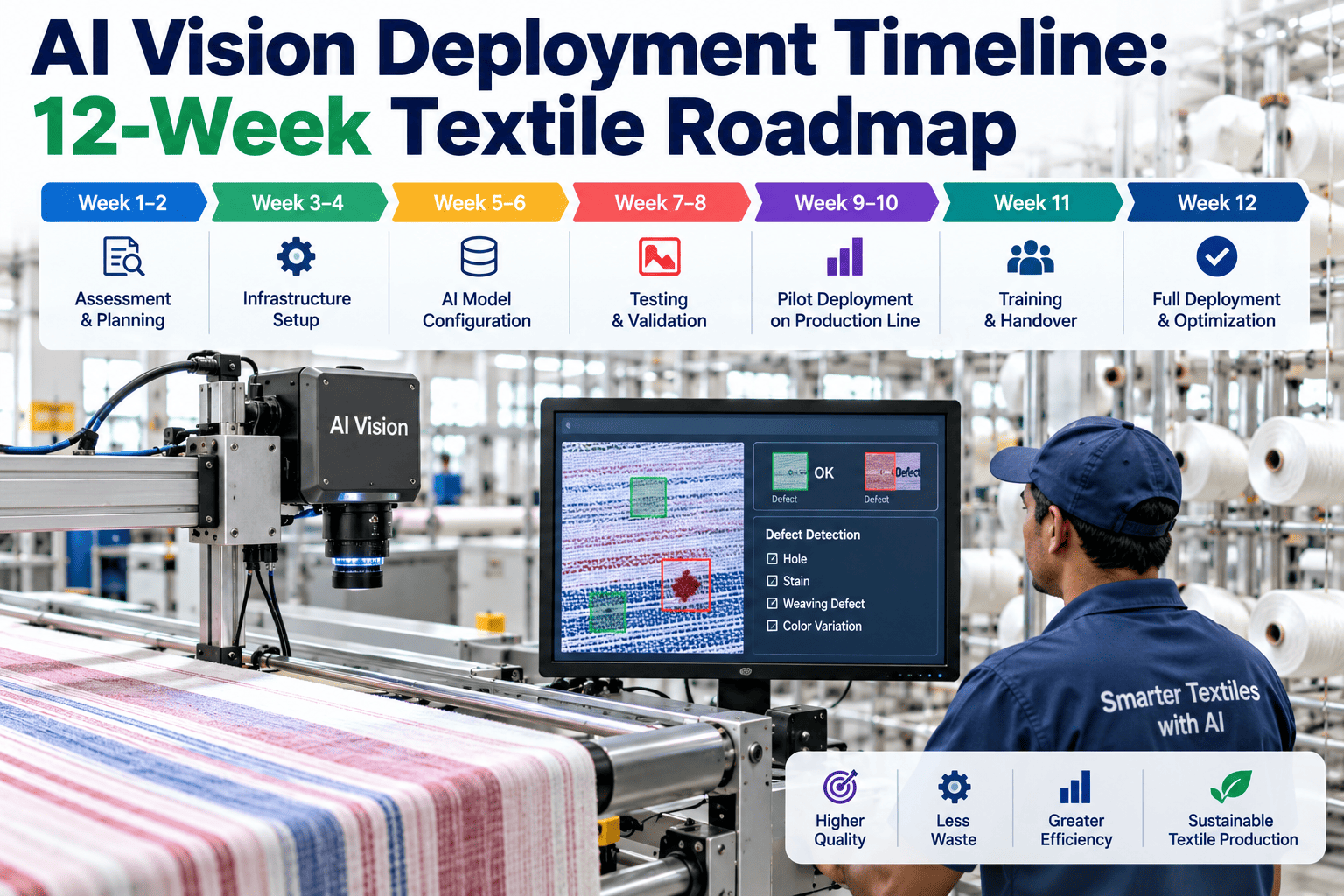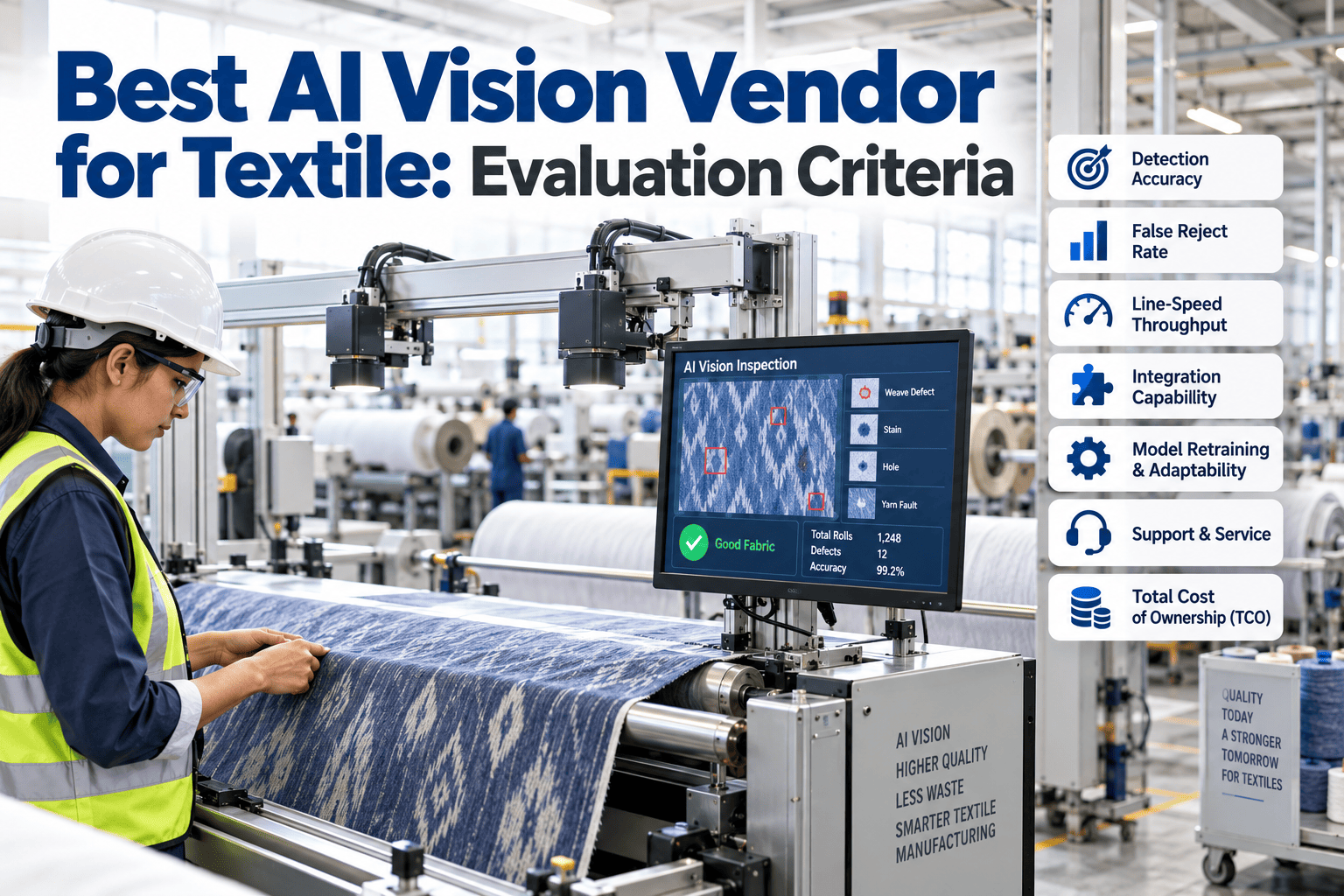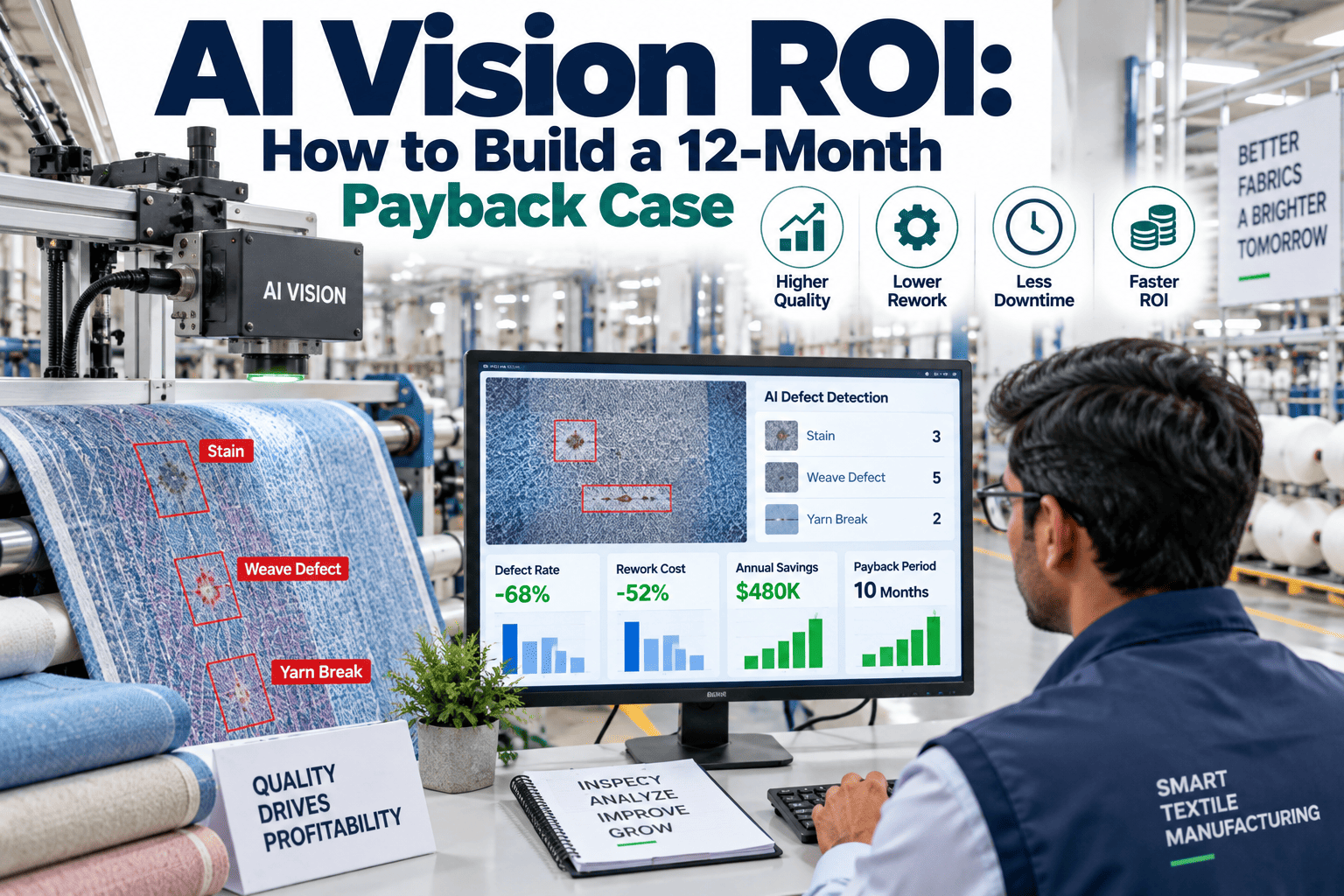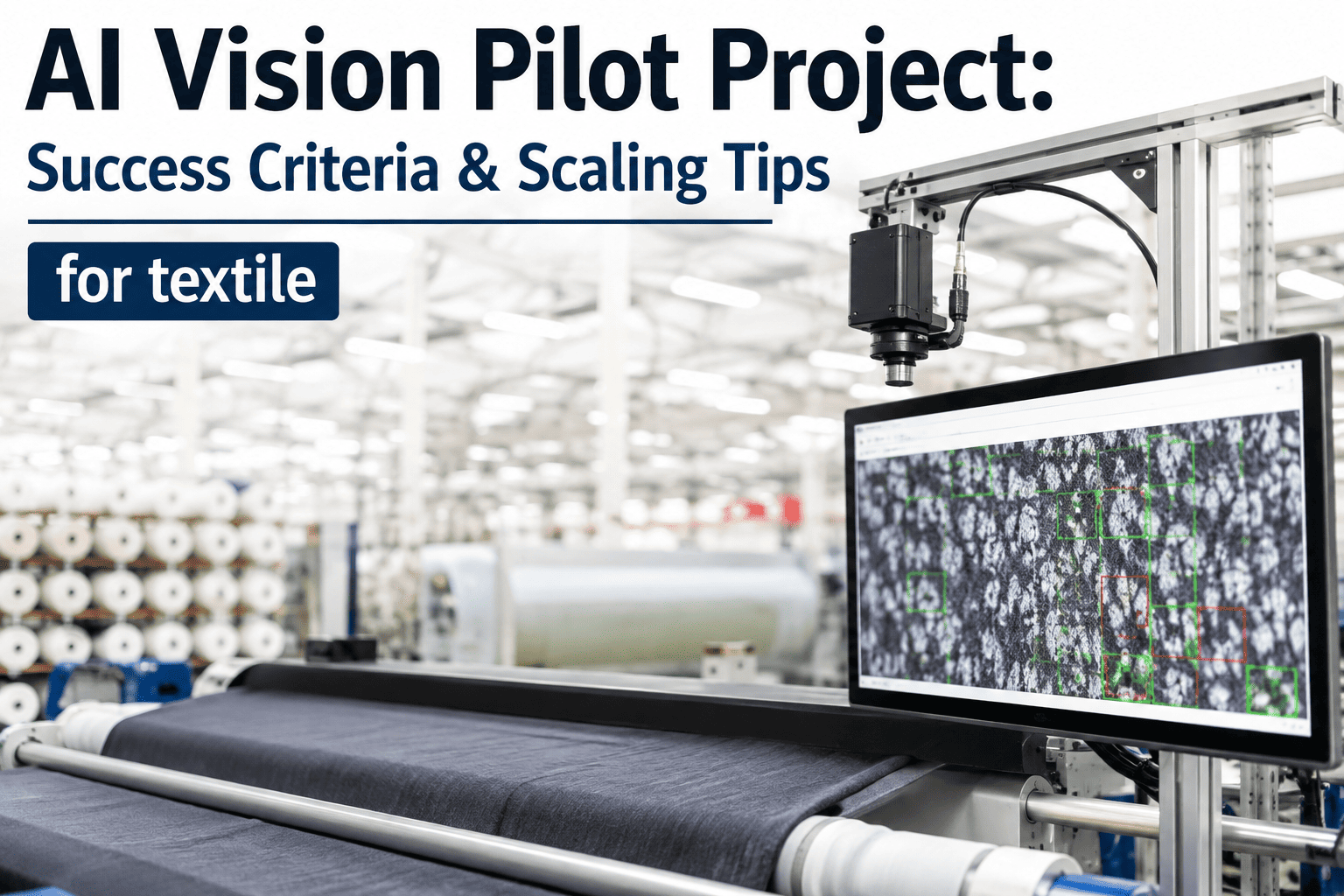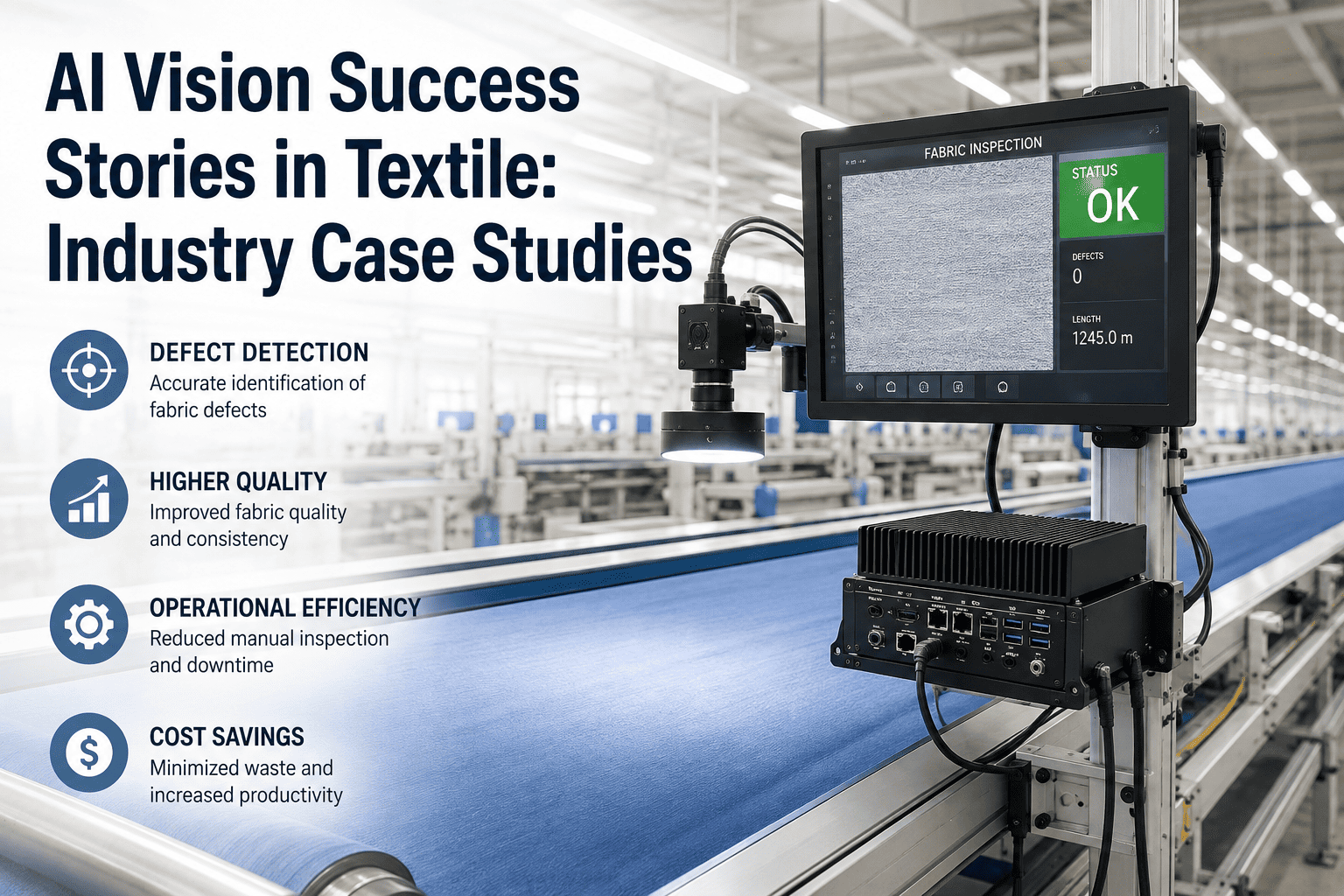
The textile mills getting the most attention in 2026 are not the ones that bought the most cameras. They are the ones that picked one measurable problem, ran a bounded pilot, and let the numbers decide whether to scale. Across weaving, knitting, dyeing, and technical textile production, the pattern in every successful AI vision deployment looks remarkably similar: a defined baseline, a pilot line, a defect-by-defect comparison against the existing grading process, and a go or no-go decision made on data rather than momentum. The four stories below are drawn from that pattern across four different textile segments. To see how a similar pilot structure would apply to your own line, book a demo.
Four Textile Segments, Four AI Vision Deployments, One Common Result
Weaving, knitting, dyeing, and technical textile production each present a different inspection problem, and each of the deployments below solved a different one. What they share is a disciplined pilot structure and a result measured against the mill's own baseline, not an industry average.
A 240-Loom Mill Replaces Manual Grading Without Missing a Buyer Deadline
A weaving mill running 240 looms across rapier, air-jet, and projectile architectures faced a familiar bind: buyer contracts with strict defect-point thresholds, a grading floor that could not scale labor fast enough for a production increase, and inspectors whose catch rate visibly declined after the first hour of a shift. The mill's leadership was skeptical of a plant-wide rollout claim, so the pilot was structured around a single measurable question — would AI grading catch what human inspectors were catching, plus what they were missing, without disrupting the loom floor.
The pilot began with sixty thousand meters of production fabric graded manually and photographed, establishing a baseline catch rate by defect category before any AI system touched the line. Camera brackets and illumination housings were engineered per loom width and beam configuration, meaning nothing about the existing looms needed to change to accommodate the new inspection layer.
The lesson that transfers to other weaving operations is less about the specific percentages and more about the milestone structure itself. No phase advanced until the production owner who would inherit the system signed off, which meant the plant manager entered go-live already trusting the numbers rather than being handed a system built by someone else's judgment.
A Circular Knitting Operation Cuts Fault Detection Latency From Shifts to Seconds
Knit fabric behaves differently from woven fabric under a camera, and a dropped stitch or a needle line unravels along the wale rather than staying localized the way a woven flaw does. A circular knitting operation running high-speed machines had a grading station positioned downstream of production, which meant a defect introduced early in a roll was not caught until the entire roll had already been knit, sometimes hours after the fault began.
Moving inspection from the downstream grading station to the point of knitting was the core change. Mounting continuous line-scan coverage directly at the knitting machine meant a fault generated an alert and a precise position record the moment it occurred, rather than being discovered as an aggregate downgrade after the roll was already complete and off the machine.
The broader pattern here matters beyond knitting specifically: the value of AI vision in any continuous textile process is often less about the raw detection accuracy number and more about closing the time gap between when a fault starts and when someone finds out about it. A defect caught at meter two costs a fraction of the same defect caught at meter two hundred.
A Dyehouse Turns Shade Consistency Into a Measurable, Repeatable Standard
Shade matching has historically been one of the hardest textile quality problems to solve with a fixed rule, because acceptable shade variation depends on lighting conditions, the specific buyer's tolerance, and subtle batch-to-batch dye uptake differences that even experienced colorists can disagree on. A dyeing and finishing operation supplying multiple retail buyers needed a way to catch shade deviation before a full batch shipped, rather than relying on end-of-batch spot checks that sampled only a fraction of total output.
The deployment paired continuous vision monitoring on the finishing line with buyer-specific tolerance profiles, since a shade variance acceptable to one buyer's contract was a rejection-triggering defect under another's. Rather than a single universal pass or fail threshold, the system needed to apply the correct grading rule depending on which order was running through the line at that moment.
The transferable insight for any dyehouse considering a similar deployment is that the hard part is rarely the camera or the model, it is encoding each buyer's specific tolerance logic correctly before go-live. Skipping that step produces a system that is technically accurate but commercially wrong for the order actually running. Dyehouses considering this path should expect the tolerance-mapping exercise to consume a meaningful share of the pilot timeline, since it requires pulling specification details from every active buyer contract rather than a single technical integration step.
A Coated Fabric Producer Solves a Defect Class Conventional Vision Couldn't See
Technical and coated textiles present a different visual problem than standard woven or knit goods, since coating flaws, delamination, and pinholes often show low contrast against the base fabric under standard illumination, and reflectance varies significantly from the softer, more diffuse light response of an uncoated woven fabric. A producer of coated technical fabric for industrial and protective applications had struggled to get consistent results from a generic vision system tuned for standard apparel fabric.
The fix was not a bigger model, it was matching the illumination and camera configuration specifically to the coated fabric's reflectance characteristics, paired with a defect head trained specifically on coating-flaw signatures rather than reusing a general-purpose fabric defect model. This is a pattern that shows up whenever a mill's product mix includes a fabric family meaningfully different from the majority of its production.
The takeaway for any technical textile producer is that a vision system's published accuracy figures usually describe standard woven or knit fabric performance, and a genuinely different construction deserves its own validation pass before anyone assumes the same numbers will carry over. This is not a reason to avoid technical textiles as a candidate for AI vision, it is a reason to budget for a dedicated calibration phase specific to that fabric family within the pilot scope, rather than folding it into a standard rollout timeline built for conventional woven or knit production.
See how a similar pilot would run on your line
iFactory structures every deployment around your own baseline, your own defect categories, and a defined pilot with clear exit criteria — not a generic industry benchmark applied to your floor.
The Pattern Behind Every Successful Textile AI Vision Deployment
Reading across weaving, knitting, dyeing, and technical textiles, the specific defect classes and metrics differ, but the underlying structure of a successful deployment repeats closely enough to treat it as a template rather than a coincidence. None of the four mills started with a plant-wide commitment; each began with a bounded pilot narrow enough to fail safely and specific enough to produce a real answer.
Why the Results Above Won't Transfer to Your Line Automatically
It would be easy to read four strong outcomes and assume the same percentages apply everywhere. They will not, and treating published case study numbers as a guaranteed forecast for a different mill is a common and avoidable planning mistake.
This is exactly why iFactory structures every new deployment around a baseline measurement specific to that mill before quoting an expected outcome, the same discipline that ran through each of the four stories above. A published case study is a useful reference point for what is possible, not a substitute for measuring your own starting point. To measure your own baseline against a realistic improvement range, contact our support team.
What to Have Ready Before Running Your Own Pilot
Every mill in the four stories above entered its pilot with a specific set of inputs already prepared. Assembling these before the first conversation with a vendor shortens the time from contract to results and produces a pilot that actually answers the question it was designed to answer, rather than one that drags on because basic groundwork was skipped at the start.
What Mills Ask Before Starting Their Own AI Vision Pilot
Ready to Measure What AI Vision Would Change on Your Line
Every deployment above started the same way: a specific defect problem, a measured baseline, and a bounded pilot with clear success criteria. iFactory runs that same process for your mill, whatever your fabric mix or line speed looks like.