Ask a plant manager why they haven't deployed AI vision inspection yet, and the answer is rarely "we don't believe it works." It's usually something closer to "we don't know what it actually costs," or "we're afraid it will disrupt a line that's already hard enough to keep running," or "we tried a vision system years ago and it never delivered what the vendor promised." These are reasonable fears, and the mills that move past them fastest are the ones who get straight answers instead of a sales pitch. To get a direct cost and integration walkthrough for your specific line, book a demo with iFactory AI.
Every AI Vision Fear Has a Straight, Specific Answer.
iFactory AI walks through real cost figures, real integration timelines, and real accuracy data for your fabric or product line — before you commit to anything.
The Four Fears That Stall Every AI Vision Decision
Textile plant managers evaluating AI vision inspection tend to circle the same four concerns regardless of mill size or region. Naming them plainly, and answering them with actual data rather than reassurance, is what moves a stalled evaluation into a funded pilot.
What "Unknown Cost" Actually Breaks Down Into
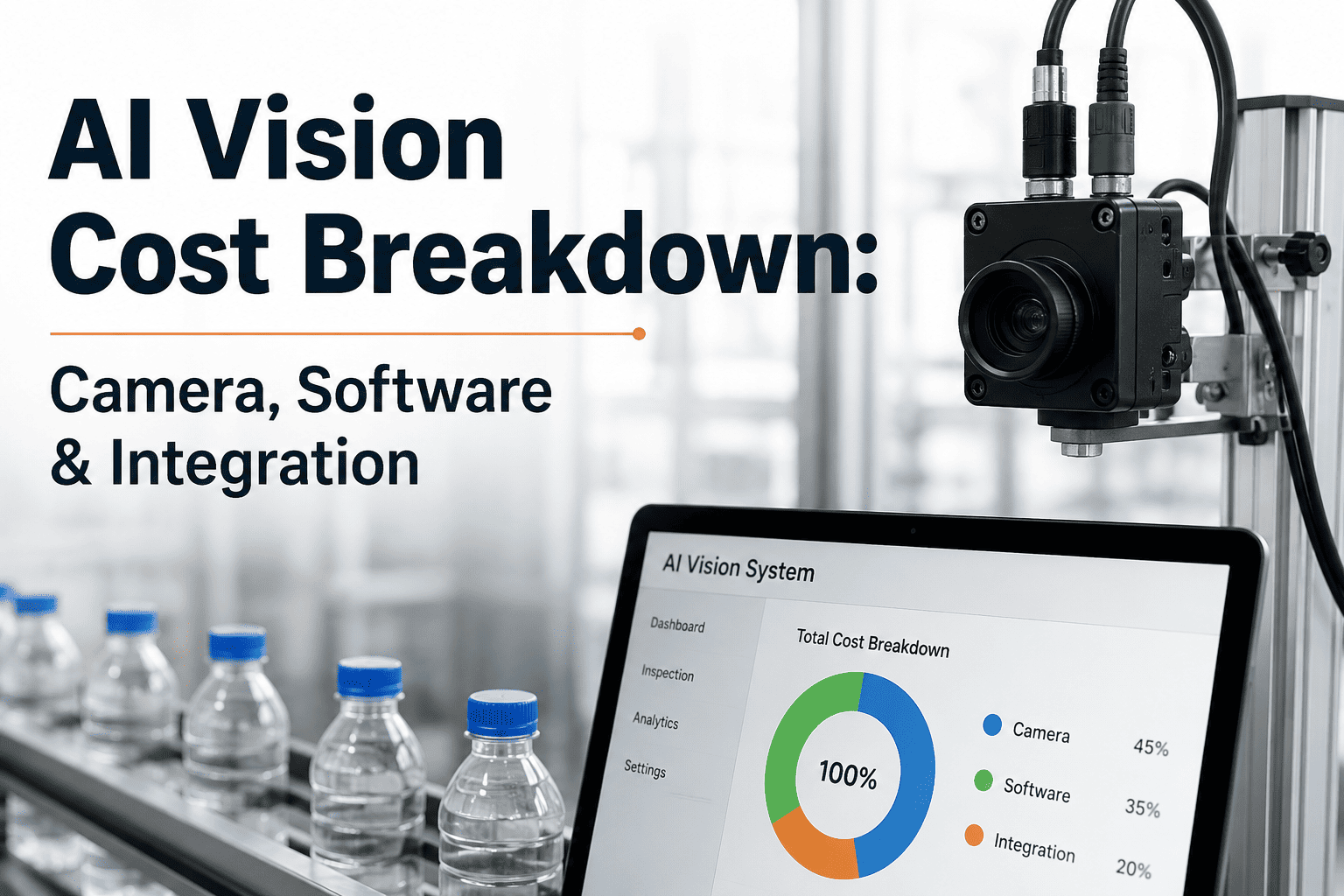
The fear of unknown cost is almost always a fear of an incomplete quote. When a vendor gives a single lump-sum number without itemization, it is reasonable to distrust it. A properly itemized AI vision cost breakdown separates spend into four transparent categories, each of which scales predictably with the size of the deployment.
Each of these categories can be quoted independently before a contract is signed, which is exactly what removes the "black box pricing" fear that keeps many mills stuck in evaluation mode for years longer than necessary.
See the Full Cost Breakdown for Your Specific Line.
No lump-sum quote — iFactory itemizes camera, software, integration, and maintenance cost before you decide anything.
How Retrofit Integration Actually Works on the Floor
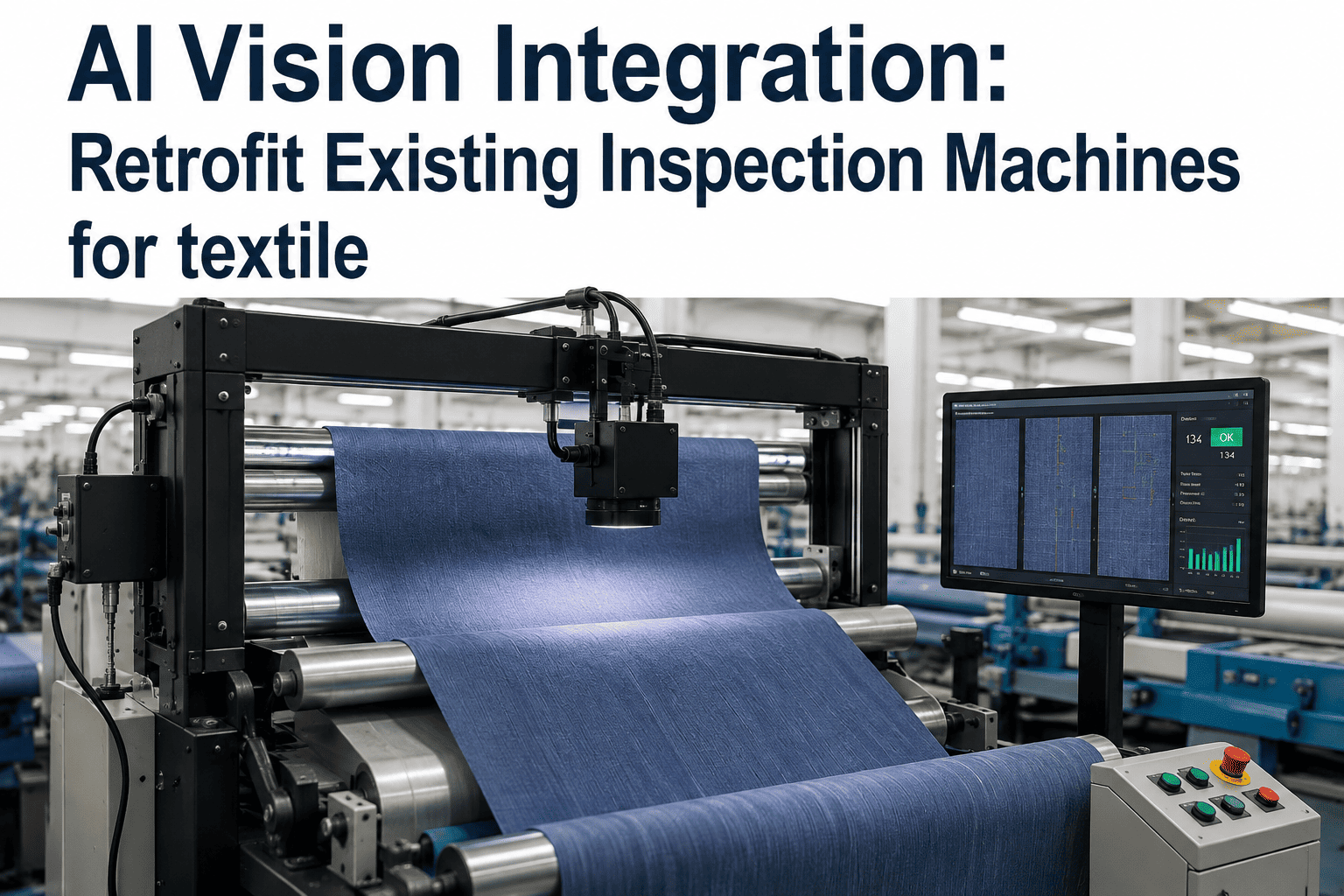
The integration fear is usually rooted in an assumption that AI vision means ripping out and replacing existing inspection equipment. In practice, most textile inspection frames — whether for grey fabric, dyed fabric, or finished goods — already have a mechanical structure that a camera and lighting module can mount onto without disrupting the fabric path.
Assess existing frame geometry, line speed, and current lighting to confirm camera mounting points.
Install camera and edge AI module alongside the existing frame — production continues on adjacent lines during setup.
Train the detection model on sample fabric runs specific to your defect types and material.
Run in shadow mode alongside manual inspection to validate accuracy before full handover.
Why "We Tried This Before" Doesn't Apply to Modern AI Vision
Many mills that evaluated automated inspection five to ten years ago encountered rule-based systems that relied on fixed thresholds — a specific color deviation, a specific pattern mismatch — and struggled badly with the natural variation inherent in textile production, generating false rejects that eroded operator trust within weeks. Modern AI vision models work differently, and the distinction matters enormously for anyone carrying skepticism from a past bad experience.
| Capability | Legacy Rule-Based Systems | Modern AI Vision |
|---|---|---|
| Handles natural fabric variation | Poorly — high false reject rate | Trained on your actual variation range |
| Learns from new defect types | Requires manual reprogramming | Retrains with new labeled samples |
| Adapts to lighting changes | Frequently miscalibrated | Normalized during preprocessing |
| Setup time | Weeks of manual threshold tuning | Days, with iterative model refinement |
Questions That Separate a Credible Vendor From an Overpromising One
A significant part of adoption fear traces back to a prior experience with a vendor who oversold capability and underdelivered on support. Asking the right questions during evaluation filters out vendors who cannot back their claims with specifics.
Can you show accuracy data on fabric similar to ours?
A credible vendor can point to comparable fabric types and defect categories with real accuracy figures, not just generic industry claims that don't reflect your specific material.
What happens if the model needs retraining after deployment?
The answer should include a clear process and cost structure for retraining, not a vague assurance that the system "learns automatically" with no described mechanism.
Can we run a shadow-mode trial before committing?
Vendors confident in their system's performance should readily offer a validation period before requiring a full commitment — reluctance here is itself a warning sign.
What does your support response time actually look like?
Ask for specific service level commitments in writing, not general reassurances, and check whether support is local or requires escalation across time zones.
Bringing Floor Staff Along Instead of Working Around Them
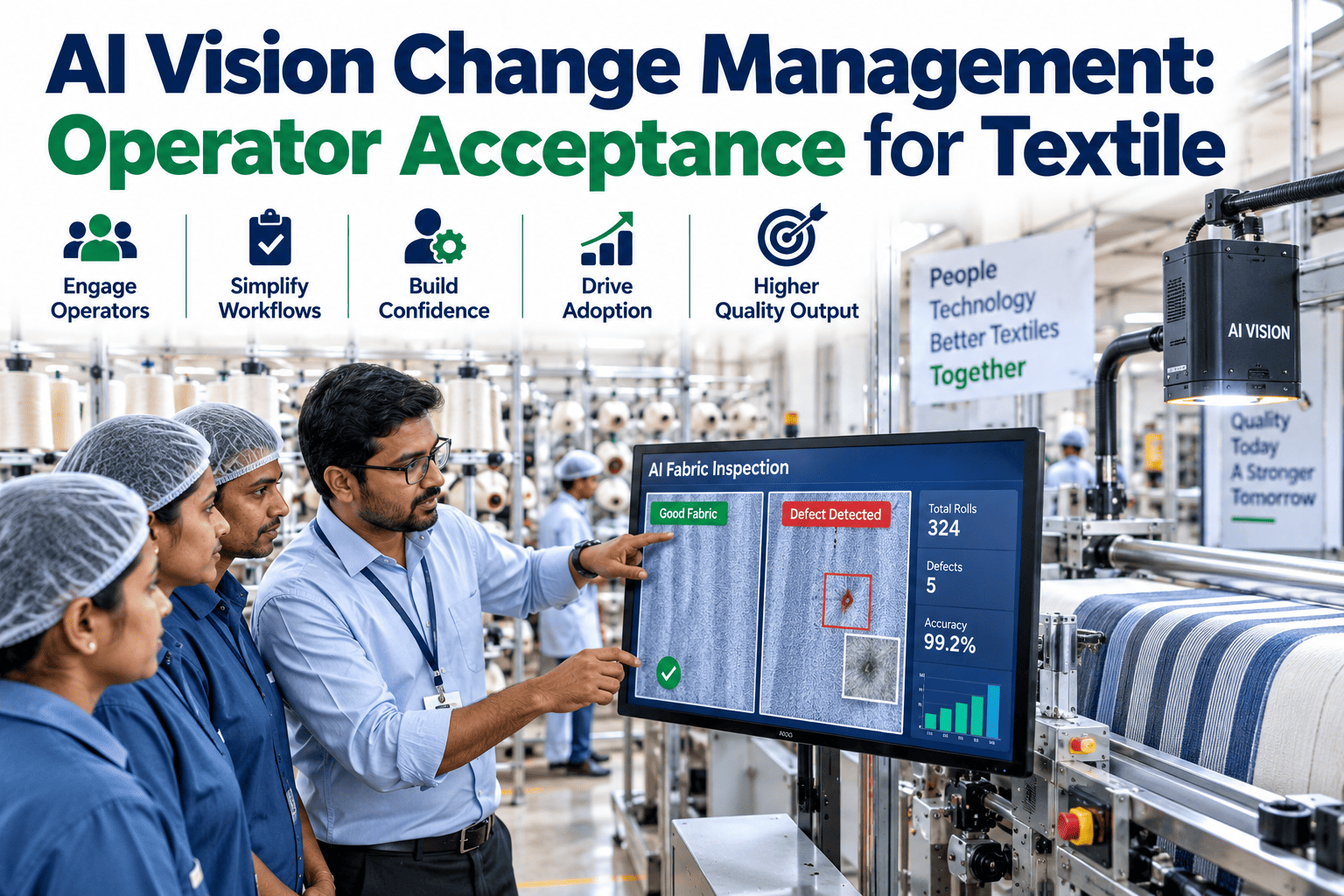
A fear that often goes unspoken in adoption discussions is the concern that AI vision will be perceived by inspection staff as a threat to their role, leading to quiet resistance that undermines even a technically successful deployment. Addressing this directly, rather than hoping it resolves itself, materially improves adoption outcomes.
The most successful deployments reframe the AI system as a tool that removes the most repetitive and fatiguing part of visual inspection — staring at fast-moving fabric for defects that are often subtle and easy to miss during long shifts — while keeping experienced inspectors in a higher-value role validating edge cases, handling ambiguous flags, and applying judgment the system escalates rather than resolves on its own. Involving inspection staff early in the shadow-mode validation phase, asking for their input on cases where the system and human judgment disagree, tends to build genuine buy-in rather than compliance under protest. Mills that skip this step and simply announce the system's arrival tend to see slower adoption curves and more informal workarounds, even when the underlying technology performs well.
What a Realistic Adoption Timeline Actually Looks Like
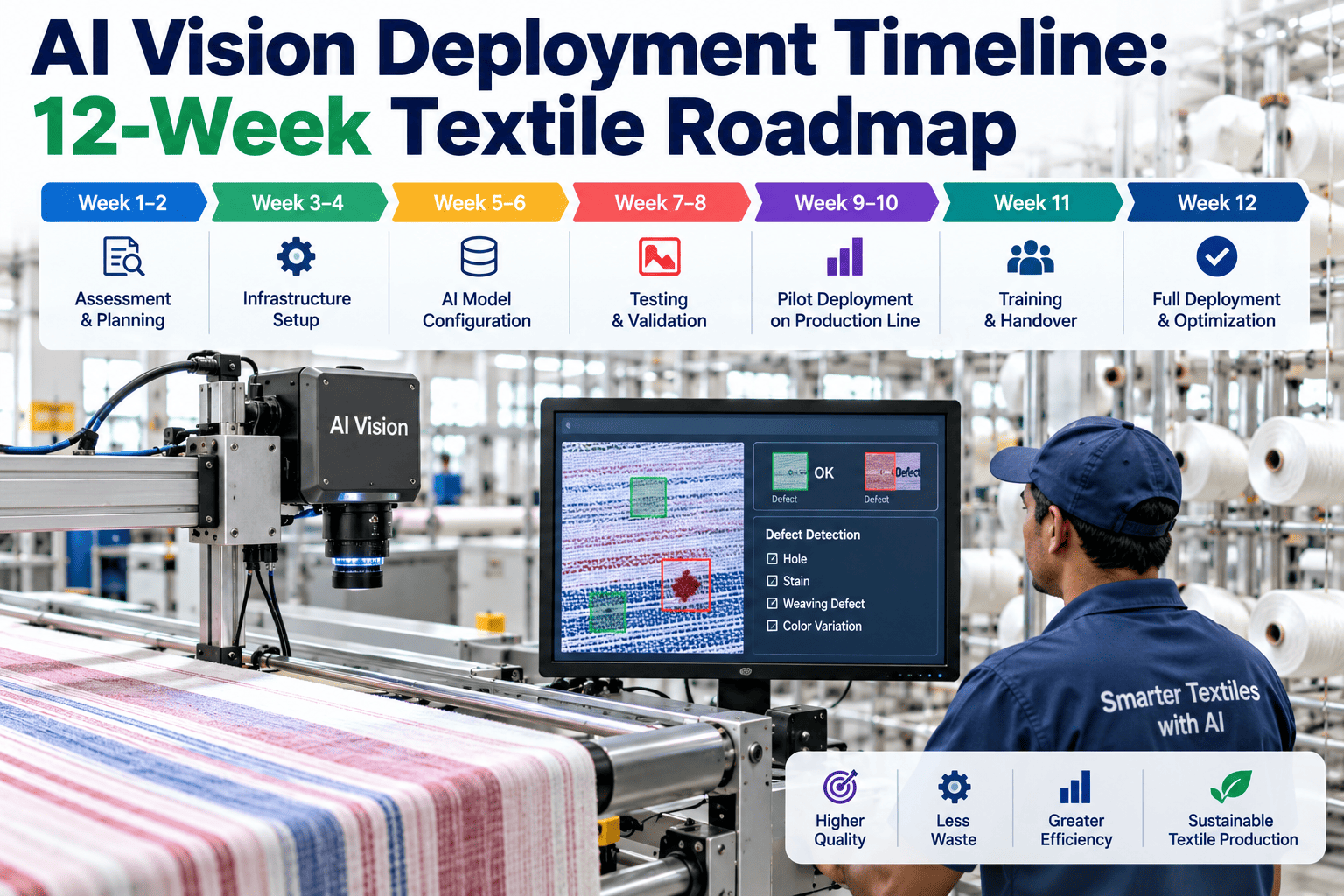
Part of the fear around AI vision adoption comes from uncertainty about how long the entire process actually takes, from initial evaluation to a fully trusted live system. Vague vendor promises of "quick deployment" without a concrete timeline breakdown make it hard to plan internally, and that uncertainty itself becomes a reason to delay a decision indefinitely.
This timeline reflects a single-line pilot deployment rather than a plant-wide rollout, which is deliberately the recommended starting scope for any mill without prior AI vision experience. A realistic fourteen-week window from initial evaluation to a validated live system is a far more actionable planning horizon than an open-ended "it depends" answer, and it gives internal stakeholders a concrete date to plan around.
Adoption Fears That Vary by Region and Mill Size
The specific fears that dominate an adoption conversation often differ depending on mill size and regional market conditions, and recognizing which fear is actually driving hesitation in your specific context helps focus the conversation on the right answer rather than a generic response.
Smaller and mid-size mills tend to weight the cost and financing concern most heavily, since a large upfront capital outlay represents a proportionally bigger risk relative to their overall capital budget, which is exactly why phased pilot approaches and vision-as-a-service financing structures have gained particular traction in this segment. Larger composite mills with multiple sites more often cite integration complexity as their primary concern, since a decision made for one line needs to be replicable across many lines with different equipment ages and configurations, making standardized retrofit processes and documented playbooks especially valuable. Mills in regions with less mature local vendor support networks tend to weight the support and maintenance concern most heavily, making local or regionally responsive support commitments a key differentiator when evaluating which vendor to trust with a long-term deployment relationship.
AI Vision Adoption — Common Concerns Answered
How long does it take to see whether AI vision actually works on our fabric?
A shadow-mode pilot, where the AI system runs alongside existing manual or semi-automated inspection without making live accept/reject decisions, typically produces a meaningful accuracy comparison within four to six weeks. This period covers initial model training on your fabric samples, a validation run against known defect batches, and a live comparison against your current inspection team's results, giving you real data rather than a vendor's general accuracy claim before deciding to proceed further.
What happens if the AI system misses a defect type our inspectors normally catch?
This is exactly why the shadow-mode validation phase exists before any live deployment decision. Any defect type the model misses during validation becomes additional labeled training data, and the model is retrained specifically to close that gap before it is trusted with live accept/reject decisions. In practice, most gaps are closed within one or two retraining cycles once the specific defect signature is identified and enough labeled examples are provided.
Do we need in-house AI expertise to operate and maintain the system?
No — the model training, retraining, and ongoing tuning is handled as part of the deployment and support relationship, not something your floor staff need to manage themselves. Your inspection and maintenance teams interact with the system through a standard operator interface, similar to any other line equipment, while the underlying AI maintenance is handled through the support relationship. Contact our support team for details on the specific support model.
Is it possible to start small instead of committing to a full-line rollout?
Yes, and starting small is the recommended path for any mill without prior AI vision experience. A single-camera pilot on your highest-defect-cost line establishes real accuracy and cost data before any larger commitment, and that data becomes the basis for the scaling decision rather than a projection. Book a demo to discuss a pilot scope sized to your specific line.
Get Straight Answers on Cost, Integration, and Accuracy for Your Line.
iFactory AI walks through your specific fabric type, line speed, and current inspection setup — no generic pitch, just real numbers.