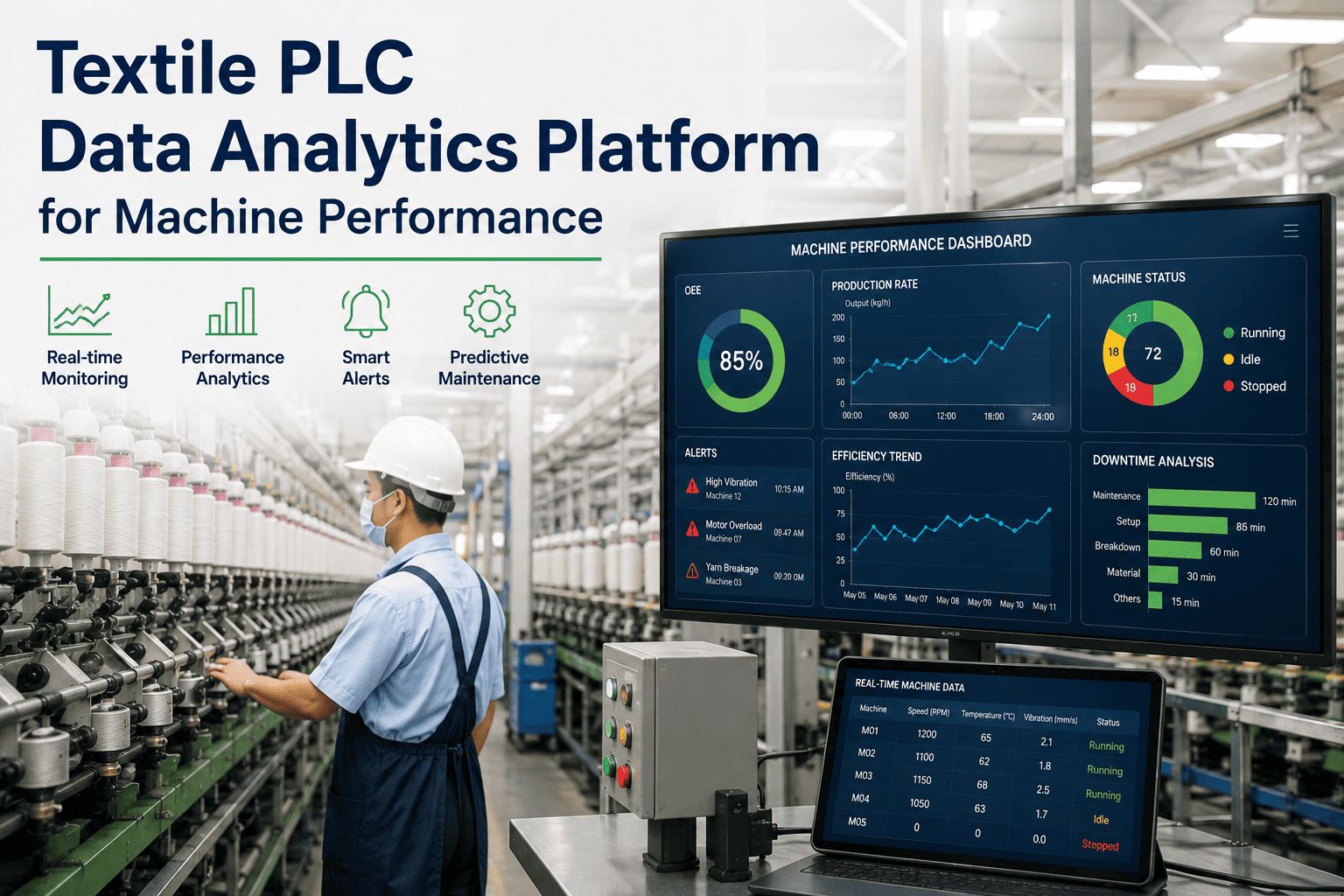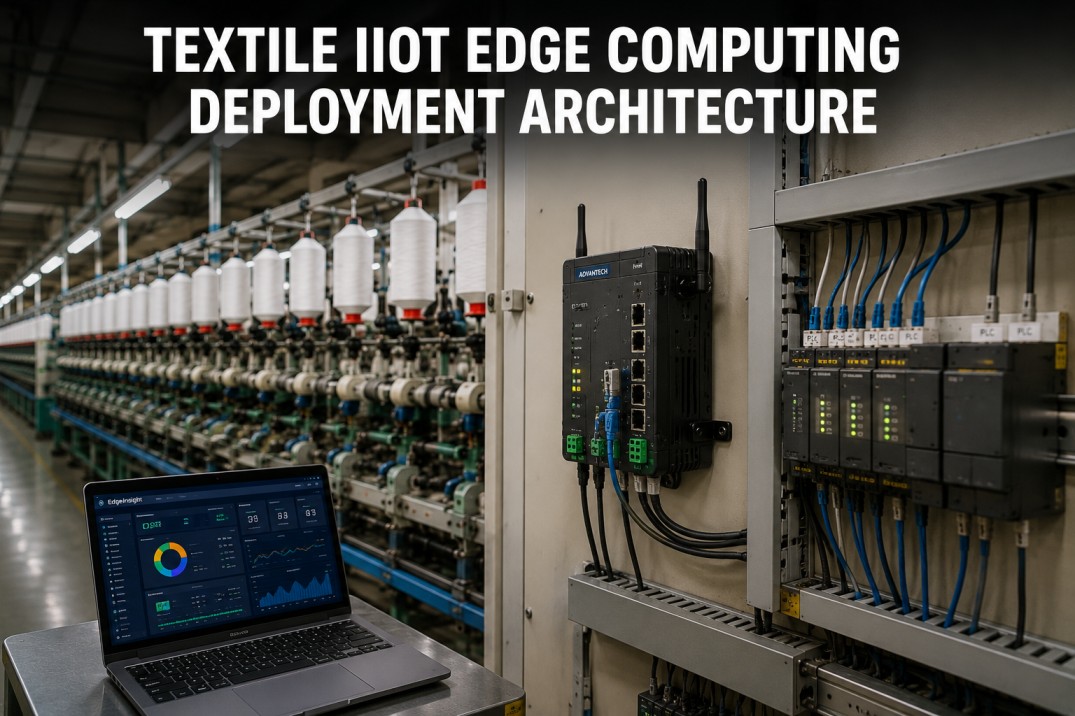
Textile mills generate more data than any other discrete manufacturing industry per square meter of factory floor — every spinning frame produces spindle speed, bobbin tension, temperature, and vibration data at 100-millisecond intervals across hundreds of spindles, every loom generates picks per minute, warp tension, weft breaks, and shed geometry at cycle rates exceeding 1,000 picks per minute, and every finishing range monitors chemical concentrations, temperature gradients, and fabric speed across multiple zones simultaneously. Sending all of this data to the cloud for processing creates unsustainable bandwidth demands, introduces 200-to-500-millisecond latency that is too slow for real-time control loops, and exposes sensitive production data to network security risks. Edge computing solves these problems by placing compute resources directly on the mill floor — at the machine, in the department, or at a plant-level aggregation point — where data is processed, filtered, analyzed, and acted upon within 10 to 50 milliseconds before selected summaries are transmitted to the cloud for long-term analytics and enterprise reporting. A well-designed edge architecture for textile IIoT spans four tiers: sensor-level edge where raw signals are digitized, gateway-level edge where protocols are unified and data is normalized, edge AI tier where machine learning models run real-time inference for predictive maintenance and quality prediction, and cloud tier where historical data powers dashboards, reports, and model training. This guide provides a complete reference architecture for textile edge computing deployment — tier-by-tier component specifications, protocol selection criteria, deployment topology options, data processing frequency decisions, hardware specifications, and security architecture for protecting production data at every layer.
Design Your Edge Architecture — Book a 30-Minute IIoT Strategy Session
iFactory has deployed edge computing solutions across 40-plus textile mills worldwide. Get a free architecture review, hardware recommendation, and deployment estimate for your facility's IIoT infrastructure.
Four-Tier Edge Architecture for Textile IIoT: From Sensor to Cloud
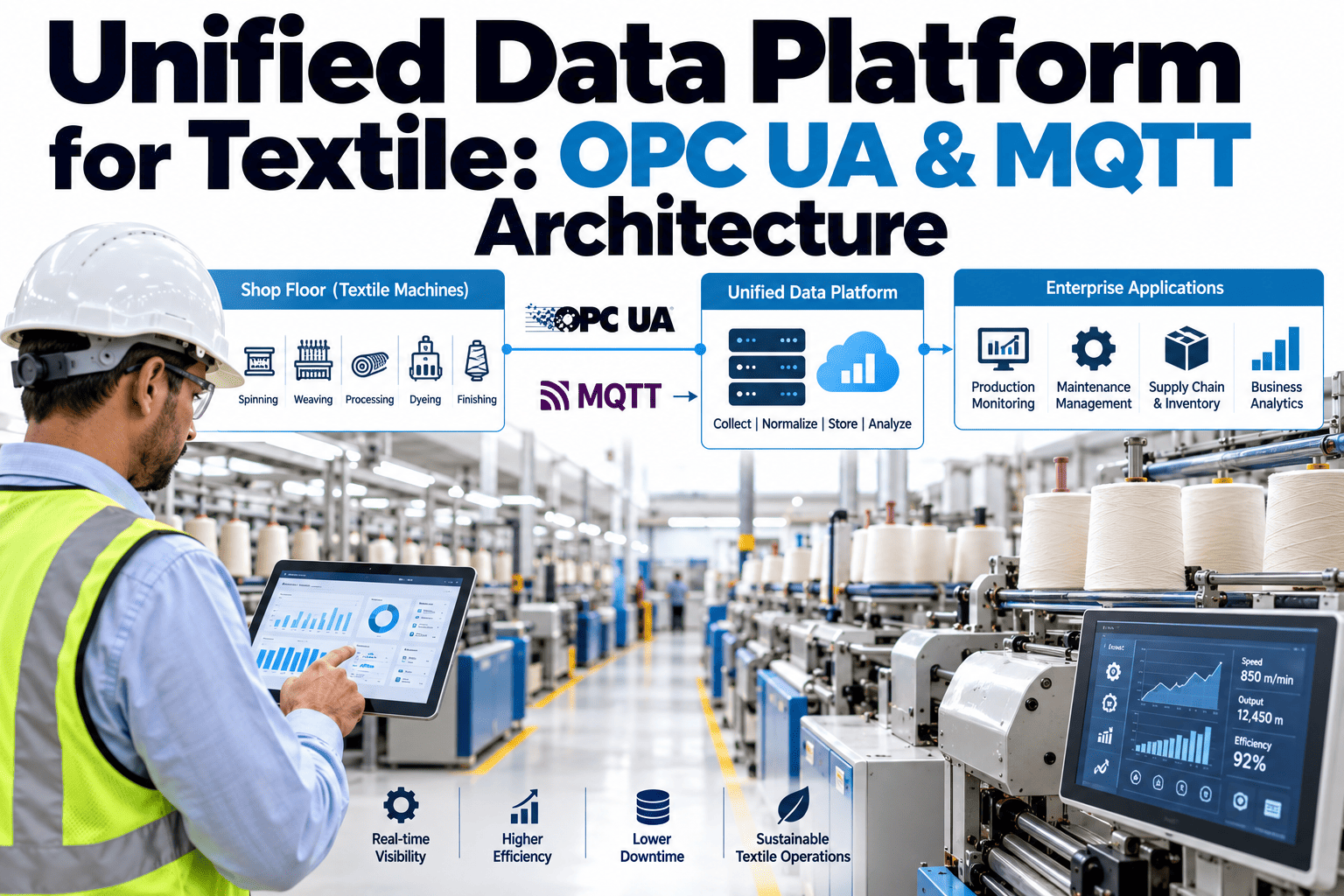
The edge computing architecture for textile mills is organized into four tiers, each responsible for specific data processing functions at decreasing frequency and increasing latency tolerance. Data flows upward through the tiers with progressive reduction — from millions of raw sensor readings per minute at Tier 1 to hundreds of aggregated KPIs per minute at Tier 4. Each tier is designed to operate independently so that a cloud connectivity failure does not interrupt real-time mill operations.
Industrial Protocol Comparison for Textile Edge Deployment
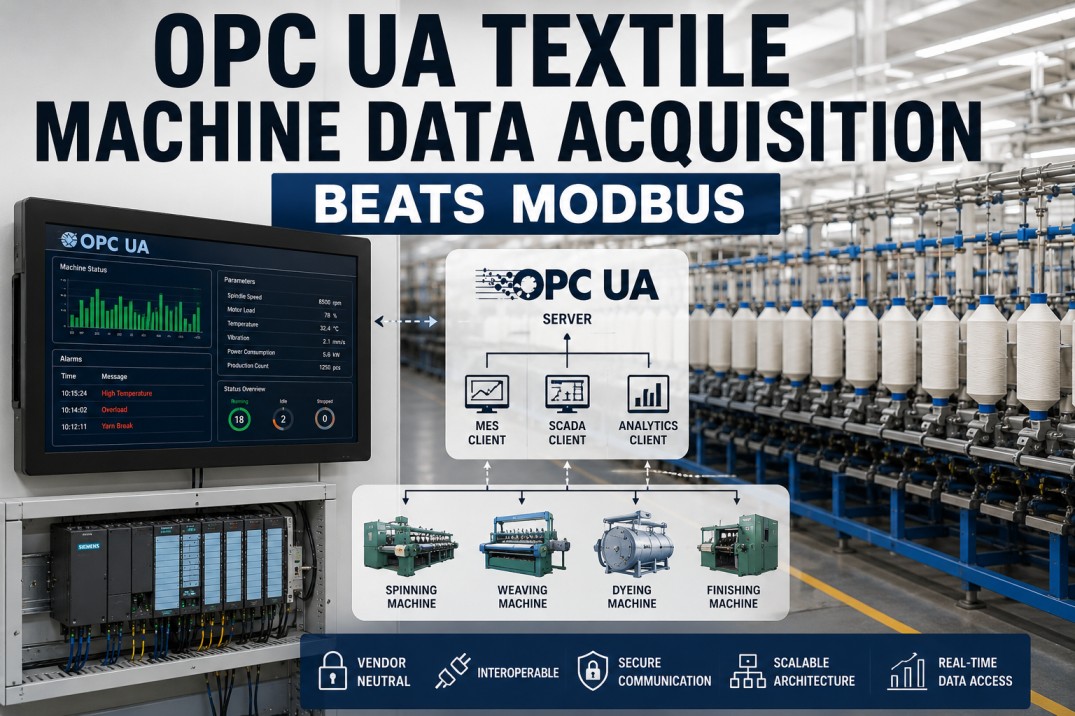
Selecting the right communication protocol at each tier of the edge architecture determines data throughput, latency, security posture, and integration complexity. The four protocols most commonly deployed in textile IIoT edge architectures — MQTT, OPC UA, Modbus TCP, and HTTP/HTTPS — each serve a distinct role in the data path from sensor to cloud. The comparison below evaluates each protocol across eight criteria relevant to textile mill edge deployments.
Need Help Selecting Edge Protocols for Your Mill?
iFactory's IIoT engineers will audit your current machine connectivity, recommend the optimal protocol stack for each tier, and design your edge gateway configuration. Schedule a free consultation to get started.
Three Edge Deployment Topologies for Textile Mill Environments
The physical deployment topology of edge computing resources across a textile mill depends on mill size, network infrastructure, latency requirements, and existing machine connectivity. Three primary topologies have emerged from iFactory's deployments across 40-plus textile facilities, each offering different trade-offs between cost, latency, scalability, and fault tolerance. The selection depends primarily on the age distribution of machinery and the availability of plant-wide network infrastructure.
Edge vs Cloud: Data Processing Decisions by Textile Data Type
Not all textile production data should be processed at the edge, and not all data should be sent to the cloud. The optimal processing location depends on data frequency, latency requirements, action criticality, and data volume. The matrix below maps common textile data types to their recommended processing tier based on iFactory deployment experience across 40-plus mill installations, helping architects make informed decisions about data routing in their edge designs.
Edge Computing Hardware Comparison for Textile Mill Deployments
Selecting the appropriate edge hardware for each tier is critical to achieving the latency, throughput, and reliability targets of the overall architecture. The table below compares four edge hardware classes suitable for textile IIoT deployment, covering the range from lightweight sensor gateways to GPU-accelerated plant servers. Hardware selection should be driven by the data volume, processing complexity, and environmental conditions of each deployment tier.
| Hardware Class | Processor | Memory | Storage | Connectivity | Operating Range | Typical Cost |
|---|---|---|---|---|---|---|
| Sensor Gateway | ARM Cortex-M4 | 256 KB RAM | 2 MB Flash | RS-485, IO-Link, BLE | 0 to 70 °C, IP54 | $150–$400 |
| Edge Gateway | ARM Cortex-A72 | 2–4 GB RAM | 32 GB eMMC | Dual GigE, Wi-Fi, 4G | 0 to 60 °C, IP42 | $800–$2,500 |
| Edge AI Server | x86 i7 / ARM Nvidia Orin | 16–32 GB RAM | 256 GB SSD | 10 GigE, Wi-Fi 6, 5G | 0 to 50 °C, IP20 | $4,000–$12,000 |
| Plant Edge Cluster | Xeon / Dual GPU (RTX/Arc) | 64–128 GB RAM | 2 TB NVMe RAID | 25 GigE, Fiber, 5G | 10 to 40 °C, IP20 | $15,000–$40,000 |
Textile Edge Computing Deployment Frequently Asked Questions
How does edge computing handle network outages in a textile mill environment?
Every edge gateway in an iFactory-designed architecture includes local data buffering with store-and-forward capability. When the network connection to the cloud or upstream tier is interrupted, the gateway continues collecting and processing data locally, storing it in a circular buffer sized for 24 to 72 hours of full-rate data depending on storage capacity. When connectivity is restored, the gateway automatically synchronizes the buffered data to the cloud in priority order — real-time alerts first, then recent KPIs, then historical raw data. The local edge AI inference and real-time control functions continue operating without interruption during the outage, ensuring that production monitoring and alarming remain functional regardless of WAN connectivity status. Textile mills in regions with unreliable internet infrastructure typically deploy departmental edge topologies with 72-hour buffer capacity as a standard requirement.
What is the typical bandwidth reduction achieved by edge processing in a textile mill?
Edge processing typically reduces cloud-bound data volume by 90 to 98 percent in textile mill deployments. For example, a spinning department with 200 spindles generating 10 readings per second per spindle produces 120,000 raw data points per minute. Edge processing aggregates these into 200 machine-level averages and 20 department-level KPIs per minute — a 99.8 percent reduction. A weaving shed with 100 looms generating picks-per-minute, efficiency, and stop-cause data produces 18,000 raw events per minute; edge aggregation reduces this to 300 machine summaries and 30 shed-level KPIs — a 98.3 percent reduction. This bandwidth reduction translates directly into lower cloud data ingestion costs (typically $200 to $800 per month saved per department) and eliminates the need for expensive dedicated internet connections at the plant level.
How are edge AI models updated and version-controlled in textile mill deployments?
Edge AI models follow a cloud-training, edge-inference lifecycle. Models are trained in the cloud using historical data from the mill's data lake, then packaged into containers with version tags and deployed to edge servers through a managed model registry. Each edge server maintains two model slots — active and standby — so new models can be pre-loaded and switched without inference interruption. Rollback to the previous model version is automated if performance metrics (accuracy, latency, throughput) fall below defined thresholds after a model update. iFactory deployments typically update edge models on a 2-to-4-week cycle for quality prediction models and 8-to-12-week cycle for predictive maintenance models. Model performance is continuously monitored through cloud-based dashboards that compare edge inference results against actual production outcomes.
What security measures are required to protect textile production data at the edge?
Textile edge computing security follows a defense-in-depth approach with five layers. Physical security: edge gateways and servers are installed in locked cabinets or rooms with access control, and all devices are secured with tamper-evident seals and intrusion detection switches. Network security: each edge device resides on a segmented VLAN separate from the business network, with firewall rules restricting all inbound traffic and limiting outbound traffic to approved cloud endpoints via TLS 1.3. Device security: edge gateways run minimal hardened operating systems with automatic security patching, application whitelisting, and disabled USB ports. Data security: all data at rest on edge devices is encrypted with AES-256, and data in transit uses TLS 1.3 for cloud-bound traffic and OPC UA with X.509 certificates for machine-to-gateway communication. Identity security: every edge device has a unique device certificate, and all API access requires OAuth 2.0 authentication with device-specific credentials.
How does edge computing affect existing MES and ERP integrations in a textile mill?
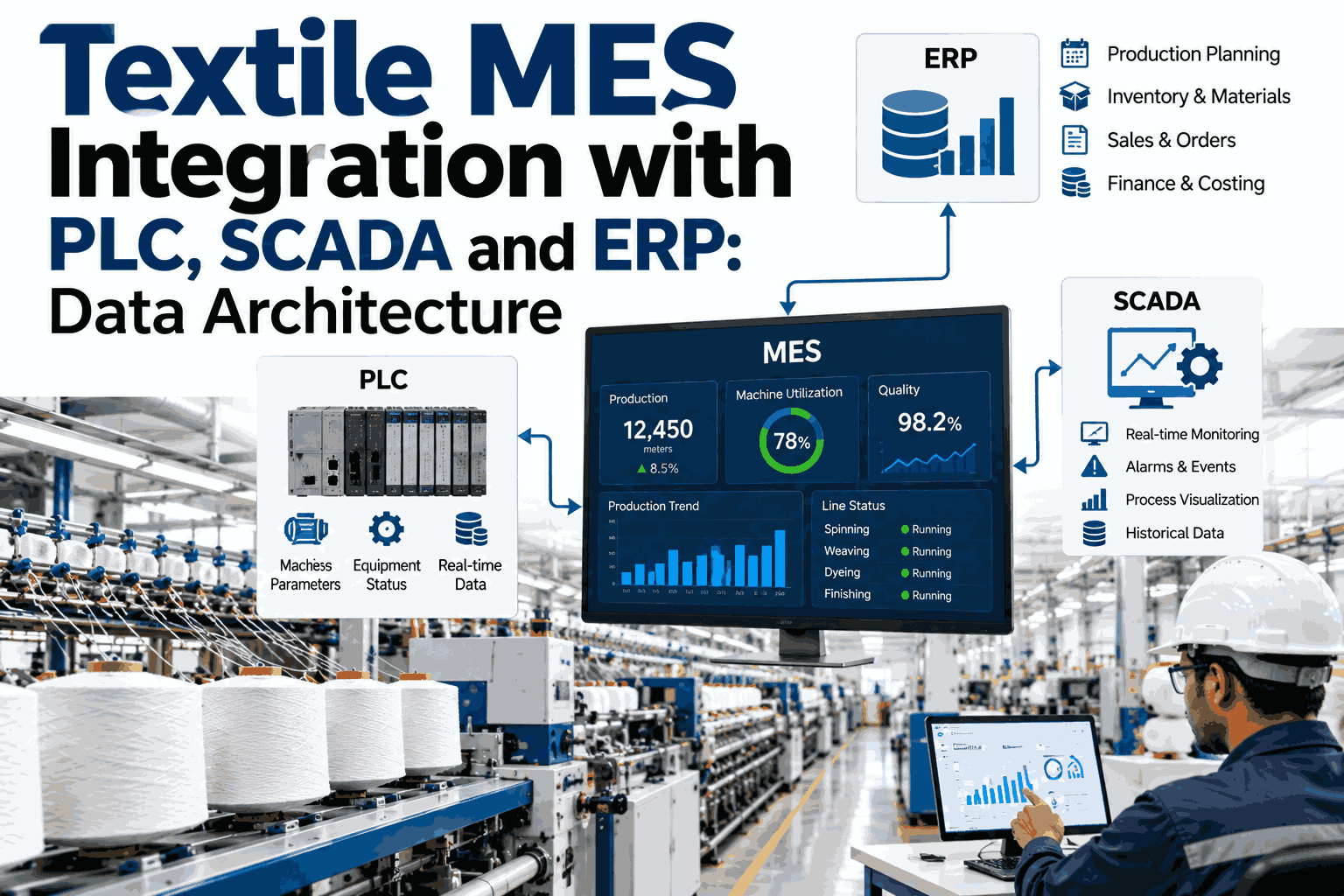
Edge computing enhances MES and ERP integration quality rather than disrupting it. The edge gateway becomes the single source of truth for real-time production data, providing the MES with normalized, timestamped, and validated machine data through a standardized OPC UA or MQTT interface — eliminating the need for the MES to directly connect to each machine's proprietary controller. The edge tier handles all protocol conversion, data cleaning, and unit normalization so the MES receives consistent data regardless of the underlying machine make or model. For ERP integration, the edge gateway aggregates production data into hourly and shift-level summaries and pushes them to the ERP via REST API or database connector, replacing error-prone manual data entry. Mills that deploy edge computing typically see MES data quality improve from 70 to 80 percent accuracy to 98 to 99.5 percent, and ERP production reporting becomes available in real time instead of with a 24-to-48-hour delay.
Ready to Build Your Edge Architecture? Schedule a Design Workshop
iFactory's IIoT architecture team will conduct a site survey, document your current machine connectivity and data flows, design a tiered edge architecture tailored to your mill, and deliver a hardware specification and deployment timeline — all within three weeks of project kickoff.