3OPC Unified Architecture has become the de facto standard for textile machine data acquisition, displacing legacy protocols like Modbus, Profibus, and proprietary vendor interfaces across new machine installations and retrofit projects alike. Unlike Modbus, which transmits raw register values with no semantic meaning — where register 40001 on one machine might mean spindle speed while the same register on another means temperature — OPC UA transmits data with a fully described information model that tells the receiving system exactly what each data point represents, its unit of measure, its valid range, and its relationship to other data points. For a textile mill operating 120 machines from 8 different manufacturers, this semantic interoperability eliminates the thousands of hours typically spent reverse-engineering Modbus register maps and writing custom protocol converters for each machine type. The 2025 ARC Advisory Group report on industrial connectivity found that mills adopting OPC UA as their primary data acquisition protocol reduced integration time for new machines by 70 percent, achieved 99.95 percent data availability compared to 97.5 percent for Modbus-based systems, and reduced network maintenance costs by 45 percent through elimination of protocol-specific gateways and converters. For mills building a unified digital platform spanning MES, SCADA, CMMS, and energy management, OPC UA provides the semantic foundation that makes machine data truly interoperable across all systems.
Replace Modbus Register Maps with OPC UA — Semantic Data from Day One
iFactory OPC UA Connector auto-discovers machine information models, maps tags with semantic context, and streams data to your MES without custom scripting.
OPC UA vs Modbus — The Semantic Advantage in Textile Data Acquisition
Modbus has served industrial automation for four decades, but its register-based addressing model was never designed for the data complexity of modern textile manufacturing. OPC UA's information model architecture fundamentally changes what is possible with machine data.
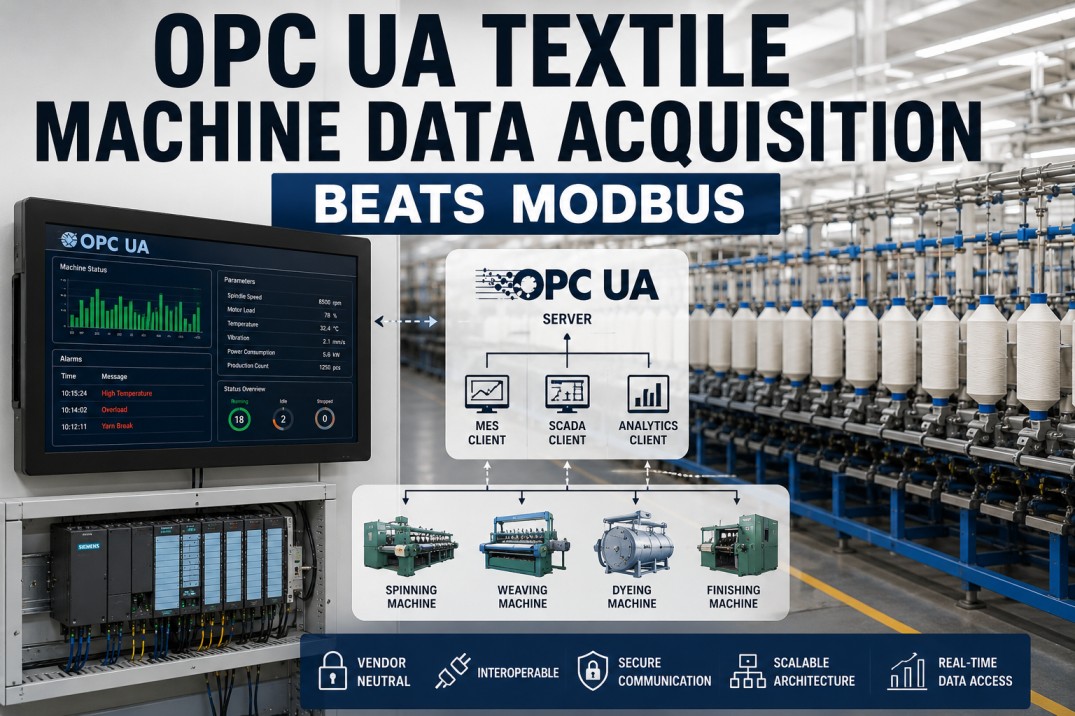
OPC UA Server-Client Architecture in a Textile Mill
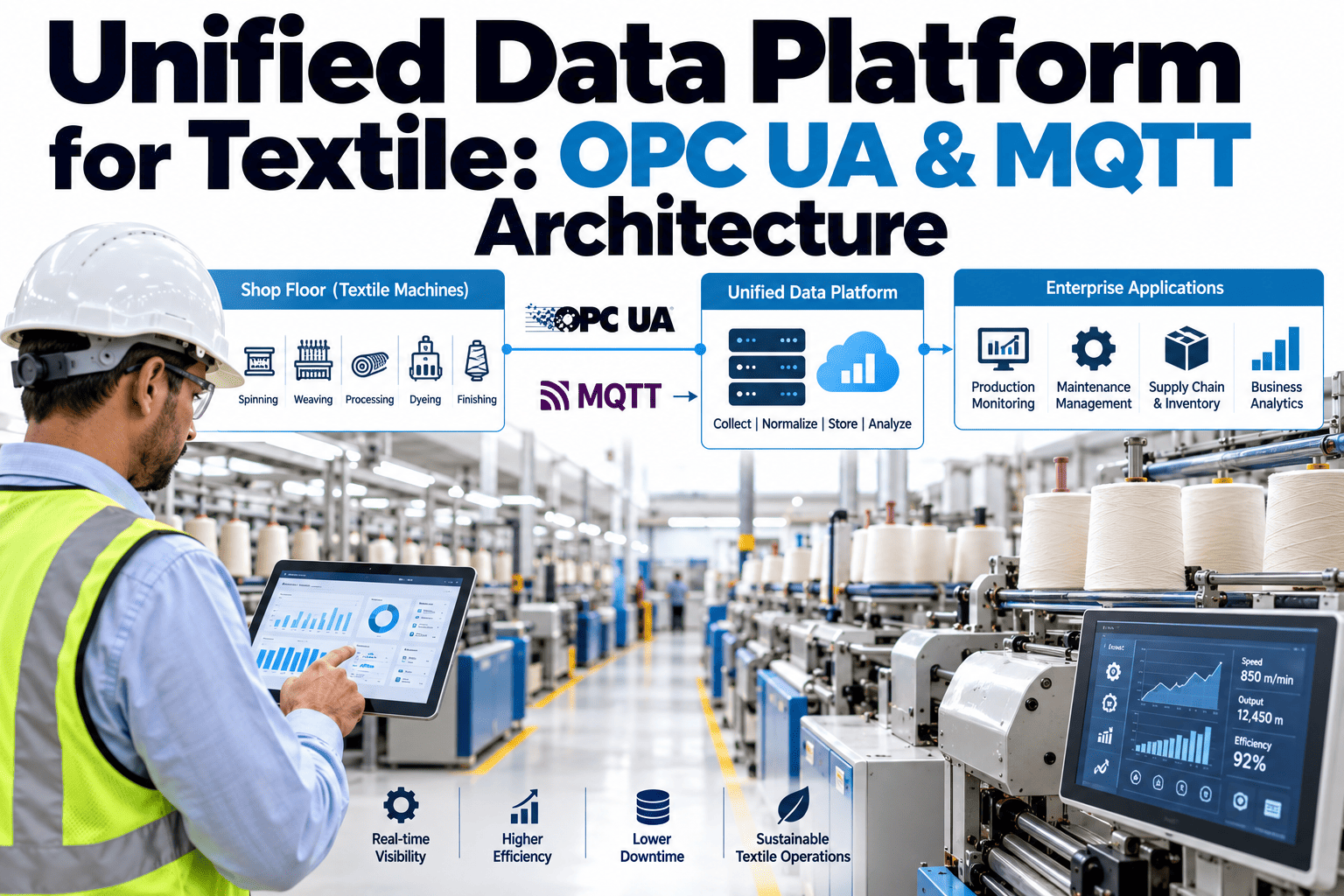
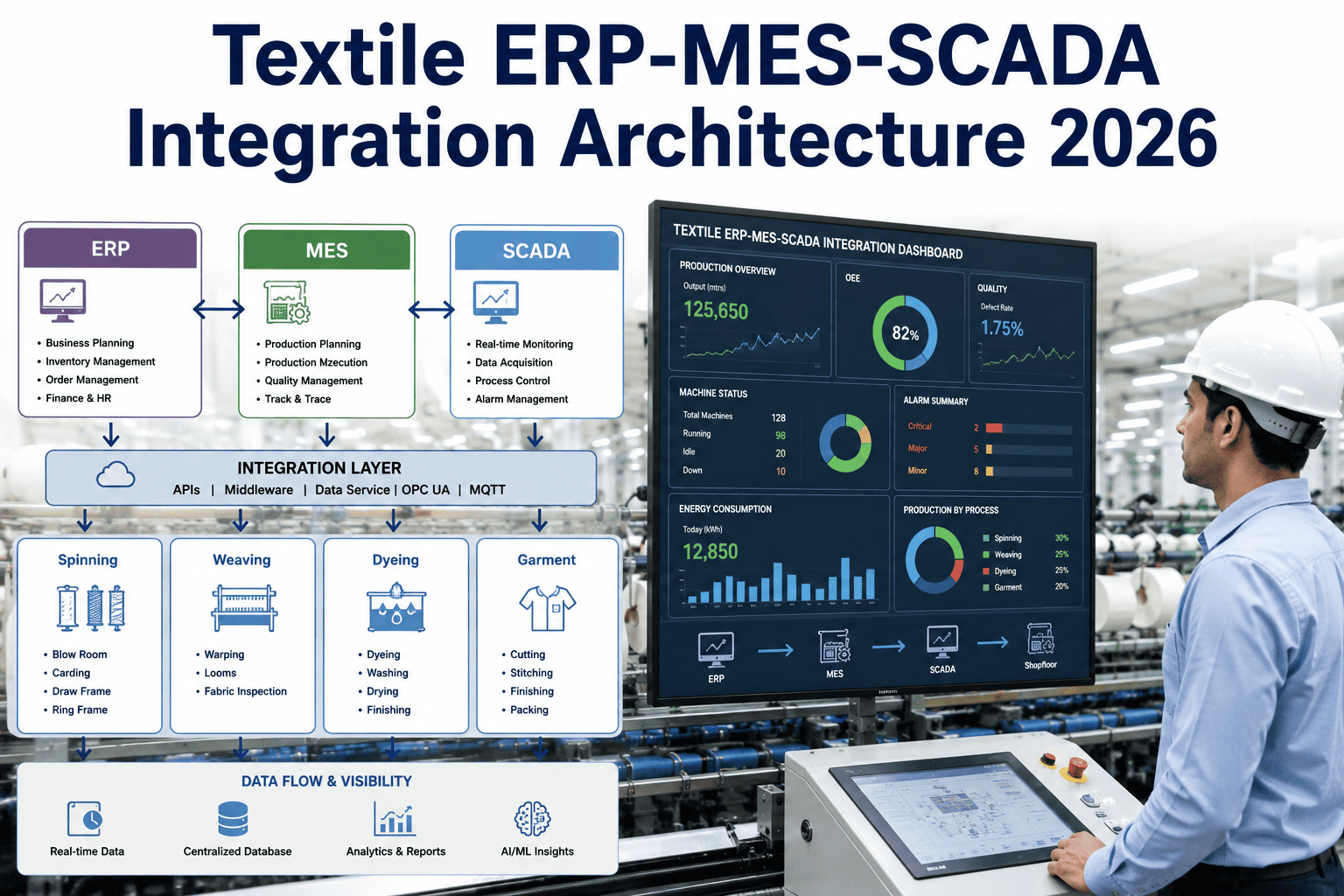
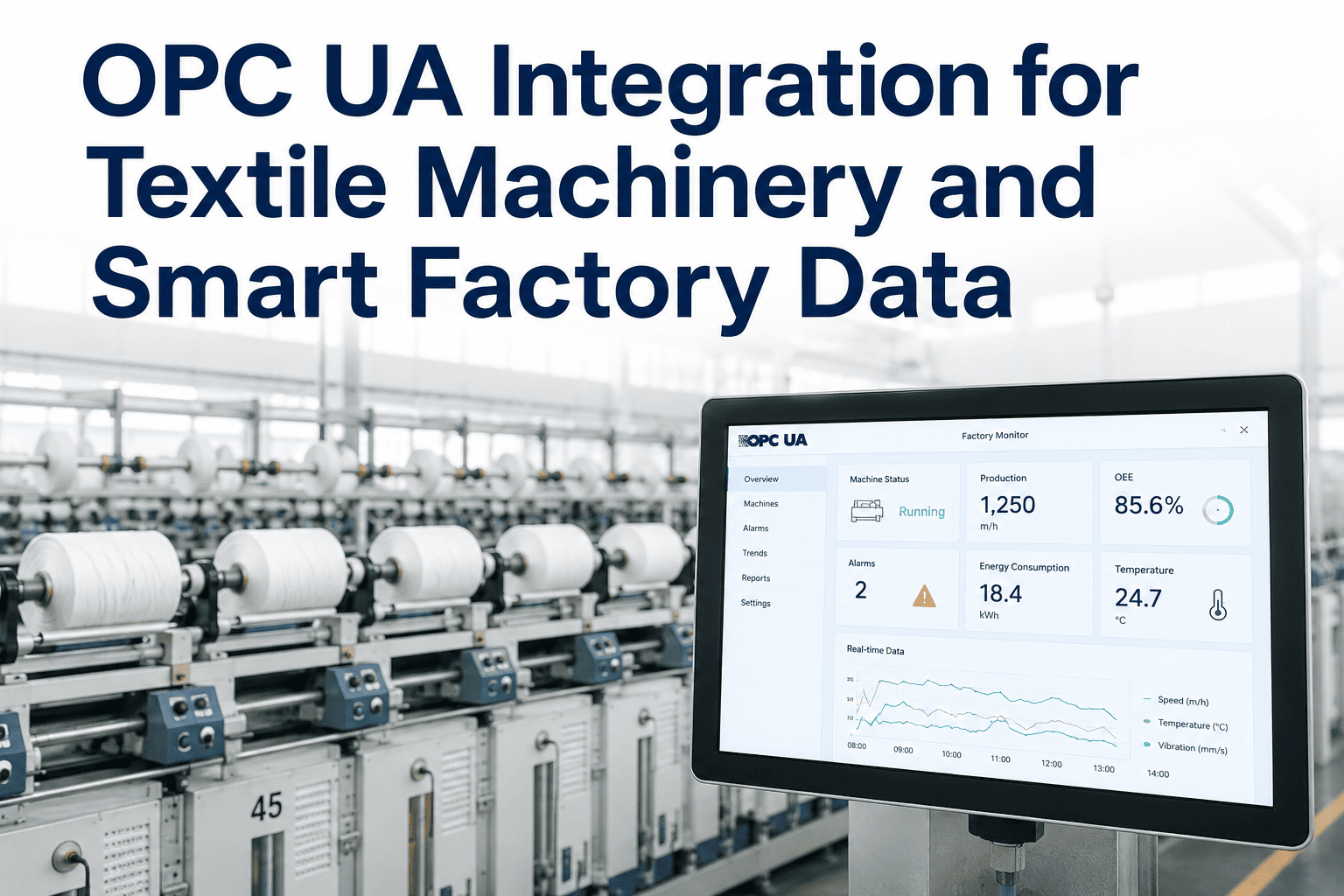
An OPC UA deployment in a textile mill follows a layered server-client architecture where each machine or gateway hosts an OPC UA server, and SCADA, MES, and analytics systems act as OPC UA clients consuming data from multiple servers simultaneously.
OPC UA Information Model — How Machine Data Becomes Self-Describing
The OPC UA information model is what separates it from register-based protocols. Each data point carries its full semantic context — name, description, engineering unit, data type, value range, and relationships to other data points — eliminating the need for external register maps and lookup tables.
Self-Describing Machine Data — No Register Maps, No Reverse Engineering
iFactory's OPC UA connector reads the full information model from any OPC UA server and maps it to your MES tag structure automatically.
OPC UA Security Architecture — Built-In Protection for Mill Data
Unlike Modbus and legacy protocols that send data in plain text with no authentication, OPC UA includes comprehensive security at every layer of the communication stack, making it suitable for both isolated OT networks and converged IT-OT environments.
Real-World Data Acquisition Throughput — OPC UA vs Modbus TCP
The performance advantage of OPC UA over Modbus TCP becomes significant in mills with high tag counts and sub-second data requirements. The table below compares real-world throughput measured across identical textile mill PLC configurations.
| Metric | OPC UA (PubSub) | OPC UA (Client-Server) | Modbus TCP |
|---|---|---|---|
| Max tags per connection | Unlimited | 10,000+ | 125 registers per request |
| Update rate (1,000 tags) | 2–5 ms | 10–25 ms | 50–200 ms |
| Network bandwidth (1,000 tags @ 1s) | ~50 KB/s | ~200 KB/s | ~800 KB/s |
| Data semantics | Full information model | Full information model | Register numbers only |
| Security | 256-bit encryption | 256-bit encryption | None |
| Tag discovery | Automatic via browse | Automatic via browse | Manual register map |
| Historical data access | Built-in (HA) | Built-in (HA) | Not supported |
| Alarm & event support | Native | Native | Not supported |
Frequently Asked Questions
Can OPC UA run on the same network as Modbus TCP and Profinet?
Yes — OPC UA uses standard TCP/IP port 4840 and runs on any Ethernet network alongside other protocols. In a typical textile mill migration scenario, OPC UA coexists with Modbus TCP, Profinet, and EtherNet/IP on the same physical network infrastructure. The key requirement is proper network segmentation using VLANs to separate OT traffic from IT traffic and to isolate legacy protocol broadcast domains from OPC UA sessions. iFactory recommends a three-VLAN architecture: VLAN 10 for real-time control traffic (Profinet, EtherNet/IP), VLAN 20 for OPC UA and SCADA traffic, and VLAN 30 for IT and cloud connectivity, with a managed firewall controlling inter-VLAN routing. OPC UA's discovery mechanism (mDNS and LDS) works within its VLAN and does not interfere with other protocols. Most textile mills run OPC UA alongside legacy protocols for 12 to 24 months during the migration window, with new machines connected via OPC UA while existing machines continue on their native protocols through protocol gateways.
What is the difference between OPC UA Client-Server and OPC UA PubSub?
OPC UA offers two communication patterns. Client-Server is the traditional model where a client (SCADA, MES) establishes a connection to a server (PLC, gateway) and requests data. The server responds with the current value. Each client maintains its own connection to each server, and data is pulled by the client on demand or subscribed to at a configured sampling interval. Client-Server is ideal for HMI screens, manual data queries, and configuration tools — scenarios where a human or application needs on-demand access to specific data points. PubSub (Publish-Subscribe) is a newer OPC UA communication pattern designed for high-speed data distribution. The server publishes data to a message broker or multicast stream, and any number of clients can subscribe to receive the data without establishing individual connections. PubSub reduces network load dramatically — in a test with 50 spinning frames each publishing 200 tags at 100 ms intervals, Client-Server generated 1,000 connections and approximately 50 Mbps of traffic, while PubSub generated zero connections and approximately 2 Mbps of traffic. iFactory supports both patterns: Client-Server for configuration and manual data access, PubSub for high-frequency production data streaming to MES and analytics platforms.
Do I need to replace my existing PLCs to use OPC UA?
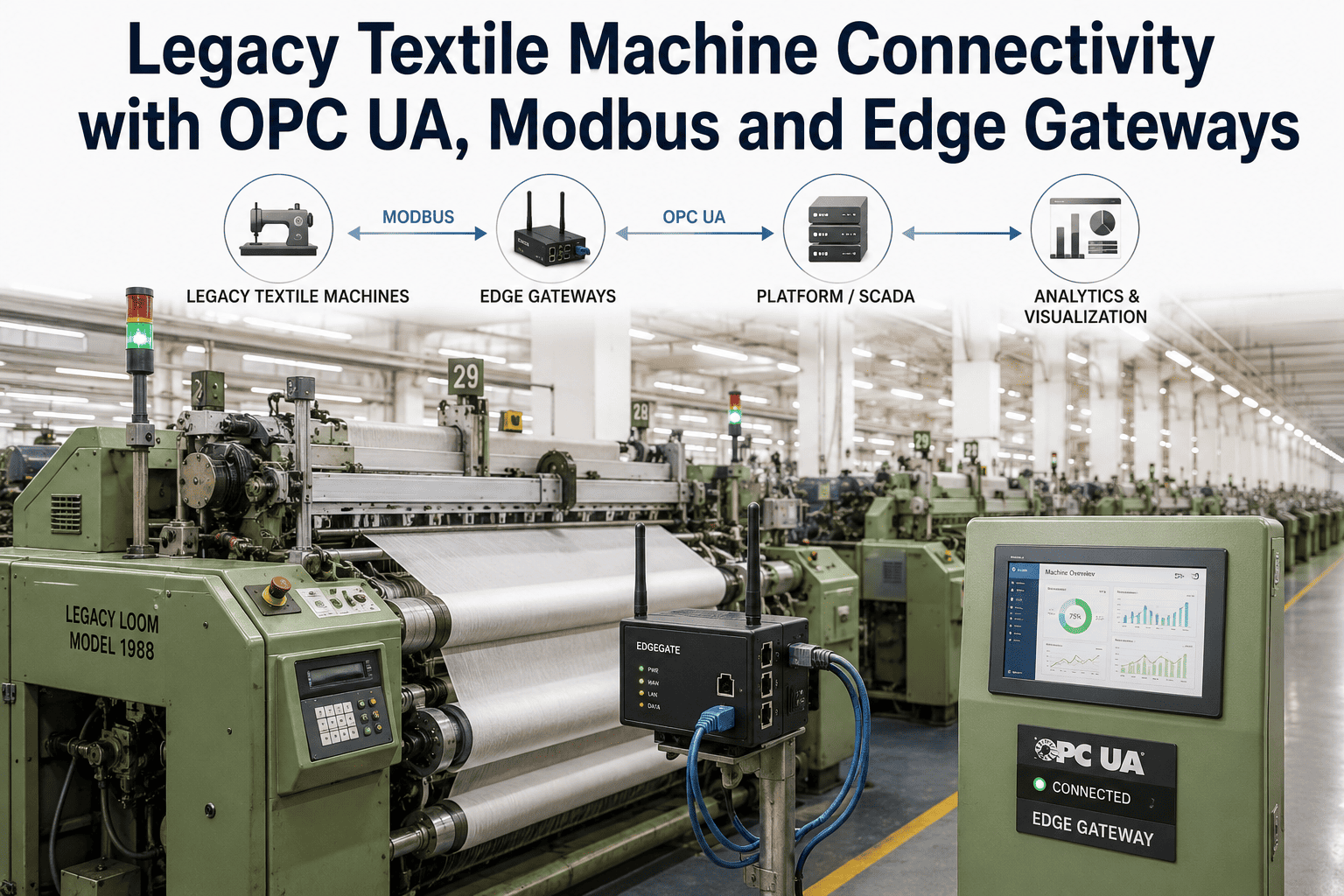
No — you do not need to replace existing PLCs to adopt OPC UA. There are three OPC UA adoption paths for existing PLCs depending on the controller model. PLCs with built-in OPC UA servers (Siemens S7-1500, ABB AC500, newer Mitsubishi iQ-R series, Schneider M580) can be enabled through firmware configuration — no hardware changes required. PLCs without built-in OPC UA but with Ethernet connectivity (Siemens S7-1200, Allen-Bradley CompactLogix, older Mitsubishi) can be connected through an OPC UA gateway appliance — a small hardware device (e.g., Softing TAP, iFactory Edge Gateway, or Kepware Edge) that sits between the PLC and the network, translating the PLC's native protocol to OPC UA. PLCs with only serial or legacy fieldbus connections (Profibus, DeviceNet, older Modbus RTU) require a protocol gateway that converts the legacy protocol to OPC UA — these are available from multiple vendors at $500–$2,000 per device depending on tag count and protocol support. iFactory's Edge Gateway supports all three paths with a single device that can act as an OPC UA server for up to 50 downstream PLCs, with automatic tag discovery and information model mapping.
How do I handle OPC UA certificate management across 100+ machines?
Certificate management is the most commonly underestimated operational task in OPC UA deployments. Each OPC UA server and client requires its own X.509 certificate, and mutual trust must be established between every server-client pair. In a mill with 100 machines and 5 OPC UA clients (MES, SCADA, energy, historian, maintenance), managing 500 trust relationships manually is impractical. The solution is a Global Discovery Server (GDS) — a centralized OPC UA service that manages certificate registration, validation, and distribution across the entire automation network. The GDS automatically pushes trusted certificates to all OPC UA servers and clients, revokes compromised certificates, and renews expiring certificates before they expire. iFactory's OPC UA integration platform includes a built-in GDS that manages certificates for up to 5,000 OPC UA endpoints, with automatic renewal alerts and certificate health dashboards. For smaller deployments (under 20 machines), manual certificate exchange using a shared network folder and iFactory's certificate import wizard is practical and requires approximately 2 hours of setup time per quarter.
What is the maximum number of tags iFactory can read via OPC UA from a single PLC?
The practical tag limit depends on the OPC UA server capacity of the PLC, not on iFactory's client. Siemens S7-1500 OPC UA server supports up to 10,000 data items per server, with a maximum subscription rate of 1,000 monitored items per subscription and minimum sampling interval of 1 ms. ABB AC500 supports up to 5,000 data items per server. For PLCs without built-in OPC UA that use iFactory Edge Gateway as the OPC UA server, the gateway supports up to 20,000 tags per device with 100 ms minimum sampling interval. For mills that need higher tag counts per machine — such as a large finishing range with 3,000+ data points — iFactory recommends using the PLC's native protocol (Profinet or EtherNet/IP) to a local OPC UA gateway rather than the PLC's built-in OPC UA server, as gateway-based servers typically support higher tag counts and faster update rates. iFactory's OPC UA client optimizes subscription groups automatically based on the server's capabilities, grouping tags with similar sampling intervals into efficient subscription batches to maximize throughput while respecting the server's monitored item limits.
Semantic Machine Data — No Register Maps, No Vendor Lock-In
iFactory's native OPC UA client connects to any OPC UA server, auto-discovers the full information model, and maps it to your MES with semantic context preserved end to end.