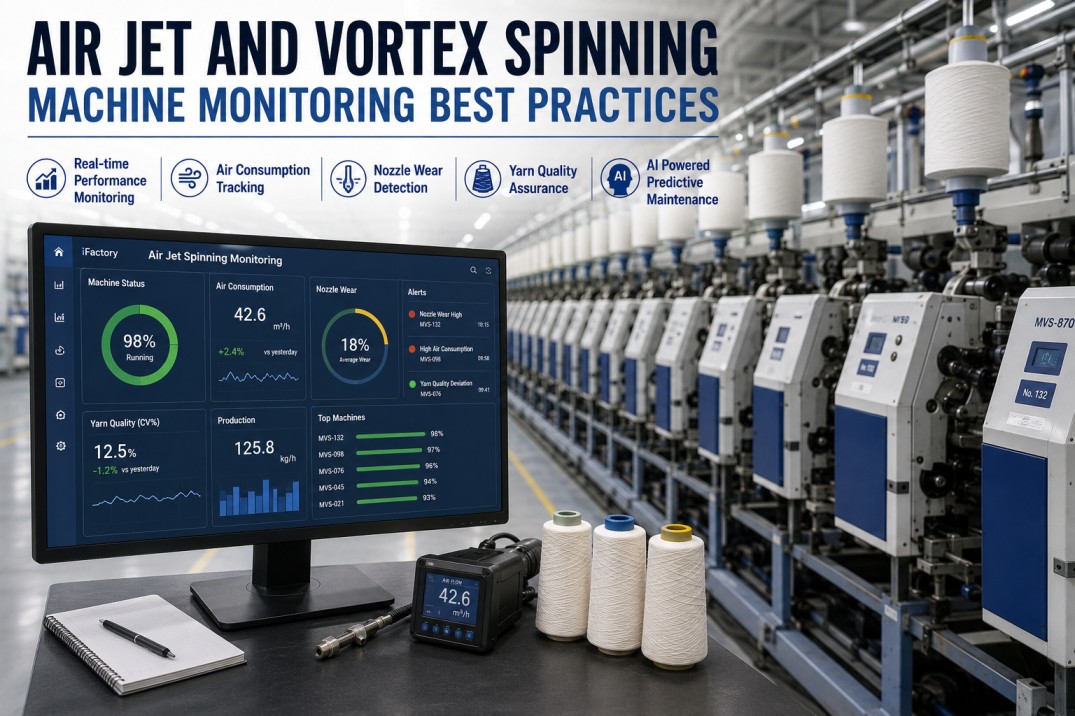
Murata Vortex air-jet spinning runs faster than almost any other yarn formation process in the industry, but that speed advantage evaporates quickly when nozzle pressure, splice quality, or wrapper fiber formation drift out of tolerance without anyone noticing on the floor. A vortex line running a few PSI off its optimal nozzle pressure will still produce yarn, it just produces more seconds per shift, more downgraded cones, and more customer complaints about strength consistency than operators realize until a quality audit forces the issue. This guide breaks down the parameters that actually move the efficiency needle on MVS systems and the checks worth running weekly rather than only when a problem shows up. For help getting these checks built into your own monitoring routine, our team is reachable any time at ifactoryapp.com/support.
Air-Jet MVS Spinning Efficiency Guide
Best Practices for Murata Vortex MVS Efficiency
Nozzle pressure, splice quality, and wrapper fiber formation are the three levers that decide whether a vortex line runs at its rated speed or well below it.
How Vortex Spinning Actually Forms Yarn
Understanding the mechanism is what makes the parameter checks below make sense, since every one of them ties directly back to how fiber gets wrapped into yarn inside the spinning nozzle.
01
Fiber Enters the Draft Zone
Sliver is drafted down to the target linear density through a standard roller drafting arrangement, similar in principle to a ring frame's front zone but feeding directly into the spinning nozzle rather than a traveller and spindle.
02
Compressed Air Creates a Swirling Vortex
High-pressure compressed air injected through angled nozzles creates a swirling air vortex around the fiber bundle as it exits the front roller nip, separating fiber ends and beginning the wrapping action that gives vortex yarn its name.
03
A Hollow Spindle Guides Twist Insertion
A stationary hollow spindle sits at the center of the vortex, and as fiber is drawn through it, trailing fiber ends wrap around the core in a false-twist action that locks in strength without a mechanical traveller.
04
Yarn Winds at High Speed
The finished yarn winds directly onto a package at production speeds far above ring or even rotor spinning, since there is no mechanical twisting element limiting rotational speed the way a traveller or rotor does.
Nozzle Pressure: The Single Biggest Efficiency Lever
Nozzle air pressure directly controls how tightly wrapper fibers bind the yarn core, and small deviations produce outsized effects on both strength and hairiness.
Yarn Tenacity
High sensitivity
Hairiness
High sensitivity
Wrapper Fiber Ratio
Very high sensitivity
Energy Consumption
Moderate sensitivity
Running nozzle pressure too low leaves insufficient wrapper fiber to bind the core, producing a weak, hairy yarn that fails strength testing. Running it too high over-compresses the core and wastes compressed air capacity without a proportional quality gain, so the optimal setting sits in a fairly narrow window that needs verifying per count and fiber type rather than assumed from a previous run.
Splice Quality by Nozzle Condition
Splice strength and appearance are the fastest indicator of nozzle wear or contamination on an MVS line, and this comparison shows what mills typically see across nozzle condition states.
See Your Line's Real Efficiency
Get a Nozzle Pressure and Splice Quality Audit on Your MVS Line
We will walk through your current nozzle pressure settings, splice performance data, and wrapper fiber ratios and show exactly where your vortex line is losing efficiency compared to its rated speed.
Wrapper Fiber Formation and Why It Determines Everything
Wrapper fiber ratio, the percentage of fiber that wraps around the core rather than running parallel within it, is the single most diagnostic number on a vortex line because nearly every other quality metric traces back to it.
Too Few Wrapper Fibers
Core fibers are not adequately bound, resulting in low strength, high hairiness, and yarn that tends to shed fiber during downstream weaving or knitting, showing up as fly and lint accumulation on customer machines.
Optimal Wrapper Ratio
A balanced ratio produces yarn with strength approaching ring-spun equivalents at a fraction of the production time, with low hairiness and consistent appearance that downstream processors can run without adjusting their own settings.
Too Many Wrapper Fibers
Over-wrapping increases yarn stiffness and can reduce softness and drape in the finished fabric, which matters significantly for apparel end uses even when raw strength numbers look acceptable on paper.
Inconsistent Wrapper Formation
Variation in wrapper ratio along the yarn length, often from fluctuating nozzle pressure or worn components, produces the most customer-visible defect of all: inconsistent yarn that dyes and behaves differently within the same lot.
Weekly Efficiency Checklist for MVS Lines
These checks catch the majority of efficiency losses before they show up as a spike in downgraded cones or a customer quality complaint several weeks later.
1Verify nozzle air pressure against the target range for the current count and fiber type, not last month's setting.
2Pull a splice strength sample and compare retention percentage against the nozzle condition table above.
3Inspect nozzles for lint buildup or wear on a fixed rotation rather than only when a break rate rises.
4Check wrapper fiber ratio consistency across at least three positions to catch pressure drift early.
5Log compressed air supply pressure at the header, since a supply-side drop can mimic a nozzle-level problem.
Frequently Asked Questions
What nozzle pressure range should I run for cotton vortex yarn?
The optimal nozzle pressure window depends heavily on count and fiber type, but most cotton vortex applications run within a fairly narrow band that balances wrapper fiber formation against energy consumption. Rather than copying a setting from another mill, run a short trial at three pressure points around your current setting and compare tenacity and hairiness results before locking in a value.
Reach out to our team for help structuring that trial.
How often should vortex spinning nozzles be cleaned or replaced?
Cleaning frequency depends on fiber trash content and production volume, but splice strength retention is the most reliable trigger rather than a fixed calendar interval. Once retention drops into the 75 to 84 percent range shown in the nozzle condition table, schedule cleaning within 24 hours, and treat consistent drops below 75 percent as a signal that nozzle replacement, not just cleaning, is needed.
Why does my vortex yarn strength vary within the same production lot?
Inconsistent strength within a lot almost always traces back to inconsistent wrapper fiber formation, which is usually caused by nozzle pressure fluctuation, uneven nozzle wear across positions, or a compressed air supply that is not holding steady pressure under full production load. Checking supply-side pressure at the header first saves time before assuming an individual nozzle is at fault.
Can vortex spinning match ring-spun yarn strength?
With well-tuned nozzle pressure and wrapper fiber formation, modern vortex yarn can approach ring-spun tenacity for many counts, though it typically does not fully match ring spinning at the finest counts or for applications demanding maximum strength. For most knit and many woven applications, the strength difference is small enough that vortex's speed advantage makes it the more economical choice.
What is the biggest mistake mills make when running MVS systems?
Treating nozzle pressure as a set-and-forget parameter is the most common and costly mistake. Compressed air supply drifts, nozzles wear unevenly across positions, and fiber batches vary, so pressure that was correct three months ago may no longer be optimal today.
Book a 30-minute review to see how continuous monitoring catches this drift automatically.
Stop Losing Efficiency to Nozzle Drift
Keep Your Vortex Line Running at Its Rated Speed and Quality
iFactory tracks nozzle pressure, splice quality, and wrapper fiber consistency across every position on your MVS line, flagging drift before it turns into downgraded cones or a customer complaint. Most mills find their first meaningful efficiency gap within the first two weeks of monitoring.