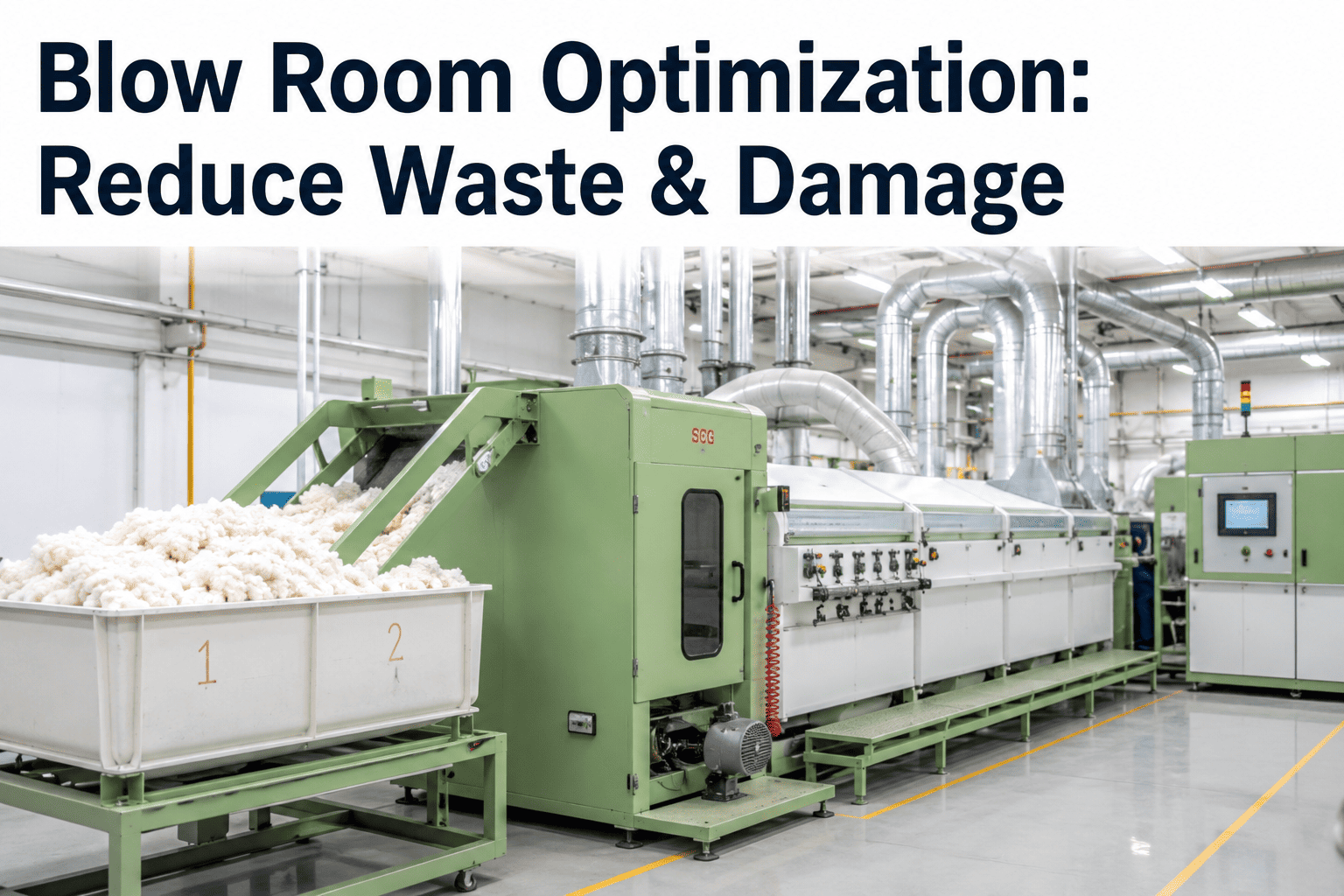
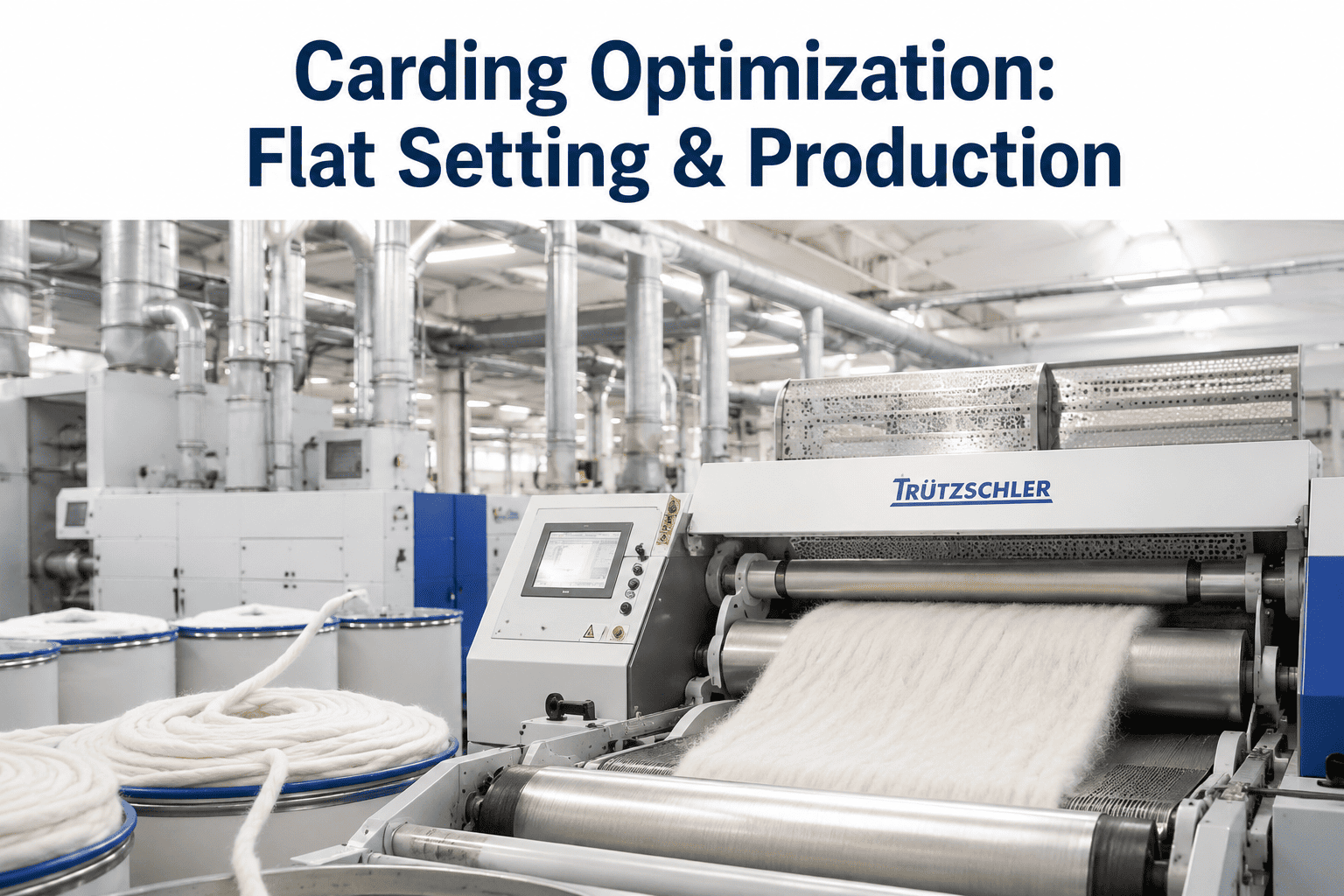
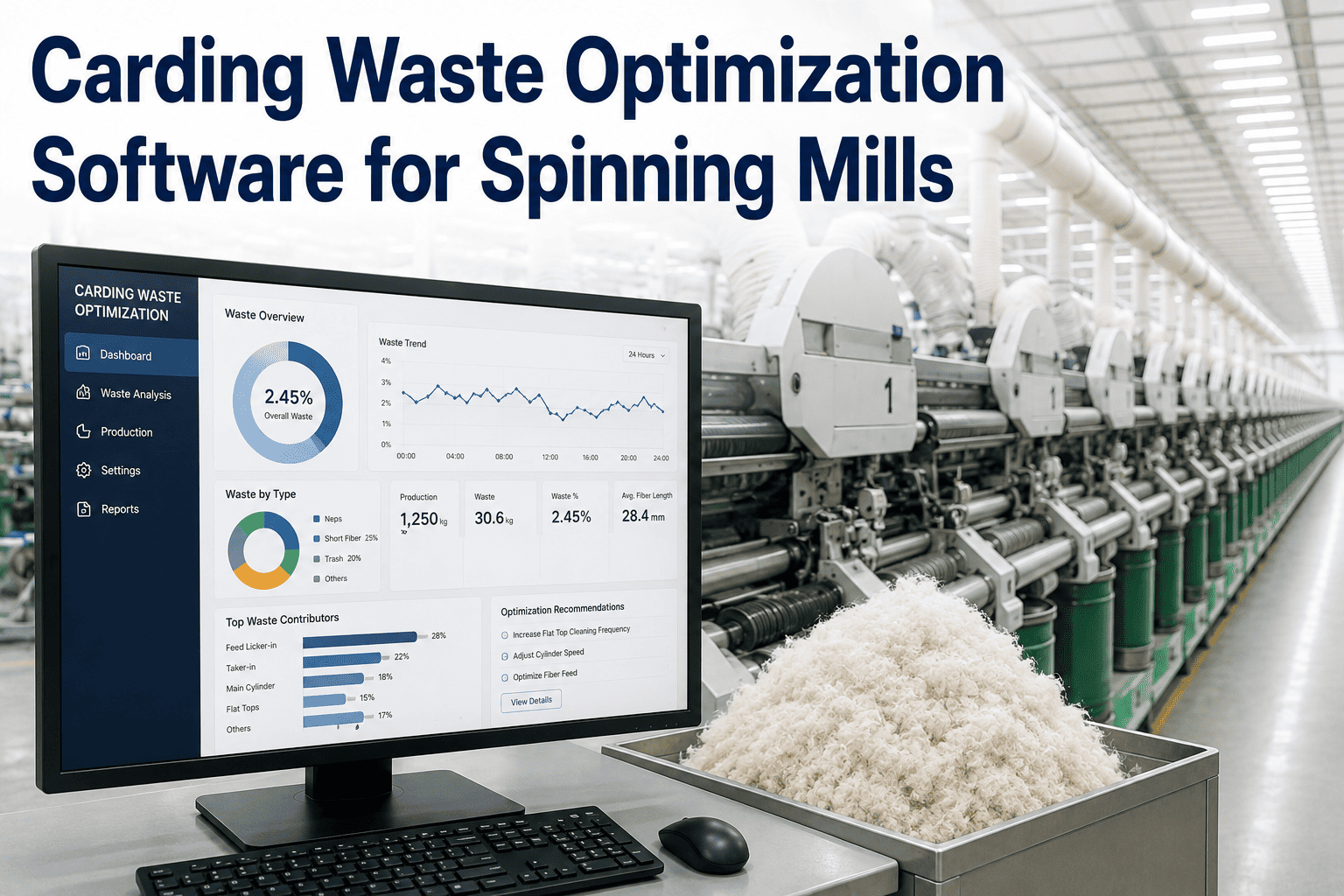
Blow room and carding together determine more than 70% of the nep removal and cleaning efficiency in a cotton spinning line — yet most U.S. mills optimize these two sections independently rather than as an integrated process. Cylinder speed, flat settings, licker-in speed, and blow room cleaning point configurations interact directly: a 10% change in blow room extraction alters the trash load entering the card, which shifts the optimal carding parameter set. iFactory Blow Room & Carding Line Intelligence monitors cleaning efficiency, nep count, trash content, and machine parameters across Rieter, Trutzschler, and Marzoli blow room lines and carding machines — giving spinning mills the integrated visibility needed to cut neps by 40% while maintaining optimal waste levels. Book a demo to see how line-level optimization transforms your cleaning and carding performance.
Optimize the Line, Not Just the Machine
A technical guide to integrated blow room and carding line optimization for U.S. spinning mills — covering cylinder speed tuning, flat setting optimization, licker-in configuration, cleaning point management, and the monitoring infrastructure that connects every stage from bale opening to card sliver delivery.
Blow Room and Carding — Eight Critical Parameters
Every parameter in the blow room and carding line affects nep count, trash content, and waste percentage — but they interact across stages. Optimizing the first two blow room cleaning points affects the trash load the card sees, which shifts the optimal cylinder speed and flat setting. The eight parameters below must be tuned as a system, not independently. Each card below shows the optimal range and the downstream impact of deviation.
Cleaning Point Spacing
Grid bar setting at each cleaning point determines opening intensity and trash removal. Tighter spacing extracts more trash but increases fiber breakage and nep formation. Optimal varies by trash content — 8-12 mm for low trash, 14-20 mm for high trash.
Beater Speed
Rotational speed of the beater in the opener and cleaner. Higher speed increases opening intensity and cleaning efficiency but generates more neps. Must be matched to fiber staple length — longer fibers require lower beater speed to minimize breakage.
Airflow (Suction/Vacuum)
Transport air velocity and extraction vacuum at each cleaning point. Insufficient airflow causes trash re-deposition; excessive airflow removes usable fiber. Maintain 8-12 m/s transport velocity and 80-120 Pa extraction vacuum at each cleaning point.
Feed Rate (kg/hr)
Mass per unit time fed to each blow room machine. Overfeeding reduces cleaning efficiency per fiber and increases nep formation. Underfeeding improves quality but reduces line throughput. Balance for target production and quality requirements.
Cylinder Speed
Primary carding cylinder rotational speed — the single most influential carding parameter for nep removal and fiber individualization. Higher speed increases carding intensity but generates heat and fiber stress. Optimal for cotton: 30-45 m/s surface speed depending on fiber quality.
Flat Setting (Carding Gap)
Distance between cylinder wire and flat wire — the narrowest gap determines carding intensity. A 0.05 mm reduction can reduce neps by 10-15% but increases fiber stress and flat strip waste. Typical range: 0.20-0.40 mm depending on fiber fineness and length.
Licker-In Speed
Rotational speed of the licker-in roller that transfers fibers from feed plate to cylinder. Controls initial opening intensity and trash removal. Too high causes fiber damage and nep formation; too low leaves trash embedded. Must be coordinated with cylinder speed ratio.
Delivery Speed (m/min)
Speed at which card sliver is delivered to the coiler. Higher delivery speed reduces fiber residence time on the cylinder, reducing carding intensity. Must be balanced with cylinder speed to maintain carding power. Higher speed also affects sliver regularity.
Cleaning Efficiency vs Nep Formation — The Optimization Frontier
Every parameter in the blow room and carding line creates a trade-off between cleaning efficiency (trash removal) and nep formation. The optimal operating point depends on the target yarn quality, raw material trash content, and downstream process capability. The table below maps the five major trade-off relationships and the recommended balance for typical U.S. mill scenarios.
| Parameter Change | Cleaning Efficiency | Nep Formation | Waste Level | Recommended Balance |
|---|---|---|---|---|
| Increase beater speed | +15 — 20% | +20 — 25% | +10 — 15% | Low trash: use moderate speed (800 RPM); High trash: use max 1100 RPM |
| Tighten carding gap | +10 — 15% | -10 — 15% | +8 — 12% | Target 0.25 mm for premium; 0.30 mm for standard quality |
| Increase cylinder speed | +15 — 20% | -20 — 25% | +5 — 8% | 40 m/s optimum for most cottons; 45 m/s for fine counts |
| Increase feed rate | -8 — 12% | +12 — 18% | -5 — 8% | Target 500-550 kg/hr for balanced quality and output |
| Tighten cleaning point | +12 — 18% | +10 — 15% | +15 — 20% | First two points aggressive; remaining points moderate |
Blow Room and Carding — Settings Tuning Guide
The reference table below provides starting-point settings for blow room and carding machines across common U.S. mill scenarios. These are baseline recommendations — final settings should be verified through nep count, trash analysis, and sliver quality measurement at each delivery.
| Scenario | Beater Speed (RPM) | Cylinder Speed (m/s) | Carding Gap (mm) | Licker-In (RPM) | Delivery (m/min) | Expected Neps/g |
|---|---|---|---|---|---|---|
| Carded ring Ne 20-30 | 800 — 1000 | 35 — 40 | 0.30 — 0.35 | 1000 — 1300 | 100 — 130 | 80 — 120 |
| Carded ring Ne 30-50 | 900 — 1100 | 38 — 42 | 0.25 — 0.30 | 1100 — 1400 | 90 — 120 | 60 — 90 |
| Combed compact Ne 40-80 | 1000 — 1200 | 42 — 45 | 0.20 — 0.25 | 1300 — 1600 | 80 — 110 | 40 — 70 |
| Open-end Ne 6-16 | 600 — 800 | 30 — 35 | 0.35 — 0.40 | 800 — 1100 | 120 — 160 | 120 — 200 |
| High trash (> 3% trash) | 1000 — 1200 | 38 — 42 | 0.30 — 0.35 | 1200 — 1500 | 100 — 130 | 100 — 150 |
Common Blow Room and Carding Quality Defects
Quality defects originating in the blow room and carding propagate through every downstream process and are visible in the final yarn. Early detection at the card delivery — before sliver enters the draw frame — is essential. The table below maps the most common blow room and carding defects to their root causes, affected output metrics, and corrective actions.
| Defect | Root Cause | Affected Metric | Downstream Impact | Corrective Action |
|---|---|---|---|---|
| High nep count | Cylinder speed too low or carding gap too wide | Neps/g at card delivery | Yarn appearance grade drops 1-2 classes | Increase cylinder speed by 2-3 m/s; reduce carding gap by 0.05 mm |
| Excessive trash in sliver | Cleaning point spacing too wide or beater speed low | Trash % at card delivery | Ring frame end breaks +20-30% | Tighten first two cleaning points; increase beater speed 100 RPM |
| Fiber breakage / short fiber | Beater speed too high or carding gap too tight | Mean fiber length | Yarn strength drops 8-12% | Reduce beater speed 100-200 RPM; widen carding gap 0.05 mm |
| High waste % | Excessive extraction at cleaning points or flat speed too high | Waste % | Reduced yield, higher raw material cost | Balance first two extraction points; reduce flat speed 10-15% |
| Variable sliver CV% | Uneven feed rate or inconsistent lap preparation | Card sliver CV% | Draw frame CV% variability +30% | Stabilize feed rate; check lap uniformity and chute feed system |
| Seed coat fragments | Insufficient opening at blow room or carding | Seed coat count | Dyeing defects, fabric grading issues | Increase opening intensity at beater; verify cylinder wire condition |
Frequently Asked Questions
What is the relationship between blow room cleaning efficiency and carding performance?
Blow room cleaning efficiency determines the trash load entering the card. If the blow room removes 70% of trash, the card receives material with 30% of original trash content — which affects optimal carding parameters. Higher incoming trash requires more aggressive carding (higher cylinder speed, tighter carding gap, higher licker-in speed) which increases waste and fiber stress. Conversely, if the blow room removes 90% of trash, the card can operate at milder settings that preserve fiber length and reduce nep formation. The optimal balance depends on total line cost per kg: aggressive blow room cleaning increases blow room waste but reduces carding wear and fiber damage. Most U.S. mills target 75-85% blow room cleaning efficiency for carded yarns and 85-90% for combed or compact yarns.
How do I determine the optimal cylinder speed for my carding machine?
Optimal cylinder speed depends on fiber length, fineness, trash content, and target quality. Start with the manufacturer baseline for your fiber type — typically 35 m/s for carded cotton, 40 m/s for combed cotton, and 30 m/s for synthetic fibers. Then run a speed ladder test: increase cylinder speed in 2 m/s increments while measuring nep count, trash content, fiber length distribution, and flat strip waste at each step. The optimal speed is the point where nep count stops decreasing by more than 5% per increment while fiber breakage remains below acceptable levels (typically less than 2% short fiber increase). Most U.S. mills running carded cotton find the optimum at 38-42 m/s depending on micronaire and trash content.
What is the correct flat setting for carding, and how often should it be checked?
Flat setting — the carding gap between cylinder wire and flat wire — should be 0.25-0.35 mm for most carded cotton applications and 0.20-0.25 mm for combed or compact yarns. The setting should be checked weekly using feeler gauges at both sides of the card (front, middle, back) to ensure parallelism. A deviation of more than 0.03 mm across the width causes uneven carding intensity and produces variable sliver quality. The flats themselves should be serviced every 6-12 months depending on running hours — wire wear can increase the effective carding gap by 0.05-0.10 mm over 12 months of continuous operation, silently degrading nep removal performance.
How can iFactory help optimize my blow room and carding line?
iFactory connects to blow room controllers (Rieter UNIcontrol, Trutzschler T-BLOW, Marzoli EASYCONNECT) and carding machine control systems (Rieter CUB with SPIDERweb, Trutzschler T-CON and T-DATA, Marzoli C-series) through OPC-UA and MQTT protocols. The platform aggregates data from every stage — beater speeds, cleaning point settings, cylinder speeds, flat settings, licker-in speeds, delivery rates, and integrated nep/trash sensors — and correlates them with actual quality outcomes at the card delivery. Custom dashboards track clearing efficiency, nep formation rate, waste percentage, and fiber length distribution across the line. Predictive alerts notify the team when parameters drift from the established optimal range for the current material, count, and target quality level.
What is a realistic payback period for blow room and carding line monitoring?
For a typical U.S. spinning mill with 2-4 blow room lines feeding 16-32 carding machines, the combination of reduced nep count (40% improvement), lower waste percentage (25% reduction), fewer ring frame end breaks from trash-related defects, and extended carding cylinder and flat wire life delivers a payback period of 5-8 months. The largest single contributor is raw material savings through waste reduction — a 1% reduction in total blow room and carding waste for a mill processing 20,000 tons of cotton per year saves approximately 200 tons of usable fiber annually. The second largest contributor is throughput improvement from reduced nep rejections at the subsequent drawing and spinning stages.
Optimize Every Machine in Your Blow Room and Carding Line
iFactory provides integrated blow room and carding line monitoring — parameter tracking, cleaning efficiency analysis, nep and trash correlation, and predictive maintenance alerts — purpose-built for U.S. spinning mills that need consistent sliver quality from the very first stage of production.