Carding wire doesn't fail all at once — it dulls gradually, a fraction of a degree of point angle at a time, and by the time a mill notices the neps count creeping up in downstream yarn testing, the wire has usually been past its optimal grinding window for weeks. The temptation in every carding department is to push the grinding schedule out as long as possible, since grinding means machine downtime and downtime means lost output. But wire condition drives fiber-to-fiber contact quality throughout the entire carding process, and the mills that grind on a disciplined schedule consistently produce better sliver quality and fewer downstream defects than mills that grind reactively once problems are already visible. Getting the timing right is a data problem as much as a mechanical one, and it's exactly the kind of equipment performance tracking iFactory's maintenance intelligence platform is built to support.
Carding Department Precision
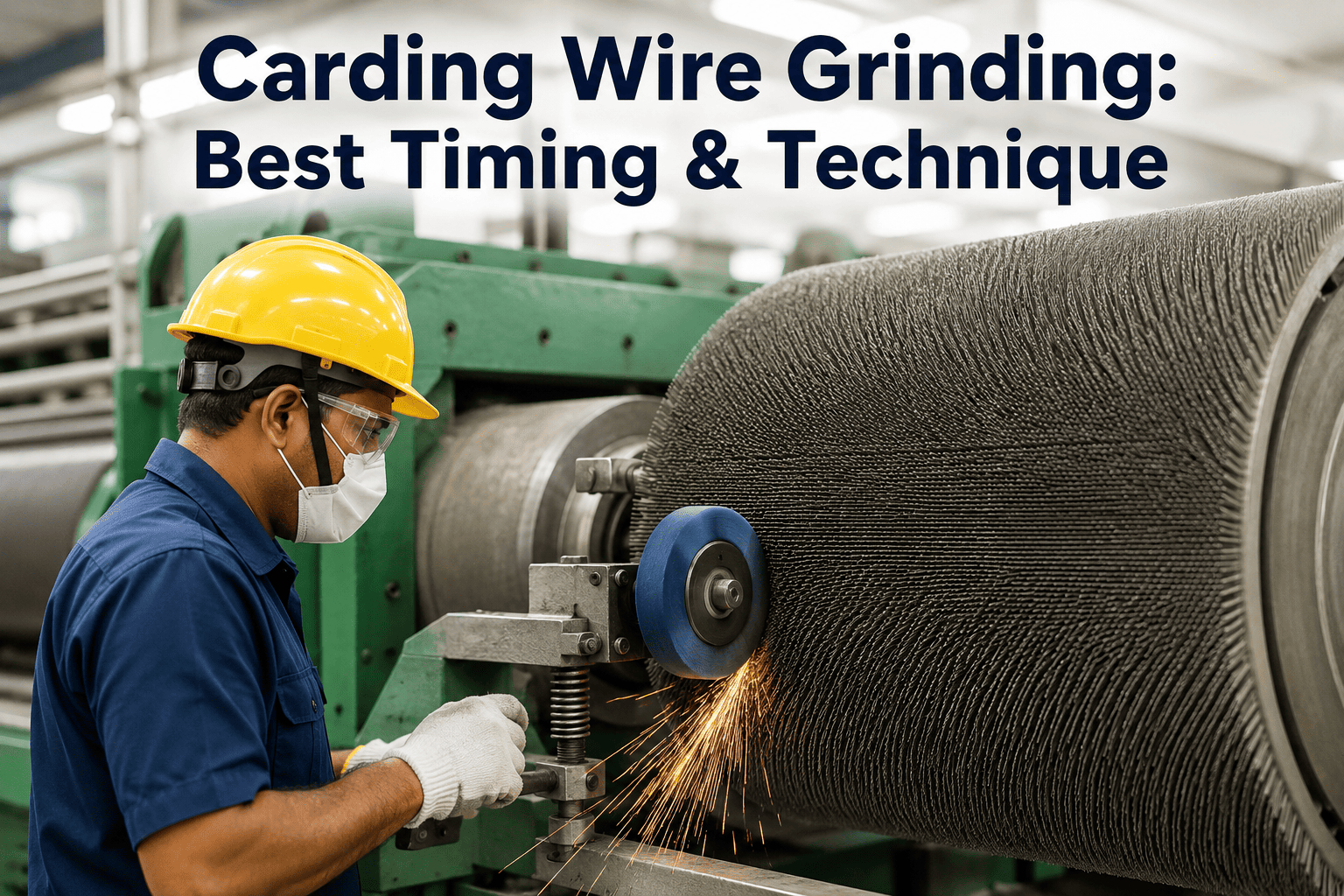
Carding Wire Grinding: Best Timing & Technique
Wire point density, grinding angles, and flat replacement timing that keeps carding performance consistent instead of reactively grinding only after quality problems already show up in testing.
The Four Stages of Wire Condition Decline
Carding wire moves through a predictable degradation curve, and understanding which stage your wire is currently in is what determines whether a light touch-up grind is sufficient or whether the wire has already crossed into territory that produces measurable quality loss. Grinding too early wastes wire life and machine time; grinding too late means you've already been producing degraded sliver quality for longer than necessary.
Stage 1
Sharp / Optimal
Point geometry intact, clean fiber transfer, minimal neps generation. No grinding action needed at this stage.
Stage 2
Early Dulling
Slight rounding of wire points begins, still within acceptable quality range but approaching the optimal grinding window.
Stage 3
Measurable Dulling
Neps count and short fiber content begin trending upward in testing data. This is the ideal window for a scheduled grinding cycle.
Stage 4
Significant Degradation
Visible quality impact in yarn testing, increased fiber breakage, and reduced production efficiency. Grinding at this stage recovers less wire life than earlier intervention.
Grinding Technique Reference
Grinding angle and technique vary by wire type and machine configuration, and using the wrong approach for a given wire style can shorten wire life significantly even when the grinding timing itself was correct. The table below summarizes general technique considerations across the most common carding wire categories.
| Wire Category | Grinding Approach | Typical Grind Frequency |
|---|
| Cylinder wire | Light traverse grinding to restore point geometry without excessive metal removal | Every 4-8 weeks under continuous operation |
| Flat tops | Precision angle grinding matched to original point angle specification | Every 3-6 weeks depending on fiber type processed |
| Doffer wire | Moderate traverse grinding, less frequent than cylinder due to lower wear rate | Every 6-10 weeks under continuous operation |
| Licker-in wire | Coarser grinding profile matched to opening-stage wire geometry | Every 4-6 weeks depending on raw material trash content |
Grind on Data, Not Guesswork
Track Wire Condition Against Real Quality Data
Connect neps count and short fiber trends directly to your grinding schedule so timing decisions are based on actual quality data, not calendar guesswork.
Grind Timing Versus Flat Replacement: A Decision Framework
Not every quality signal from worn wire means it's time to grind — sometimes it means the flat tops themselves have reached the end of their usable life and need replacement rather than another grinding cycle. Confusing these two decisions is a common and costly mistake, since grinding a flat top that's already too thin from repeated grinding cycles can push it past a safe metal-removal threshold and compromise the point structure permanently.
Grind When
Wire points show measurable dulling but flat top thickness remains within the manufacturer's safe grinding range, and quality data shows a gradual trend rather than a sharp drop.
Replace When
Flat top thickness has been reduced by repeated grinding to near the manufacturer's minimum safe threshold, or quality data shows a sharp drop that grinding alone doesn't resolve.
Frequently Asked Questions
How do we know when wire has entered the ideal grinding window versus grinding too early?
The most reliable signal is a gradual upward trend in neps count or short fiber content in your regular yarn quality testing, correlated against time since the last grinding cycle, rather than a fixed calendar interval applied uniformly regardless of actual wire condition. Fiber type, machine speed, and raw material trash content all affect how quickly wire dulls, so two machines running different materials may need meaningfully different grinding intervals even if they were ground on the same original schedule.
Talk to our team about setting up quality-trend-based grinding triggers.
How much wire life is actually lost by delaying grinding past the optimal window?
Wire ground while still in the early-to-measurable dulling stage typically requires a lighter metal removal pass to restore point geometry, preserving more usable wire life across the machine's total service span, while wire ground after significant degradation often needs a heavier pass that removes more metal to fully restore the point structure. Over many grinding cycles across a machine's lifespan, this difference compounds into a meaningfully shorter total wire service life.
Book a walkthrough to see how grinding timing affects total wire life in practice.
Can grinding technique differences actually be measured in downstream yarn quality?
Yes, incorrect grinding angle or excessive metal removal shows up in downstream yarn testing as elevated neps, increased short fiber content, or inconsistent evenness, often before it's visible through a purely visual inspection of the wire itself. This is why pairing grinding records with downstream quality data is far more informative than tracking either one in isolation, since it lets you confirm whether a specific grinding technique change actually improved output quality.
Reach out to our team for guidance on connecting grinding records to quality outcomes.
How do we decide between grinding again versus replacing flat tops entirely?
Track cumulative metal removal against the flat top manufacturer's minimum safe thickness specification, and treat that threshold as a hard limit rather than pushing for one more grinding cycle when a flat top is already near its safe minimum. Mills that track this cumulative metal removal over time avoid the costly mistake of grinding a flat top past the point where its point structure can be reliably restored.
Book a demo to see how cumulative wear tracking works across a full set of flats.
Does raw material type significantly change the optimal grinding schedule?
Yes, materials with higher trash content or coarser fiber characteristics accelerate wire dulling meaningfully compared to cleaner, finer raw materials, which means a mill processing varied material types across different machines should expect different optimal grinding intervals for each rather than applying one schedule uniformly across the whole carding department.
Talk to our team about calibrating grinding schedules to your specific raw material mix.
Ready to Optimize Your Grinding Schedule?
Turn Quality Data Into Precise Grinding Timing
Share your current neps and short fiber trend data, and we'll show you how to time grinding cycles for maximum wire life and consistent quality.