Most spinning mills operate their preventive maintenance programs on institutional memory rather than structured schedules. The carding set gets checked when the operator remembers. The ring frame oil levels get verified when the maintenance supervisor walks past. The roving frame belt tension gets measured when someone hears a noise. This informal approach costs measurable production output every shift. Data from over 300 spinning mills that adopted structured PM schedules shows a 38 percent reduction in unplanned breakdowns within the first quarter and an average equipment life extension of 22 percent across ring frames, roving frames, and carding machines. The difference between a mill that runs a formal PM schedule and one that relies on tribal knowledge shows up in every measurable metric: downtime, quality, spare parts cost, and ultimately profit per spindle.
Get Your Spinning Mill PM Schedule Template
iFactory provides a complete preventive maintenance schedule framework for ring frames, roving frames, and carding machines with configurable daily, weekly, monthly, and quarterly task lists. Deployed in 7 to 14 days.
What Structured PM Scheduling Delivers
Mills that implement a formal preventive maintenance schedule across all spinning departments consistently report measurable improvements within 90 days. These benchmarks are drawn from iFactory implementations across 300-plus textile operations.
PM Schedule by Machine Type
Each spinning machine category requires a different maintenance cadence. The schedules below reflect the protocols adopted by high-performing mills. Click each section to expand the full task list for that machine group.
Ring Frame
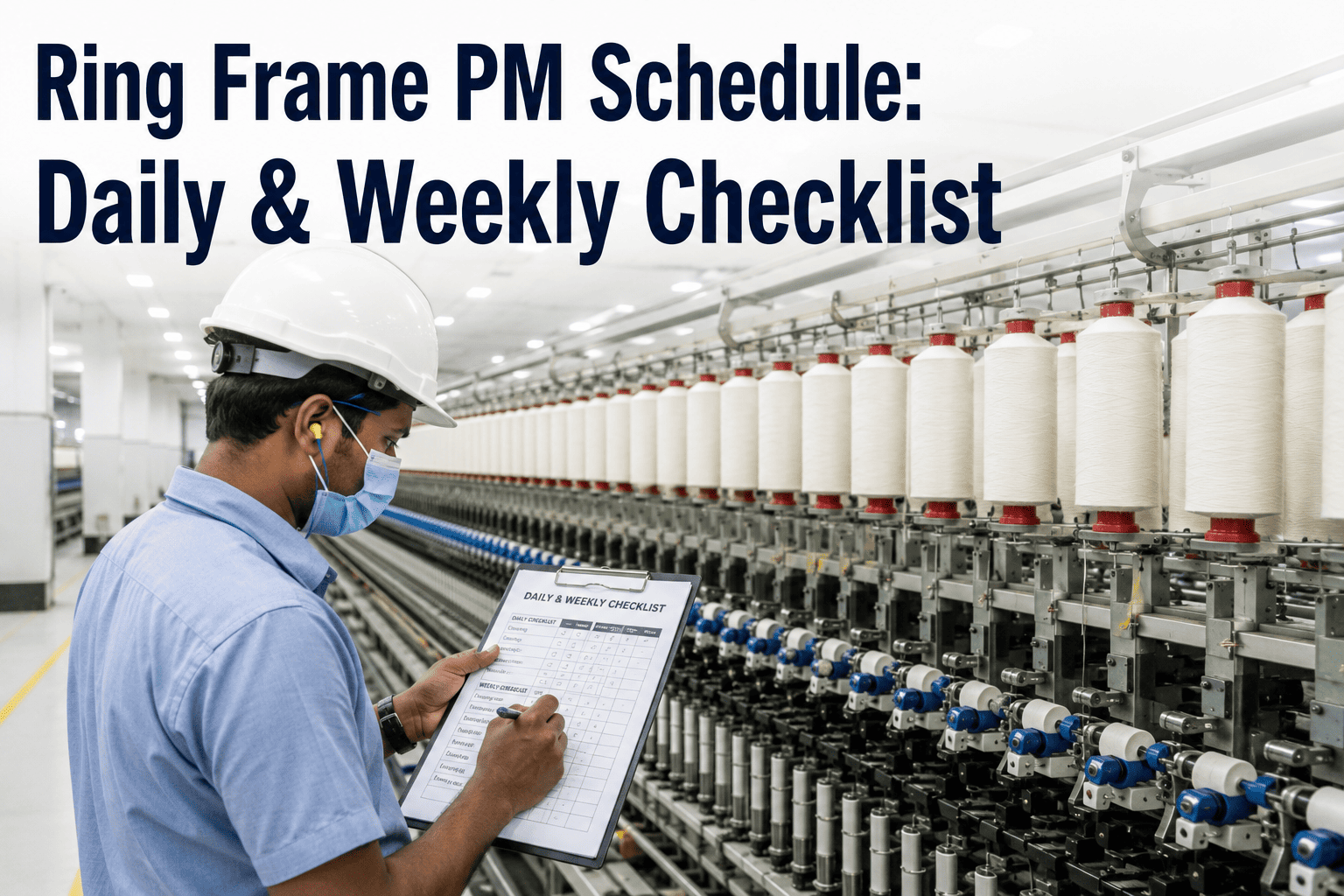
Schedule per 48-spindle section
Roving Frame
Schedule per 80-spindle section
Carding Machine
Schedule per carding unit
Master Preventive Maintenance Schedule
The table below consolidates all PM tasks across the three critical spinning machine groups. Every row specifies the task, frequency, responsible role, and estimated duration per machine unit.
| Machine | Task | Frequency | Responsible | Duration |
|---|---|---|---|---|
| Ring Frame | Spindle temperature check | Daily | Operator | 10 min |
| Ring Frame | Traveler wear inspection | Daily | Operator | 5 min |
| Ring Frame | Belt tension measurement | Weekly | Technician | 20 min |
| Ring Frame | Ring rail leveling | Weekly | Technician | 15 min |
| Ring Frame | Gearbox oil analysis | Monthly | Engineer | 30 min |
| Ring Frame | Spindle bearing vibration test | Monthly | Engineer | 45 min |
| Ring Frame | Main drive shaft alignment | Quarterly | Engineer | 2 hr |
| Roving Frame | Flyer pressure check | Daily | Operator | 10 min |
| Roving Frame | Package formation inspection | Daily | Operator | 5 min |
| Roving Frame | Drafting roller condition | Weekly | Technician | 25 min |
| Roving Frame | Bobbin rail alignment | Weekly | Technician | 15 min |
| Roving Frame | Pneumatic system pressure test | Monthly | Engineer | 30 min |
| Roving Frame | Creeper shaft bearing inspection | Monthly | Engineer | 20 min |
| Roving Frame | Differential gearbox overhaul | Quarterly | Engineer | 3 hr |
| Carding Machine | Flat strip waste inspection | Daily | Operator | 10 min |
| Carding Machine | Sliver quality check | Daily | Operator | 5 min |
| Carding Machine | Wire point condition assessment | Weekly | Technician | 30 min |
| Carding Machine | Licker-in speed verification | Weekly | Technician | 15 min |
| Carding Machine | Feed roller eccentricity check | Monthly | Engineer | 20 min |
| Carding Machine | Air duct cleaning schedule | Monthly | Technician | 45 min |
| Carding Machine | Revolving flats timing calibration | Quarterly | Engineer | 2 hr |
Deploy a Structured PM Schedule Across Your Entire Spinning Department
iFactory’s preventive maintenance module configures tasks, assigns roles, and tracks completion automatically across ring frames, roving frames, and carding machines with real-time mobile checklists.
Results: Structured PM Schedule versus Unplanned Repairs
The operational and financial gap between mills with formal PM schedules and those operating reactively is measurable across every dimension of spinning performance. The comparison below draws from documented mill outcomes.
Without Structured PM Schedule
- 8 to 12 unplanned breakdown events per month
- 60 percent of maintenance hours spent on emergency repairs
- Machine lifespan shortened by 25 to 35 percent
- Spare parts inventory 40 percent higher than needed
- Maintenance cost per spindle 1.8x to 2.4x higher
- Production quality variance at 3 to 5 percent U%
With iFactory Structured PM Schedule
- 1 to 3 unplanned breakdown events per month
- Under 15 percent of maintenance hours on emergency work
- Machine lifespan extended 20 to 25 percent
- Spare parts inventory optimized with data-driven planning
- Maintenance cost per spindle reduced 35 to 45 percent
- Production quality variance under 1.5% U%
Implementing a PM Schedule in Four Weeks
The mills that achieve the fastest ROI from structured preventive maintenance follow a repeatable deployment sequence. Each week targets a specific milestone that builds on the previous one.
Audit Existing Maintenance Practices
Document current PM tasks, frequencies, responsible personnel, and completion rates for every machine group. Identify gaps where machines receive no scheduled maintenance and quantify the cost of emergency repairs over the past six months.
Week 1Define Schedule and Task Library
Build a complete task library with frequency, duration, and skill-level requirements for each spinning machine type. Configure daily, weekly, monthly, and quarterly schedules in the iFactory PM module with automated assignment to operators, technicians, and engineers.
Week 2Deploy Mobile Checklists and Training
Roll out iFactory mobile checklists to maintenance and production teams. Conduct training sessions covering task execution, data entry, and escalation protocols for each role. Establish a two-week parallel run where digital and paper systems operate side by side.
Week 3Monitor Compliance and Optimize
Track schedule compliance, task completion rates, and resulting downtime trends in real time. Adjust frequencies where data shows over-maintenance or under-maintenance. Convert initial deployment into a continuous improvement cycle with monthly reviews.
Week 4 onwardFrequently Asked Questions
Stop Managing Maintenance by Memory. Start Managing It by Schedule.
iFactory gives spinning mills a complete preventive maintenance platform with configurable task libraries, mobile checklists, automated compliance tracking, and real-time downtime analytics. Deployed in 7 to 14 days.