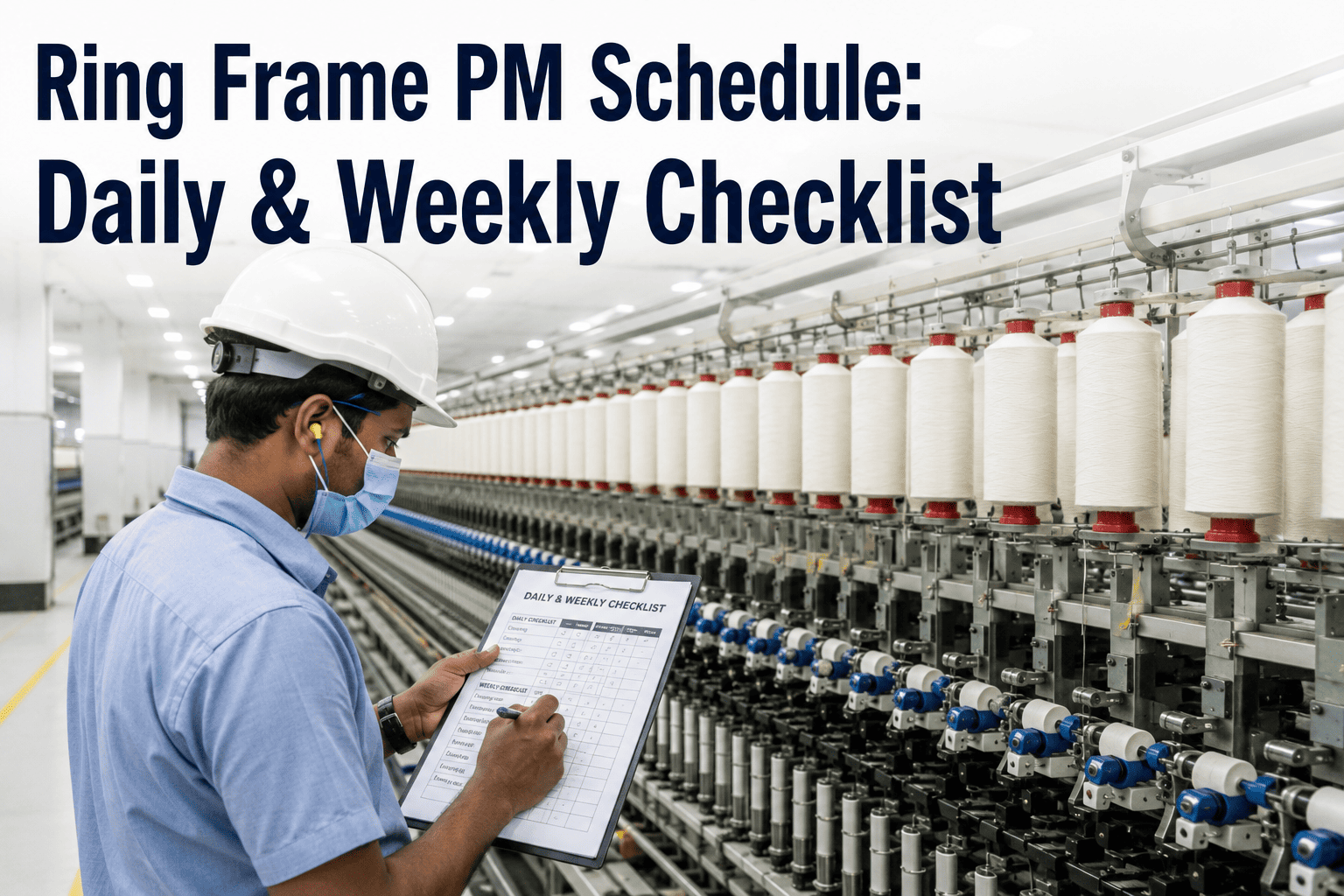
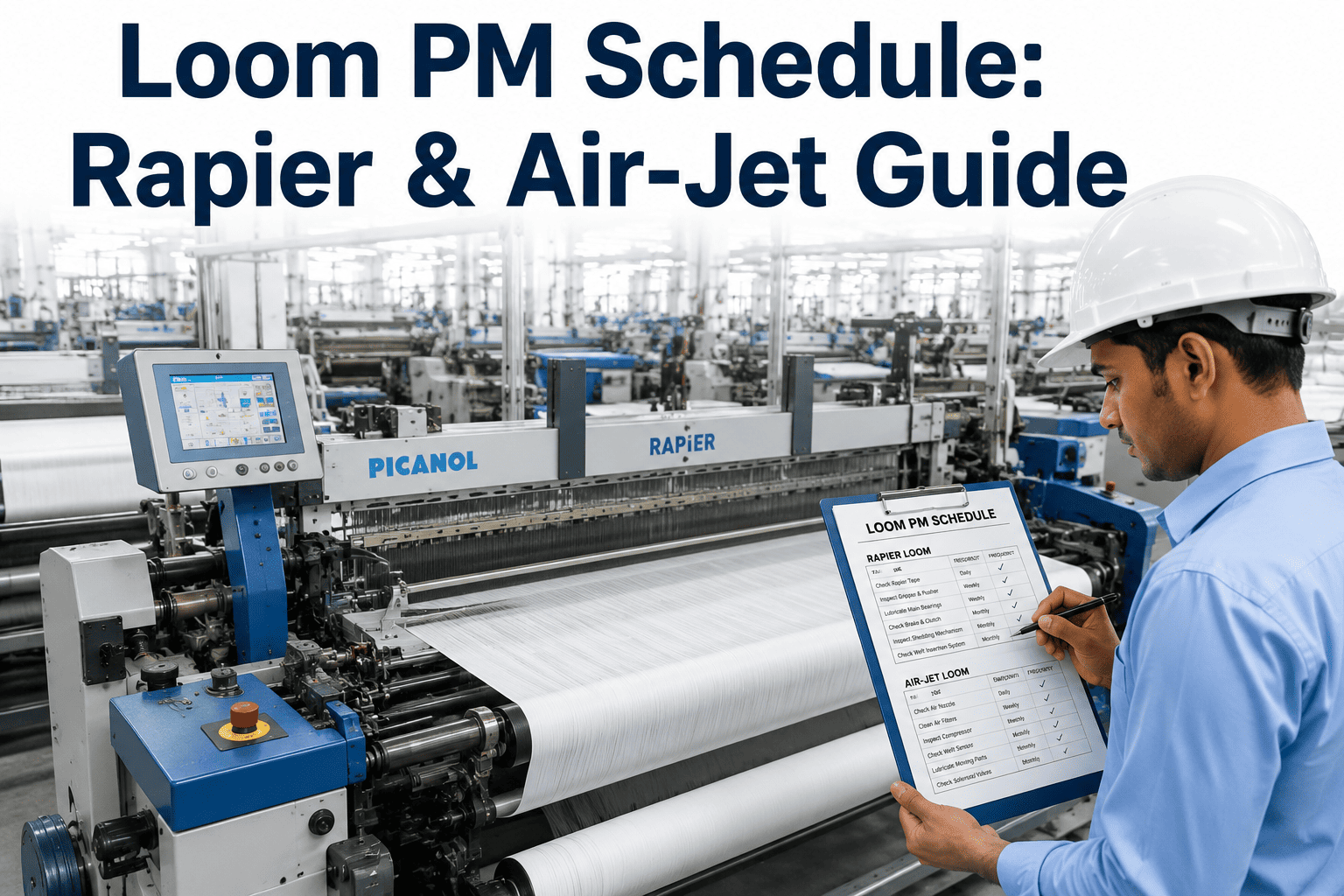
If your team is replacing the same spindle bearing on the same ring frame every three weeks, the problem was never the bearing — it was a maintenance schedule that never got structured. A ring spinning frame carries thousands of spindles, each needing regular lubrication and traveller changes, alongside a drafting system, creel zone, and drive train that all wear on different timelines and fail in different ways. Treating all of that with a single generic "check the machine" routine is how the same five or six failure modes end up accounting for most of unplanned spinning floor downtime. This schedule breaks ring frame maintenance into daily, weekly, monthly, and annual tasks across the four zones that actually matter — spindle, drafting, creel, and drive. Book a demo to see this running as auto-generated work orders.
Equipment Maintenance & Reliability
Ring Frame PM Schedule: Daily & Weekly Checklist
15 min read
8-14 days
Typical traveller replacement interval, varying with yarn count and spindle speed on the specific frame
Per Shift
Recommended frequency for spindle oiling checks on a running ring frame under normal production load
4 Zones
Spindle, drafting, creel, and drive systems — each with distinct wear patterns and maintenance requirements
5-6
Failure modes that typically account for the majority of unplanned ring frame downtime when PM is inconsistent
Daily Tasks: Start-of-Shift Checks
Daily checks catch the failures that develop fastest and cost the most if missed — a bearing running dry for one shift can progress from a minor issue to a full stoppage before the next scheduled inspection. These take minutes per frame but are the single highest-leverage habit in the entire schedule.
Weekly Tasks: Detailed Zone Checks
Weekly tasks go deeper than a shift-start glance, covering wear patterns that accumulate over days rather than hours. Start free trial to see weekly PM tasks auto-scheduled and assigned to technicians by zone.
Why Traveller Interval Should Not Be a Fixed Number
A traveller schedule set to a flat calendar interval misses the variable that actually drives wear — spindle speed and running hours. A frame running extra shifts at higher speed wears travellers faster than one running standard hours at a lower count, so the interval needs to track actual usage data rather than a single fixed number applied uniformly across every frame in the plant.
Monthly Tasks: Component-Level Maintenance
Monthly tasks address components that wear on a slower timeline but cause more significant disruption when neglected — greasing, deeper cleaning, and drive-train inspection that a daily or weekly glance would not catch.
Periodic and Annual Tasks: Overhaul-Level Maintenance
These tasks run on longer cycles — several months to a full year — and typically require the frame to be pulled from production or scheduled during a planned stoppage window. Book a demo to see annual overhaul tasks scheduled automatically against your production calendar.
Maintenance Frequency by Zone: Summary Reference
Stop Chasing the Same Ring Frame Failure Every Few Weeks
iFactory auto-generates daily, weekly, monthly, and annual PM tasks by zone, assigns them to the right technician, and adjusts intervals based on actual spindle hours and speed rather than a fixed calendar date.
What Mills Report After Structuring Ring Frame PM
Fewer
Repeat Failures
Same bearing or traveller failure recurring on the same frame drops sharply once PM is structured by zone and usage
Auto-Scheduled
PM Task Generation
Traveller changes, oiling, and buffing generated on schedule rather than tracked manually across hundreds of frames
Usage-Based
Traveller Intervals
Replacement scheduling tied to actual spindle hours and speed instead of a fixed calendar date across every frame
Fewer Defects
Downstream Quality
Apron and roller wear caught before it propagates into thick-and-thin yarn defects further down the line
Frequently Asked Questions
QWhy does traveller replacement need to vary by frame instead of following one plant-wide schedule?
Traveller wear is driven primarily by spindle speed and total running hours, not by calendar time alone, so two frames running different shift patterns or different yarn counts will wear travellers at meaningfully different rates even on the same replacement calendar. A frame running extra shifts at higher speed reaching the same wear point faster than a frame running standard hours at a lower count means a single fixed interval either replaces some travellers too early, wasting the part's remaining life, or leaves others running too long, risking the yarn breaks and quality defects that premature traveller failure causes.
Book a demo to see usage-based traveller scheduling applied across your specific frame mix.
QHow do drafting zone issues on a ring frame end up showing as defects on machines further down the line?
Drafting zone faults — apron cracks, roller lapping, or trumpet wear — do not always produce an immediate visible defect at the ring frame itself, but they alter the fiber guidance and drafting consistency in ways that show up as thick-and-thin places in the yarn once it reaches downstream processes. This is why condition-based inspection of the drafting system at defined intervals matters even when nothing looks obviously wrong during a quick visual check, since the propagation delay between the actual fault and its visible symptom can span multiple machines and processing stages.
QWhat is the most common mistake mills make when setting up a ring frame PM schedule for the first time?
The most common mistake is treating every zone of the ring frame identically with one generic maintenance routine, when spindle, drafting, creel, and drive components each have genuinely different wear mechanisms and failure modes that call for different inspection frequencies and methods. A close second is setting every interval by fixed calendar date rather than accounting for actual usage — running hours and spindle speed — which causes both wasted early replacements on lightly used frames and missed failures on heavily used ones.
Start free trial to see zone-specific, usage-adjusted scheduling set up for your ring frame fleet.
QHow can a maintenance team tell if a recurring bearing failure is a part quality issue or a root cause problem elsewhere?
If the same bearing failure recurs on the same specific frame repeatedly, on a timeline shorter than the component's expected service life, the underlying issue is rarely the bearing itself — it is far more often something else in that frame's operating environment, such as contamination from inadequate lint control, a misalignment issue, or a lubrication cycle that is not actually being followed as scheduled. Root cause investigation tools like a structured "5 Whys" review help maintenance teams trace the failure past the immediate symptom to find what is actually different about that specific frame compared to others in the plant that are not failing at the same rate.
QShould overhaul kit replacement be scheduled the same way across every ring frame in a mill?
Full overhaul kits, which bundle key components across the creel, drafting, spindle drive, and suction zones, are typically recommended on a multi-year replacement cycle to extend machine life while maintaining original performance, but the exact timing benefits from being adjusted per frame based on actual production intensity rather than a single blanket schedule. A frame that has run consistently at high speed and high utilization will generally benefit from earlier full-kit replacement than a lower-utilization frame, even if both were installed at the same time.
Turn This Schedule Into Automatically Generated Work Orders
iFactory tracks spindle hours, running speed, and zone-specific wear across every ring frame in your plant, generating daily, weekly, monthly, and annual PM tasks automatically — assigned to the right technician, before the same failure repeats again.