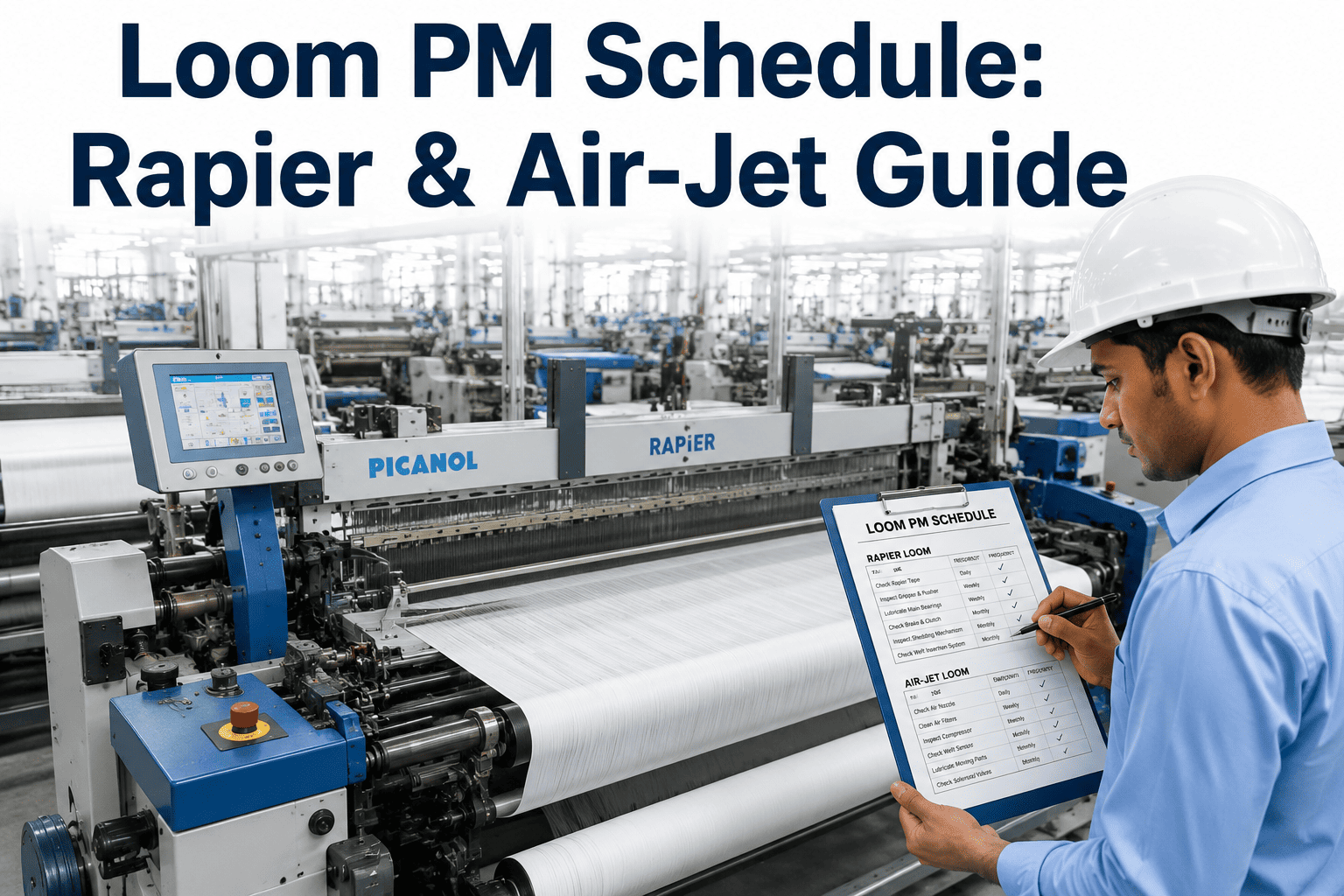
Running a rapier and an air-jet loom on the same PM checklist is one of the fastest ways to under-maintain one machine while over-servicing the other, because the two weft insertion systems fail in genuinely different ways and at different rates. A weaving loom that stops unexpectedly costs between 800 and 1,400 dollars per hour in lost production depending on fabric width, weave complexity, and machine speed, and the mills that consistently achieve 92 percent or higher loom efficiency do not rely on operator memory — they run documented PM programs with intervals tailored to each loom type. Getting those intervals wrong in either direction — too loose and failures compound silently, too tight and labor hours get wasted on components that didn't need attention yet — is the difference between a well-run weaving shed and one perpetually fighting unplanned stops. This guide breaks down PM intervals separately for rapier and air-jet looms across the four primary motions — shedding, picking, beating, and let-off — plus the specific failure causes each interval exists to prevent. Weaving sheds standardizing their PM program across mixed loom types can book a 30-minute demo to see how iFactory tracks loom-specific maintenance intervals automatically.
Loom Preventive Maintenance — Rapier & Air-Jet Schedules, Side by Side
Daily-to-quarterly PM intervals for shedding, picking, beating, and let-off motions, with the specific failure causes and overhaul cycles that differ between rapier and air-jet loom types.
What Actually Causes Unplanned Loom Stops
Before building a schedule, it helps to know exactly what that schedule is defending against — three failure causes account for the majority of unplanned stops across both loom types.
These three preventable causes — air pressure failures, worn grippers, and drive belt failure — account for roughly three-quarters of unplanned loom stops that a properly tuned PM schedule is designed to catch before they happen.
Daily and Weekly Tasks — Both Loom Types
Some inspection points apply across both weft insertion systems because they protect the shared primary motions — shedding, beating, and let-off — that every loom depends on regardless of how the weft crosses the shed.
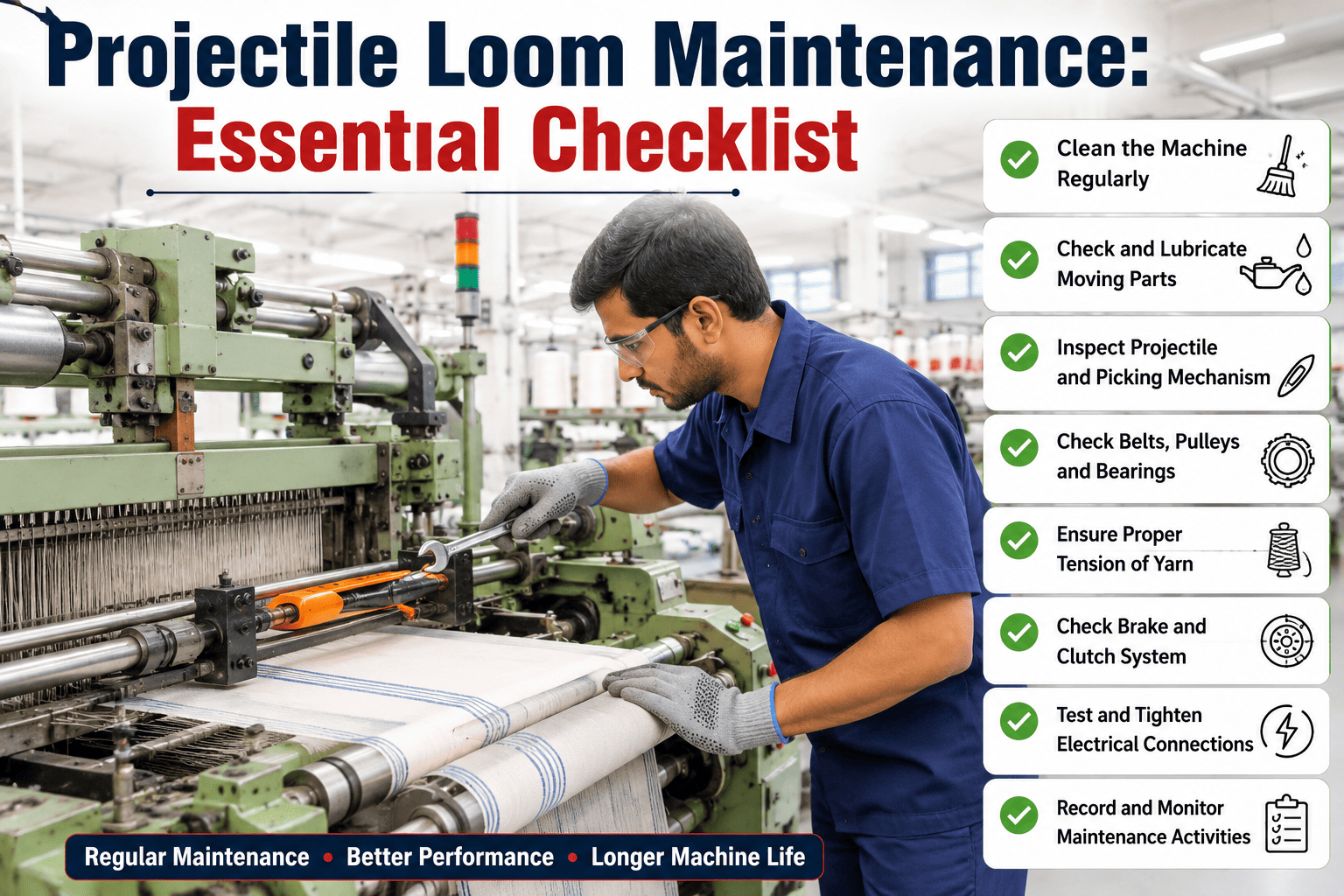
Lubrication points, reed and heddle inspection, warp tension, fabric take-up, and electrical safety checks performed each shift.
Cam and tappet inspection, shedding mechanism service, beam drive inspection, weft feeder and tensioner check, and pneumatic system check.
Full oil change, bearing inspection with a vibration pen, motor and drive audit, electrical panel cleaning, and a full loom alignment check.
Where Rapier and Air-Jet Schedules Actually Diverge
This is the section most generic maintenance checklists skip — the interval differences below exist because the two mechanisms wear at genuinely different rates and fail in different ways.
| Maintenance Point | Rapier | Air-Jet |
|---|---|---|
| Weft insertion component check | Rapier head gripper inspected weekly — wear directly affects selvedge fabric quality | Nozzle maintenance on a monthly interval |
| Guide/drive lubrication | Rapier guide rods require daily lubrication | Pneumatic system components as the primary daily focus |
| Drive system inspection | Cam followers and connecting rods inspected quarterly | Pneumatic and air pressure system components prioritized |
| Overhaul interval | Typically 4,000 to 5,000 running hours | Typically 6,000 running hours |
PM by Primary Motion
Every loom, regardless of weft insertion type, depends on the same four primary motions working in precise timing with each other — PM tasks map cleanly onto each one.
Shedding
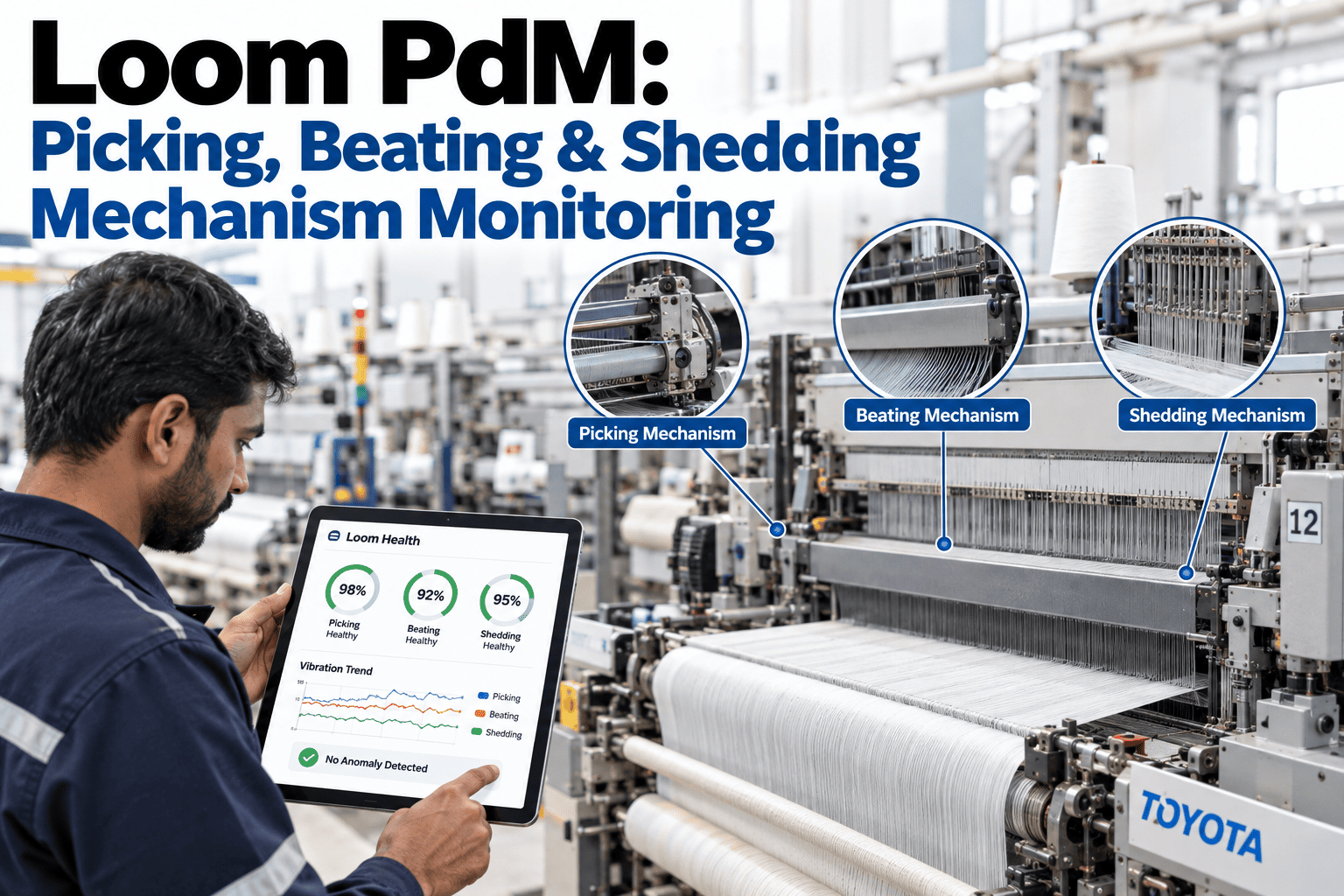
Shedding divides the warp into two sheets so the weft has a clear passage from one side of the loom to the other. Dust and lint accumulation in shedding mechanisms and dobby linkages is the second most common cause of loom failure after lubrication errors.
Picking
Picking is the operation that transfers the weft yarn into the shed from one side of the loom to the other. This is where rapier and air-jet PM diverges most, since the two mechanisms carry the weft in fundamentally different ways.
Beating
Beat-up pushes the newly inserted weft yarn back into the cloth fell using the reed, a motion that depends on precise cam and tappet timing checked weekly.
Let-Off
Let-off motion delivers warp to the weaving area at the required rate and constant tension, unwinding it from the weaver's beam — a motion PM protects through beam drive inspection and warp tension checks.
Root Cause, Not Just Symptom
Two failure patterns account for the overwhelming majority of premature loom breakdowns across both mechanism types, and both are fully preventable with a properly logged PM route.
Lubrication Errors
Wrong grade, wrong quantity, or missed lubrication points account for 40 to 50 percent of premature bearing failures in textile plants — the single largest preventable failure category.
Dust & Lint Accumulation
Dust and lint buildup in shedding mechanisms and drafting zones is the second most common failure cause, fully preventable with scheduled cleaning routes and logged records.
A poorly maintained loom degrades quality long before it breaks outright — worn heddle frames misalign warp threads, dirty shuttle mechanisms create skip weaves, and drifting loom timing produces uneven weft that gets woven into the cloth and shipped before anyone notices. This is the strongest argument for scheduled PM over reactive repair: by the time a loom actually stops, defective fabric has often already been produced and packed.
Rapier grippers and air-jet nozzles don't fail on the same clock — your PM schedule shouldn't either.
iFactory applies distinct PM intervals by loom type, tracks running hours toward each machine's overhaul cycle, and logs failure history so repeat breakdowns get traced back to a schedule gap instead of blamed on the part.
Frequently Asked Questions
We run both rapier and air-jet looms — do we need two completely separate maintenance teams?
Not necessarily two separate teams, but definitely two separate schedules and, ideally, technicians cross-trained on both mechanism types rather than one generic loom maintenance certification. The daily and weekly tasks around shared components — lubrication points, reed and heddle inspection, warp tension, shedding mechanism service — apply across both loom types and can be handled by the same rotation. Where it genuinely diverges is the weft insertion system itself: rapier gripper inspection and guide rod lubrication versus air-jet nozzle and pneumatic system maintenance require different specific knowledge, even if the underlying maintenance discipline is the same. Most mixed sheds find it more efficient to train their whole team on both systems' specific checkpoints rather than splitting into two isolated crews. Book a demo to see how a mixed-loom PM schedule is organized in one system.
Our air-jet looms keep having pneumatic-related stops even though we're following the monthly nozzle interval — what are we missing?
Air pressure system failures account for a substantial share of unplanned air-jet stops, and nozzle inspection alone doesn't cover the full pneumatic system — compressor performance, air line leakage, filter condition, and pressure regulator function all affect weft insertion reliability independently of nozzle wear itself. A mill seeing recurring pneumatic stops despite following the nozzle schedule should look upstream at the compressed air infrastructure feeding the loom, since a nozzle in good condition still fails to insert weft cleanly if the air pressure reaching it has degraded from a leak or a failing regulator somewhere in the line. Weekly pneumatic system checks, not just monthly nozzle inspection, are usually the missing layer in this situation.
Is it worth extending our rapier overhaul interval past 5,000 hours to save on downtime?
Extending an overhaul interval without evidence from your own fault history is a real gamble, since the 4,000 to 5,000 hour rapier overhaul window exists specifically because rapier looms typically need shorter overhaul intervals than air-jet's roughly 6,000 hour cycle. Pushing past that window without tracking actual wear data risks trading a planned, scheduled overhaul for an unplanned mid-run failure that costs considerably more in lost production and rushed repair than the overhaul itself would have. The right way to test whether your specific looms can safely run longer is tracking fault history and gripper condition data across several overhaul cycles first, then adjusting the interval based on your mill's actual wear pattern rather than guessing based on the OEM default alone.
How much of our unplanned downtime is actually preventable versus just normal wear and tear?
Lubrication errors and dust and lint accumulation together account for the large majority of premature bearing and mechanism failures in textile plants, and both are fully preventable with scheduled routes and logged records. Combined with the air pressure, gripper wear, and belt failure causes that account for roughly three-quarters of unplanned loom stops, the honest answer for most mills is that the majority of what looks like normal wear and tear is actually deferred or inconsistent maintenance showing up as a breakdown. Mills that shift from informal, operator-intuition-based maintenance to documented, interval-based PM programs consistently see their unplanned stop rate drop substantially within the first several months, which is strong evidence that most of what felt inevitable actually wasn't. Contact iFactory Support to benchmark your current preventable-versus-unplanned downtime split.
What's the fastest way to tell if a loom stop was caused by a maintenance gap versus an operator error?
Checking the maintenance log against the failure timing is the most reliable first step — a stop caused by a missed or overdue lubrication point, an overdue gripper inspection, or a component past its scheduled service interval points clearly to a maintenance gap rather than operator handling. Failures that correlate with a specific operator, shift, or unusual production run — like a sudden material change or an atypical fabric construction — point more toward operational factors than a maintenance schedule failure. The clearest signal is repetition: a single stop could be either cause, but the same failure recurring on the same loom across multiple operators and shifts almost always traces back to a maintenance interval that's too loose or a component that was never properly serviced at its last scheduled point.
Air pressure failures, worn grippers, and belt failure cause three-quarters of unplanned loom stops — and all three are preventable.
iFactory tracks PM intervals separately for rapier and air-jet looms, flags overdue tasks before they become stops, and logs failure history so your schedule keeps improving instead of repeating the same breakdown.