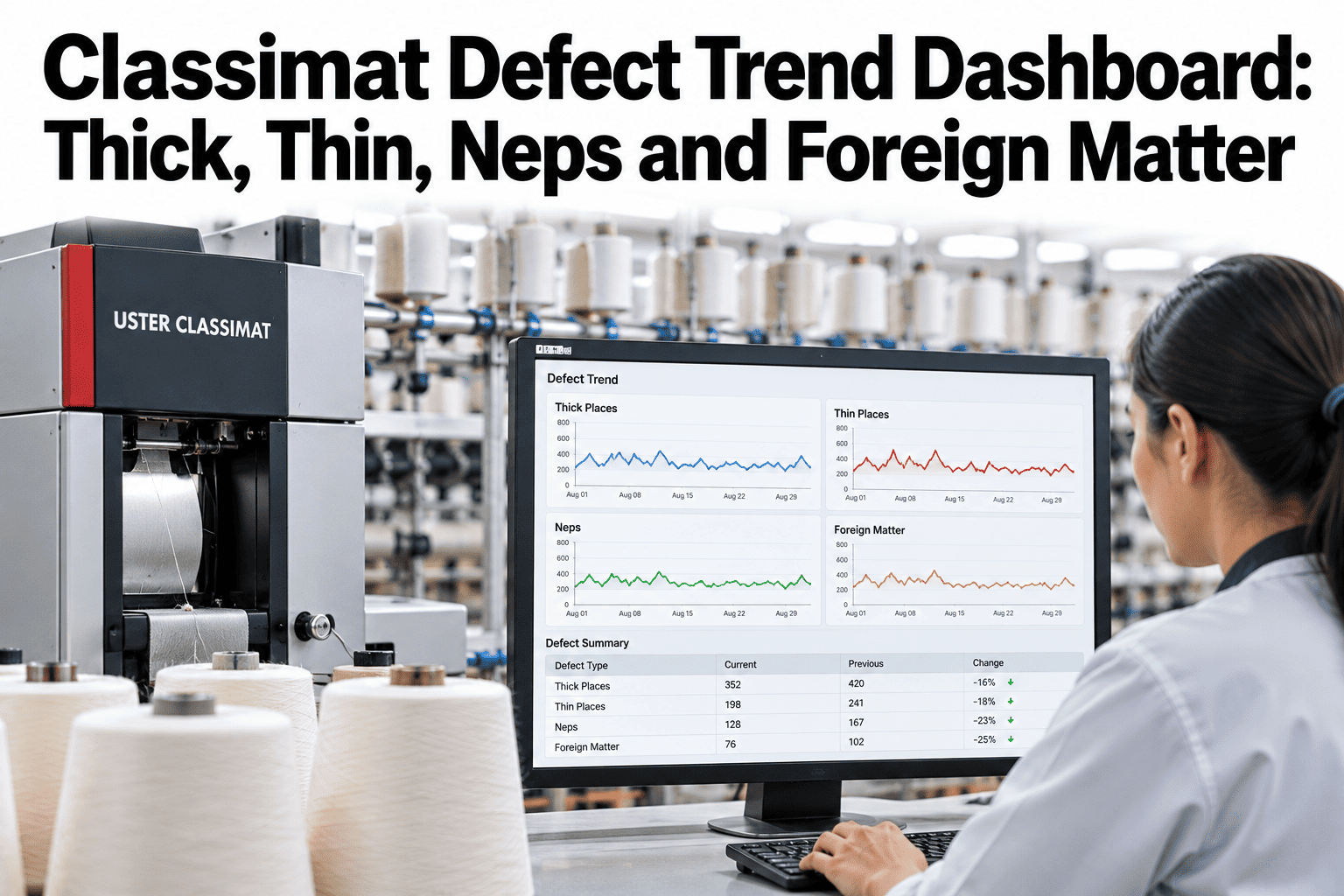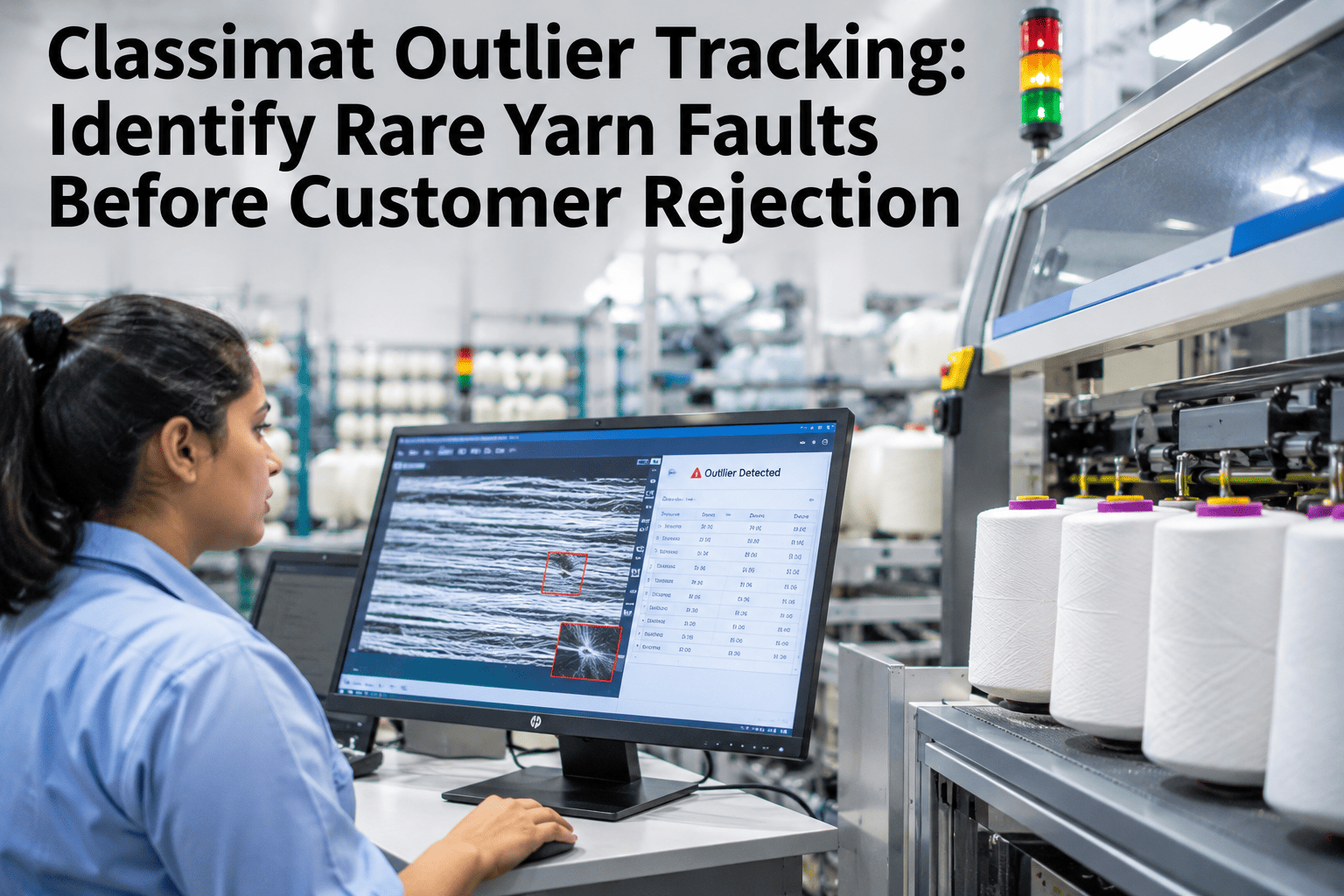
Outlier bobbins are the hidden liability in every yarn shipment. Uster Classimat 5 introduced formal outlier classification — thick, thin, nep and foreign-matter cop-level events that fall outside the mill's own Yarn Body — and a single shipment containing even a handful of outlier bobbins can produce barré, cloud, or pilling complaints weeks after the yarn has left the gate. iFactory AI connects Classimat outlier counts to the bobbin, spindle position, machine frame, raw material lot and shift so that a quality manager can act on a pattern before it becomes a customer rejection. To see outlier tracking built around your own machine and lot structure, book a 30-minute walkthrough with our team.
Find the Bobbin Behind the Barré Before Your Customer Does
iFactory AI connects Classimat outlier events to spindle, machine, lot and process condition — turning a lab number into a traceable production action.
What Is a Classimat Outlier and Why Does It Matter?
A Classimat outlier is a bobbin whose fault profile falls outside the mill's established Yarn Body — the statistical fingerprint of normal production for that count, fibre and machine. Uster Classimat 5 introduced outlier classification as a formal standard because rare, severe bobbins — not the average fault distribution — are what drive downstream fabric defects such as barré, cloud, pilling and weave irregularity.
Uster research shows that preventing a single barré claim can save a mill up to CNY 200,000 (approximately USD 28,000) in claims and rework (Uster Technologies, 2026). The economic case for systematic outlier tracking is not theoretical — it is the cost of complaints that arrive silently in shipment after shipment.
The Classimat Outlier Tracking inspection
Effective outlier management is a connected workflow from test instrument to production decision. The eight practices below distinguish mills with consistent outlier control from those that discover problems through customer complaints.
Connect Your Classimat Data to Production — Before the Next Shipment
iFactory AI links outlier counts to machine, spindle, lot and process condition so your quality team can act on a pattern, not wait for a complaint.
Root Cause Mapping: Which Outlier Type Points Where
The fault category in a Classimat outlier event is a diagnostic shortcut. Knowing which process area each category implicates narrows the investigation before any machine is opened.
| Outlier Category | Primary Mechanism | Process Area First | Urgency Signal |
|---|---|---|---|
| Thick outliers | Inconsistent drafting force; fibre bundle doubling | Apron condition, roller eccentricity, cradle spring pressure | Rising rate on one frame — check apron before next shift |
| Thin outliers | Fibre slippage or mass reduction in drafting zone | Apron tension, bottom roller fluting, drafting settings | Thin outliers on multiple machines — check raw material lot first |
| Nep outliers | Entangled fibre knots from card or blow-room | Card wire condition, cylinder speed, web cleanliness | Rate increase with new bale lot — isolate lot immediately |
| Foreign matter | Contamination from raw cotton or handling | Bale inspection, blow-room controls, storage hygiene | Foreign matter on every test — trigger bale lot audit |
| Periodic outliers | Mechanical fault with calculable wavelength | Roller eccentricity, gearing — wavelength identifies component | Periodic on single machine — calculate fault wavelength immediately |
Where Outlier Data Disappears in Most Mills
Classimat data is routinely collected and routinely ignored. These four gaps separate mills that catch outlier problems early from those that discover them through claims.
Outlier Rate Benchmarks for Ring Spinning
No universal standard exists for acceptable outlier rates — the threshold depends on count, fibre, and the end-use fabric's defect tolerance. The table below provides illustrative ranges to frame internal targets.
| Outlier Bobbin Rate | Indicative Performance | Fabric Defect Risk |
|---|---|---|
| Under 1% | High consistency, regular monitoring in place | Low — unlikely to generate barré claims at standard volumes |
| 1–3% | Acceptable for mid-range applications; needs monitoring | Moderate — statistically likely to include fabric-affecting bobbins |
| 3–6% | Process drift or mechanical wear — investigation warranted | High — customer complaints probable for sensitive applications |
| Above 6% | Active process problem — hold and investigate before dispatch | Very high — fabric defects probable across most end uses |
How iFactory AI Builds the Outlier Tracking Layer
iFactory AI, an on-premise AI platform deployed on NVIDIA GPU servers, connects the Classimat output to production, maintenance and lot records through a structured data layer — inside the mill, with no cloud dependency.
Classimat Data Integration
Direct ingestion of Classimat results by lot, machine and test batch — no manual re-entry.
Machine-Level Dashboard
Per-frame outlier rates trended over time, with threshold alerts visible during the shift.
Lot-to-Outlier Linkage
Each test batch linked to the active raw material lot, separating lot-related spikes from mechanical root causes automatically.
Maintenance Cross-Reference
Outlier events cross-referenced with maintenance history — connecting component wear to quality change traceably.
Quality Hold Triggers
Configurable thresholds that generate a hold before dispatch — converting Classimat data from a record into a gate.
Yarn Body Drift Monitoring
Trend analysis on Yarn Body profile shape over time, flagging drift as an early warning before fault counts cross a threshold.
Frequently Asked Questions
What is the difference between a Classimat fault class and an outlier?
Fault classes (A–D for thick, E–H for thin) categorise individual yarn faults by size and length. An outlier is a bobbin-level event — a cop whose fault count falls so far outside the mill's Yarn Body that it is statistically abnormal. Class counts say what type of fault is occurring; outlier rate identifies which bobbins will cause customer problems. Both are needed. See both tracked on a single dashboard.
How many bobbins need to be tested for a reliable outlier rate?
A single test per lot is almost never sufficient — outlier detection requires statistical sampling of rare events, so sample size matters more than for average-fault analysis. iFactory AI calculates sampling plans for each count and machine based on production volume and customer tolerance, and our team can review your current frequency against your exposure level.
Can outlier tracking be set up without replacing existing Classimat instruments?
Yes. iFactory AI integrates with existing Classimat 5 instruments through data export connections — no instrument replacement required. Mills on earlier Classimat generations may need to upgrade the instrument to access outlier classification features, which is an Uster decision independent of the software integration. Review your instrument configuration in a session before committing to any approach.
How does the system connect outlier events to maintenance records?
iFactory AI timestamps each test result and cross-references it with the maintenance log for the tested machine at that time — surfacing correlations between outlier rate increases and overdue component replacements automatically, reducing investigation time from days to minutes. Ask our team how maintenance linkage is configured for your data structure.
What is a practical first step for a mill with no current outlier tracking?
Establish machine-level outlier rates for your top five counts by volume, tracked over four consecutive weeks without process changes. This baseline reveals which machines carry the highest risk and allows setting meaningful hold thresholds. Book a session to design the baseline measurement plan for your mill configuration.
Turn Your Classimat Data Into a Quality Hold, Not a Customer Complaint
iFactory AI connects outlier counts to machine, spindle, lot and maintenance history — giving your quality team the information to act before the yarn leaves the mill.