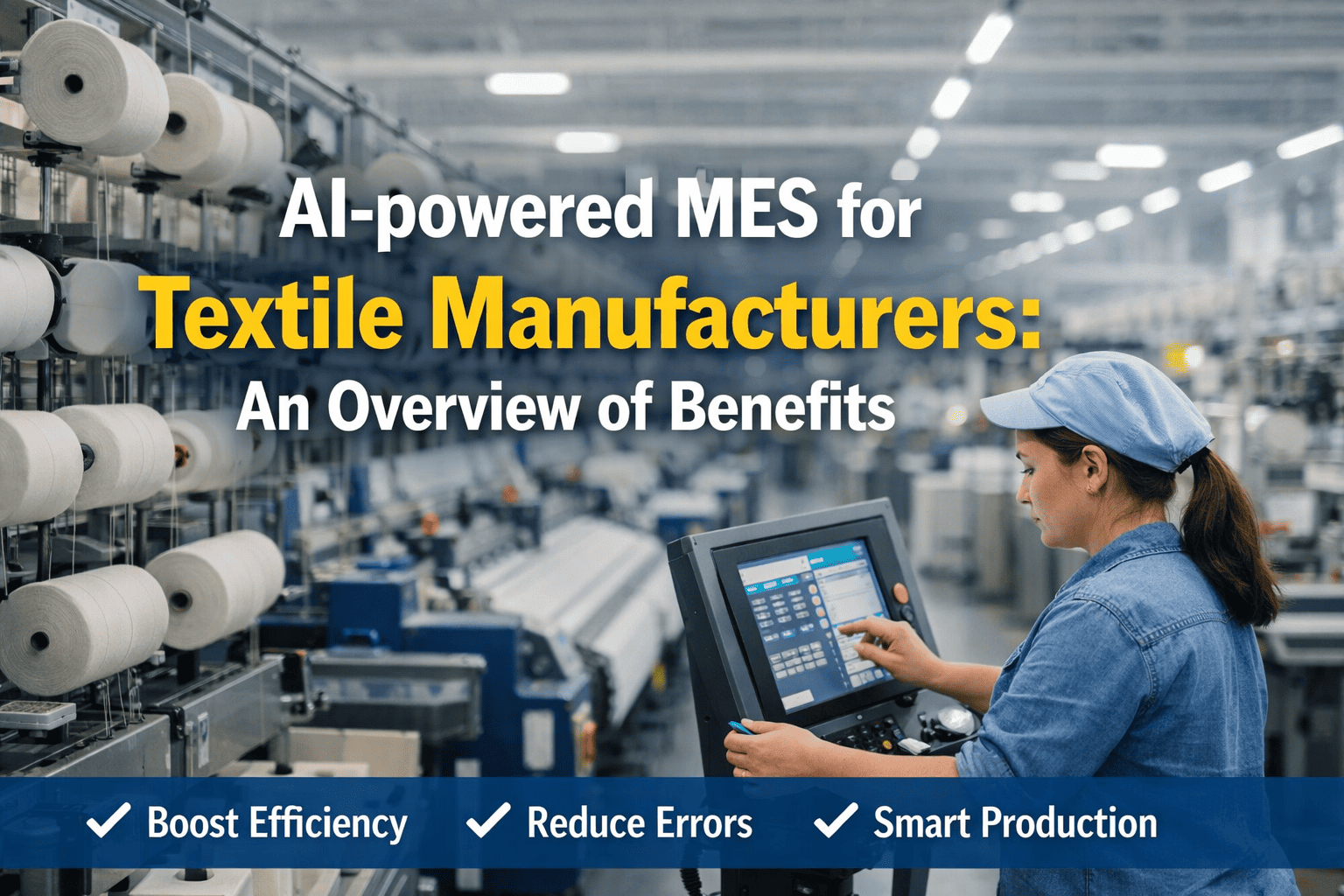
Textile manufacturing has always been data-rich but insight-poor. Machines generate signals, operators make decisions, and production events happen across dozens of departments every hour — yet most factories still rely on spreadsheets, paper travellers, and end-of-shift summaries to understand what actually happened on the floor. Cloud-based Manufacturing Execution Systems are changing this completely. By connecting every production event to a centralised, intelligent platform accessible from anywhere, cloud MES gives textile manufacturers the real-time control they have never had before. Book a free demo with iFactory and see how cloud MES works on a live textile production floor.
Your Entire Factory. One Cloud Platform. Real-Time.
Cloud-based MES gives textile manufacturers complete production visibility, automatic traceability, and the data infrastructure to compete in a compliance-driven global market.
Why Traditional MES Has Failed Textile Factories
Legacy on-premise MES systems were built for large-scale, single-site manufacturers with deep IT teams and multi-year implementation budgets. Textile mills — with their multi-department workflows, seasonal order swings, and thin IT resources — were never the intended customer. The result has been decades of expensive deployments that delivered limited value and even more limited adoption on the shop floor.
What a Cloud-Based MES Actually Does
A cloud MES is not just production tracking software hosted online. It is a live intelligence layer that connects machines, operators, quality checkpoints, and management — giving every decision-maker accurate, current data at every moment of the production cycle.
Machines, operators, and QC points feed data in real time through connected inputs and manual log stations.
All data is aggregated, structured, and analysed instantly — accessible from any device, anywhere, with no on-site server required.
Cloud MES integrates with your ERP for seamless order sync, and generates buyer-ready reports on demand.
Yarn count, loom parameters, and picks per inch tracked per roll — defects traced to machine and shift instantly.
Dye recipe compliance, temperature curves, and chemical dosing monitored in real time per batch.
Automated quality logs, timestamped sign-offs, and one-click compliance exports for GOTS, OEKO-TEX, and buyer audits.
Six Ways Cloud MES Transforms Textile Operations
The value of cloud MES is not limited to one department or one metric. It creates a compounding operational advantage across planning, production, quality, and finance simultaneously.
Every department — spinning, weaving, dyeing, finishing, packing — reports into a single live dashboard. Production managers see order progress, machine utilisation, and bottlenecks the moment they occur, not the next morning.
Cloud MES logs quality parameters at every checkpoint. When a reading deviates from the accepted range, the system triggers an instant alert to the responsible operator and supervisor — before the defect propagates into finished goods.
Every production event — machine setting, batch movement, operator sign-off, quality inspection — is automatically timestamped and linked to the originating buyer order. Full trace from fibre to dispatch is available in seconds, not days.
Machine downtime and performance trends are tracked automatically. Cloud MES identifies patterns that precede machine failures — enabling planned maintenance before breakdowns occur and reducing unplanned downtime by up to 45%.
Cloud MES auto-generates compliance-ready documentation from live production data. Audit preparation that previously required 3 to 5 days of manual document retrieval is completed in under 15 minutes — with complete, formatted production histories.
Cloud MES is accessible from any device — desktop, tablet, or mobile — without VPN or office access. For multi-site operations, a single dashboard aggregates performance across all factory locations in real time.
iFactory's cloud MES is built specifically for textile manufacturing — not adapted from a generic platform.
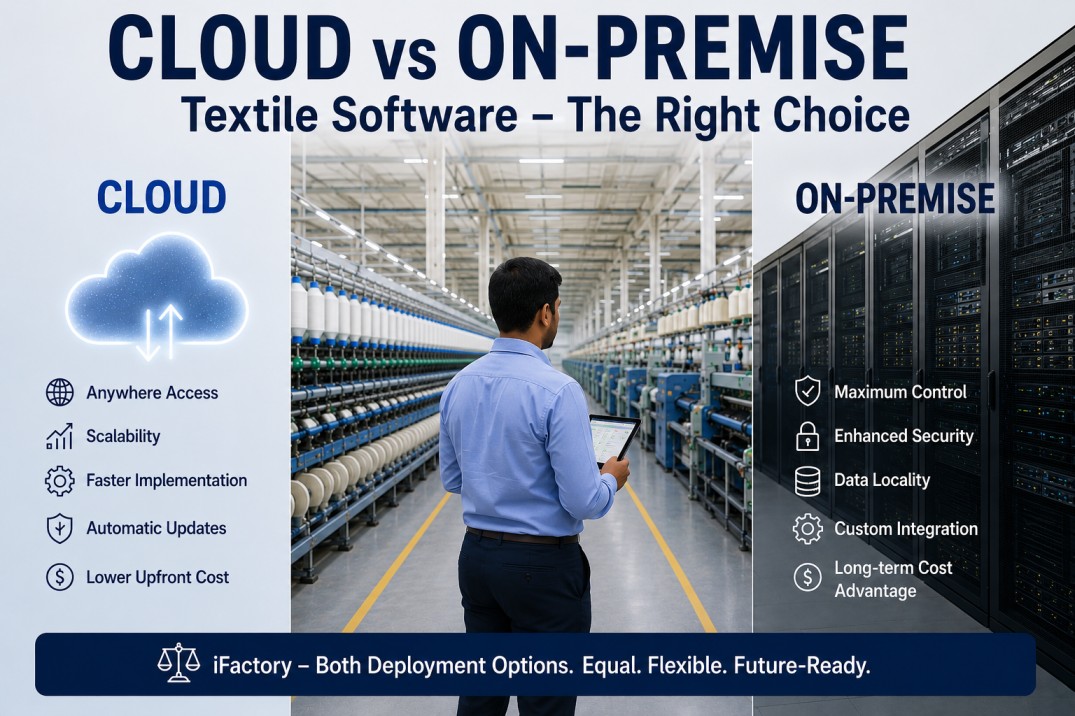
Cloud MES vs On-Premise MES vs Manual Systems
Not all production management approaches deliver equal value. Here is how cloud MES compares across the dimensions that matter most to textile manufacturers.
Who Uses Cloud MES — and What They Gain
Cloud MES serves every role in the factory differently. Here is what real-time data access means for each stakeholder.
Access efficiency trends, cost-per-metre analysis, and department performance from any device — at any time. Make strategic decisions with accurate, current intelligence instead of yesterday's summaries.
View live order progress across all departments. Identify bottlenecks as they form and reassign capacity in real time — turning reactive firefighting into proactive production control.
Receive mid-process defect alerts linked to the exact machine, operator, and time window. Generate compliance-ready quality reports automatically — without end-of-day document scrambles.
Produce full production traceability reports — fibre source to finished roll — in minutes. Meet GOTS, OEKO-TEX, and buyer-specific requirements without weeks of manual document preparation.
The Market Shift Driving Cloud MES Adoption
Cloud MES is no longer an optional technology upgrade for forward-thinking mills. Global buyers, certification bodies, and regulatory frameworks are now setting minimum data standards that only real-time cloud systems can meet reliably.
of global apparel brands now require digital production records from Tier 1 suppliers as a contract condition for 2025 partnerships
mandates full supply chain production traceability for textiles entering European markets — effective from 2025 onwards
of Indian textile exporters in a 2024 survey cited inability to provide real-time production data as a barrier to new international buyer acquisition
faster new buyer onboarding achieved by mills with cloud MES versus those relying on manual documentation and legacy systems
A buyer asked us for a full production trail on an 8,000-metre export order — machine records, quality sign-offs, dye lot parameters, everything — with 48 hours' notice. We pulled the complete report in eleven minutes and sent it while still on the call. The buyer increased their next order by 30%.
— Export Operations Manager, Mid-size Composite Mill, Coimbatore | Q1 2026What Sets iFactory's Cloud MES Apart
Most cloud platforms are built for generic manufacturing and then stretched to fit textiles. iFactory was designed ground-up for the specific workflows, terminology, and quality standards of the textile industry.
iFactory understands yarn counts, shade tolerances, GSM variation, picks per inch, and loom efficiencies without requiring custom configuration. The platform speaks textile from day one.
iFactory goes live across all departments in 4 weeks or less — with no hardware procurement, no server installation, and no months-long IT project. The first production traces are visible within the first week.
Operators in dyeing basements and finishing halls with poor connectivity can still log quality data. The system syncs automatically when network access returns — with zero data gaps.
iFactory connects to SAP, Oracle, Tally, and most ERP systems via standard API. Production orders, material records, and quality data flow between platforms without double entry or manual exports.
No large upfront capital commitment. iFactory is priced on a per-department or per-site subscription basis — meaning small and mid-size mills get enterprise-grade MES without enterprise-grade budgets.
Frequently Asked Questions
Move Your Mill to Cloud MES in 4 Weeks
Join textile manufacturers across India, Bangladesh, and Vietnam who are running their operations on iFactory's cloud MES — with real-time visibility, automated compliance, and production intelligence that helps them win and keep global buyer accounts.