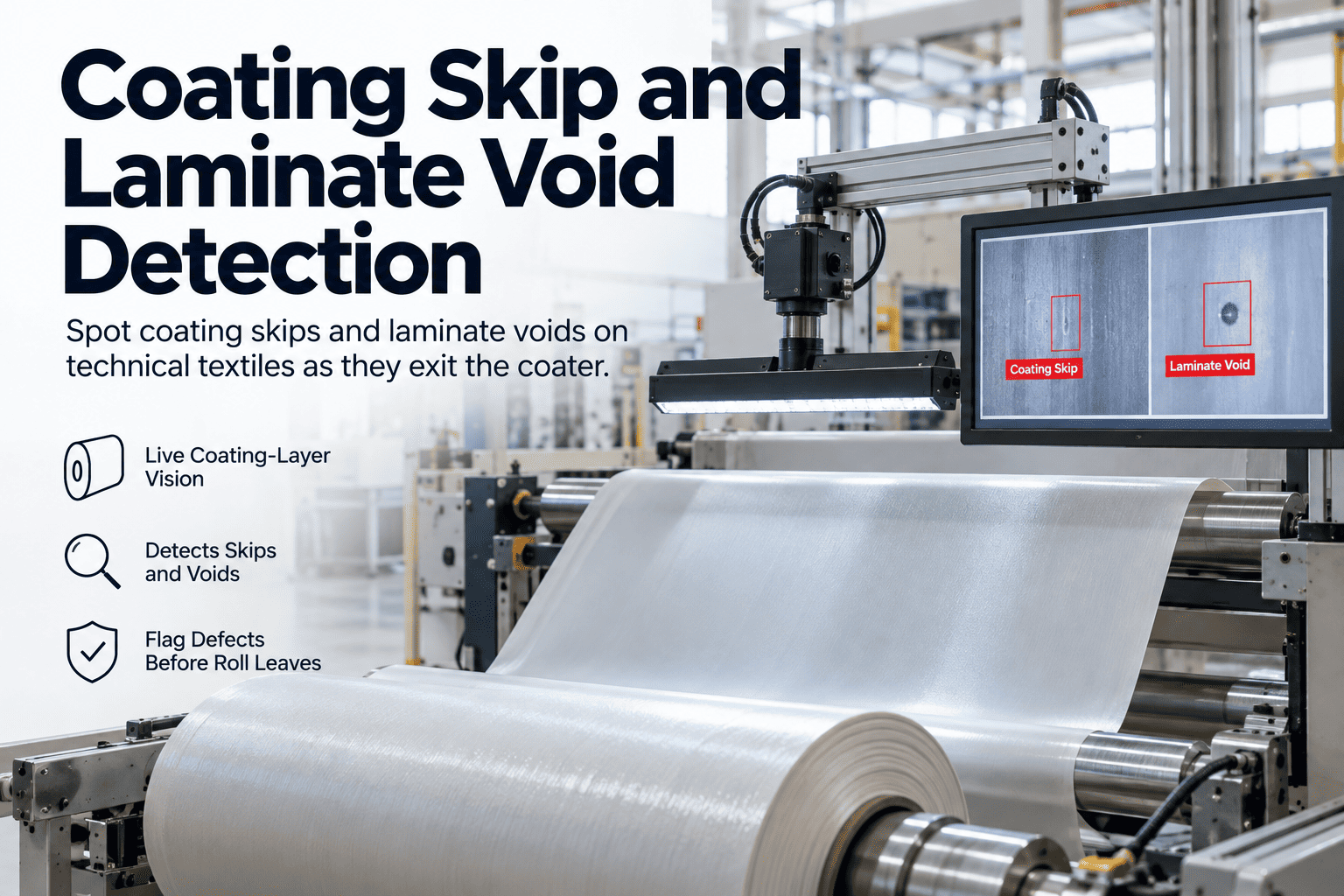
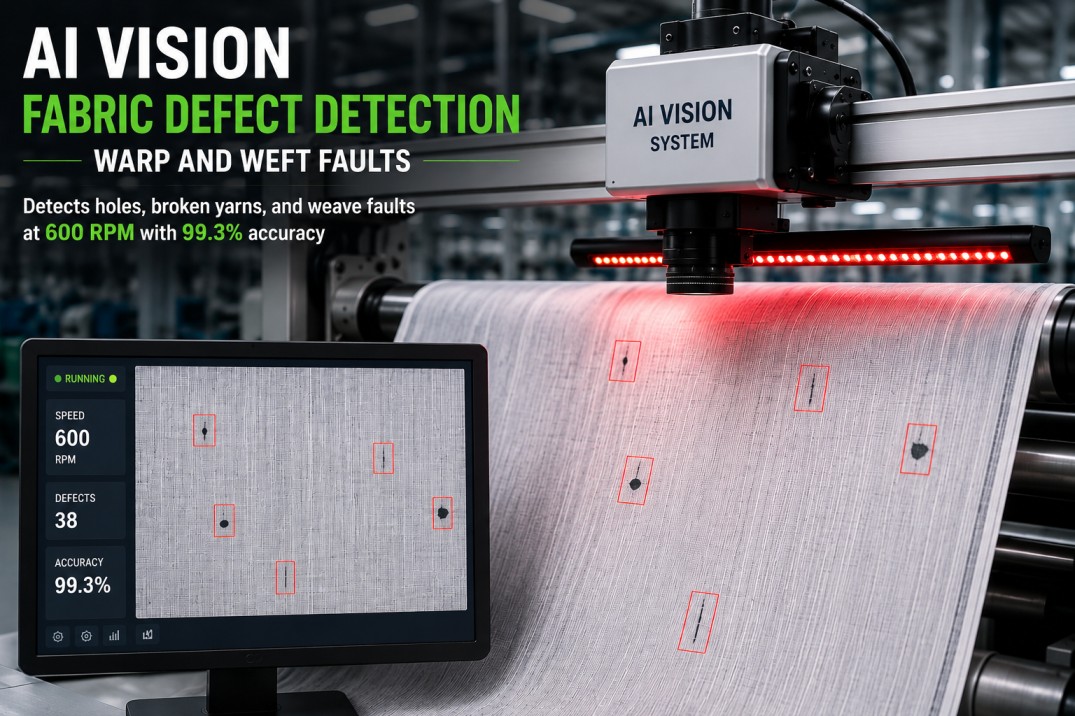
Technical textiles — waterproof breathables, PU-coated tarps, TPU-laminated fabric, medical barrier fabrics — are built on the coating line and killed there too. A coating skip from a momentary knife-over-roll gap or a laminate void from air entrapment turns an expensive coated roll into scrap the buyer will find at incoming inspection. Human inspection at coater exit catches obvious defects and misses subtle ones; by the time roll-length QC catches subtle defects, the coating has cured and the fabric is not salvageable. Live coating-layer vision at coater exit flags the defect while the roll is still being wound.
iFactory / Coating & laminate vision
Read the Coating Layer Live at Coater Exit — Not After the Roll Is Wound
Live vision on the coating and lamination line reading skip, void, thickness variance, and edge coverage at the coater exit — flagging defects while the roll is still being wound so operators intervene before hundreds of metres of coated substrate become rework.
7 m fabric window · coater exit
Coating skip · knife-over-roll gap
Laminate void · air entrapment
Skip · void
live at coater exit
Roll-mapped
defect coordinates
The Problem in Coating & Laminate QC
A typical coating or lamination line runs at 10-40 m/min producing coated rolls worth $8-30 per square metre of substrate. Human inspection at the coater exit catches gross defects and misses subtle ones that only become visible after coating cure or under specific light. Roll-length QC at the winder catches more but the coating has already cured by then. Full-roll inspection at the QC table catches everything but only after the roll is finished, and by then the defect has been repeating for whatever caused it. Buyer incoming inspection finds what QC missed, and the return quantities compound over the following weeks.
Where Coating Defects Actually Escape
Coating and lamination defect modes are consistent across knife-over-roll, gravure, and reverse-roll coaters. Each is a live-vision-detectable event.
Nozzle plug skip
Slot-die or spray nozzle partially plugs. Coating skips or thin spots repeat every revolution. Human inspector notices after 30-100 m of affected fabric — all rework or scrap.
Air-entrapment void
Air entrained between substrate and coating layer creates voids that appear only after cure. Detected at final QC when the roll is already committed. Chronic pattern traces to speed or tension variance nobody adjusted.
Edge coverage miss
Coating misses the fabric edge by 3-6 mm because knife or slot-die alignment drifted. Roll fails buyer edge-coverage spec. Discovered at buyer incoming inspection with return-shipping cost.
Thickness variance
Coating thickness varies 15-25% across width because knife gap is uneven. Roll passes visual but fails buyer thickness spec at their lab. Return and reputation cost compound.
What Good Looks Like in Coating Vision
A working coating vision system holds four disciplines together — live at coater exit, defect classification, roll-position mapping, and intervention before compounding.
Live at Exit
Vision cameras positioned immediately after the coater or laminator, before winding. Skip, void, thickness variance, and edge coverage read on every metre as fabric passes.
Every metre, live
Defect Classification
Skip, void, thickness variance, and edge miss classified distinctly. Operator sees which defect type is happening so root cause (nozzle, air entrapment, alignment, knife gap) is diagnosable.
Type-specific
Roll-Position Map
Every defect logged with roll position (metre count, cross-web position). QC downstream sees exactly where each defect is without re-inspecting. Buyer receives roll map with the shipment.
Mapped, not just flagged
Intervention Signal
Threshold-breach signals operator to intervene before defect pattern compounds across the roll. Recurring pattern per line raises CMMS work order for the specific coater component.
Intervene before compounding
How iFactory AI Fits
iFactory AI overlays your coating and lamination lines (knife-over-roll, gravure, reverse-roll, slot-die, hot-melt lamination), roll-mapping systems, and QMS — providing the exit-vision layer that catches defects before winding and the roll-map data QC and buyers actually use.
Exit Vision
Vision Layer
Vision cameras across web width immediately after coater or laminator exit. Skip, void, thickness variance, edge coverage read continuously with defect type classification.
Roll Mapper
Vision + Winder
Every defect logged with roll position (metre, cross-web). Roll map generated per finished roll — QC and buyer see defect coordinates without re-inspection.
Intervention Alert
Vision + HMI
Threshold-breach alerts operator with defect type and probable cause (nozzle, air entrapment, alignment). Enables intervention before defect pattern compounds.
CMMS Bridge
Vision + CMMS
Chronic defect pattern per coater component raises CMMS work order. Nozzle cleaning, knife alignment, tension adjustment attributed to specific machine element.
Ask your technical textile line head how much of last month's finished coated fabric was returned by buyers or held internally for defects that started with skip or void. If the number is measured in tens of thousands of dollars, the vision at coater exit is where those dollars get recovered. Book a coating vision review.
10-Week Coating Vision Pilot on One Line
One coating or lamination line, ten weeks. The pilot mounts vision at coater exit, activates defect classification, tests intervention alerts, and closes the first month of roll-map data flowing to QC.
Weeks 1–2
Vision Mount
Vision cameras mounted across web width at coater or laminator exit. Calibration against reference substrates. Baseline current-state defect rates from QC history.
Weeks 3–5
Classification Live
Defect classification live with type-specific display (skip, void, thickness, edge). Operator training on interpretation and root-cause diagnosis.
Weeks 6–8
Roll Mapping
Roll maps generated per finished roll flowing to QC. QC bypasses defect-hunting on mapped rolls. Buyer receives roll map with shipment for select customers.
Weeks 9–10
Intervention Rate
Intervention alerts active. Operator intervention rate measured. Buyer returns and internal holds compared against baseline. Rollout to sister lines scoped.
Who Owns the KPI
Coating vision crosses production, QC, maintenance, and customer-facing account management. Each function owns a specific KPI or the defects continue leaking to buyer incoming inspection.
Technical Textile Line Head
Coated roll first-pass yield
Owns the floor outcome — the share of coated rolls passing QC without rework or scrap. Rising yield means live vision is catching before compounding.
Quality Manager
Buyer returns for coating defects
Owns the customer-facing outcome — returned rolls for skip, void, thickness, or edge defects. Zero is the target; each carries return-shipping cost and reputation.
Maintenance Lead
Coater MTBF on nozzle and knife issues
Owns the reliability outcome — mean time between failures on nozzle plugging and knife alignment. Vision-attributed patterns drive planned intervention.
Sales / Account Lead
Buyer scorecard trend
Owns the customer confidence — buyer scorecard trend on coated shipments. Roll maps delivered with shipment differentiate the account.
FAQ
Does this work on knife-over-roll, gravure, and slot-die coaters equally?
Yes, because the vision is external to the coating mechanism itself. Vision cameras positioned at the coater exit read the coated substrate regardless of how the coating was applied. Knife-over-roll, reverse-roll, gravure, slot-die, spray, and hot-melt lamination all present the same downstream artifact — a coated web with defects visible on the coating layer. The classification models train on the specific coating type (aqueous, solvent-based, hot melt, silicone, PU) and substrate combinations the line runs, which is where the vision-AI value compounds versus generic optical inspection.
What about coating thickness — can vision actually measure that?
Vision can measure thickness indirectly through optical properties (light transmission for translucent coatings, colour density for pigmented coatings, texture pattern for matte coatings). For applications requiring precise thickness measurement (medical barrier, technical membrane), the vision layer is combined with beta-gauge or laser triangulation thickness sensors that provide the direct thickness reading with vision providing the spatial map. Where thickness tolerance is loose (many industrial applications), vision alone catches significant thickness variance well enough for intervention. Where thickness tolerance is tight (medical, aerospace), the combined vision + gauge approach is the industry standard.
Book a demo to see the thickness handling for your specific application.
How does this handle two-sided lamination where the void is between layers?
Two-sided lamination (film-to-fabric, fabric-to-fabric) presents voids as air pockets between layers — often invisible from the top surface but visible from below or under transmitted light. The vision layer positions cameras above and below the laminated web (or uses transmitted-light imaging where translucency allows) to catch voids that single-side vision would miss. For laminations where transmitted light is not possible (opaque combinations), the vision is combined with thermal imaging that detects the thermal signature of trapped air. What the layer promises is honest capture of what happened at lamination — not a perfect view of internal geometry, but enough to catch void patterns before they become chronic.
Stop letting coating defects wind into the roll.
Watch One Line's Coating Layer Live — With Roll Mapping
Bring one coating or lamination line's last month of return and internal-hold history, current QC protocol, and the substrate/coating specs you run most. We'll walk what vision at coater exit would have caught, and demonstrate the roll-map export QC and buyers actually use.
Intervention
before compounding