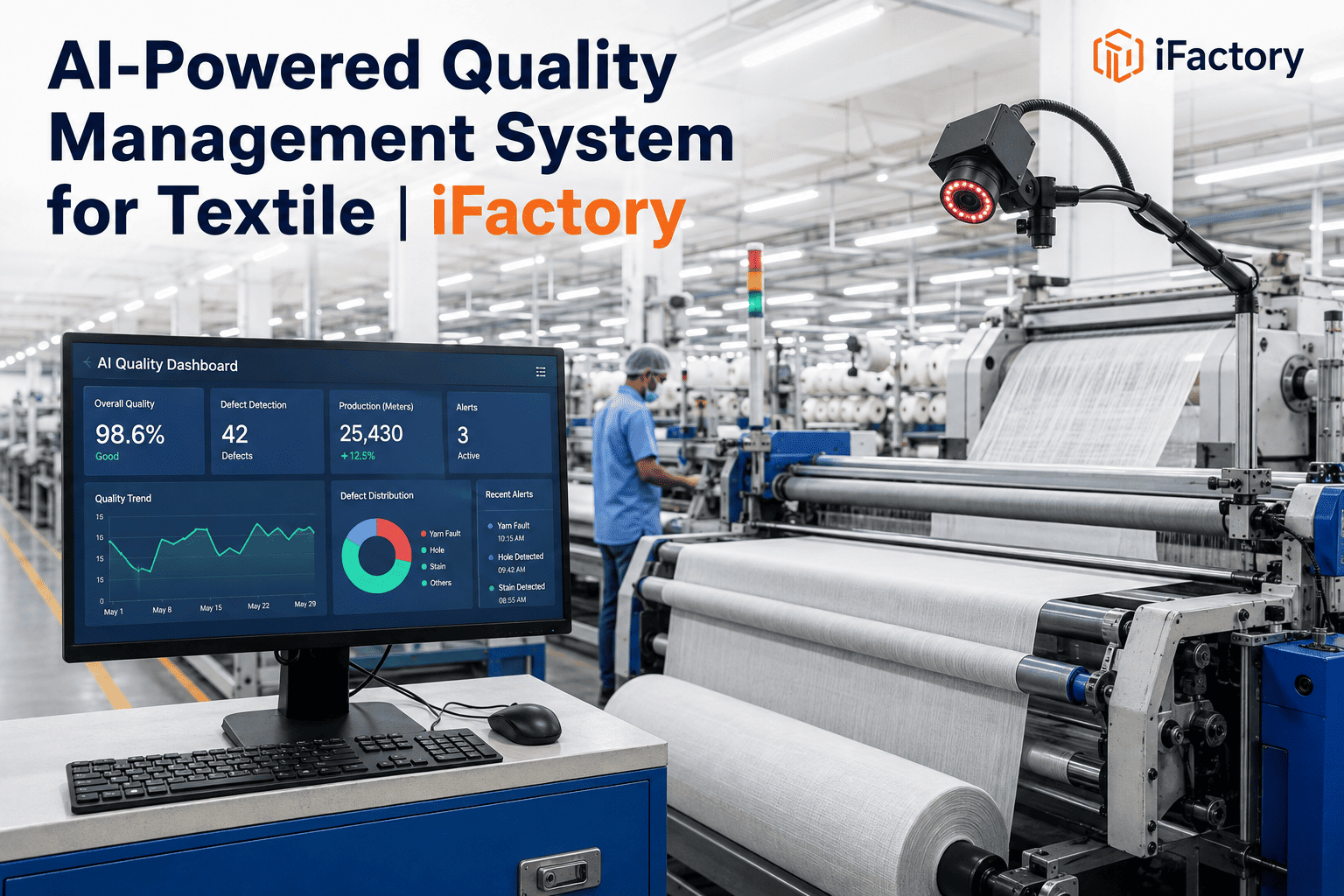
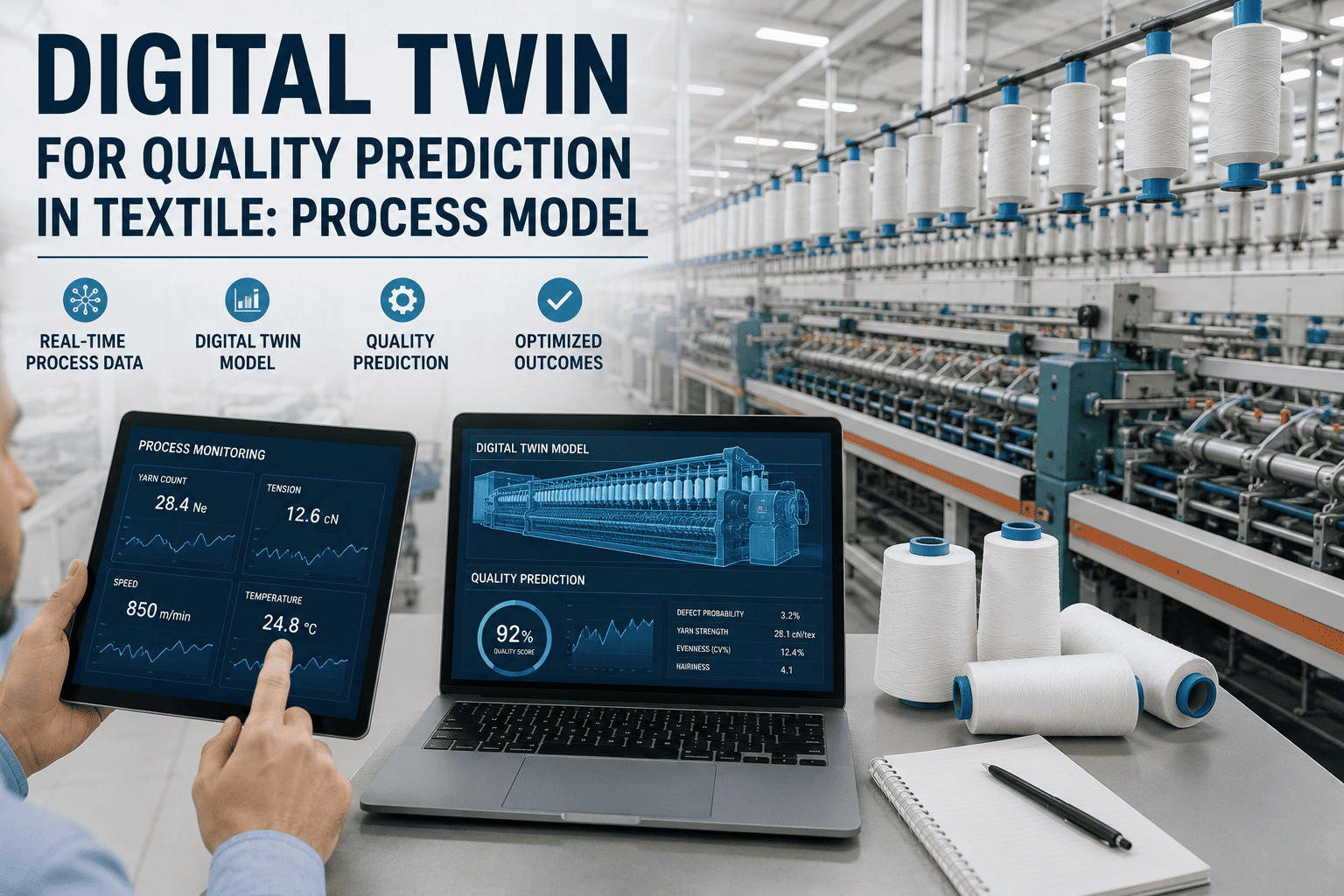
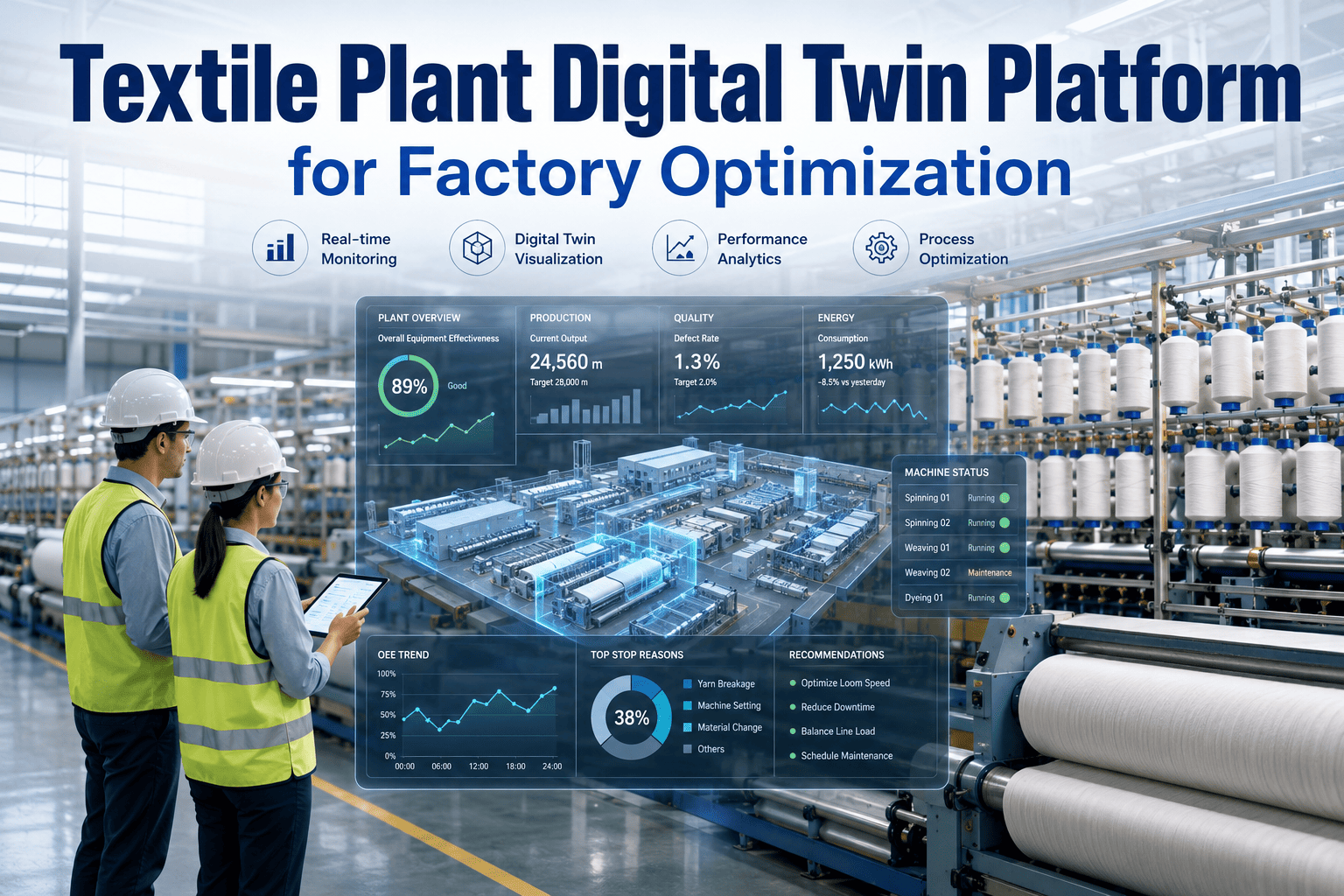
Textile manufacturers exploring smart quality management often start by asking which AI inspection tool to buy, when the more foundational question is what infrastructure needs to exist underneath that tool for it to actually work at scale. An AI vision model is only as useful as the sensor data feeding it, and that data is only accessible if a cloud platform exists to aggregate and analyze it across every line and every facility. Building that layered infrastructure correctly, in the right order, is what determines whether a digital quality initiative scales smoothly or stalls after the first pilot line — and it's the architecture iFactory designs for textile manufacturers.
DIGITAL INFRASTRUCTURE
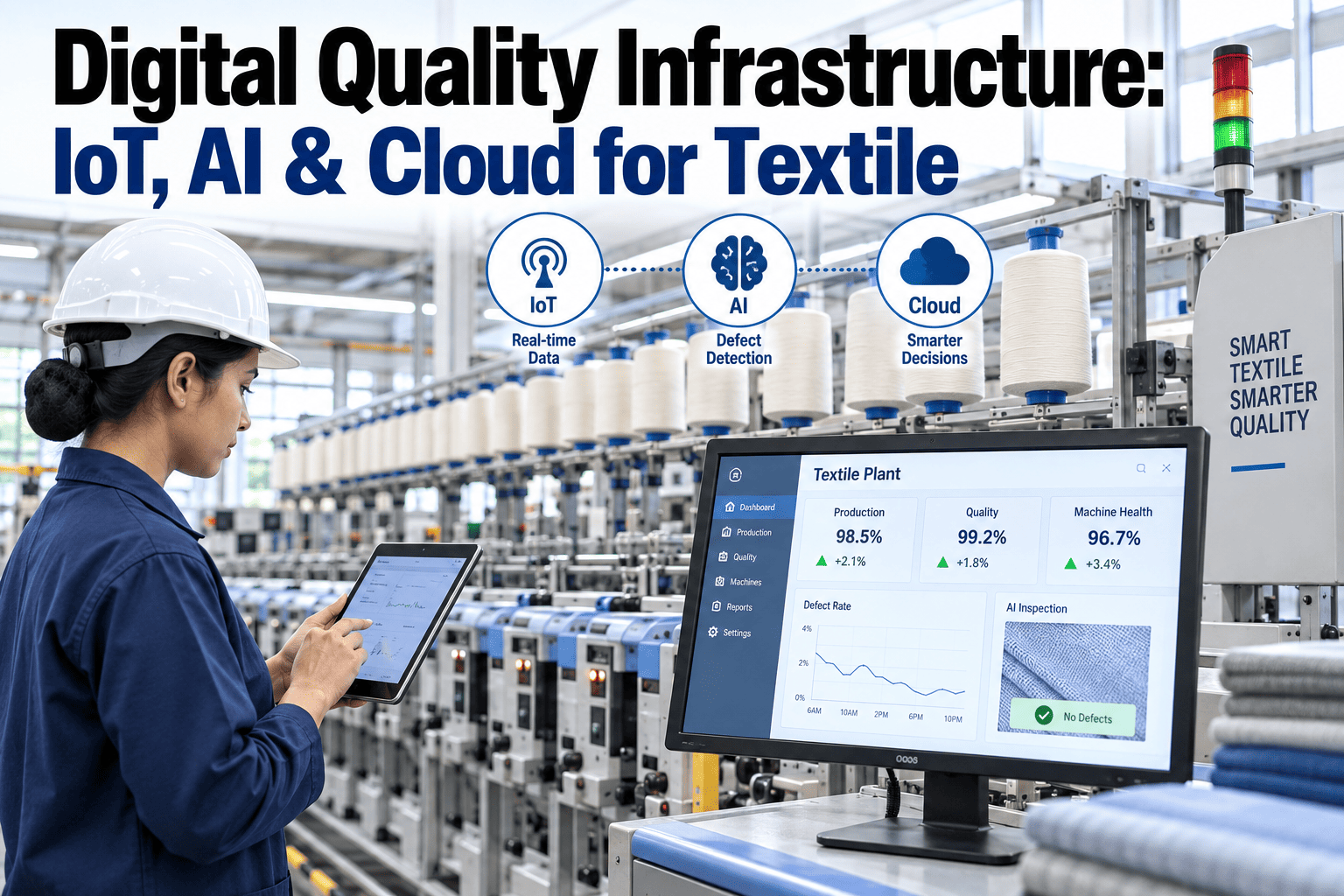
Digital Quality Infrastructure: IoT, AI & Cloud for Textile
IoT sensor deployment, AI analytics, and cloud platforms layered in the right order to build scalable smart quality management — not just a pilot that never expands past one line.
CLOUD — Analytics & Reporting
AI — Defect Detection & Prediction
IoT — Sensors & Data Capture
Why the Order of Infrastructure Investment Matters
A textile manufacturer that buys an AI inspection system before establishing reliable IoT sensor coverage ends up with a powerful model starved of consistent data. One that builds sensor infrastructure without a cloud layer to aggregate it across lines ends up with isolated data silos that never produce a facility-wide or portfolio-wide view. Each layer depends on the one beneath it being solid first, which is why sequencing this build correctly matters as much as selecting good technology at each layer.
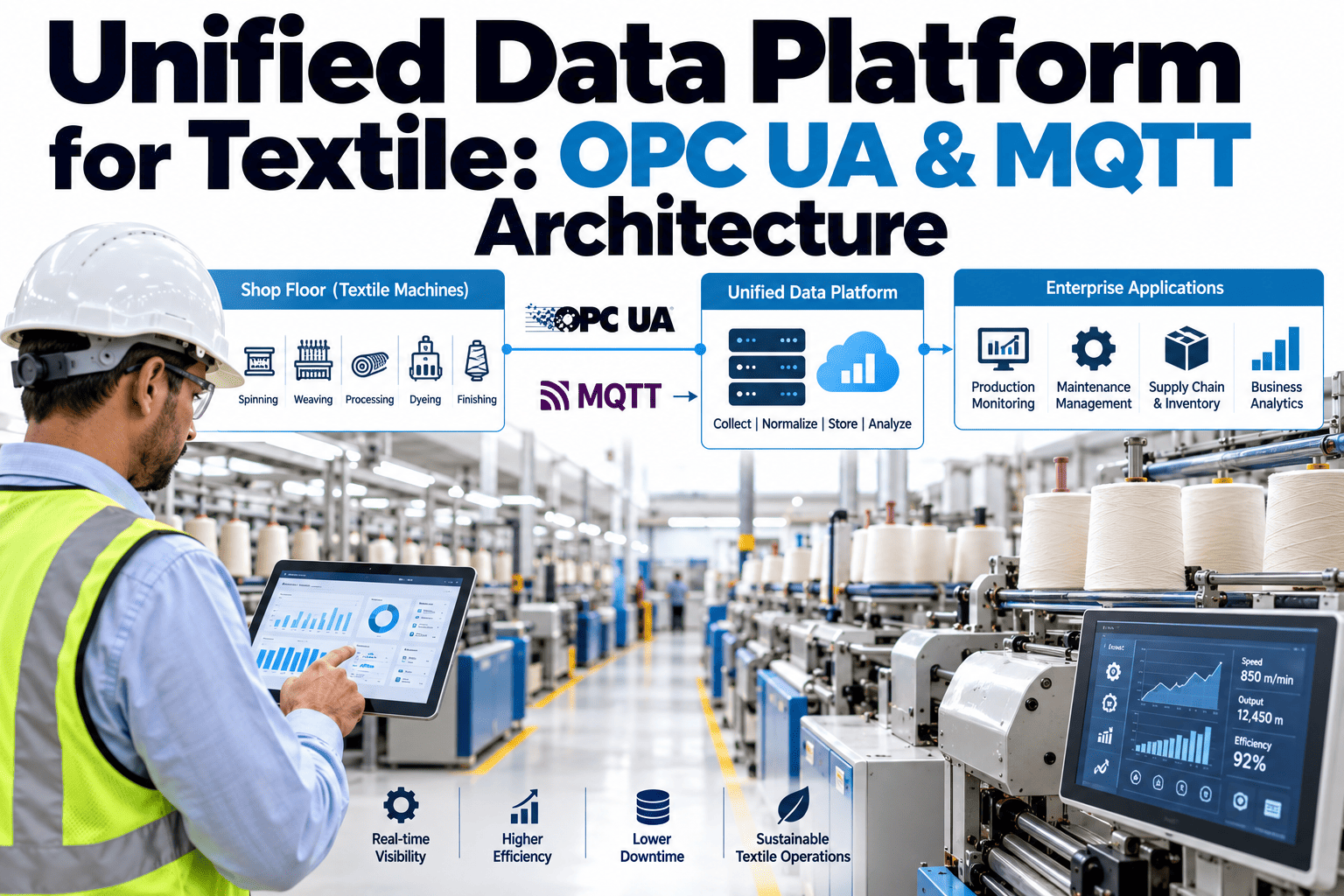
The Three Layers and What Each One Actually Does
Understanding what each layer is responsible for — and explicitly not responsible for — helps clarify why skipping or under-investing in any one of them limits what the layers above it can accomplish.
FOUNDATION LAYER
IoT Sensors & Data Capture
Cameras, fabric inspection sensors, and machine data feeds capture raw production and quality signals directly from the line, forming the data foundation everything above depends on.
MIDDLE LAYER
AI Analytics & Detection
Machine learning models trained on sensor data identify defects, predict quality issues, and flag anomalies, turning raw signals into actionable quality intelligence.
TOP LAYER
Cloud Platform & Reporting
Aggregates AI output and sensor data across every line and facility into unified dashboards, enabling portfolio-wide quality visibility and trend analysis.
Building the Infrastructure Layer by Layer
The table below reflects a typical phased investment sequence, building each layer on a solid version of the one beneath it rather than attempting to deploy all three simultaneously from day one.
| Phase | Focus | Success Criteria Before Moving On |
|---|
| Phase 1 | Deploy IoT sensors on pilot lines | Consistent, reliable data capture validated against manual checks |
| Phase 2 | Train and validate AI detection models | Model accuracy confirmed against known defect samples |
| Phase 3 | Connect pilot data to a cloud reporting layer | Dashboards accurately reflect pilot line performance in real time |
| Phase 4 | Scale sensor and AI deployment facility-wide | Infrastructure proven reliable enough to expand with confidence |
Design a Layered Infrastructure Plan for Your Facility
iFactory builds IoT sensor deployment, AI defect detection, and cloud reporting as a sequenced infrastructure plan, so each layer is solid before the next one is built on top of it.
Common Mistakes When Building This Stack
Most infrastructure rollouts that stall trace back to one of a small number of sequencing or scoping mistakes, each of which is avoidable with a deliberate layered approach.
✓
Buying AI before validating sensor reliability — a model trained on inconsistent data produces unreliable results regardless of how sophisticated the algorithm is.
✓
Skipping the cloud layer entirely — isolated line-level dashboards never produce the facility or portfolio-wide view that justifies the broader investment.
✓
Scaling before the pilot is fully validated — expanding sensor and AI deployment before confirming pilot-line accuracy multiplies any unresolved issues across every new line.
✓
Treating infrastructure as a one-time build — sensors need maintenance, models need retraining, and cloud platforms need ongoing data governance.
A Director of Digital Manufacturing on Building It in the Right Order
"
We made almost the exact mistake this kind of sequencing advice warns against on our first attempt — we purchased an AI fabric defect detection system before we had reliably functioning cameras and sensor coverage on the pilot line, assuming the AI vendor's technology would just work with whatever data we could give it. The model's accuracy was genuinely disappointing for the first several months, and it took us a while to recognize the problem wasn't the AI itself, it was that our underlying sensor data was inconsistent enough that the model was essentially being trained and tested on noise. Once we went back and properly stabilized the sensor layer first — consistent camera positioning, reliable lighting, validated data capture against manual inspection — the exact same AI model's accuracy improved dramatically without a single change to the algorithm itself. The cloud reporting layer we added afterward was almost anticlimactic by comparison, because once the first two layers were solid, aggregating that data into a facility-wide dashboard was genuinely the easy part.
— Director of Digital Manufacturing, Textile Production Group · Built Infrastructure Across 5 Production Lines
Frequently Asked Questions
How long should sensor validation take before moving to AI model training?
A meaningful validation period typically runs several weeks, comparing sensor-captured data against manual inspection results across a range of normal production variation, to confirm the sensors are capturing consistent, reliable data before any AI model is trained on top of it. Rushing this step to move faster toward the more exciting AI capabilities is one of the most common causes of disappointing model accuracy later, since the model can only be as reliable as the data it learns from.
Do we need a full cloud platform if we're only running a single pilot line initially?
For a genuinely single-line pilot with no near-term plans to expand, a lighter-weight local reporting solution may be sufficient initially, but it's worth building with the eventual cloud connection in mind from the start rather than creating a standalone system that will need to be rebuilt later. Most textile manufacturers pursuing digital quality infrastructure do have expansion beyond a single line as an eventual goal, which makes early cloud architecture planning worthwhile even if full deployment happens later.
How often do AI defect detection models need to be retrained?
This varies based on how much your product mix and materials change over time, but many textile manufacturers find retraining every few months, or whenever a significant new fabric type or pattern is introduced, keeps model accuracy strong. A model trained exclusively on one fabric category will typically underperform when applied to a significantly different material without additional training examples, so retraining cadence should track meaningfully with how much your actual production mix evolves.
What happens to this infrastructure investment if we later change AI vendors?
This is exactly why building the layers with some separation matters — a solid IoT sensor layer and a well-architected cloud data platform should be largely reusable even if the specific AI model or vendor changes later, since the sensor data itself isn't tied to any one AI provider's proprietary format if the infrastructure is designed with reasonable data portability in mind. This is worth confirming specifically during vendor selection, since some AI platforms are built in ways that make switching later more difficult than others.
Can iFactory build this layered infrastructure for our specific facility?
Yes — iFactory designs and deploys IoT sensor infrastructure, AI defect detection models, and cloud reporting platforms as a sequenced build, validating each layer before the next is added, specifically to avoid the sequencing mistakes described above. To scope a layered infrastructure plan for your facility,
book a demo with our team.
Build Digital Quality Infrastructure That Actually Scales
IoT sensors, AI detection, and cloud reporting each depend on the layer beneath them being solid first. iFactory builds this stack in the right order, so your digital quality initiative expands past the first pilot line.