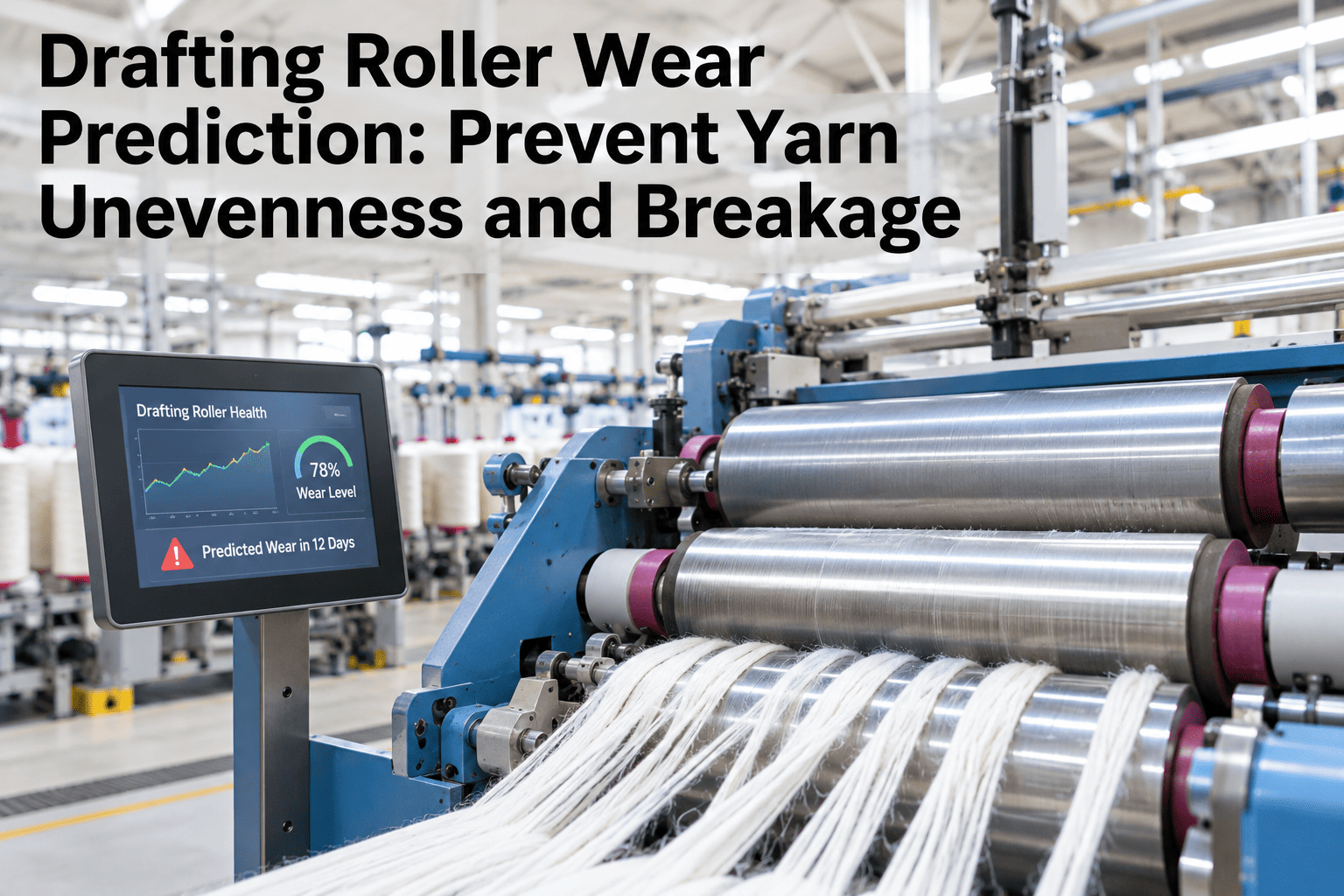
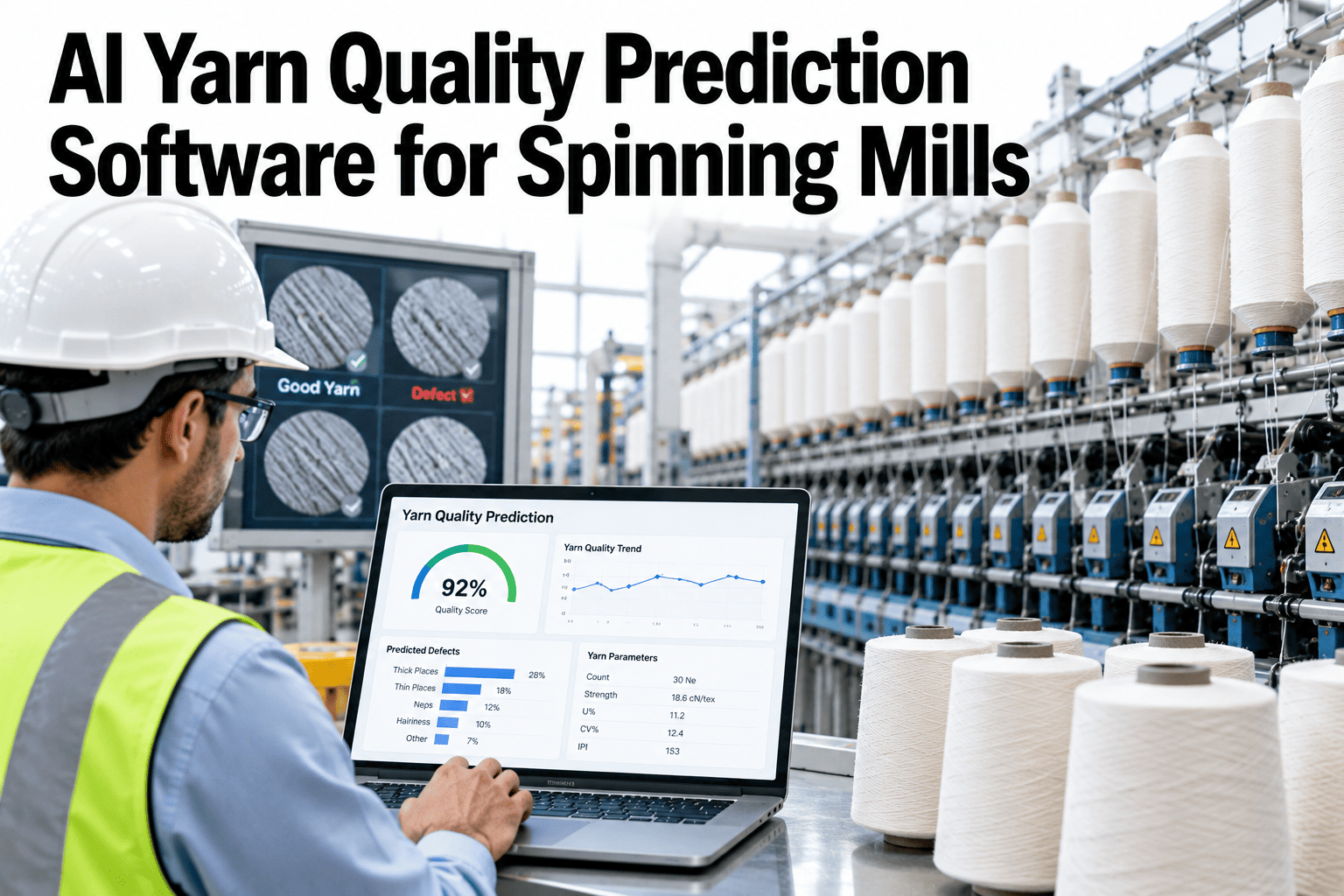
A drafting roller cot does not fail suddenly — it flattens and glazes gradually over 2,000 to 4,000 operating hours, and yarn CV% can already rise 0.5 to 1.5 points before any machine alarm fires (textile predictive maintenance industry research, 2026). iFactory, an on-premise AI platform with predictive maintenance built in, tracks drafting roller condition against running hours and yarn quality together. Spinning mill teams who want to see their own roller wear curve can discuss their plant data with our team.
Drafting Roller Wear Prediction · Ring Spinning, 2026
A Flattened Roller Cot Raises Yarn CV% Before It Ever Trips a Machine Alarm
iFactory AI tracks drafting roller condition against running hours and yarn evenness results, so a worn cot gets scheduled for replacement before it shows up as a quality complaint.
0 hrsRoller cot wear window: 2,000–4,000 hrs4,000+ hrs
What goes wrong
Three Ways a Drafting Roller Degrades
Cot flattening
The rubber cot surface compresses unevenly, producing a periodic drafting-force variation at the roller's rotational frequency.
Cot glazing
The surface hardens and loses grip on the fiber, reducing draft control consistency across the drafting zone.
Roller eccentricity
Runout beyond roughly 0.03 mm on the top roller introduces a cyclical thickness variation independent of cot condition.
The quality link
How Roller Condition Shows Up in Yarn Evenness Data
A yarn evenness tester reports CV%, thin places, thick places, and neps — and each of those metrics responds differently to a degrading roller. Reading them together narrows the diagnosis before a physical inspection is even scheduled.
| Yarn metric | What a worsening trend suggests | Likely roller cause |
|---|
| CV% rising gradually | Progressive drafting-force variation | Cot flattening or glazing |
| Periodic thick/thin pattern | A repeating defect tied to roller rotation | Localized flat spot or eccentricity |
| Thin places increasing | Reduced grip on fiber during draft | Cot glazing, loss of surface texture |
| Position-specific defects | One drafting position consistently worse than others | A single roller pair needing attention |
Detecting the trend early
Current Signature as an Early Indicator
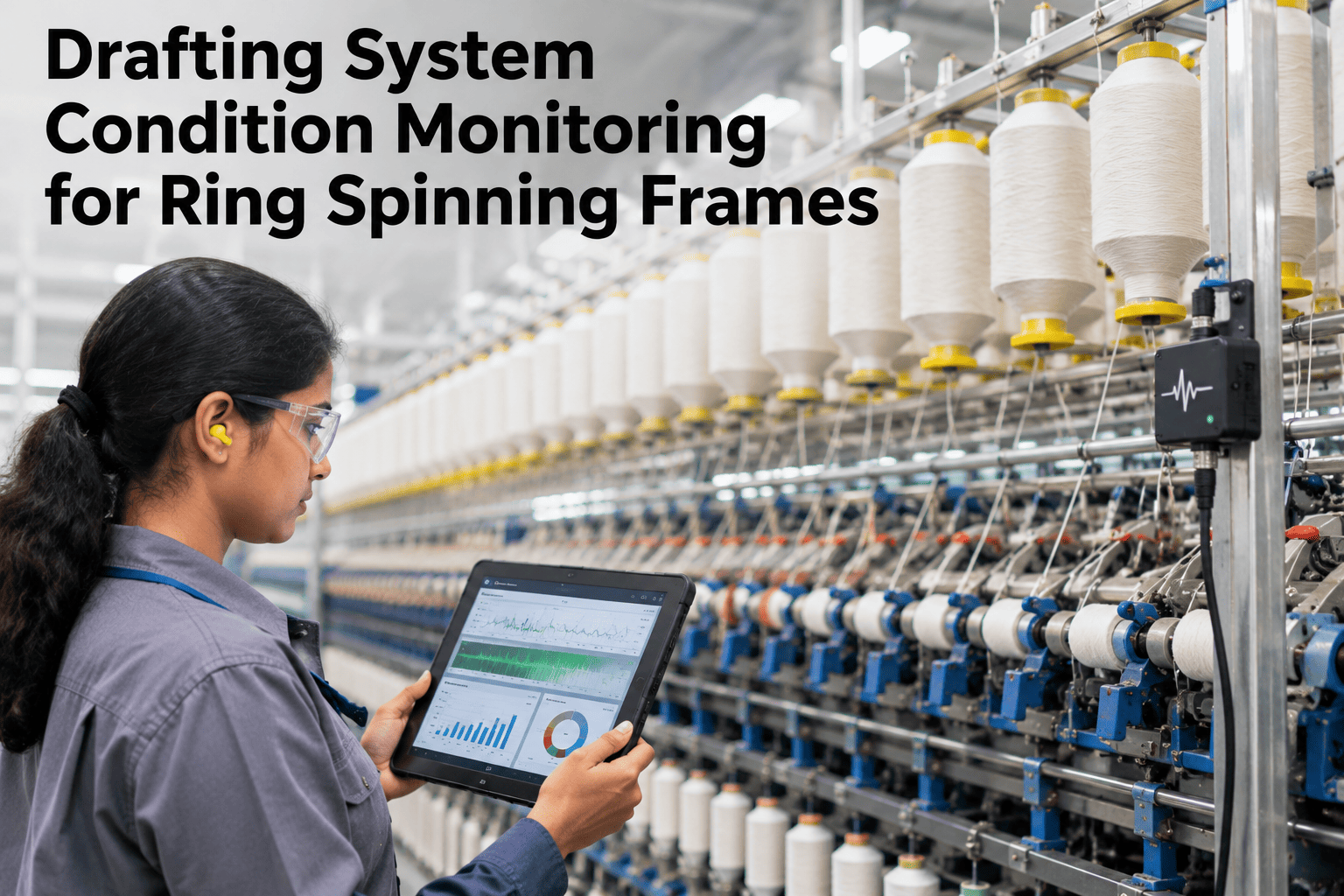
Drafting force variation can be read from the drafting motor's current signature before it shows up as a confirmed yarn evenness defect, giving a maintenance team a real-time signal to confirm against the next scheduled quality test rather than waiting for a full evenness run.
See Where Your Roller Population Sits on the Wear Curve
Share your current roller replacement log and recent evenness test results, and iFactory AI will show which positions are approaching the point where quality starts to drift.
Fixed interval vs condition-based
Why a Calendar-Based Cot Change Misses Both Directions
Fixed replacement interval
Some cots are changed before they needed to be
Others wear faster and run past the interval unnoticed
No link between the change decision and actual yarn quality
Condition-based replacement
Replacement timed to actual wear trend, not a fixed calendar
Fast-wearing positions are caught before quality drifts
Replacement decision backed by evenness and current data together
Building the program
Four Steps to Connect Roller Wear to Quality Data
1
Log running hours per position
Track cumulative hours since the last cot change, by individual drafting position.
2
Connect evenness test results
Tie CV% and defect data back to the specific position and roller age.
3
Watch for early drift
Flag positions where quality is trending worse ahead of the typical wear window.
4
Schedule the swap
Replace the cot at the point the data justifies it, not a blanket calendar date.
What it costs to miss
Why a Missed Roller Trend Is More Than a Single Bad Batch
A worn roller rarely announces itself and goes away on its own — left unaddressed, it keeps producing the same CV% drift shift after shift until a customer complaint or a downgrade forces the investigation. By that point the cost is no longer just the roller.
Downgraded production
Every shift run on a worn roller before detection is yarn produced at a lower quality grade than it should have been.
Rework and retesting
Tracing a quality complaint back to a specific roller after the fact consumes lab and engineering time that a live trend would have avoided.
Customer confidence
Repeated evenness complaints from the same mill erode a buyer's confidence well before any single defect would on its own.
Expert review
What a Spinning Reliability Engineer Checks First
Roller wear prediction earns trust by linking two data sets that usually sit in separate systems — maintenance hours and quality lab results — so a trend is confirmed from both sides before a cot is pulled.
Verdict
Strong when position-level running hours and position-level evenness data are reconciled against each other.
Watch for
Treating every drafting position as wearing at the same rate when fiber type and setting differences mean they do not.
Do next
Pull your last quarter's evenness tests and check whether CV% drift correlates with cot age at each position.
Frequently asked questions
What Spinning Mills Ask About Roller Wear Prediction
How long does a drafting roller cot typically last before it needs replacing?
Roller cot surfaces generally degrade over 2,000 to 4,000 operating hours depending on fiber type and drafting pressure, though individual positions can wear faster under heavier load (textile predictive maintenance industry research, 2026).
See how this compares to your current replacement cycle.
Can roller wear really be detected before a yarn quality test confirms it?
Drafting force variation shows in the drafting motor's current signature, which can flag a developing issue ahead of the next scheduled evenness test, though confirmation against lab data is still the standard practice.
Ask support how current-signature detection works.
Does this replace our existing roller eccentricity gauge checks?
How much CV% increase should trigger a roller investigation?
Can this work across multiple frames and shifts?
Yes — position-level running hours and quality data roll up into a single view across every frame and shift, so a mill-wide wear pattern is visible rather than hidden inside individual shift logs.
Talk through a multi-frame rollout.
Catch the wear before it reaches the yarn
Connect Roller Running Hours to Your Quality Lab Data
Book a session with iFactory AI to see how a connected drafting roller wear view would work on your frames.
{"@context":"https://schema.org","@type":"FAQPage","mainEntity":[
{"@type":"Question","name":"How long does a drafting roller cot typically last before it needs replacing?","acceptedAnswer":{"@type":"Answer","text":"Roller cot surfaces generally degrade over 2,000 to 4,000 operating hours depending on fiber type and drafting pressure."}},
{"@type":"Question","name":"Can roller wear really be detected before a yarn quality test confirms it?","acceptedAnswer":{"@type":"Answer","text":"Drafting force variation shows in the drafting motor's current signature, which can flag a developing issue ahead of the next scheduled evenness test."}},
{"@type":"Question","name":"Does this replace our existing roller eccentricity gauge checks?","acceptedAnswer":{"@type":"Answer","text":"No, eccentricity gauging remains the direct physical check; condition data adds an early signal for when to prioritize it."}},
{"@type":"Question","name":"How much CV% increase should trigger a roller investigation?","acceptedAnswer":{"@type":"Answer","text":"A 0.5 to 1.5 point CV% increase tied to a specific position is a commonly cited early signal."}},
{"@type":"Question","name":"Can this work across multiple frames and shifts?","acceptedAnswer":{"@type":"Answer","text":"Yes, position-level running hours and quality data roll up into a single view across every frame and shift."}}
]}