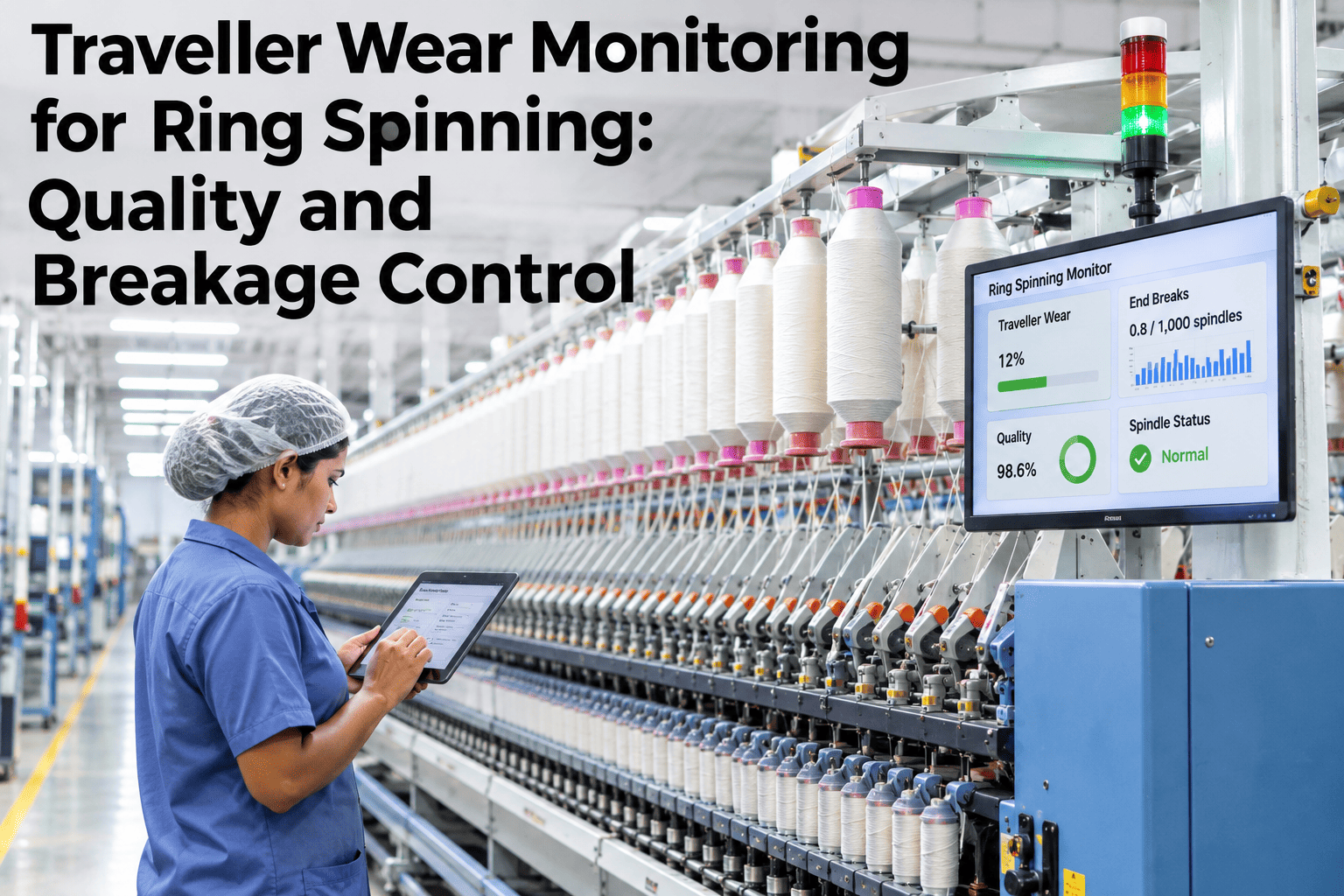
The traveller is the fastest-wearing component on a ring spinning frame — typically replaced every 6 to 20 weeks, far sooner than any other drafting or spindle part (textile predictive maintenance industry research, 2026). iFactory, an on-premise AI platform with predictive maintenance built in, ties traveller running hours and replacement history to the break data they influence. Spinning mill teams who want to see this against their own rotation can discuss their plant data with our team.
Traveller Wear Monitoring · Ring Spinning, 2026
The Traveller Wears Out Faster Than Almost Anything Else on the Frame
iFactory AI tracks traveller running hours against replacement schedules and break data, so the fastest-wearing component on the frame stops being the hardest one to stay ahead of.
Roller cot
2,000–4,000 hrs
Why travellers wear so fast
The Highest-Friction, Highest-Speed Component on the Frame
A traveller runs around the ring at speeds that can reach roughly 35 meters per second, under constant friction against both the yarn and the ring flange. That combination of speed and contact load is why it is consumed so much faster than any other spinning component.
Incorrect weight for count
A traveller weight mismatched to the yarn count changes tension balance and accelerates wear on both the traveller and the ring.
Profile mismatch
A traveller profile that does not match the ring flange geometry wears unevenly and can damage the ring itself.
High-speed acceleration
Running above the traveller's rated speed range for its weight class shortens working life significantly.
Inadequate break-in
Skipping the recommended break-in procedure on a new traveller increases early failure risk.
The break signature
How a Traveller-Related Break Shows Up in the Data
| Signature | What it suggests | Where to check |
|---|
| Repeat breaks at the same spindle | Localized traveller or ring issue, not a mill-wide condition | That specific spindle's traveller and ring |
| Visible traveller debris on the ring | Traveller is disintegrating under load | Ring flange wear and traveller profile match |
| Correlates with vibration above baseline | Spindle axis or ring tilting issue compounding wear | Spindle alignment and ring flange condition |
| Clustered on specific frame sections | A batch of travellers installed together is reaching end of life together | Installation log for that section |
Rotation scheduling
Why a Running-Hours Rotation Beats a Blanket Calendar Date
Because spindle speed, yarn count, and even ambient conditions all affect traveller life, a single fixed replacement date applied across an entire frame either changes travellers too early on light-duty positions or too late on the hardest-running ones. Rotating replacement based on actual running hours per position closes that gap.
See Which Positions Are Closest to a Traveller Change
Share your current traveller replacement log and recent break data, and iFactory AI will show which spindles are due before they start generating repeat breaks.
Building the program
Four Steps to a Data-Driven Traveller Rotation
1
Log installation per spindle
Record the date and weight class every time a traveller is installed.
2
Track running hours
Accumulate actual run time per spindle, not just calendar time since installation.
3
Watch for repeat breaks
Flag any spindle with clustered breaks ahead of its expected replacement window.
4
Rotate proactively
Replace travellers approaching their running-hours threshold before they start failing.
Weight selection
Getting Traveller Weight Right for the Count Being Spun
Traveller weight is not a one-size setting — it is selected against yarn count, spindle speed, and the specific ring diameter in use, and getting it wrong shows up as accelerated wear long before it shows up as a break.
Too light
Insufficient tension can let the yarn balloon excessively, increasing hairiness and breakage risk.
Too heavy
Excess tension accelerates both traveller and ring wear and can strain the yarn itself.
Correctly matched
Balanced tension gives the traveller its expected working life and keeps yarn tension within the tested range for that count.
Re-verified on count change
Any change in count or spindle speed should trigger a traveller weight review, not just a spool change.
Expert review
What a Spinning Maintenance Manager Checks First
Traveller programs succeed when the rotation is driven by actual running hours and break data per spindle, not a single plant-wide replacement date that ignores how unevenly the component actually wears.
Verdict
Strong when repeat breaks at a specific spindle trigger an immediate traveller check, not a wait for the next scheduled rotation.
Watch for
A traveller weight or profile mismatch for the count being run — this accelerates wear independent of running hours.
Do next
Pull your last month of yarn breaks and check how many clustered at the same spindle more than once.
Frequently asked questions
What Spinning Mills Ask About Traveller Wear
How often do travellers actually need replacing?
Travellers are typically replaced every 6 to 20 weeks depending on yarn count and spindle speed, making them by far the fastest-wearing component on a ring spinning frame (textile predictive maintenance industry research, 2026).
See how this compares to your current rotation.
How do we know if a break is traveller-related or something else?
Repeat breaks at the same spindle, visible traveller debris on the ring, and a correlation with vibration above baseline are the main signatures pointing to a traveller or ring issue specifically.
Ask support how to read your break log.
Can the wrong traveller weight really cause this much wear?
Should every spindle on a frame be rotated on the same schedule?
Not necessarily — spindle speed, position, and even localized conditions can mean some spindles wear travellers faster than others, which is why running-hours-based rotation tends to outperform a single frame-wide calendar date.
Ask support about per-spindle rotation.
Does this integrate with our existing traveller inventory and ordering process?
Replacement data can feed directly into a parts and inventory workflow, so travellers approaching their running-hours threshold are flagged alongside the stock needed to replace them.
Talk through your inventory integration.
Rotate before the repeat break, not after
Track Traveller Running Hours Against Break Data
Book a session with iFactory AI to see how a connected traveller rotation schedule would work on your frames.
{"@context":"https://schema.org","@type":"FAQPage","mainEntity":[
{"@type":"Question","name":"How often do travellers actually need replacing?","acceptedAnswer":{"@type":"Answer","text":"Travellers are typically replaced every 6 to 20 weeks depending on yarn count and spindle speed."}},
{"@type":"Question","name":"How do we know if a break is traveller-related or something else?","acceptedAnswer":{"@type":"Answer","text":"Repeat breaks at the same spindle, visible traveller debris on the ring, and a correlation with vibration above baseline point to a traveller or ring issue."}},
{"@type":"Question","name":"Can the wrong traveller weight really cause this much wear?","acceptedAnswer":{"@type":"Answer","text":"Yes, an incorrect traveller weight for the yarn count changes tension balance on the ring, accelerating wear."}},
{"@type":"Question","name":"Should every spindle on a frame be rotated on the same schedule?","acceptedAnswer":{"@type":"Answer","text":"Not necessarily, since running-hours-based rotation tends to outperform a single frame-wide calendar date."}},
{"@type":"Question","name":"Does this integrate with our existing traveller inventory and ordering process?","acceptedAnswer":{"@type":"Answer","text":"Replacement data can feed directly into a parts and inventory workflow alongside stock needed for replacement."}}
]}